
The Ramakrishna Report’s final results seemed to imply that Keezhadi archaeology would compel the prehistory of India to be upturned and rewritten.
The ASI was extra-circumspect in accepting the Report without incontrovertible proof. Hence, the number of critical queries that were raised in their response to Ramakrishna.
This led immediately to a sort of proxy political arm-wrestling between the BJP Union Government of India and the DMK Tamil Nadu State Government. The battle lines between academia and politics were about to be clearly drawn.
The ASI chose to scrutinize the Ramakrishna Report under a fine microscope just to ensure it understood how its integration into mainstream Indian historiography could profoundly reshape Tamil Nadu’s civilizational identity within the larger Indian national identity in several different ways as outlined below:
1. Affirmation of Antiquity and Urban Sophistication
• Earlier Urban Roots: If Keezhadi is officially recognized as evidence of an advanced urban settlement from as early as the 6th–8th century BCE, it would firmly establish Tamil Nadu as one of the cradles of ancient civilization in India, on par with the Indus Valley and Gangetic plains.
• Independent Development: The narrative would shift from seeing Tamil civilization as secondary or derivative to one that developed parallel to, or even before, many northern cultures.
2. Cultural and Linguistic Pride
• Deep Roots for Tamil Language: The discovery of Tamil Brahmi script and evidence of early literacy would reinforce the idea that Tamil is one of the world’s oldest living languages with a continuous literary tradition.
• Strengthening Dravidian Identity: The findings would validate long-held beliefs about the antiquity and uniqueness of Dravidian (especially Tamil) culture, fueling regional pride and a sense of distinct identity.
3. Rebalancing Indian Historical Narratives
• From Margin to Center: Tamil Nadu’s history would move from the margins of Indian history textbooks to a central place, with greater emphasis on Sangam literature, urbanization, and trade networks.
• Plurality in Indian Civilization: The revised narrative would highlight India’s diverse civilizational roots, showing that advanced societies flourished in both the north and south, challenging the “north-centric” view of ancient India.
4. Political and Social Impact
• Empowerment: Recognition of Tamil Nadu’s ancient urban heritage could empower local communities and political movements, reinforcing demands for cultural autonomy and respect within the Indian Union.
• Unity Through Diversity: While strengthening Tamil identity, the broader Indian narrative could evolve to celebrate unity through diversity, acknowledging multiple ancient streams rather than a single civilizational core.
5. Educational and Global Recognition
• Textbook Revisions: School curricula would be updated to include Keezhadi and other Tamil archaeological sites, giving students a more balanced and accurate understanding of Indian history.
• International Prestige: Tamil Nadu could gain global recognition as a key site of early human civilization, attracting scholars, tourists, and cultural investment.
All the above multi-dimensional implications of redefined Tamil identity thus became the cause for much muscle-flexing in the arm-wrestling match the state and the centre began to engage in. So profound would be the political repercussions on Indian history that the DMK Dravidian ideology would have successfully delivered a blow below the belt to the Hindutva ideology.
***********
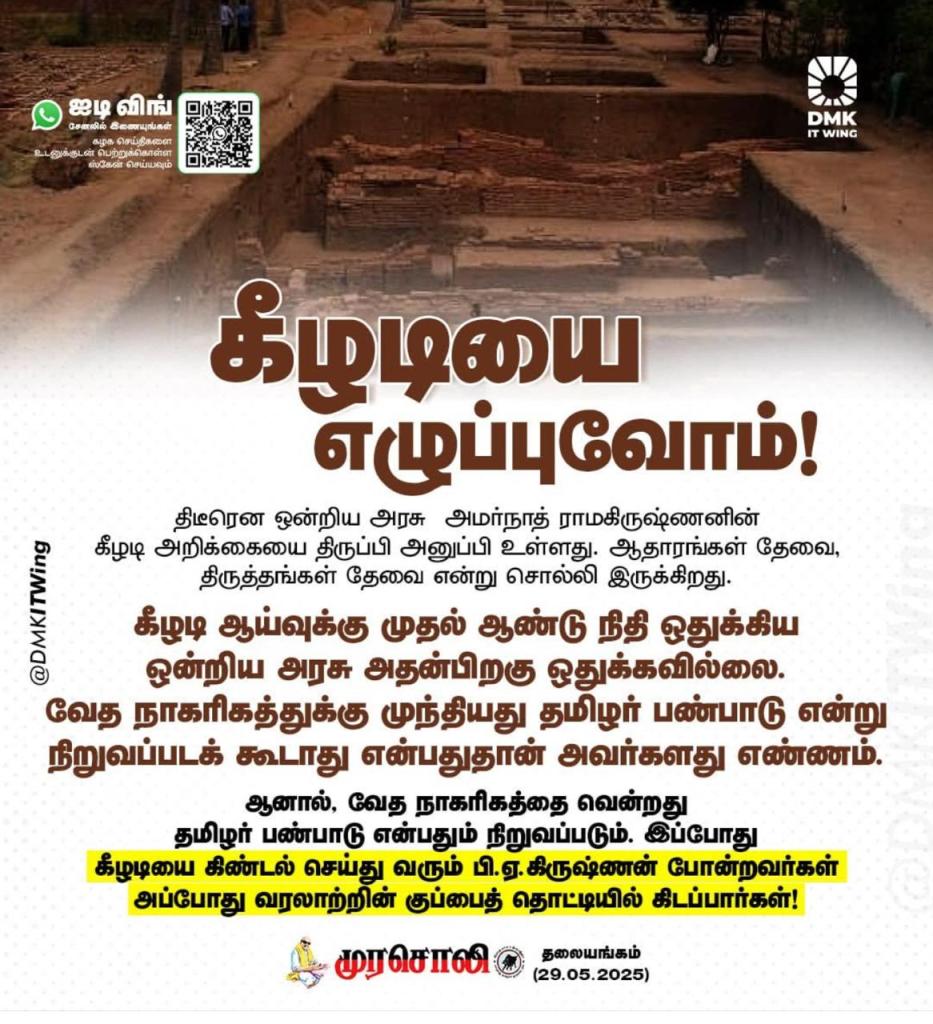
In the digital meme-poster of the DMK shown above, there is the name of one P.A. Krishnan who the Party says will get “thrown into the dustbin of history” once the Ramakrishna Report gets published and official/academic recognition.
Who is this P.A.Krishnan? What is his role in Keezhadi archaeology and in the political arm-wrestling match?
P. A. Krishnan is an Indian writer and essayist who writes in both Tamil and English, with a background as a physics teacher, bureaucrat, and later a senior executive in research and multinational organizations. He is known for his novels (The Tiger Claw Tree, The Muddy River) and essays on social, cultural, and historical topics.
P. A. Krishnan’s role as a critic—despite his lack of direct archaeological involvement—makes him a convenient and symbolically important target in a larger battle over history, identity, and political legitimacy in Tamil Nadu. The DMK’s focus on him is less about his individual influence on research and more about shaping and defending a collective narrative.
Reasons for Targeting P. A. Krishnan
• Influence as a Public Intellectual: While Krishnan is not an archaeologist, he is a well-known writer and commentator whose articles—such as those in The Federal—have questioned the uniqueness, dating, and interpretation of Keezhadi’s findings. His critical stance provides intellectual ammunition to those skeptical of the Dravidian narrative, making him a visible figure in the debate.
• Symbolic Opposition: In highly politicized issues, critics who articulate dissenting views—especially those who are Tamil and have a public platform—are often singled out as representatives of the “other side.” Discrediting such voices serves as a warning to others and helps consolidate the DMK’s narrative.
• Narrative Management: The Keezhadi controversy is not just about archaeology but about cultural pride, regional identity, and political legitimacy. By publicly challenging Krishnan, the DMK seeks to delegitimize alternative interpretations and reinforce its own version of Tamil antiquity and victimhood in the face of perceived central (northern-Aryan) bias.
• Distrust of Dissent: As Krishnan himself has written, there is a “deep distrust” of voices seen as undermining Tamil claims, especially when those voices are Tamil but critical of the dominant narrative. The DMK’s anxiety reflects the high stakes involved in controlling the public perception of Keezhadi.
************
In this ongoing political arm-wrestling match, the most important question playing now on everyone’s mind is this:
What are the possible consequences if the ASI were to accept the findings of the Ramakrishnan Report ? Will it force rewriting of entire Indian pre/history? In what way and what manner ?
(to be continued)
Sudarshan Madabushi