
Sastri felt politically marginalized by the rise of Gandhi and Nehru’s mass movements. He expressed melancholy and resignation about the eclipse of moderate liberalism. ‘I am a clod of miserable earth, which nothing can galvanise. Let me be’”, he had written to a friend. His personal relation with Gandhi was respectful and affectionate despite political dissent. Nehru respected Sastri but politically differed sharply and no historian really knows if there was personal animosity towards him. Sastri’s own mood was more one of sorrowful withdrawal and principled dissent rather than outright bitterness or rancor.
The feeling of being “unwanted” however did hurt Sastri acutely. He was aware that many within the Indian National Congress (INC) thought of him as a closet Anglophile whose real sympathies for British sense of constitutionalism overrode Indian spirit of proud nationalism. And he also was only too conscious, again, that amongst more radical-minded quarters within the INC, a few people secretly even suspected his patriotism even though none did go so far as to regard him as an outright traitor to the causes of Indian freedom struggle. While all this indicated personal disappointment and sadness at his marginalization, Sastri still always maintain a dignified stance, continuing his intellectual and diplomatic contributions.
The only occasion however when Sastri’s heart broke out and he felt the need to give voice to his long-suppressed feelings of hurt, pain and humiliation was during the period in Madras when he was delivering to his large Mylapore audience the “Lectures on the Ramayana“.
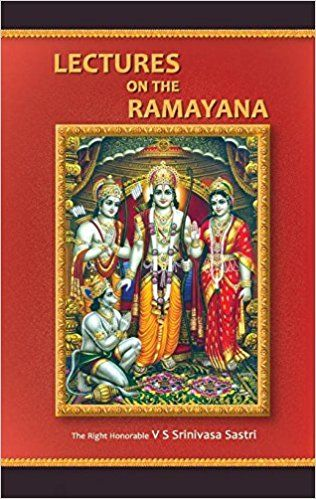
Throughout the thirty brilliant Lectures that he delivered — over a span of seven long months between April and November of the year 1944 just as World War-2 was ending and India’s own Independence Movement, after the near-abortive Quit India agitations, had wound down and but poised to revive again — not once did Sastri in any of his grand narrations of the episodes and themes of the Valmiki Ramayana, stray from its faithful textual interpretations and character delineations into anything that could have been construed as veiled, related commentary insinuating upon the state of contemporary politics and social affairs of that time. The Lectures instead were scrupulously focused only on the finest features and aspects of Valmiki Ramayana — i.e. on its literary excellence, poetic beauty, aesthetic qualities, philosophical and moral inquiry of the profundest kind… Not once did the narrations descend to low-grade discourse about the sordid situations in run-of-the-mill politics prevailing then, nor about its polemics nor about the dramatis personae in it.
However, there was one departure… one glaring exception that stood apart from all the rest… It was in Sastri’s Lecture No. 15.
In this exceptional Lecture some deeply distraughtful feeling seemed to have overcome Sastri and broken right through — like raging flashflood-waters breaching the great concrete wall of a high dam — Srinivasa Sastri’s reticence and characterestic self-restraint. It made him deliver a vociferous speech, pulling no punches and it indeed did go all out to reveal his disapprobation and utter disillusionment with the entire class of political leadership in India and the political climate it had created.
***********
In Lecture No: 15 Sastri devoted himself to a detailed charater study of Vibheeshana, the Lankan Prince.
This brother of the tyrant king, Ravana, as the story goes, relinquished his royal status, renounced ties with the Lankan nation and went seek Lord Rama’s asylum. Later he also threw in his lot with the latter’s army that had gathered upon Lankan soil, waiting to launch a great war against King Ravana who had stubbornly refused to return to Rama the Lady Sita who he held hostage.
The dramatic dynamics of the whole Vibheeshana episode — commonly known to all Ramayana scholars as “Vibheeshana saranaagati sarga-s” — appears in the Yuddha Kandam of the Ramayana. The setting is the great War that is about to begin between Rama and Ravana. And the political fallout and churning that then consequently occurs inside the royal palace of Ravana — in the form of tumultuous disagreements breaking out amongst brothers, uncles, cabinet ministers and advisors — are all indeed so very redolent of the kind of widespread nasty politicking and venal political discourse we see in present-day India.
The entire Yuddha Kandha is filled, in fact, with the familiar theatre of disruptive, hate-filled, cynical and acrimonious scenes and script. Accusations and counter-accusations of treason, deception, tyranny, moral turpitude, hubris and blood disloyality are seen to fly thick and fast, and back and forth with mutual recriminations thrown at each other by brother against brother, kith against kin, amongst ministerial colleagues and between friends who turn suddenly into foes….
The battleground atmosphere of the Yuddha Kandam is not just about military conflict alone. More significantly, such scenes in the epic also serve as metaphor for the greater battle of morals, of Dharma and Karma, the clash of ideologies, and for values at odds with culture. The role that the character of Vibheeshana plays in this Kandam is even today one of the most complex and enduring controversies in the entire “itihaasa“. Vibheeshana was perhaps really the precursory model for Hamlet since his own moral predicament too was in the nature of that classic and often irreconciliable human dilemma: “To be or not to be … that is the question!”.
This roiling Ramayana episode seemed however to provide Sastri with the perfect platform from which he felt he could sought to put up a moral defense of the difficult choices he had made when he was in the thick of politics of India along with his guru Gopal Krishna Gokhale (1866-1915 CE) who had been a leading figure in it. It was because of the Gokhale brand and style of politics that Sastri had chosen to espouse and follow that why, later on, he had come to be virtually ostracised and eventually excommunicated by the INC leadership under Gandhi and Nehru who had left him to languish in political oblivion. Even though during the prime years of his career, Sastri was thought to be the most qualified of the entire lot of Congressmen and the most capable even amongst others who could fully engage, on behalf of the country, in international diplomacy at the highest levels not only with Imperial Britain but with the whole world, when the job was done, however, and the INC changed course, it let it be known that the Party had no further use for Sastri.
Like Vibheeshana of the Ramayana, Sastri too felt that he had been unjustly treated by his compatriots, Gandhi, Nehru, Patel and Rajaji, simply for remaining true and deeply committed to his very own philosophy of “constitutional liberal-humanism” that was in fact also that of Gandhi’s own one-time mentor, Gopal Krishna Gokhale, a leader whose principles were rooted in the tenets of Dharma and who fearlessly advocated opposition to the more popular but more radical philosophy of Gandhian “sathyagraha” which as far as he was concerned was essentially nothing but anarchist ahimsa.
***********
In Lecture#15 thus, Srinivasa Sastri struck what is clearly discernible in the delivery of his oration a vaguely autobiographical tone.
In the character of Vibheeshana, he found the almost identical moral reflection of own. The Lecture thus presents itself as a sort of auto-suggestive psychotherapy through which Sastri perhaps sought to deal with his own inner struggles to overcome the deep and dormant trauma that his political marginalisation from the centre-stage politics of the Indian Independence movement had caused and lacerated him. If Ravana was the elder brother of the dissenting Vibheeshana, then perhaps Sastri was the dissenting younger brother to Mahatma Gandhi? And if Vibheeshana’s renunciation of his elder brother and his embracing his adversary, Sri Rama, was morally defensible, how could Sastri’s rejection of Gandhi’s methods of “sathyagraha” in favour of the much more moderate and constitutional forms of Gokhaleian political struggle be condemned as traitorous flirtations with Anglophilia and siding with the British?
In Sastri’s own unexpressed opinion, the “sathyagraha” of the Gandhi-Nehruvian type was perhaps “crypto-himsa” or, at best, say, a kind of dangerous “hybrid-ahimsa“, which he feared would in the years ahead become the normative style of the general political culture, style and discourse in India. in his view, it was never going to instil true patriotism or true national spirit. And the fears he boldly articulated did not mean that he must be attacked ad hominem and cast out as some sort of a traitor to the cause of India’s freedom from the British…
If one were to keep in mind all that is stated above, one certainly can get a much better understanding of the various issues that Srinivasa Sastri spoke about in Lecture#15. The tone and content of his speech might seem to some even today as a bit fulminatory but the language — even in flights of rhetoric — is yet ever so refined, cultured, reasonable and typically “inoffensive“. And the trenchant messages so conveyed too can hardly be ever faulted on any account … certainly not of bile, falsity, intemperance, exaggeration or self-righteous bromide.
*************
The brilliant Lecture#15 contains brilliant observations upon a very wide range of profound matters, political and philosophical viz.:
Conscientious objecters, Patriotism, Treason, Nationalist pride, Democracy, Political Dissent, Political civility, Temperance of speech and last but not the least, the supreme importance of mutual respect that one human must alway culivate for the other, no matter what idea, thought, feeling or prejudice separates them.
Today, as I read Lecture#15 again — for god knows how many times — I am more than ever convinced that every word in it is an invaluable lesson in lofty ethics for our own times. It is simply amazing to me how the Lecture as far back as 1944 foresaw and predicted the pathetic way Indian politics would ultimately go… And how we in 2025 are seeing right with our eyes how Politics is conducted today and the way our politicians behave atrociously towards one another, both in public and in private.
Sastri’s stirring words does make me recall the words of his own favourite English poet, William Shakespeare:
O judgment! thou art fled to brutish beasts,
And men have lost their reason…
O, what a fall was there, my countrymen!
Then I, and you, and all of us fell down,
*************
There is no other way for me but to extensively reproduce below, long and whole extracts from Lecture#15 because any attempt on my part to present Sastri’s speech in a paraphrase of my own will only end up marring, mutilating and mocking the mettle, the majesty and magniloquence of Rt.Hon’ble Srinivasa Sastry’s masterful oratory.
(to be continued)
Sudarshan Madabushi