
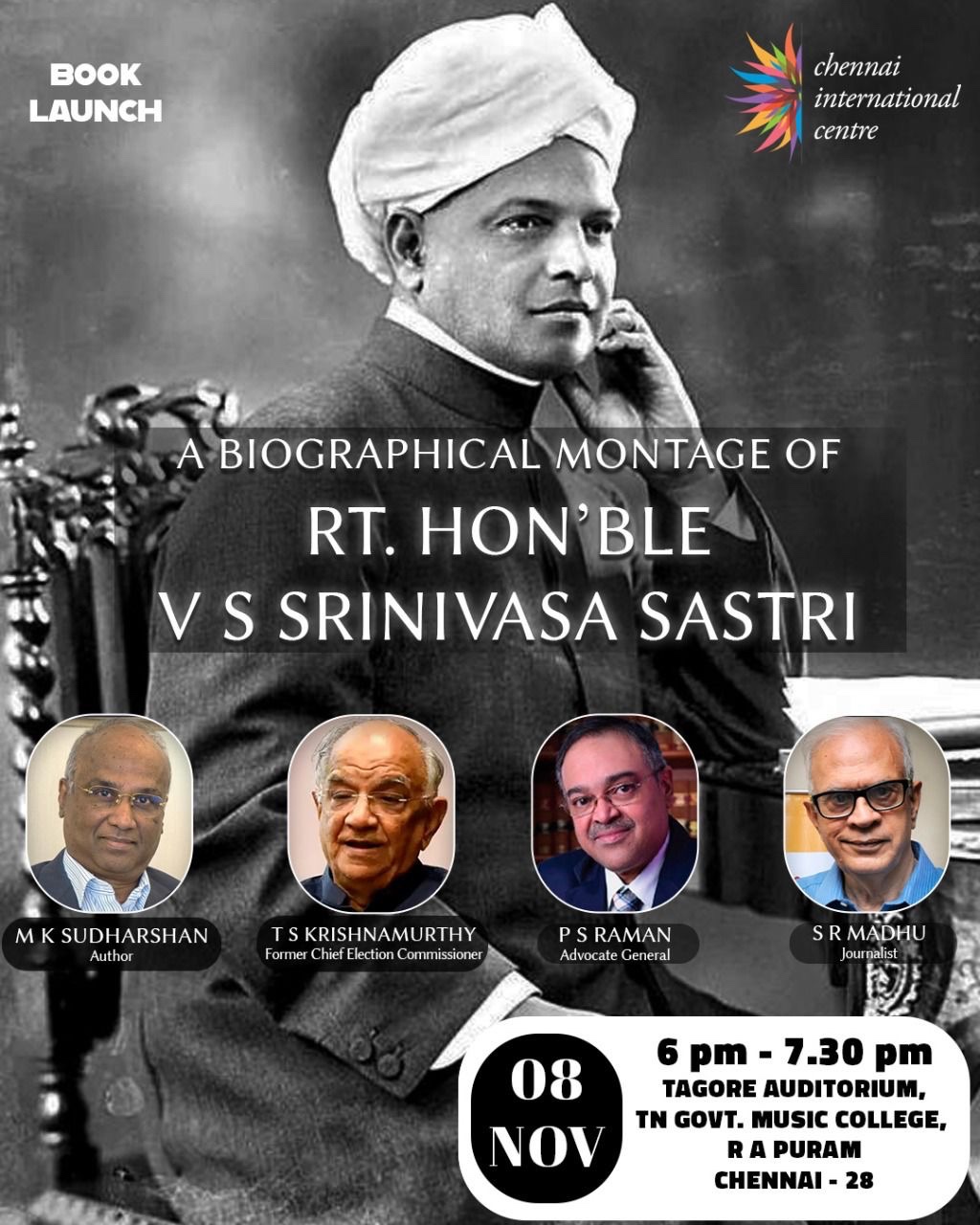
Following my opening speech at the book launch event organised by Chennai International Centre (November 8, 2025) of my recently published work, “The Death of the Brahmin-Liberal” (Blue Rose Publishers), a gentleman named Sri. Srinivasan Ranganthan (Chennai) sent me an email this morning wherein he shared his impressions about the book and the event. However, he also posed to me very trenchant questions to which I provided answers to the best of my knowledge and ability. The correspondence is being shared here below only for the benefit of other readers of my book — both those who already have read it and more importantly, for those who may buy the book soon.

************
Dear Sri Ranganthan,
Thank you for your email below.
You have no idea how much it delights me to have a general reader from the public write to me to review my speech and (perhaps eventually my book too). Your observations are all so very pertinent. I appreciate your feedback and this is exactly the sort of thoughtful/critical remarks that all authors wish to receive.
Please read below in red font my responses to each of your queries and observations. I hope after reading them you will get a better understanding of what Srinivasa Sastri’s positions and stances were vis-a-vis the Civil Disobedience and Non-Cooperation Movement. For more nuanced explantions of the same you will have to make the effort to fully read my book right till the end.
Please do give similar feedback on the book after you have read it, I would welcome it.
Thank You,
Best Regards,
Sudarshan MK
**************
On Monday 10 November, 2025 at 08:58:25 am IST, Srinivasan Ranganathan <@gmail.com> wrote:
Respected Sir,
I was one of the attendees at the Chennai International Center on your book launch on Shri. Srinvasa Sastry, about whom I had known very little before attending this event. My late father had told me about his great oratorical skills in English that impressed even the British. I came away with a very good understanding of the person and his views, and his differences with the Big 4 of the Indian Freedom movement.
True…! people of Tamil Nadu and especiallhy the Brahmin community did a great disservice and discredit to Srinivasa Sastri by rather than knowing more about and celebrating his greater accomplishments in Diplomacy, Politics, Education and Literature turned him into a Post-Independence kind of poster-boy for Anglophilia. Apart from simply gloating and singing peaens to his legendary eloquence, the Tamil Brahmin community did little to appreciate his brilliant achievements in Diplomacy and political statesmanship… and his principled stands against many of the Independence era nationalist ideas and agenda. They called him “silver tongued Sastri” and simply left him hanging with that sobriquet … as if he was no more than a stage performing artiste with extraordinary god given gifts of the gab … no more, no less… Amongst the audience that evening, the audience response to my question as to how many had read seriously anything about Sastri saw not more than a dozen hands go up from amongst a 100-150 others! That by itself tells me that what I have stated above is largely correct.
Of late, I have heard from some Historians/political commentators that his idea of a soft approach for achieving India’s freedom through diplomacy and negotiations portrayed him as an ‘apologist’ of the Colonial Govt. , since the context , during the days of our freedom struggle was, either you are with the Freedom Movement or you are against Indian people. In my view, he might have strengthened such a perception through his attempts to dilute the gains of the Freedom struggle by opposing Satyagraha and other potent methods of protests by Gandhi and his team, with or without realising it .
Yes, this exactly was the impression about Sastri created by the INC under Nehru. If you read my book you will come across a couple of chapters describing how Sastri was slighted and humiliated as an British lackey and Anglophile.
I am reproducing below a few passages just as a sampling of the attacks on him:
Some critics at home in India minimized the outcome or scorned diplomatic success as insufficient, not recognizing the scale of the challenge or the constraints he faced as a colonial delegate. (Chapter 4)
The Indian Opinion, edited by the late Manilal Gandhi, son of Mahatma Gandhi, was somewhat critical of Sastri because he did not advocate satyagraha by South African Indians to redress their wrongs. It said:
“We respectfully differ from Mr. Sastri on some matters…. His moderation and forbearance are at times, we think, far too stretched, but we know he is absolutely sincere. His heart is too soft to see suffering on either side. He would wish to gain for us things without our having to suffer. We believe, however, that nothing can be achieved without suffering…. Nevertheless, Mr. Sastri is a great man. The European press and the people of South Africa have almost unanimously hailed Mr. Sastri as being the greatest man in South Africa today.
If Sastri were an anglophile so was also Gandhi, Jawaharlal Nehru and Ambedakar and many others in the Indian Freedom struggle who all went England to get educated and returned to India as barristers… Nehru especially had great love for English thought, manners and customs. So, it was a bit thick on his part to call Sastri an Anglophile who in fact had the all the deportment of a typical Mylapore Brahmin rather than an English peer.
Sastri’s “Brahmin Liberalism” represented a unique synthesis of classical Brahminical values and liberal humanism—a blend increasingly rare today. Critics have called him an Anglophile, but this was a nuanced affinity: he admired British constitutional principles and linguistic finesse as models for Indian reform, without uncritical reverence. The death of this ethos symbolizes the evaporation of civility, reasoned debate, and respect in public life. — (Chapter 14)Sastri made no secret of the fact that he regarded British Rule as a mixed blessing. He said so plainly in his speech:
Sastri handsomely acknowledged the good that the British institutions had done in India.
“Not only have standards of efficiency and thoroughness in administration been raised fan above the level reached at any time before in our history, but the springs of public conduct have been purified, official probity has received a new meaning, public opinion has been taught and encouraged, in spite of frequent lapses, to assert itself, and whether between sexes, between capital and labour, or between teacher and pupil, a nobler and more chivalrous relation has been established, beyond danger, let us hope, of being forgotten when Britain’s hand is withdrawal from the helm.
Who, again, would hesitate to acknowledge handsomely the awakening of the social conscience towards the servile and depressed classes as a result of Western ideals? Why, the national ambition, of which the intensity is proving a serious embarrassment to the Government, is itself the product of English education….
Our tale of indebtedness would not be complete if we did not pay an unreserved tribute of admiration and gratitude to the loving devotion and heroic sense of duty with which many missionaries, teachers and officials from the West have laboured for the good of the people of this land and the unstinted homage and welcome of our hearts to the men and women of another race who recognise in the present distracted political movement the throes of a nation’s birth and rejoice in openly championing the claims of those brethren among whom their lot is cast.”
Sastri also said this in a speech:
“Good-will and ill-will must evoke likes. Is it too late to try a little mutual trust? Whether in the first instance or under provocation, certain of our politicians have indulged in indiscriminate abuse. We have insulted; we have bullied; we have threatened. We have been super-sensitive and too prone to see national insult and humiliation. We have boasted of our national virtues and capabilities, to which our claim is doubtful, and we have denied national faults and weaknesses which blaze as the noonday sun. We have allowed political hatred to mar social intercourse. We have invented a theory of Non-cooperation which should carry us to our destined goal in disregard and defiance of the Imperial Parliament, the British Cabinet and the Government of India. We have in the extremity of despair actually inculcated a spirit of disobedience and direct action which, while creating disorders and tumults and embarrassments now, is certain to recoil with terrible force on our own heads and expose our home-rule regime, when it is established, to the serious risks of continued and chronic distemper”
“To an abnormal type of mind political disorder may appear a necessary preliminary to the establishment of a happier polity than India has ever known before. If we throw everything into chaos, God will know how to bring cosmos out of it. That is it.”
Having set the context as above, I would like to know from you, through your research on Shri. Sastry if you had come across his rationale/justification for taking a stand that India’s Freedom could be achieved through Negotiations and diplomacy ,with a brutal Colonial regime as events like Jalianwala Bagh massacre amply proved. I wanted to put this during the question session but unfortunately was unable to do so. Would be great to have your response on this, if you will.
Iam not sure if you agree that India’s Non-Cooperative struggle was an excellent middle path between Shri.Sastry’s soft approach and Netaji’s conviction on armed struggle to secure India’s Freedom. It was a brilliant conception, in my view, by Gandhi and this was widely acclaimed all over the world, some of the well-known leaders of those times, notably, Dr.Martin Luther King, had confessed to using the methods of non-violent struggle inspired by Gandhi.
Sastri was categorical in his rejection of Gandhi’s methods of Sathyagraha, Non-Cooperation. He conceded that street level agitations were effective in the short-term and for very narrowly limited political purposes. But if allowed to become widespread in a large country like India, Civil Disobedience would become default standard political culture of Post-Independence India with people taking to the streets at the drop of hat for every little group grievance they harbored.
In several letters and speeches, Sastri said that constitutional methods of agitation were better than street mass protests … it was a gradulist approach to the aspiration for freedom but then from a future perspective it would be the wiser one.
Here are some of the speeches and letters of Sastri which you can read in the chapters of the book:
“In Germany and France, in Britain and America, in the Dominions and, indeed, all over the civilised world, his (Gandhi’s) sayings and doings as the head of the Non-cooperation Movement are studied with intense interest as a new evangel for the future of mankind in the international as well as in the national sphere. His theatre encompasses the earth. History, far off history, is his only competent judge, after God. This, the present writer believes, is a true and just picture of the psychology of Mr. Gandhi. It is not drawn in a spirit of disrespect or with a view to pass moral judgment. But Mr. Gandhi’s contemporaries, be they ever so puny, have a duty to the country as well as he. They may not see clearly; they may not judge rightly. But as they see and judge, so they must act. If they believe that in the search of highly problematical good, he is bringing highly probable evil on their common motherland, they are bound to oppose him all they can. It is a comfort to know that he at least will not blame them”.“The forces that will be unloosed we cannot hope to control or regulate, and we shall hopelessly thicken the problems of our children because we choose to neglect a comparatively easy solution in our time.”
He warned: “The forces that will be unloosed we cannot hope to control or regulate, and we shall hopelessly thicken the problems of our children because we choose to neglect a comparatively easy solution in our time.”
And Sastri had the courage of conviction to stick to his guns
“I have said before and will say it again that we are far from having exhausted the possibilities of constitutional agitation in India. It is not impossible for us to attain by methods of peace what elsewhere and at other times has cost the shedding of much blood and the misery of many generations. Mr. Gokhale worked in that faith to the end. I have that faith too and would fain communicate it to others.”
He defended the philosophy of the Indian Moderates or Liberals:
“Moderation has no doubt fallen on evil times. But why should it hang down its heart and go about with an apology al-ways on its lips?… Men of the Moderate school have no need to be ashamed either of their name or of their policy. It is no crime to be in the minority. It cannot be unpatriotic to say yes when they feel yes. To be rallied by an English politician is not wrong when they are rallied to the standard of peaceful and substantial progress. On the lips of the sneering majority, expressions of noble import are often degraded. Rallying the Moderates, sobriety, statesmanship are not despicable because they are now generally despised. Let us be true to our convictions and remember that a single turn of events may prove us right. History honours Cavour as well as Mazzini, and Emmanuel has a noble niche in the hall of fame by the side of Garibaldi.”
The points made by the other panelists on the stage, iam afraid, tended to focus on the criticism of Shri.Sastry by the towering 4 of the Freedom Movement , as unwarranted, bordering on doing injustice to Mr.Sastry’s legacy, while trying to implicitly eulogise his views. Mr.TSK (T.S.Krishnamurthy, former CEC) read out passages of Pandit Nehru’s book, where he had made stringent criticism of Shri.Sastry, while the latter’s criticism of Gandhi through your references evoked no response. I wondered if Nehru bashing was not limited to present day ruling elite but has also extended to some writers, bureaucrats now and retired. One wonders , what can be inferred by many , if Shri. Sastry was unable to convince even one of the great 4 leaders and bring them around to his view to the path of negotiating with the British. Iam sure you will concede that these four leaders were not ordinary people, they were great thinkers and selfless contributors to India’s well freedom and staunch patriots without doubt.
Sastri himself had great respect and regard for the Big 4… but from my reasearch I can only conclude that the respect and regard was not reciprocated genuinely at all times. Except Gandhi who always held Sastri in very high esteem in spite of their deep differences. It was the greatness of both men that they saw each other’s greatness of character and spirit and were not reticent in mutual admiration.
The Government’s determination to procced with the Rowlatt Bill antagonised Indian public opinion of all shades as never before. Sastri was critical also of the Satyagraha movement, which the Mahatma started and then suspended it after the Jalianwala Bagh tragedy:
“I must say, in the next place, that the Satyagraha movement, though Mr. Gandhi has now suspended the civil disobedience part thereof, has, in its turn, contributed to the difficulties of the situation. I am one of those who hold that it was not the intrinsic nature of Satyagraha that led to the outbreaks of disorder; nor were these intended. Nevertheless, it is difficult to dissociate them entirely from a movement which brought together an unprecedentedly large mob in a highly excited frame of mind, and from the undesirable forms it subsequently assumed.”
Of the Mahatma he said: “You will see that with his extraordinary readiness to take the responsihility even when it does not directly rest on him, Mr. Gandhi himself admits that he failed to appreciate in its fullness the absolute inability of the mob to rise to the height of the Satyagraha-plan and that he failed to take full note of the extent of the excesses which might be. committed under its cover. When Mr. Gandhi is so ready to take upon himself the blame of it all, it is ungracious — highly ungracious—to dwell long on it. We recognise the unfortunate, though indirect connection between the Satyagraha movement and the disturbances; but no one thinks that Mr. Gandhi had anything to do with them…. We know that nobody is so unhappy over these events as Mr Gandhi himself”.
And here is what Gandhi once said about Sastri:
“I have called Gokhale my political Guru. Therefore, Sastriar is a fellow disciple. And what a disciple and yet an amiable usurper!!! I was to have the honour of being Gokhale’s successor but I found in Sastriar a worthy usurper to whom I made a willing surrender…. I had and have no gifts which Gokhale had and Sastriar has in luxurious abundance.”
Your brief foray into today’s politics was focussed on criticizing only the Opposition and its protests inside and outside the Parliament on Farm laws, without consideration of the merits of their protests. The present Govt’s hollowing out of every available oversight Institution , their fraudulent practises in elections, their brazen support to unethical, unlawful practises of select favored Oligarchs as a quid pro quo for investing in Electoral bonds seems to be glossed over by the Panel in sharp contrast.
I agree that the Congress of today is now a degenerated cabal and is in the grip of a Dynastic progeny, but that should not be any reason to support another evil, unethical, divisive and hatred spewing alternative.
Here I am not willing to give my own personal views…. (my views are unimportant). But in response to what you say above, I will only offer to you what in my opinion would have been Srinivasa Sastri’s likely public stance if he had been alive today:
If Srinivasa Sastri were alive today, he would likely highlight—with considerable grief—several features of contemporary Indian political culture as problematic “carryovers” of the Gandhian era’s reliance on extra-institutional means (Satyagraha, non-cooperation, agitation) rather than mature, constitutional, and parliamentary processes. His own liberal, constitutionalist vision for independent India was rooted in debate, reason, legislative mechanisms, and the rule of law—not mass agitation as a routine tool in democratic life.
Contemporary Examples:
• The 2020–21 Farmers’ Protests: Months-long large-scale occupations of public highways and blockades in and around Delhi, with parliamentary channels exhausted or sidelined.
• Recurring opposition walkouts and disruptions in Parliament and legislative assemblies, where debate is often stalled by slogan-shouting and physical obstruction, closely resembling pre-independence non-cooperation rather than constructive legislative engagement.
Sastri’s likely view: He would lament that these protest modes, once justified against colonial rule, now undermine the constructive functioning of Indian democracy, rule of law, and citizen confidence in constitutional bodies. Sastri would urge commitment to debate, legislation, and reasoned advocacy inside parliament, rather than chronic reliance on agitation.
1. “Means Justify the End” Mindset and Institutional Erosion
Observation: The culture of achieving political ends—electoral, legislative, economic—often appears to privilege “successful” mass pressure or disruption over slow, rule-bound institutional work.
Contemporary Examples:
• The frequent disruptions and even adjournment of sessions in Parliament (e.g., the entire Monsoon Session in 2023 and Budget Session 2024 marred by deadlocks), resulting in little legislative progress and major bills passed without full debate, sometimes through controversial “voice votes.”
• State-level agitations: Mass agitations for sub-caste reservations, language issues, or special status (as in Andhra Pradesh, Haryana, or Maratha agitation in Maharashtra).
Sastri’s likely view: He would grieve that the Gandhian legacy—originally a tool of resistance against foreign rule—now weakens respect for institutional norms and the delicate fabric of legislative compromise in a free nation.
2. Civil Unrest as Political Weapon and Identity Clashes
Observation: The normalization of mass street agitation as the primary instrument for all significant group grievances or identity clashes—be it communal, linguistic, or sub-national—has become deeply ingrained.
Contemporary Examples:
• Communal and sectarian riots (such as the Delhi riots of 2020 or the Manipur ethnic unrest of 2023), where political and civil actors quickly resort to street action and law is often sidelined or overwhelmed.
• Judicial populism/political litigation: The near-constant recourse to the judiciary to block or enforce government actions outside regular legislative consensus, with the Supreme Court and High Courts regularly called upon to resolve political conflict.
Sastri’s likely view: He would see in these patterns a lamentable persistence of “politics of obstruction”—a negative carryover of mass-mobilization strategies meant for colonial resistance now corroding the discipline, restraint, and civic culture necessary for a stable constitutional democracy.
Sastri’s Guiding Alternative
Sastri would have insisted:
• Mature democracies demand deliberative debate, public reasoning, and respect for majorities/minorities in the legislative process.
• Civil disobedience and agitation are extraordinary tools for extraordinary wrongs—not a daily method of negotiation in a sovereign democracy with accountable institutions.
• Progressive change comes from education, civic ethics, constitutional fidelity, and tireless institutional reform—not perpetual agitation.
In Essence
Sastri’s lament would be that much of independent India’s political culture—through disruptions, ritual protest, and mass agitation—reflects the hangover of pre-independence means, now repurposed against one another rather than against a colonial state. He would urge a new culture of constitutionalism, continuity, and public-spirited dialogue to truly fulfil the promise of Indian democracy.
Thanks for an enlightening speech and information on the lives and views of Shri. Sastry. I came back home better informed about this great man.
Best Regards
Ranganathan K.S
Adambakkam , Chennai.
Thank you so much indeed for taking the time to pen your gracious email to me. I now look forward to comments after you have read my book fully. Sudarshan