
Yesterday, November 28, 2025 will go down as a sad, black day of mourning for the Vadakalai Sri Vaishnava sectarian community in India and abroad.
The Madras High Court has legally affirmed that the Kanchipuram Vadakalai temple must be treated as a Thenkalai/Thennacharya Sampradaya temple, with corresponding denominational rights flowing primarily to the Thennacharya group under Article 26 of the Constitution.
It is no surprise that, today, November 29th, being the morning after, sees many hundreds of the Vadakalai Sri Vaishnava sectarian community going numb with shell-shock on reading about the news of the temple now legally going out of their hands into the administrative and managerial reins of the Tenkalai sectarian group. Quite naturally, a pall of hushed anguish and sheer despair seems to have descended upon all Vadakalai devotees of Kanchi Varadar Kovil…. The spirit of “ubhaya-vedanta” seems to have been dealt a grievous if not fatal blow delivered by the secular justice system of the State.
One Vadakalai member of the priestly group in Kanchipuram could not help venting his feeling of defeat and bitterness to me via a WhatsApp message sent this morning. I could gauge the depth of his personal distress since I knew that the Court verdict to him was a negation of the high ideals of “ubhaya-vedanta” traditions that the Vadakalai sect had stood representing for well over 800 years since the time its “paramacharya”, Sri Vedanta Desikan (1268-1368 CE) of Thoopul Village, Kanchi, had first established what is today is known as “Sri Desika Sampradayam“, a school of theology that distinctly dissents from that of the Tenkalai sect. Hence, his lamentations below:
ஸ்வாமி தேசிகனை போல் பரிபவம் எந்த ஆச்சாரியருக்கும் வர கூடாது!:
“May no acharya ever have to suffer the kind of humiliation that Swami Desika has had to face!”
நின்றுபோன பிரபந்தத்தை காப்பாற்றி கொடுத்தது தப்பு!: “It seems it was a ‘mistake’ on his part to have revived a prabandham-chanting tradition amongst Sri Vaishnavas that had (historically already) fallen into disuse.”
வரதன்மேல் அளவுகடந்த ப்ரேமை வைத்து பிரபந்தம் பண்ணியது தப்பு!: “Was it a great ‘mistake’ on his part that, out of boundless love for our Lord Varadan, he composed Tamil prabandhams and celebrated them… (only to be all cast away today by this verdict)?”
ஆழ்வார்களை அபிநவ தஸாவதாரம் என்று தூக்கி பிடித்து தப்பு!: “ Was it a ‘mistake’ on his part that he exalted the Alvars (too highly and too unwisely) as the ‘new’ ten avataras (of Vishnu)?”
பரமபதம் போயும் பல்லாண்டே பல்லாண்டும் பாடுவோமே என்று ஏற்றம் கொடுத்தது தப்பு!: “Was it a ‘mistake’ on his part (in going overboard with his love for the Azhwar prabhandhams) that he went about proudly saying that even in “paramapada” we will go on singing only that (Tamil hymn) of “pallāṇḍu pallāṇḍu”? ”
பாதுகா ஸகஸ்ர வ்யாஜத்தில் ஆழ்வாரை ஆயிரம் ஸ்லோகம் பண்ணியது தப்பு!: “Was it a ‘mistake’ on his part that, under the pretext of his (composing the great Sanskrit poetic work, the) “Pāduka Sahasram”, he actually sang a thousand verses eulogising the Alvars too?”
**********
Lamentations of the Vadakalai sect are alright and understandable on the day after the High Court has spoken finally and rendered legal justice. But every Vadakalai knows that they are futile.
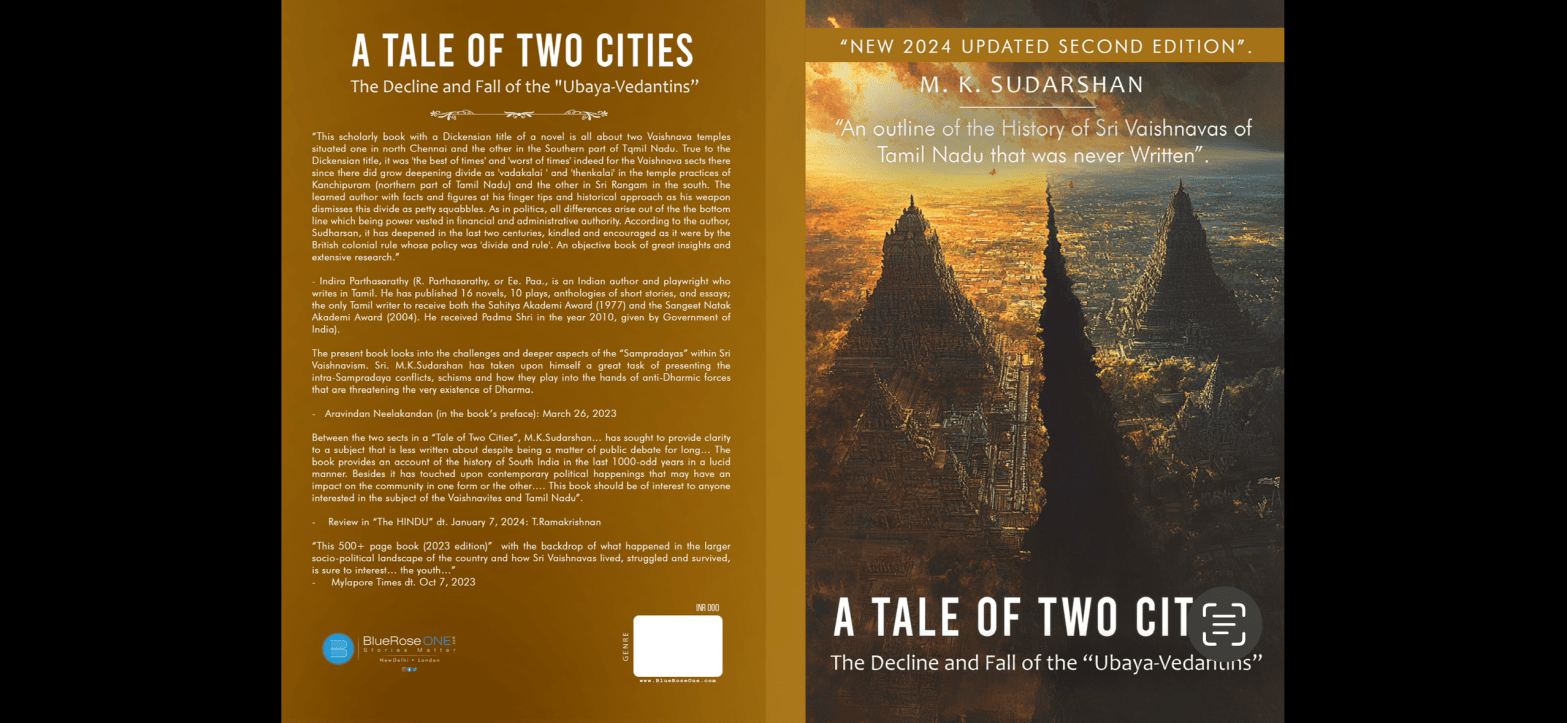
In 2023, I had authored a book “A Tale of Two Cities: the Decline and Fall of the “ubhaya-vedantins” (with a Preface written by Aravindan Neelakandan). It makes poetic sense to see this verdict as a “fin” for my own book’s narrative arc. It is also, conceptually speaking, more like a powerful late chapter than a definitive last page. My book’s central thesis had been that ubhaya‑vedantins gradually had lost the capacity to hold a common Sri Vaishnava space above sectarian fractures, under long historical pressures ranging from politics and economics to intra‑Brahmin rivalries. In that frame, the Madras High court judgment of yesterday does crystallise one sub‑sect’s primacy at a major divya‑desam, after a century of litigation, and makes it certainly look like a symbolic sealing of the “Decline” side the story I told in my book. In that sense, I see myself today — and I wish I did not — as a sadly confused but prophetic author. The Kanchipuram Temple verdict today does seem to me ambivalent: it confirms how far ubhaya‑vedantin unity had frayed till date that it still leaves the community wondering if Tenkalai and Vadakalai will step back from perpetual war and rediscover a more constructive, sharable religious life under a clarified legal framework.
So, this judgment of the High Court to me is a striking postscript or an added “Epilogue II” to my “Tale of Two Cities”. It dramatises the costs of sectarian legal warfare at the very temple that anchors so much of its 1000-year and more long history.
*********
Taking an overall view of this very long standing historical dispute between the two sects , and in the light of this now court judgment, could it be said that the Vadakalai cause in Kanchipuram Temple is lost ? Should the verdict be respected and Vadakalais should let bygones be bygones… and move on ?
The Vadakalai “cause” at Kanchipuram is certainly weakened in the narrow, legal sense of priority over certain rituals, but it is not annihilated in the broader spiritual, historical or practical sense. The judgment strengthens the line that, for specific core rites and goshti precedence, the temple is to be treated as Thennacharya‑denominational; yet it does not and cannot erase centuries of Vadakalai presence, scholarship, acharyas, festivals, and shared devotion at Kanchi.
Has the Vadakalai cause been “lost”?
Legally, the balance has tilted further towards Thenkalai primacy in the contested zones that still stand under the bannr of the Vadakalai sect: who leads prabandham, what mantrams are recited inside, and how earlier decrees are to be understood. That makes it much harder for Vadakalai litigants to reclaim the old demands of equal or superior precedence at exactly those points of friction.
At the same time, the temple remains a great pan‑Vaishnava centre visited, served, and ritually engaged by both sub‑sects; the judgment does not ban Vadakalai worship, darshan, or participation as part of the larger devotee‑body, nor does it strip Vadakalai tradition of its theological or cultural stature in Kanchi.
Should Vadakalais “move on”?
From a pragmatic and dharmic standpoint, there is a strong case for accepting the verdict as the working framework and consciously stepping away from further combative litigation over the same points.
Prolonged appeals and periodic street‑level confrontations have repeatedly disturbed utsavams and given both sampradayas an unsavory reputation for quarrelling in front of the deity; that cost, in terms of public perception and internal spiritual focus, is arguably greater than the marginal gains any one side can now extract.
“Moving on” need not mean emotional surrender or erasure of Vadakalai identity; it can mean:
- continuing to serve Varadaraja Perumal through avenues not dependent on leading the goshti or receiving the grace of theertam and sattaari (i.e. via supporting veda‑patasalas, anna‑dana, temple upkeep, cultural work, and above all real and uncompromising scholarship in Ubhaya Vedanta);
- nurturing Vadakalai ritual and doctrinal life strongly in other Kanchi shrines and mathams where their position is undisputed; and
- informally negotiating dignified space and honour within the current legal framework, rather than trying to overturn it.
Given the length, cost, and limited success of the litigation history, it is reasonable to say that the phase of “courts as battleground” — as I described it in my book — has run its course and has not delivered the kind of clear victory Vadakalai aspirants once hoped for.
Continuing to fight every inch may only harden sectarian lines and invite stricter state/administrative control and meddling by HR&CE Commission, which ultimately will only constrain both sides. A historically-minded Sri Vaishnava (who has probably read and found my book useful in this regard) could, therefore, see more wisdom in treating this judgment as a closing bracket on one chapter, and re‑centring the shared identity as Sri Vaishnavas at a divya‑desam, rather than as rival law‑parties trying to win the last procedural skirmish that all first began in 1792 CE.
Sudarshan Madabushi
A நானேதானாயிடுக moment for (us) Vadakalais…