

This detailed analysis below of the Common Judgment dated November 28, 2025, passed by the Division Bench of the High Court of Judicature at Madras in a batch of cases (including W.A. Nos. 1381 & 1382 of 2022) reveals the plausible story of how and why perhaps a flawed legal strategy adopted by the Vadakalais litigants to secure their priestly rights within the Kanchipuram Sri Varadaraja Perumal temple led to their case coming a cropper .
Disclaimer : I am not a lawyer and do not lay claim to in-depth knowledge of Constitutional Law . The below Notes were generated by me simply by submitting what I considered were relevant and intelligent common man’s prompts/questions to AI tool.
**************
The judgment addresses a long-standing, volatile sectarian dispute between the Thengalai and Vadagalai sects of Sri Vaishnavites over performing ceremonial worship rights at the Arulmigu Devarajaswamy Thirukkovil in Kancheepuram.
- The Vadagalai Contention: The Vadagalais argued that the old civil judgments (e.g., Appeal No. 175 of 1910 and Appeal No. 283 of 1963) violated their fundamental rights under Articles 25 and 26 (Freedom of conscience and free profession of religion; Freedom to manage religious affairs) and should be set aside in the present writ proceedings.
- The Court’s Holding: The Court emphatically rejected this challenge, relying on the nine-member Supreme Court Bench decision in Naresh Shridhar Mirajkar (AIR 1967 SC 1). The Court held that judicial orders passed by a competent court, which have attained finality, cannot be challenged in writ proceedings on the ground of violation of fundamental rights and no Writ of Certiorari would lie against them.
- The Court’s Holding: The Court determined that the ‘Mirasi Right’ of the Tenkalais is a “perfect blend of religious right as well as property right”. This right is protected under Article 26(c) and (d) of the Constitution (right to own and acquire movable and immovable property and to administer such property in accordance with law). The right to the office, having been conferred on Tenkalais residing at Kancheepuram), is a perpetual and heritable one.
- The Vadagalai Petition was deemed to deserve dismissal as it was an attempt to indirectly challenge final judicial orders on untenable grounds.
- The Vadakalai sect chose to file a Writ Petition primarily because the Appeal route against the 1910 and 1963 Decrees was legally foreclosed due to the extreme age of the original civil court decrees, and they were attempting a strategy to challenge the continuing effect of these old decrees on modern constitutional grounds.
- An appeal against a civil court decree must be filed within a strict and relatively short period (usually 30 to 90 days, depending on the court, under the Limitation Act). Since the decrees were passed in 1910 and 1963, the time limit for filing an appeal had already expired decades ago. The 1910 and 1963 judgments had long attained finality, meaning they were conclusive and binding on the parties involved. (Res Judicata).
- Since a direct appeal was impossible, the Vadakalai sect adopted the strategy of using the High Court’s extraordinary Writ Jurisdiction (Article 226 of the Constitution) to indirectly challenge the validity of the centuries-old decrees.
- The strategy focused on two main legal arguments:
Challenging an Executive Order: The Vadakalai W.P. was filed against a recent notice issued by the Executive Trustee of the temple, which sought to restrict Vadakalai recitation rights based on the old civil decrees. The Writ Petition (W.P.) sought a Writ of Certiorari to quash this administrative notice. - Violation of Fundamental Rights (Articles 25 & 26): The core Vadakalai argument asserted that enforcing a decree that granted exclusive rights to one sect, while excluding another, violated the fundamental rights of the Vadakalai devotees to:
Freedom of Conscience and Religion (Article 25).
Freedom to Manage Religious Affairs (Article 26). - The intent was to argue that, regardless of the old civil judgments of 1910 and 1963, the Constitution, being the supreme law, nullified the effect of the discriminatory decrees on the ground that they perpetuate the caste system or violate modern religious freedom rights.
- The Court however held that judicial orders passed by a competent civil court, which have attained finality, cannot be challenged in writ proceedings on the ground of violation of fundamental rights.
the Division Bench ruled that the Vadakalai petition was an unsuccessful attempt to reopen settled civil litigation using the pretext of an administrative order and a constitutional challenge. - The court, by upholding the Mirasi right and the non-applicability of limitation, necessarily cleared the path for the enforcement of the Thengalai sector’s exclusive recitation rights as originally decreed.
- Consequently, the Thengalai Petition was disposed of with strict directions to the Temple’s Executive Trustee and Police Dept. to ensure that the temple administration strictly adheres to the terms of the 1910 and 1963 judgments defining the Thengalai sect’s specific rights to Adhiapaka Mirasi.
WHAT WERE THE 1910 and 1963 JUDGMENTS?


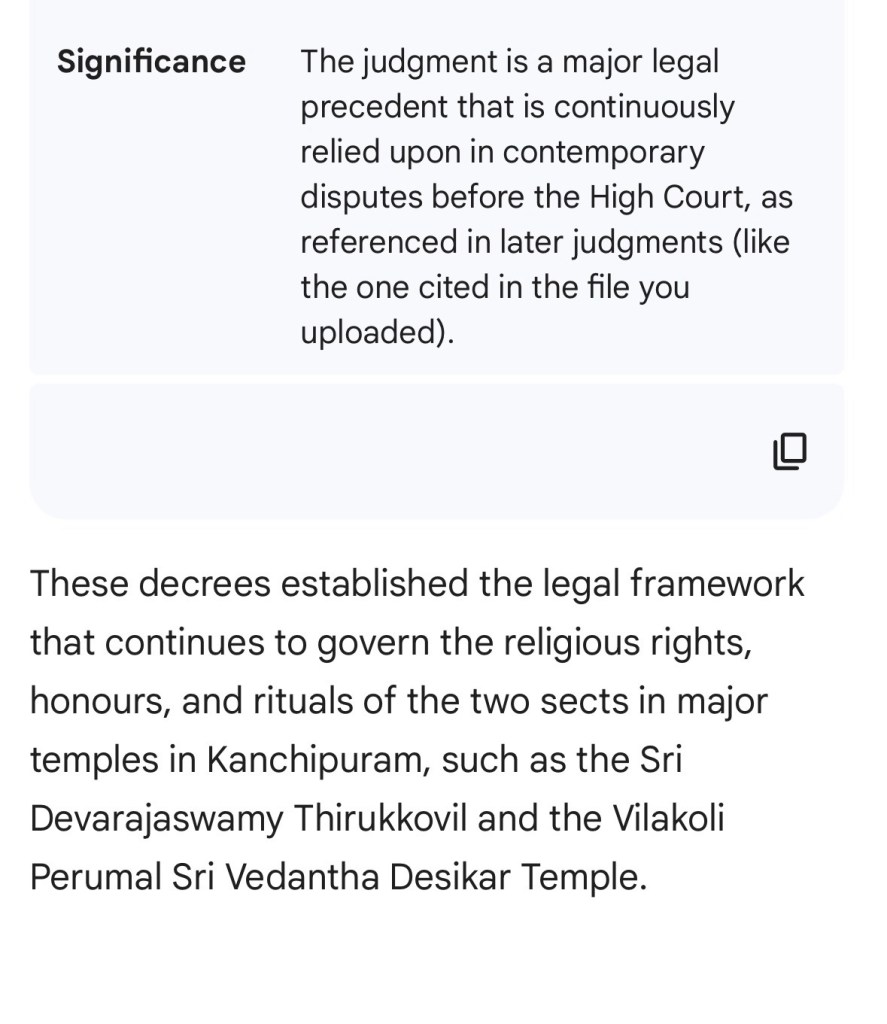
Significance of the 1910/1915 Decree:
This decree related to the ritual practices at the Sri Varadarajaswami Temple in Kanchipuram and largely settled the question of who had the right to recite certain texts during worship and processions.
- Recitation Rights: It was a modification of a lower court’s decree, which ultimately:
- Upheld the Thengalai right to lead the ceremonial chanting (Adhyapakam Miras) by reciting their distinctive mantram (Sreesailesa Dayapathram) in front of the idol during the Pooja/worship period.
- Allowed Vadakalais to form a separate group (goshti) to sing their own Prabandhams and Mantrams, but mandated that they must do so behind the Vedic goshti and not in front of the idol during the core worship period.
Present Status of the Vadakalais’ Rights under the 2025 Order
The 2025 High Court Common Judgment (pronounced on 28.11.2025) effectively maintains the status quo established by the earlier decrees.
- The Court’s directive is to implement the decrees passed in both the 1910 and 1963 cases in their “letter and spirit”.
- The Vadakalais’ rights remain subject to the prohibitions in the earlier decrees: They are generally restrained from reciting their own specific mantram (‘Ramanuja Deyapatram’) or their own Vazhi Thirunamam during the official ceremonial worship (Puja time) and processions, as this is exclusive to the Thenkalai Adhiapaka Miras.
- The entire litigation in 2025 was an effort to ensure the Adhiapakam service adheres strictly to the earlier judgments, which declared the Thenkalais’ right to commence the recitation with the Thenkalai mantram(‘Sri Sailesa Dayapatram’) and conclude with their Vazhi Thirunamam..
How should/could the Vadakalais have handled the executive order better?
The Vadakalais’ handling of the Executive Officer’s (EO’s) Notice (dated 14.05.2022) ultimately led to the High Court affirming the Notice.
From a purely legal and strategic standpoint, the Vadakalais could have potentially handled the situation better in the following ways, recognizing the difficulty posed by the existing, binding decrees from 1915 and 1969:
Strategic Options for the Vadakalais
1. Avoiding a Direct Challenge (Writ Petition)
The Vadakalais’ primary legal error was challenging the EO’s Notice through a Writ Petition (W.P.No.12955 of 2022) seeking a Writ of Certiorari to quash it.
- The Problem: The EO’s Notice was an administrative order that merely sought to implement the final, binding judicial decrees of 1915 and 1969. The High Court views such administrative orders that enforce prior decrees as legally sound. Challenging it on constitutional grounds (violation of fundamental rights) was almost certain to fail because the court’s core finding was that the matter was res judicata (already settled by judicial decree).
- Better Approach: Instead of a direct challenge, the Vadakalais could have sought to clarify, not quash, the EO’s order. They could have filed a representation with the temple authorities or a civil application seeking clarification that the EO’s order:
- Applies only to the ceremonial Adhiapakam Miras during the official Seva Kalam (worship period).
- Does not restrict the Vadakalais’ rights as ordinary worshippers at other times, or their right to recite their Prabandhams in their own homes or other public spaces. This would have narrowed the scope of the dispute and might have been partially successful.
2. Focusing on Change of Circumstances or Custom
The Vadakalais’ arguments were heavily focused on constitutional rights and challenging the validity of the older decrees, which the High Court rejected as impermissible in a subsequent proceeding.
- The Problem: The High Court explicitly stated that the matter of who owns the mirasi is a proprietary right settled by final civil decrees.
- Better Approach: The Vadakalais could have focused on establishing that the customary practices of the temple had evolved since 1969, and that a co-existing right of recitation had been silently permitted by the temple administration for decades. By proving an established, continuous, and non-controversial new custom, they might have argued for an equitable modification or interpretation of the EO’s enforcement.
3. Proactive Use of Contempt Proceedings (Counter-Contempt)
The Thenkalais filed the original Contempt Petition (Cont.P.No.367 of 2020).
- The Problem: The Vadakalais were put in a defensive position, arguing against the contempt petition.
- Better Approach: The Vadakalais could have simultaneously filed their own contempt petition against the Executive Trustee based on the non-implementation of the parts of the 1915 decree that recognized some of their rights (such as the right to form a goshti behind the main Vedic goshti on the public street, as detailed in some earlier rulings). This strategy, sometimes called “counter-contempt,” puts pressure on the administration to implement all parts of the decree equally, potentially creating space for Vadakalai participation.
In summary, the most effective strategy would have been to avoid challenging the EO’s order outright and instead seek an interpretation or clarification that restricted the order’s scope only to the exclusive ceremonial service, thereby preserving their rights as general worshippers. The attempt to quash an order that enforced a final decree was a very high hurdle to overcome.
****************
(To be concluded)
Sudarshan Madabushi