

The 1910 decree did certainly establish the legal framework that later, in Kanchipuram right until Nov 28, 2025, became as reported, the single most compelling reason why the Madras High Court relied upon it as overriding precedent governing the religious rights, honours, and rituals of the Tenkalai and Vadakalai sects in all major temples such as the Sri Devarajaswamy Thirukkovil and the Vilakoli Perumal Sri Vedantha Desikar Temple.

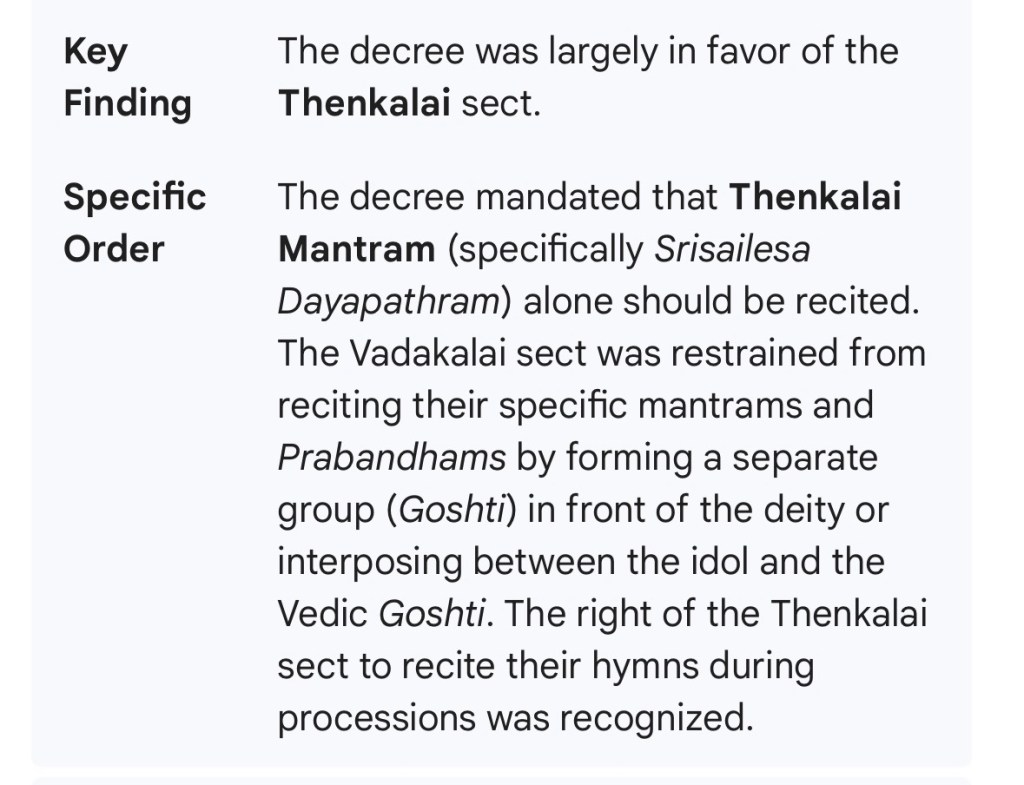
Below is an extract from that 1910-15 Decree that reveals the underlying rationale of the then Court’s Order:
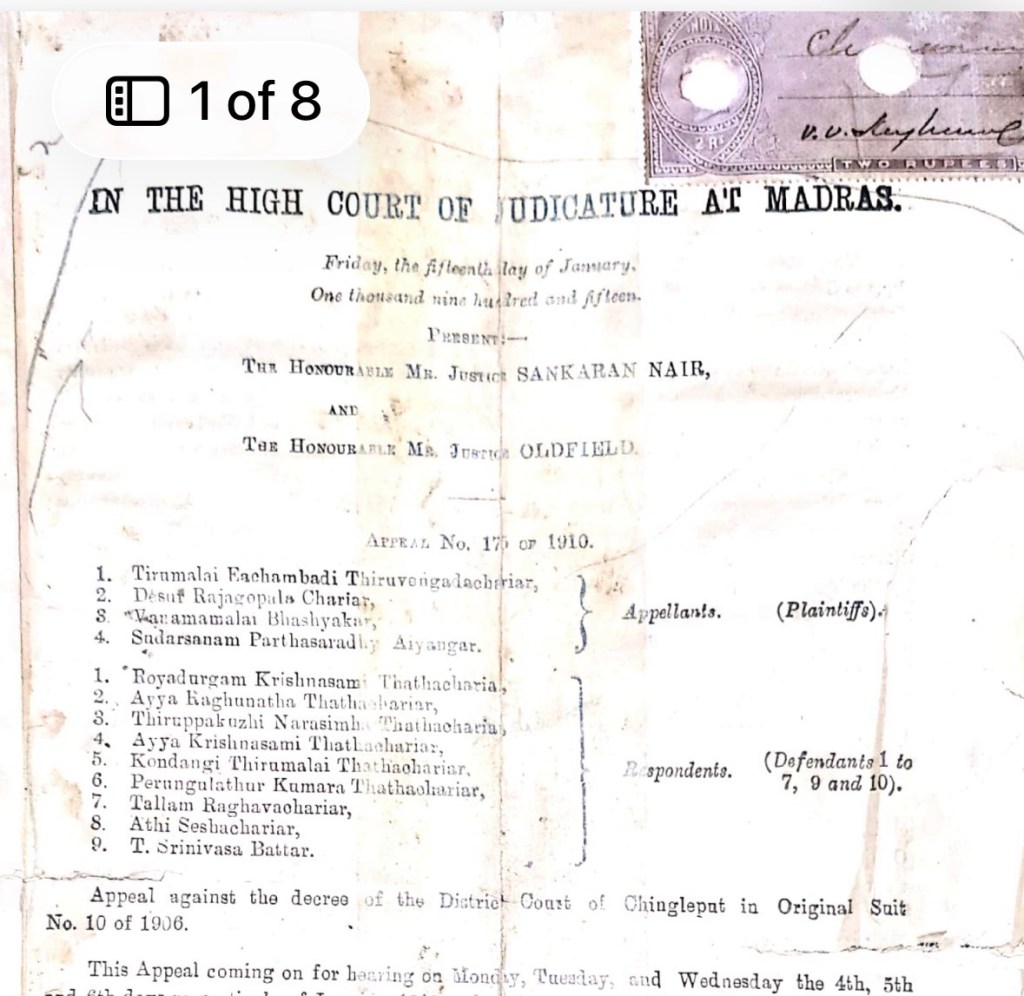
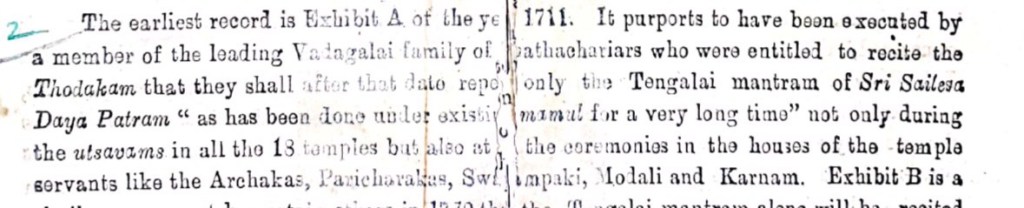
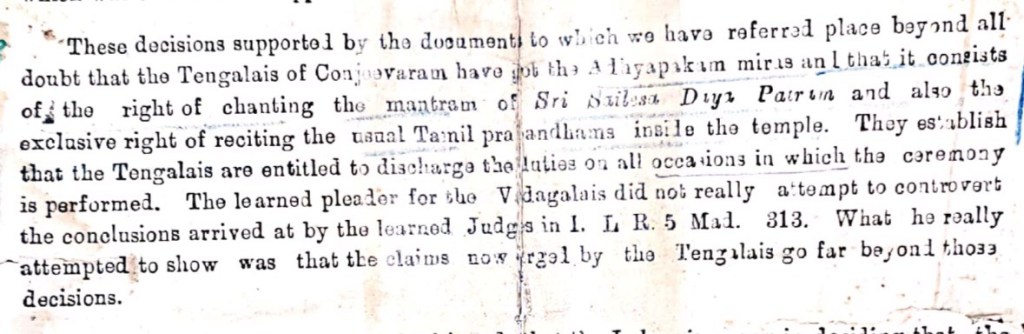
In the above extracts, there is mention of a certain “Exhibit A of the year 1711” which the Court takes cognisance of as being “the earliest record …. (that) purports to have been executed by a member of the leading Vadakalai family of Thathacharisrs who were entitled to recite the “Thodakam” (commencement of ritual ceremony in the temple) that they shall after that date recite the Tengalai mantram of “Sri Sailesa Daya Patram” as had been done under existing “mamul” for a very long time not only during the “utsavams” in all the 13 temples (of Kanchipuram) but also at the ceremonies in the houses of the temple servants like the Archakas, Paricharikas,, Swamipaki, Molali and Karnam (all temple servitors).”
It is precisely this “Exhibit A” as so-called purported document of 1711 which the Court then – in 1910 – held to be conclusive evidence of the solemn and legally binding undertaking given by a Thathachari family member to willingly chant only the Tenkalai Tanian litany of “Sri Sailesa Dayapatram” inside the temple and to abandon the Vadakalai Tanian of “Ramanuja Daya Patram Tanian”.
That “purported document” mentioned as “Exhibit A” in the 1910 Court order was really not any sort or form of legal Agreement or Affidavit at all! It was an unverifiable , inauthentic and mere hearsay historical document that came to be called “Atthaan Jeeyar Agreement”.
WHAT IS THE “ATTHAAN JEEYAR AGREEMENT”?
The Atthaan Jiyar Agreement of Kanchipuram refers to a historical agreement associated with the administration and custodianship of the Sri Varadarajaswami Temple in Kanchipuram. This agreement was signed by one Ettur Immadi Lakshmikumara Tatacharya and delivered to one Attan Jiyar, a significant religious figure entrusted with responsibilities in the temple’s management during the tumultuous era of Muslim invasion of South India under the reign of Moghul Emperor, Aurangzeb.
The agreement holds legal significance as it played a role in establishing the authority and rights of the Jiyar (a religious official) and the Tatacharya family in managing the temple’s affairs, including the upkeep, administration, and possibly the distribution of temple assets and endowments.
Legally, the Atthaan Jiyar Agreement became very significant because it was used by the Courts during the British Colonial era as a convenient foundational document in historical disputes and litigations over temple control and management that had continued over the centuries.
The agreement always remained contentious primarily due to its sectarian implications and the complex, long-standing rivalry between Vadakalai and Tenkalai factions associated with the temple. It was part of larger disputes involving religious authority, temple management rights, and interpretations of historical privileges. The contending parties interpreted the agreement and related historical records differently, thus fueling ongoing disagreements about rightful custodianship and control of temple assets, rituals, and property. This sectarian contestation highlighted how historical religious agreements —lacking legal genuineness — nonetheless retained juridical and cultural weight in contemporary temple administration disputes also.
There is no clear public record or evidence to this day that the original Atthaan Jiyar Agreement of Kanchipuram is preserved in any accessible archive. However, attested copies or certified reproductions of older historical agreements related or incidental to religious institutions are sometimes maintained by temple trusts or regional archives, though such documents are often not digitized or publicly available.
Some British-era records and related government documents involving temple affairs from the 19th century had been attested by officials and preserved in local archives or libraries.But a specific attested copy of the Atthaan Jiyar Agreement itself has never been explicitly identified in known public archives or government repositories at any time in history of Kanchipuram.
Even though the original or directly attested copy of the Atthaan Jiyar Agreement is not found today, courts accepted — as in 1910-1915 ! — secondary forms of proof and considered the document’s historical and customary weight, confirmed through community practice and additional or collateral evidence. This blend of legal doctrine and evidentiary flexibility allowed the agreement to be used as a “foundational document” in later ongoing litigation about temple management between the Vadakalai and Tenkalai sects.
In summary:
• The original Atthaan Jiyar Agreement was never publicly available.
• No specific attested copy was or is currently known in archives.
• Courts, including the Court in 1910–1915, however, continued to admit the agreement based on evidentiary rules for ancient documents and secondary proof.
• Notarization and community acknowledgment bolstered the agreement’s legal standing in such disputes.
• Such approach thus explained how the agreement came to influence all contemporary litigation despite original document absence.
This is why the Atthaan Jiyar Agreement played such a legally significant and contentious role in court cases involving the Tenkalai and Vadakalai sects from 1711 onwards right until 1910-1915.
*********
In view of all the above historical and legal developments, the Vadakalais of Kanchipuram came to be left stranded high and dry :
— the Atthaan Jeeyar Agreement “purportedly” became so-called “settled evidence” of the Thathachari family conceding to the Tenkalai sect their right to chant “Ramanuja Daya Patram” litany;
— the 1910-1915 Court Decrees effectively put legal seal of resolution on the matter; and the Tenkalais were held to be the legitimate claimants to all religious rights in the Kanchipuram Varadarajan Temple.
— Now comes the 2025 Madras High Court Order upholding the Decrees of 1910-1915 and 1963 which has finally driven the final nail into the coffin, as it were, of several legal cases that the Vadakalai sect for so many past decades had been filing in courts pressing for and hoping to reclaim their own rights in the temple.
**************
How can the Vadakalais legal counsels revise their strategy now? What strategies can be effective?
The Vadakalais’ legal counsels need to fundamentally revise their strategy away from directly challenging the final, binding civil decrees (the principle of res judicata) and the administrative orders (like the EO’s Notice) that merely enforce them.
The 2025 High Court judgment has upheld the exclusive mirasi right of the Thenkalais during official service, making further direct challenges on this core issue highly unlikely to succeed in appellate courts unless a gross error of law is demonstrated.
An effective, revised strategy must focus on interpretation, scope limitation, and securing rights as ordinary worshippers.
Revised Legal Strategy for the Vadakalais
1. The Direct Appellate Path (To the Supreme Court)
The immediate and primary legal action would be to file a Special Leave Petition (SLP) before the Supreme Court of India challenging the 2025 High Court Common Judgment.
- Objective: Argue that the High Court failed to adequately address the conflict between the pre-Constitutional decrees (1915 and 1969) and the fundamental right to religious freedom and equality (Articles 25 and 26 of the Constitution).
- Focus: Counsel must argue that while the hereditary proprietary right to the mirasi(the right to be paid and lead the goshti) may be settled, the blanket prohibition on individual or group worship by the Vadakalais, which involves reciting their own Acharya’s mantram at other times or places in the temple complex, violates their right to practice their religion.
- CHANCES OF SUCCESS OF THE SUPREME COURT ENTERTAINING an SLP :
- The 2025 Madras High Court “Common Judgment” (likely akin to June 2025 rulings urging unity between sects as “two petals on one stem”) emphasizes harmony in Kanchipuram temples like Varadaraja Perumal or Vilakkoli Perumal, viewing such conflicts as historical rather than rights violations. No records show an SLP yet filed or admitted in this exact matter, but the Court’s weariness with “never-ending” sect disputes (as noted in High Court observations) may deter admission unless the petition demonstrates interference with core religious practice beyond settled proprietary rights. Strong drafting highlighting equality in general worshipper status and narrow decree interpretation could boost chances to 20-25%, aligning with SLP trends in constitutional religious cases.
A 15-25% admission likelihood emerges if the SLP stresses unaddressed Article 25 violations in non-seva areas, differentiating it from prior High Court dismissals focused on official goshti. Courts often prioritize public order and mediation in Vaishnava sect clashes, so pairing the SLP with HR&CE SOP requests may indirectly aid by signaling practical resolution efforts. Overall, success hinges on proving “grave injustice” without revisiting factual mirasi findings.
2. Strategy of Narrow Interpretation (Restricting the Decree’s Scope)
This is the most critical strategy for daily practice, aiming to limit the application of the decrees to the narrowest possible circumstances.
- Limit the Mirasi Right: Argue that the exclusive Adhiapakam Miras only applies to the official, State-sanctioned ceremonial service (Seva Kalam), typically occurring inside the temple near the sanctum sanctorum at specific times.
- Differentiate Recitation: Clearly distinguish between:
- (a) Official Service (Prohibited):Where the Thenkalai mirasidar is performing his paid duty.
- (b) General Worship (Permitted):Where a Vadakalai devotee, acting as an ordinary worshipper, recites the Divya Prabandham or their Guru mantram (like Sri Ramanuja Dayapathram) outside the official goshti, in the temple courtyards, or during non-service hours.
3. Assertion of General Worshipper Rights
The Vadakalais must leverage their undeniable status as members of the Hindu public and as general worshippers of Lord Varadaraja Perumal.
- Focus on Public Space and Worship: File a fresh civil suit (if necessary) or a representation to the HR&CE Department asserting that:
- The right to enter a public temple and worship is a fundamental right, and the mirasi decrees cannot restrict individual worship or quiet group recitation by devotees who are not interfering with the main goshti.
- The 1915 decree on goshti (congregation) applies primarily to the Vedic Goshti during processions on public streets, and should not be stretched to prohibit all forms of recitation within the vast temple complex.
4. Administrative and Mediation Approach
Since the courts are weary of the “never-ending problem,” a diplomatic approach may be beneficial.
- HR&CE Intervention: Seek mandatory intervention from the Hindu Religious and Charitable Endowments (HR&CE) Department to establish a written Code of Conduct or Standard Operating Procedure (SOP). This SOP should clearly demarcate the time and space for the Thenkalai exclusive mirasi rights and the time and space for general worship by all devotees, including the Vadakalais, ensuring minimal friction.
- Appeal to Unity: As the High Court has often noted, both sects are “two petals on one stem.” The counsel could advise the Vadakalai leadership to engage in mediationwith the Thenkalai leadership, possibly under the supervision of a revered Acharya or a retired judge, to find a practical, spiritual, and peaceful compromise that respects the historical mirasi while allowing space for both traditions to coexist.
**************
CONCLUDED
Sudarshan Madabushi
நீங்க சொல்ற 3வது அறிவுரை சட்டப்ரகாரம் செல்லாது. எனவே வடகலையார் இதுவரை வந்துள்ள கோர்ட் தீர்ப்ப மதிச்சு தென்கலை கோஷ்டி ஸ்ரீசைலேச தயாபாத்ரத்தை வடகலையார்கள் எந்தவித தடங்கலும் பண்ணாம அமைதியாகத் தொடங்க அனுமதிப்பதுதான் ந்யாயமான மத்யஸ்தமாக இருக்கும்.
Liars, Damn Liars and VadagaLiars!