

The verdict of the Madras High Court dated November 28, 2025 in the long-standing dispute over which Sri Vaishnava sect has the right to press for and exercise its “mirasi rights” to chant its own sectarian litanies and hymns in the sanctum has ruled wholly in favour of the Tenkalais. The judgement has now left the Vadakalais of Kanchipuram, especially the traditional custodians of the temple, the old Thaathacharya family descendants, feeling bitterly disappointed.
The verdict also seems to have opened up a few old scars of very old wounds that in the past 150 years were inflicted on each other during bruising legal battles between Tenkalai and Vadakalai sects over the question of whose right to helmsmanship of the Kanchi Sri Varadaraja Perumal temple was more legitimate and indisputable. The mood of sombre nostalgia the High Court Judgement has aroused in minds has led also to a bit of pained introspection amongst a few members of the Sri Vaishnava community at large … I say this because a couple of them, all belonging to the Vadakalai sect, have even privately corresponded me with me in the last couple of days on the issue.
The issue triggers once again a few old questions that everyone so far had thought had been settled a long time ago in the courts and were thrown into the dustbin of Sri Vaishnava history. But “No“… this High Court verdict it seems has only lit afresh a flame everyone believed had died out completely.
My private correspondents expressed the following strong sentiments in the aftermath of the court verdict. Some were downcast; many were just curious; and many more to me sounded as though they were still deeply rankled and hurt by inner pain. Without disclosing all their identities, I reproduce below my exchange of messages with them held in the last couple of days.
**********
#1: I am a Hindu and Sanatanist. Period. There is only one ultimate being , call it by any name. All this hair splitting and getting into arguments and legal bickering are for me a waste of time , ignoring the larger threat (to our community). Ask these (quarrelsome) people what are the 18 ( as I understand ) philosophical differences between Thenkalai and Vadakalai, I bet 99.9% won’t know the answer.
Me: This is not about theology or philosophy . This is about control over temple assets. If you care to spend time to read my book “A TALE OF TWO CITIES: The Decline and Fall of the “Ubhaya Vedantins”“, you will get an idea of why this power tussle between the two sects in Kanchipuram is mixed up not only with theological incompatibilities but it has a lot more to do too with political history, linguistic and cultural identity . Many people read only newspaper reports and form opinions .
“I did read your book. My point is that we Vadakalais and Tenkalais not caring for the larger threat to our Brahmin way of life… end up fighting within ourselves for identity, albeit cultural,linguistic etc. This only weakens us and we become a laughing stock. This is very painful.
Me: I agree. Going to court to fight in the first place was wholly regrettable!
**********
#2: Who was it that went to the Courts in the first place? The Tenkalai or the Vadakalai sect?
Me: There were two celebrated cases of dispute between Tenkalai and Vadakalai sects in Kanchipuram. One was regarding the “mirasi” right to chant in “goshti” (assembly) the sectarian litany of “sri sailesa daya paatram” Vs “ramanuja daya patram” and the respective concluding hymns known as “vaazhi tirunaamam”.
It was the Thenkalai sect that carried the mirasi dispute all the way to the Privy Council in London and succeeded in having their exclusive Adhyapaka‑mirasi right recognised.
The second case was the famous (infamous!) dispute over which Naamam should the temple processional elephant wear — Tenkalai or Vadakalai. In the Sri Devarajaswami (Varadaraja Perumal) temple at Kanchipuram, both Thenkalai and Vadakalai Śrīvaiṣṇavas participate in worship and processions, with a temple elephant traditionally leading the procession bearing a sectarian nāmam on its forehead. The dispute concerned who had the right to have “their” form of nāmam painted on that temple elephant on festival and other ceremonial occasions.
The Thenkalai party filed the representative suit in the Munsif’s Court, claiming that, by established usage, the temple elephant was to bear only the Thenkalai nāmam and seeking a mandatory injunction to that effect. The Vadakalai side opposed this, asserting their own right to use the temple elephant and paint it with the Vadakalai nāmam, but they were defendants in that suit, not the original plaintiffs.
The original Thenkalai suit in this round of litigation was instituted in the year 1965. This suit then led to the well‑known sequence of trial, appeal and Letters Patent Appeal, culminating in the High Court’s 1976 decision in R. Thathadesika Thathachariar & Another v. K.V. Alagia Manavala Jeerswamy & Others which granted an injunction in their favour at the trial and in appellate stages, subject only to later modifications regarding each sect keeping its own elephant.
***********
#3: So, the inference to be drawn is that it was the Vadakalais who at least in the above 2 cases (leave aside a host of other smaller litigation) who were the principal cause for the Tenkalais being forced to go the Courts for relief and justice?
Me: I don’t know and no one can say which sect is right or wrong since both have fought with conviction for very long for what they believed was their just cause. This matter is not black and white… It’s all grey!.. And that is all what any Sri Vaishnava can in all honesty say about it.
Even amongst the Vadakalai sect, there are a few who openly defend the Tenkalai position much to the chagrin and fury of their sectarian brethren. One Vadakalai member posted his comment on Facebook as follows:

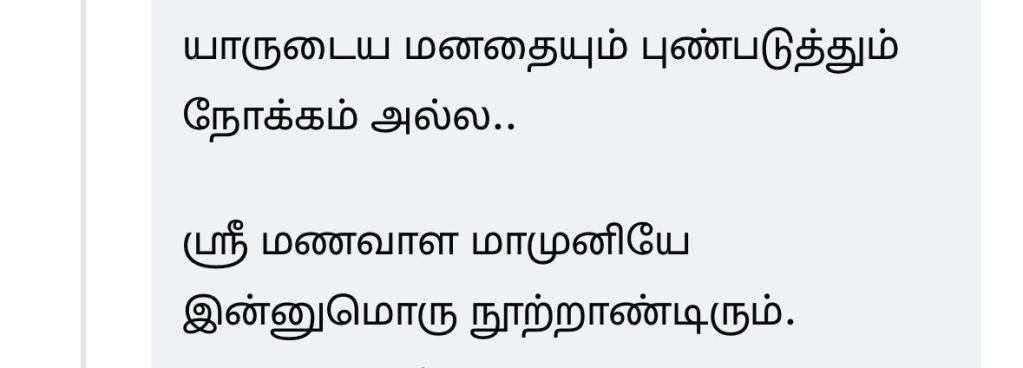
Translation:
What kind of justice is this..?
If there is to be only one “vadakalai”, what is the need for the word “Sri Vaishnava” in the first place..?
Both in Guruparampara works and in the Sri‑Ranga Kovil Ozhugu language say in many places that Sri Vaishnavam is a single tradition, and they keep pointing to only that as one definition of Sri Vaishnavam… So, wherefrom this argument that there were two groups?
The temple whose vimaanam was worshipped by even King Dasaratha, its beautiful ornate halls and pillars… and its sacred shrines … the mādavīdhi streets, the temple ponds and tanks, the sannidhis and everything that stands there, all of them together form the Thirumeni‑svarupa called Sri Vaishnavam.
Even the Muslim descendents of the Khilji invading army that came here long ago proudly recall today their ancestral roots to this tradition of Sri Vaishnavam..
But not the the Vadakalai people!!
They go about breaking and wounding people’s minds! Is it dharma..?
May the memory of Sri Manavala Mamuni live for a hundred more years!
*************
#4: Can you explain to me why the difference of signifying Thenkalai as ‘Y’ and Vadakalai as ‘U’ naamam ?
Me: Well… there are 2 ways to explain the significance. One is the strictly orthodox theology doctrine handed down to us by the Acharyas of both Tenkalai and Vadakalai “parampara”. They each say totally contradictory things about the other’s “naamam” shape and what it signifies. That is the main cause for disputes that few outsiders can really fathom and understand.
Then, there is the unusual, non-sampradaya way of explaining the difference to which no traditional Sri Vaishnava will ever give credence or reverence. However, I will share the same “unusual explanation” with you since I regard myself as a bit of a maverick, “Unusual Sri Vaishnava”, who has never been able to resist in life the temptation to seek “unusual” insights into even the most esoteric aspects of our ancient and most fascinating belief-systems including what I call the “Theo-symbolism” of the “naamam” difference in the Tenkalai and Vadakalai styles that has caused so much ill-will and historical skirmishing between the two.
The naamam (thiruman, तिरुमण्) shape—Y for Thenkalai (toe-tip of nose) and U for Vadakalai (eyebrow junction)—is one visible marker among the Sri Vaishnavas. Vadakalai apply it higher, symbolizing stricter scriptural adherence; Thenkalai lower, aligning with Alvars’ emphasis. Both represent Narayana’s lotus feet (white clay) with Lakshmi’s midline (srichurnam, श्रीचूर्णम्, red/yellow), but the form reflects interpretive variances on Sruti injunctions.
The “U” of the Vadakalais symbolises the “thiruvadi of perumal”, representing only one Sacred Foot of Bhagavan, whereas, it is said, the Tenkalais draw both thiruvadis with lotus-shaped “Y”.
For the Vadakalais, the esotericism of the naamam shape is well-founded in the “pramaanam” (scriptural authority) of the ancient treatise titled “Sath sarithra raksha” authored by Swami Vedanta Desikan. “There are 100+ pramaanams on thiruman-kappu alone that Swami Desikan has referred to and hence there can be no doubts about its authenticity’, says a staunch Vadakalai Iyengar.
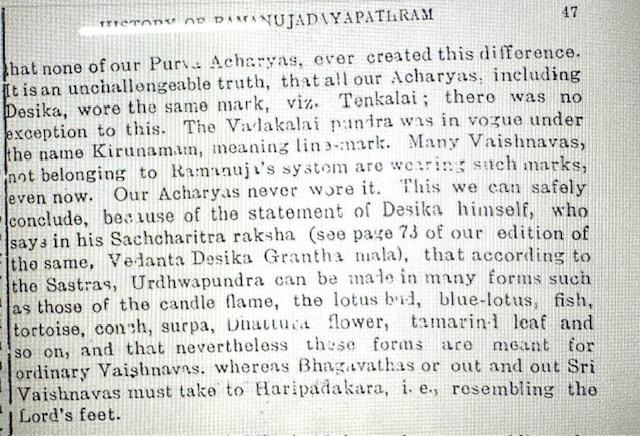
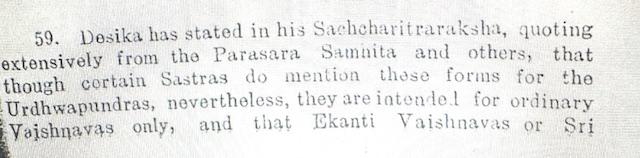
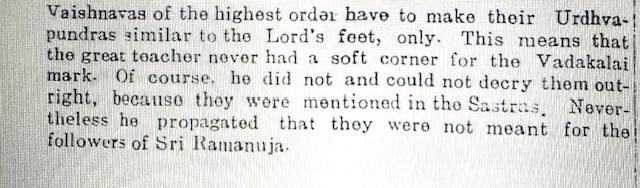
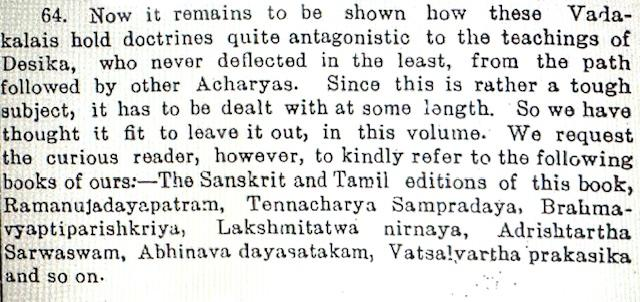
For, the Tenkalai sect, the assertions of the Vadakalais are wholly anathema and false. The noted Tenkalai scholar of Kanchipuram, Sri. Prativadabhayankara Annagarachariar wrote a polemical work titled “Ramanujadayapatram” (1951) in which he claimed that Vedanta Desika himself endorsed only the Tenkalai tiruman and which itself proved that since the days of Sri Ramanuja, the only insignia of Sri Vaishnavism was the Tenkalai naamam with slight variations in form and shape. He implied that the Vadakalai naamam came into vogue only around the 18th century CE when the Vadakalai-Tenkalai sectarian clashes commenced. Below are excerpts from Sri Annangarachariar’s treatise:


**************
#5 : In SriPerumpudur temple, there is the Ramanuja’s statue which is supposed to be the first one installed during his life time (தாம் உகந்த உருவம்). It carrys the ‘thenkalai namam’. How come? And what about all other temples too which all followee suit after his death?
Me: Almost all idols of Ramanuja bear only Y Naamam. Out of 106 Divya desams , only about 10 today belong to Vadakalai sampradayam . So, it’s no surprise that the Y insignia predominates everywhere . The Vadakalais, I am loath to say, have been reduced to a feckless minority sampradayam.
#6 : Thirukkudanthai is a Vadakalai kshetram where Prabhandams were discovered because of the initiative of Sri Nathamuni. I belong to Kudanthai and I am a proud Vadakalai.
#7: According to Bhagavad Ramanuja, a Srivaishnava is one who should shed tears looking at the travails of another Srivaishnava. But look at the fate of Vadagalais, they can’t recite vedanta Desika’s stothras and prabhandams in temples where thengalais have dominance. Stothras of Vedanta Desika cannot be recited in Srirangam ( Bhagavad dhyana sopanam, paduka sahasram, sristhuthi), in Thirukkovilur ( Dehaleesa sthuthi), Thiruppakkutzi (paramartha sthuthi), Thiruvehka (vegasethu sthothram), Ashtabhujam temple ( ashtabhujashtakam), Velukkai (kaamasikaashtakam), Tirumala (Dayasathakam) etc. This speaks volumes about tolerance levels and personalised hatred towards one sect shown by the other.
Me: All the above Vadakalai sentiments of grief and frustration can be sympathised with, no doubt. But unfortunately, in the Courts of Law, the honourable judges will not be moved by them since they have to go strictly by hard evidence and facts. Sentiments have no place in a legal argument.
Furthermore, to the best of my understanding of the Court verdict, there is no bar to the Vadakalai members to assemble in a goshti and chant their litanies in the temple as “ordinary Worshippers” … i.e. so long as it is not at the appointed time when the Tenkalai goshti assembles there in the sanctum or Sannidhi to conduct its own service (“sevakaalam”, “thodakam”, “saatrumarai”).
***********
#8: What is the “unusual and “non-sampradaya” / non-doctrinal explanation for the difference in the significance of “Y” and “U” symbols that you were referring to earlier above?
Me: I don’t claim any originality in offering that explanation since I had learned about it many years ago from a Vadakalai “sampradaya” scholar who possessed great depth of understanding of Sri Ramanuja’s theology and who could— through a bit of lateral thinking— explain the difference in significance to me using the English language. That non-doctrinal, unorthodox explanation helped me, in fact, to better understand what is truly the underlying theologically nuanced explanation for for the “Y” and the “U” symbols of Sri Vaishnavism.
The Pranava mantram (Om) symbol is constituted by 3 syllables — A U M … the English mirrors of what in Sanskrit are अ , उ , and म .
“A” signifies Paratattva , “U” signifies Piraatti tattva and “M” signifies Jivatma svarupa.
In the Vadakalai soteriology , salvation (“moksha”) for the jivatma is enabled only through the medium of “Purushaakaaram” — the compassionate interceding or pleading of Piraatti (Lakshmi) with Paramatma for the sake of the jiva who otherwise would not deserve the grace of redemption .
So, in our Vadakalai soteriology , Lakshmi Piraatti, the mediatrix, is at the very core of spiritual salvation .
So , such central tenet is symbolised by the “U” symbol embedded in the Pranava mantra “AUM”. Thus, we bear the symbol “U” on our forehead .
The Tenkalai Y symbol has a more visual than theological significance . For them the Y denotes the shape of the Paduka or sacred feet of Sriman Naaraayana. So, they bear that visual representation upon their foreheads . For, the Tenkalai sampradaya , Piraatti tattva is not the equal of Narayana tattva . For Vadakalais , Piraatti and Narayana tattva are equal and inseparable.
************
The strong objection to the above “non-sampradaya”, most “unusual” explanation was not unanticipated by me. And when it did come as it did from a devout Vadakalai Sri Vaishnava, I knew also that it could not be faulted at all:
#9: For the significance of the U in AUM … it is an English Alphabet. Hence , do you think it is correct to say that we are bearing it on our Foreheads, because it is part of “AUM”? Similarly, by extension, the Principle of 3 Aksharas too?
Me: I do concede that the English U in the AUM is not the same as the Sanskrit syllabled equivalent of उ .
The sacred Pranavam mantra, known as AUM or Omkaara shabdha, the sound of pranavam, breaks down the English alphabets “A U M” into three distinct Sanskrit syllables: अ , उ , and म .
The naamam that we Vadakalais wear on our forehead is certainly not the उ of the Pranavam but its English equivalent U.
In spite of the above fact, there is one thought to seriously ponder over :
The short vowel उ is the fifth letter in the Sanskrit vowel alphabets and it is well documented in Sanskrit phonetics and dictionaries.
The 5th place which उ holds is very significant …
In Sri Vaishnava theology, the “Panchaakshara mantra” – the 5-syllabled mantra — denotes Piraatti tattva (the divine consort Lakshmi’s principle). It is नमो नारायणाय (Namo Nārāyaṇāya). The theological significance of this five-syllable mantra—na-mo nā-rā-ya—invokes Sri Vaishnava reverence for Narayana with his inseparable Piraatti, emphasizing her role as the compassionate mediator in purushaakaara (recommendation for grace).
The Panchaakshara mantra नमो नारायणाय (Namo Nārāyaṇāya), with five syllables (na-mo nā-rā-ya), differs from the Sri Vaishnava Ashtaakshara mantra ॐ नमो नारायणाय (Oṃ Namo Nārāyaṇāya), which adds the Pranava syllable ॐ for eight syllables total (oṃ na-mo nā-rā-ya).
Panchaakshara thus focuses on direct salutation to Narayana and Piratti, together and inseparably, and is used in specific rituals invoking her tattva. Ashtaakshara, the primary rahasya mantra (one of the three secrets), prefixes Pranava to amplify potency, representing complete surrender (upaya) and moksha fruit (phala) per acharyas like Sri Ramanuja.
So, using the 5th vowel of उ and its English equivalent of U as the underlying principle of the Vadakalai U is not wholly inappropriate in my humble opinion. In Andal’s “Tiruppaavai“, you will recall, the 18th Paasuram is famously recognized as “piraatti paasuram“… the hymnal verse signifying “Piraatti tattvam“…. Why?!! ….
உந்து மதகளிற்றன் ஓடாத தோள்வலியன்
நந்தகோபாலன் மருமகளே நப்பின்னாய்
கந்தம் கமழும் குழலீ கடை திறவாய்
வந்து எங்கும் கோழி அழைத்தன காண் மாதவிப்
பந்தல் மேல் பல்கால் குயிலினங்கள் கூவின காண்
பந்தார் விரலி உன் மைத்துனன் பேர் பாடச்
செந்தாமரைக் கையால் சீரார் வளையொலிப்ப
வந்து திறவாய் மகிழ்ந்தேலோர் எம்பாவாய்
… Why?!! … Because this verse begins with the syllable “உ” the Tamil counterpart of the Sanskrit “ उ ” … the counterpart of the English “U” …. and all three of which refer to the one and same Piraatti-tattva embedded in the sound of “pranavaakaaram“.
***********
Sudarshan Madabushi
How about “Yelle ilangiliYe”