Excerpts from the ORDER OF THE HIGH COURT OF JUDICATURE AT MADRAS DATED : 07.06.2021: A devastating indictment of the Tamil Nadu HR&CE Commission and its working of the past several decades!

The Court’s Order is 224 pages long . It is almost a comprehensive White Paper on the present condition of the 42,000 Hindu temples in the state . As far as Hindu temples in Tamil Nadu are concerned everything (to use a Shakespearean expression from Hamlet) “is rotten in the state of Denmark!”…

I read the entire Order today… Much of it I quickly flipped and sped through … but the parts and passages in it that really caught my eye … and which I think are absolute zingers … I have reproduced below : Every Hindu who is a temple goer and who believes in the institution of the temple should read this High Court Order ! It is an education!

Sudarshan Madabushi

The HR&CE Department is the custodian of most of the temples and the properties including the idols belonging to them. It is their primary duty to protect, maintain and safeguard the temples and its valuable idols/antiques, which, this Court with great anguish, expresses that the department has failed to do. The protection of the temples would, without saying, go on to imply protection of the temple lands as well as all the activities associated with the temple and its tradition. It is startling to find that the HR&CE department with all its income from major temples has not been able to maintain historical temples and safeguard the Idols, which in market, have antique value based on their age. Some temples in the state have also been recognised by the UNESCO as heritage sites. Many temples constructed at least 2000 years ago or much before, recognised by UNESCO, are in ruins. Neither the Archaeology Department nor the HR&CE Department has shown interest to identify and protect them. This has also come to the advantage of the miscreants, who have laid their hands on the Idols. Some of the officials are only interested in reaping the benefits of their position in the department, without adhering to the task entrusted to them with devotion.

The Tamil Nadu Hindu Religious and Charitable Endowments Act, XXII of 1959 came into force with effect from 28th April, 1960. It has been 61 years and yet, the HR&CE department has not even taken inventory of the idols, properties, jewels and other Articles gifted to and owned by the temples. Further, the department has not computerised the details of idols, jewels and properties of the temples and provided adequate ICON Centres with surveillance to keep safe custody of the valuable idols in the centre and in the temples. This has led to the advantage of the culprits, who have aided in smuggling the Idols out of the country. As the theft of Panchaloka idols worth crores kept on increasing, the Idol Wing, CID, vide G.O.Ms.No.2098, Home (Police IV) Department, dated 07.10.1983, a first of its kind, was created to investigate and recover the Idols, but, the steps taken by the department to arrest the theft, are unsatisfactory. Now, the wing is also effectively ineffective.

A duty is cast on the Commissioner under Section 23, to ensure that such temples and endowments are properly administered and that their income is duly appropriated for the purposes for which they were founded or exist and therefore, whenever any order is passed, the object of the endowment is not to be forgotten. Section 29 of the Act lays down the preparation of register for all institutions by the Commissioner. That apart, the Joint Commissioners are clothed with the power to retrieve the temple lands from the encroachers by exercising the powers under Sections 78, 79 and 80. But, the officials have not properly exercised the power conferred on them and they are in dereliction of duties and responsibilities assigned to them. At least from now, the HR&CE Department should act diligently to retrieve all the properties under the encroachments.

“….. role of the state department is to protect the monuments by carrying out appropriate repair works without damaging the original structures. It is also the duty of the state to ensure that all illegal encroachments and constructions are removed.

Similarly, it is the duty of the officers of the central Government to ensure that appropriate action is taken to protect the monument or sites. Section 30C of the Ancient Monuments and the Archaeological Sites and Remains Act is an exhaustive provision and when read together with Sections 30A and 30B, it not only empowers action against any officer of the central department, who has failed in his duty, but also indirectly enables the officer of the central department to take action against any person, be it even an officer under the state who has acted in detrimental to the interest of the monument or site in collusion with the perpetrator and any officer of the central Government. However, the report filed by the UNESCO team referred to above would clearly indicate that both the central and state departments have failed in its efforts to safeguard the sites and remove the encroachments and illegal constructions in and around many temples and sites of archaeological importance including Mamallapuram and hence, they are liable to be prosecuted under Section 30C.

31.18 Though the Rules relating to custody of jewels and valuables are in vogue, proper inventory is not maintained. There is no central registry, wherein the details of all the valuables, jewels and documents are maintained, so as to make cross verification and put culpability on individuals handling them.

32.5 Based on documentary resources and physical inspection of the temples, the mission has provided a detailed assessment report for each of the 10 listed temples. The major issues observed in conservation of temples as stated by UNESCO in its report, are extracted hereunder:


“1.HR & CE neither has the capacity nor the qualified experts to carry out conservation works at such large scale and number.
2.There is no appropriate system or process being followed as per conservation norms for documenting, assessing, reporting, tendering etc. of heritage works. There is no empanelment of experts at various levels or qualified heritage work contractors for such specialised works.
3.The quality of most of the current regional and local sthapathy’s is questionable as most of them were found incompetent on site. And this point was also accepted by the Chief Sthapathy of HR & CE.
4.Some of the HR & CE staff members (few JCs and juniors) seem sensitive to heritage and show potential for being trained as Heritage Managers for future. However, majority of them lack essential qualification and expertise and seem totally misfit for such a responsibility. It needs to be recognised that the HR & CE officials
are primarily in place to manage the day to day affairs of the temple and do not hold any qualification to oversee technical works like conservation. This is part of the TN HR & CE Act as per the Commissioner, HR&CE. However, at times they go beyond their mandate to take decisions regarding works in the temples, in some cases even overruling their own expert committee members’ opinion.
5.The quality of conservation works at the temples assessed during the mission varied to a large extent with some good examples, some mediocre works and some truly shocking scenes of demolition and massacre of historic temples. Details of each temple assessment and visuals are included in Section 3 of this report.
6.Despite involvement of experts such as ASI, Ex-ASI archaeologists, Chief Sthapathy, Structural experts; it was found that HR & CE is not following the reports of their own experts at ground level. A detail of expert reports for each temple and deviations made are recorded in the individual assessment for each temple under Chapter 3 in this report.
7.Inputs from Agama Shastras are not to be seen in any of the conservation projects. Consultation with Agama Experts and justification from religious perspective for the intervention, be it demolition, conservation, new construction is missing in all temples inspected. In fact, from HR & CE perspective there seems to be a disjunction between Agama Shastras and Shilpa Shastras failing to realise that Shilpa is just and extended arm of the Agama Shastra. Hence, all that is observed is a very limited attempt to adhere to the Shilpa Shastras.

8.Maintenance of record of existing, proposed drawings, historic research and historic layering of temples is completely missing in most cases. It is the most essential part and forms the base for any future conservation works.
9.A Comprehensive Conservation Plan and / or a Detailed Project Report for the temples are missing, which is essential in any conservation works. Many decisions for interventions seem to be taken at the site by few individuals without any holistic process to assess the urgency, necessity, severity and justification for the intervention.”


32.6 Quoting Agama Shastras, reference to Shilpa Shastras, Alignment with Conservation Guidelines as per ASI Policy / ICOMOS Charter (Venice/Athens/Burra/Nara Document of Authenticity etc.), adherence to National and State Acts, Scientific Procedures such as Structural Analysis, Surveys and Detailed Reports for each action and a completion report after works and also the need for communicating the Conservation Approach, the mission made final recommendations, as per which, the temples being handled by the HR&CE Department are unimaginable and unless a very coherent operational structure along with an army of experts, skilled stapathis and craft persons are available on hand, the task of simultaneously conserving / managing repairing temples is not feasible.
(xvii) There are certain documents relating to the estimates for works undertaken in the Srirangam temple between 2014-16 at Rs.5,66,90,801/-. But the total amount of funds spent by the temple during this period according to Board Resolution, is Rs.20,90,98,368/-. Apart from this, the temple has spent more than Rs.25 crores for conservation work of Rampart walls on the 5th, 6th and 7th prakaras and hence, the temple has spent in excess of Rs.50 crores during 2014-16. There are documents depicting the fact that the Board of trustees of the said temple, have resolved to spend temple funds for non essential works, which show the depth of corruption by the trustees appointed.

(xxii) It is asserted that the HR&CE Department have a total extent of 478462.46 acres of land. However, the land records were not produced to audit and the correctness of the figures and the custody of the land in possession of temples could not be ensured. Hence, it is necessary to furnish the information relating to the extent of land to which pattas are to be transferred to temples from private persons, the extent of land pattas to be restored in the name of temples in computerized chitta from private persons, the extent of lands to be cleared from encroachment and to be restored in the name of temples, etc.

36.6.1 Reiterating the averments made in the latest affidavit filed on 11.01.2021, Mr.M.Karthikeyan, learned Special Government Pleader (HR&CE) submitted that there are about 44,121 religious institutions under the control of the HR&CE Department, out of which, 1966 are Mutts, Charities and Endowments, 42155 are temples in which nearly 8450 temples are ancient one, which are built before 100 years; and it was found that nearly 21000 temples need to be renovated and Kumbabhishegam to be performed in the upcoming years.

36.6.2 Adding further, the learned Special Government Pleader (HR&CE) stated that from the database so far collected for 40695 temples, 32935 are stated to be in good condition, while 6414 temples are considered to be having damages that are needed to be repaired; 530 temples have been identified as partially dilapidated; and 716 temples have been identified as severely dilapidated; and steps have been initiated to restore/renovate all the 1246 dilapidated temples in a phased manner and a unique ID for all the dilapidated temples has been created in the Tiruppani module of Department website to give priority for the restoration process.

…, the statistical record reveals that out of 5.25 lakh acres of land, only 4.78 lakh acres are available as of now and the balance acres of land are in the hands of encroachers. It is significant to mention here that the HR & CE department is the custodian and administrator of the temples and its properties. But this department, to the knowledge of this Court, has not purchased even a small portion of land for the benefit of any temple. As administrator, the role of this department is much more responsible and the officials are culpable and liable to be punished in case of breach of their responsibility. The administrative right to deal with the temple properties is only to preserve and augment more revenue, implying that the temple lands ought not be alienated or given away. It is to be noted that the Government cannot claim right over the temple lands and the same cannot be a part of any Government scheme, otherwise, the very object of the creation of the HR & CE department would get defeated.

Another important contention that is often raised is non appointment of a “Trustee” and managing the temples with department staff appointed as “Fit Person”. As per the provisions of the HR & CE Act, the Commissioner is empowered to appoint a fit person to administer the temple in the absence of a Trustee and the same cannot be resorted to as a matter of routine exercise. The word “Fit” is synonymous to “Appropriate”. The intention of the legislature is to appoint a person not only with impeccable integrity, devotion, sincerity, honesty and belief, but also a person with some basic knowledge in agamas, tradition and administration. The appointment cannot be mechanical, but it has to be made with application of mind in a transparent manner. Similarly, only a theist can be permitted to occupy any post in the temple or in the department as the occupation of any post not only requires sincerity, but also an interest and belief to augment the object of the Act. It is needless to state that the trustees so appointed must also be worthy to such appointments. Mere political recommendation or a person capable of making huge donations cannot be a criteria for being appointed as a Trustee. A true donor would be a person, who makes such donations in pursuance of his philanthropic or spiritual ideology but not for a quid pro quo appointment as a Trustee. Therefore, the trustees must also satisfy the requirements as mentioned above.

The HR&CE Department shall file a report before this Court within a period of eight (8) weeks listing out the number of temples without Trustees, the duration of such vacancy, the particulars of the persons appointed as “Fit Person” and the steps taken by the Department to appoint trustees.
(55) If no hereditary trustees stake claim, then steps must be taken to appoint non-hereditary trustees. The non-hereditary trustees must be from the religious denomination, to which the temple belongs to, without the political background.

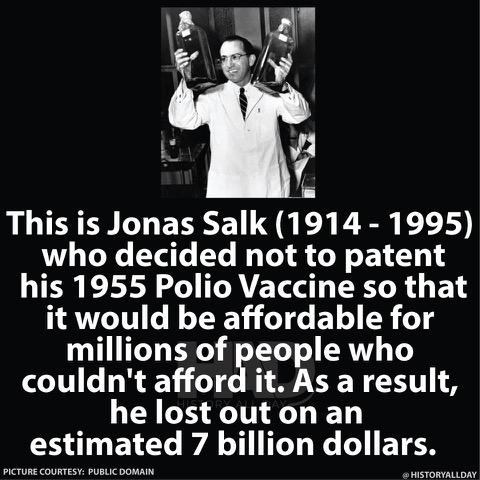
A PICTURE FROM HISTORY ABOUT VACCINES TELLS ME WHAT 1000 WORDS CANNOT ABOUT OUR WORLD TODAY !

BERLIN : German Chancellor Angela Merkel said on Saturday she was opposed to waiving patent protections for COVID-19 vaccines as this could jeopardise the quality of shots against the disease. 08-May-2021

Angela Merkel on Vaccine Waiver

The U.S., Germany and other countries will take up debate over the idea in the coming weeks via the World Trade Organization, pitting the idea of sharing proprietary know-how against the need to boost global supplies, especially in developing countries that have struggled to get their populations inoculated. Merkel’s position shows she’s sympathetic to the argument of drugmakers such as Mainz, Germany-based BioNTech, whose vaccine with Pfizer Inc. uses cutting-edge messenger RNA technology.

***********************

The above pictures tell me exactly and very graphically how the world and world leaders’ mind-sets and philosophy has changed since 1945 …

O tempora, o mores!

Sudarshan Madabushi

Mr.Palanivel Thyagarajan, Finance Minister of Tamil Nadu, hits all the right notes on GST reforms song but his rhythm goes a tad awry

https://indianexpress.com/article/opinion/columns/why-the-distortions-built-into-gst-are-coming-undone-7346960/

Indian Express : 7 June 2021

In the above Op-Ed that Minister Palanivel writes, he does make a powerful case indeed for reform of the GST (VAT) law of India. The graven of his argument is that the basis of sharing the central pool of tax-revenues collected by the Union (Federal) Govt. does no justice to States that contribute most to the pool whereas it provides for vastly disproportionate share to States that in fact contribute far less to thr central kitty.

So far Mr.Palanivel’s argument is flawless . The tune he sings is right.

But then the Minister says something that strikes a rather jarring note … he gets his rhythm suddenly go a tad awry. And that is when he writes this:

Quote:

This is the scenario in which the “one state one vote” model (each state, regardless of its size or contribution to the GST pool has one vote in the GST Council) causes further grave injustice….. The “one state one vote” structure under GST is untenable and coming undone.

Unquote

I can’t help thinking thinking PTR is talking through his hat when he advocates the scrapping of the “one-state , one-vote principle” in the GST Council . He says he’s championing for the rights of states that contribute more to the central pool of taxes than other states in the country . That’s a feudal argument which smacks more of separatism than of federalism .

The Minister seems to have deficiently understood the federal concept that the “central pool of taxes” is an asset owned by the entire union of India . Every state of India has an equal stake in it. Every state therefore has a right of say in deciding how the asset must be used or disposed of. How much share of the pool each state must get is a different matter altogether but then the right to decide upon that mode of sharing or disposal in itself cannot be based other than on the fundamentally democratic principle of “one-state one-vote” …

If Mr Palanivel’s contentious view to scrap the “one-state one-vote” principle is to be accepted as good then nothing prevents it from being extended also to all forms of voting rights of legal ownership. Under Companies Act , to take only one example, every shareholder in a General Assembly has one vote irrespective of the size of his shareholding in the company . Are we going to now say it makes sense to change the law or principle there too by asserting that voting rights ought to be dependent on number of shares owned ?

Why don’t we go even further then and also demand extending the Minister’s view on the same principle to citizens electoral voting right also?! i.e. Those citizens who contribute more to the aggregate income-tax revenue-pool should be entitled to more votes than the only one at the ballot-box they presently have?

Small state or big state, Mr Palanivel, every State of the Union has to be treated as an equal citizen of India. Which is why the Goan State FM I feel was quite right in protesting your specious line of reasoning on the “one-state one-vote” matter at the last GST council meeting …

To my mind, while Mr Palanivel’s demand for a more rational system of revenue sharing of central collection of taxes with States inter alia is certainly justified, his shrill views about scrapping the “one-state one-vote” seems iniquitous, undemocratic … and above all unpatriotic.

Minister sir, you’d do well to please correct your “thappu thaaLam”.

Sudarshan Madabushi

ARE WE ALL MISREADING THE “WUHAN LAB-LEAK THEORY” .. or BEING MISLED BY IT?

Excellent article below !

My question though after reading it is this :


Isn’t there enough circumstantial evidence to indicate that it is rather presumptuous to regard the “lab leak theory” as the most plausible and call it the result of “almost certainly by accident”? Would not a prosecutor be within his remit to stretch a little bit more the same set of circumstances to include in the same theory for further consideration and deeper inquiry the evident fact that China’s PLA (People’s Liberation Army) too was deeply involved in the WIV (we know a 3-star military general equivalent was posted there in the institute full-time)?


If that piece of circumstantial evidence too is allowed juridically, then would it be possible, — even though granted it may not entirely be reasonable— and tenable too to conclude that the virus outbreak was the very first one of “pandemic tests” conducted by China? After don’t we all know only too well how “rogue” scientists help countries go nearly nuclear, have done it before and even do try it today to conduct “secret nuclear tests” either underground or under sea to evade world attention?

Isn’t it equally possible that given the nature of undertaking such “pandemic tests” , the USA might have secretly “offshored” it to China where public scrutiny and scientific ombudsmanship is far less vigilant and effective than in America or elsewhere in the free world?


Why are journalists and scientists jumping the gun and concluding already that it is a case of “almost certainly a lab leak”, the most likely the smoking-gun? Why is nobody even even willing to pause, look for and collect more circumstantial evidence suggesting that the so-called “lab-leak” could be an ingenious red herring? That it could well be an experimental but deliberate “viral pandemic test” (ala nuclear-test) conducted by China, with or without the tacit connivance of USA, that has indeed caused the destruction in the world today? Why must that construction of the evidence be ruled out altogether?

Why is the case for considering such circumstantial evidence slowly being ignored or rejected by mainstream scientific community worldwide and the media as well to be inadmissible?

I am beginning to wonder now if I smell another fish here ! I am no criminal lawyer or prosecutor … but then I am by training a professional auditor and accountant.

Sudarshan Madabushi

*******************

The Lab-Leak Theory: Evidence Beyond a Reasonable Doubt

By ANDREW C. MCCARTHY

June 5, 2021 6:30 AM

Experts from China and the World Health Organization joint team visit Wuhan Tongji Hospital in Wuhan, Hubei Province, China, February 23, 2020. (China Daily via Reuters)

Every good prosecutor will tell you that the best case is a strong circumstantial case — and that’s exactly what we have.

NRPLUS MEMBER ARTICLE‘Of course, it’s only circumstantial evidence. We may never know the truth.”

If I’ve heard this once, over more decades than I care to admit, I’ve heard it a thousand times. It is the rote dismissal of circumstantially based cases, and it is almost always wrong.

We can no longer afford to be wrong when it comes to the origin — the generation by regime-controlled Chinese scientists, almost certainly by accident — of a pandemic that has caused nearly 4 million deaths globally (now closing in on 600,000 in the U.S.), in addition to geometrically more instances of serious illness, trillions of dollars’ worth of economic destruction, and incalculable setbacks in the educational and social development of tens of millions of children.

I was a prosecutor for a long time, and prosecutors are in the business of proving stuff. Every good one will tell you that the best case is a strong circumstantial case. It is the most airtight and least problematic kind of proof.

Circumstantial cases are a tapestry of objectively provable facts. No one of those facts, by itself, establishes the ultimate conclusion for which all the interconnected facts collectively stand. Instead, each single fact supports a subordinate proposition that must be true in order for the ultimate conclusion to be valid. Stitch enough of those subordinate propositions together and the ultimate conclusion is inexorable.

We have a natural human reluctance to trust circumstantial evidence. In our own lives, we know what we know — or at least what we think we know — because we have lived it. We don’t need to run down a plethora of clues to grasp our own experiences. We can describe them firsthand. If we worked in a lab that came under scrutiny, we could tell everyone how an accident there happened — or assure them that it didn’t happen. Ergo, we reason, what we really need is direct evidence, someone like ourselves who can narrate the goings-on.

Only then, we tell ourselves, can we really know. Even when all the disparate circumstantial trails lead to the same answer, we instinctively ask how we can trust that answer unless and until it has been confirmed by someone who was there.

But that is not how it works in the real world. Once you get beyond the narrow limits of your own experience, everything else is about what you can trust. And you quickly realize you can trust a constellation of objective facts that fit together (i.e., circumstantial evidence) more reliably than the subjective account of a witness — “direct” evidence — whose entanglement in a controversy may erode his credibility.

The murderer is apt to tell you he didn’t do it. And even the murderer who tells you he did do it is apt to be lying about something significant. Maybe he’s currying favor with the prosecutor, who has demanded testimony against an accomplice in exchange for a reduced sentence; maybe he is settling a score with the accomplice; maybe he has mistakenly assumed that the accomplice was complicit because of what some intermediary told him.

When we are trying to judge a scenario we did not personally witness, we always want a firsthand witness to look us in the eye and say, “Here is what happened.” But even as we listen to such testimony, we realize that we are still in a realm of epistemic uncertainty. For now, we need to consider the witness’s motives, biases, intelligence, scrupulousness, and capacity under the circumstances to have perceived what happened, recall it accurately (for memory plays tricks on us all), and relate it clearly.

ALSO FROMANDREW C. MCCARTHY

What’s the upshot of all that? Well, it means we’re necessarily right back to circumstantial evidence.

When it comes to something of consequence, we don’t take the direct witness’s word for it. We demand corroboration. And how do we corroborate a witness’s testimony? The same way we prove a circumstantial case: by establishing that the subordinate facts line up with the testimonial version of events — that, for example, the records show the alarm triggered just when the witness says the break-in happened; that a nearby surveillance camera captured a streaking vehicle matching the getaway car’s description only 20 seconds later; that the next morning, a series of suspicious cash deposits started to be made at banks just a few blocks apart from each other; and so on.

Apodictic knowledge eludes us. That’s the human condition. Whether we are in the position of relying on circumstantial evidence, direct evidence, or some combination of the two, we are forever at a deficit. Our knowledge is imperfect and our premises may be flawed (and constantly reminding oneself of that is what separates good intelligence analysts from bad ones). Notice that in the criminal justice system, where we apply the most exacting evidentiary standards, the requirement is proof beyond a reasonable doubt, not proof beyond all possible doubt.

There is no proof beyond all possible doubt.

What NR’s Jim Geraghty has chronicled for months is proof beyond a reasonable doubt that the coronavirus pandemic was generated by an accident — a lab leak, a not-uncommon mishap in medical research conducted by fallible human beings — at the Wuhan Institute of Virology. Ditto the important work of Nicholas WadeVanity Fair’s Katherine Eban, our own Michael Brendan Dougherty, and a few intrepid others.

Lab accidents are common, and have been known to spawn infectious diseases (including the escape of SARS1 from the Chinese National Virology Institute in Beijing “no less than four times,” according to Wade). WIV scientists were conducting gain-of-function research on bat-based coronaviruses, in particular their capacity to infect humans. The bats in which are found closely related (but, importantly, not identical) viruses do not inhabit the vicinity of Wuhan — they are nearly a thousand miles away from that densely populated city and have limited flight range. The likelihood of naturally occurring interspecies transmission (outside a lab setting) is infinitesimal. The lab conditions in Wuhan were insufficiently safe — grossly so, it appears. Several of the lab’s researchers fell ill (at least three severely enough to be hospitalized) right at the critical time, in autumn of 2019, before the first identified case of infection with SARS-CoV2, the virus that causes COVID-19.

Here, two additional points are salient. First, those implausibly claiming that the circumstantial case is weak always skip past the inconvenient fact that the circumstantial case for their preferred theory of natural transmission (from bat to human, directly or through an intermediary species) is so weak as to be negligible — there being, most tellingly, no known existence of a bat (or pangolin, etc.) in which a virus matching SARS-CoV2 has been found.

Second, we are not in a U.S. prosecution. The presumption of innocence that obtains in U.S. criminal trials does not apply in other contexts, and China is not entitled to it. Nor is China vested with the privilege against self-incrimination. We are fully within our rights to conclude that the monstrous regime in Beijing is not an innocent actor, and that it has sealed records, silenced witnesses, and hidden evidence because it knows both that SARS-CoV2 was generated by an accident in one of its labs and that its sundry deceits in concealing this fact undermined any possibility of containing the damage — to catastrophic effect.

On the same rationale, we can justifiably infer that American officials who zealously maligned sensible, informed efforts to investigate the lab-leak theory were motivated not by some adherence to science but by the awareness that the U.S. government knew about and was supportive of China’s virological research.

China and its abettors have much to account for. Unless and until China comes forward with convincing evidence that the lab-leak theory is wrong, the position of the United States and the world must be that China is culpable. We should stop spouting the untenable and irresponsible drivel that, because the case is “circumstantial,” the truth may never be known. We know plenty.

Hurrah! And the “Winner” is… the lousy “Baby-Boomer”: Bane of the 21st Century!

Caution:,This Chart relates to the USA . I am extrapolating the trend onto to the rest of the world only out of pure academic curiosity. It may have no accurate resemblance to actual reality.

Take a look please at the very illustrative chart above!

It indeed shows how generous the Silent Generation has truly been in passing on its wealth to the three other generations: Babyboomer, GenX and Millennial.

The biggest beneficiaries of this transfer of wealth over the last 3 decades has been the Babyboomer – 33% (I’m one of them) and the Gen-X –27% .

In 1990, for your information, the Gross Wealth Product (GWP) of the world was (in contemporary US$) USD. 27.5 trillion . Today’s GWP of the world is USD 87.8 trillion.

With the above figures given, please do the maths now yourself and calculate how much of the Delta GWP-change (of USD 60 Trillion) created since 1990 by the Silent Generation has been handed down now up to 2020 to the Babyboomers and GenXers .

However, do not forget that back in 1990 the Global Debt to GDP ratio was c. 60% and today in 2020 it is .. USD. 281 trillion or 355% of GDP!

So, you if you did your maths (or, should I say Economics?) correctly, you will surely realise that much of the Delta-change in GWP that the Babyboomer created between 1990 and 2020 was really all financed by borrowings from the future of the Millennials and generations that come after. It was never real wealth creation, after all!

In net aggregate terms, it should be clear to all, that whatever wealth we might claim has been handed to Babyboomers by the Silent Generation has been merrily enjoyed by the former only at the expense of the GenXers and Millennials … and the their future.

It is my fear therefore that the Baby-boomers generation to which I belong is surely going to be judged very harshly by History of a Post-Covid world as being the “Bane of the 21st Century” … and History’s verdicts are seldom unfair or inaccurate!

Sudarshan Madabushi

FORMER AMBASSADORS OF INDIA Vs FORMER FOREIGN POLICY MANDARINS OF INDIA

www.facebook.com/100043468479302/posts/347475476711399/

THE FORUM OF FORMER AMBASSADORS OF INDIA (FFAI)

WHAT A FANTASTIC, FITTING, DEVASTATING REPLY BY FFAI TO THE LIKES OF SELF-DESIGNATED “FOREIGN POLICY PUNDITS” AND MANDARINS such as M/s M.K. Narayan, Shivshankar Menon, P Chidambaram, Shashi Tharoor, Suhasini Haider, Brahma Chellaney et al !

(…. https://www.nationalheraldindia.com/amp/story/india%2Findia-has-isolated-itself-through-caa-former-foreign-secretary-shiv-shankar-menon)

Quote:

“It is regrettable that at a time when the country is battling the ravages of the pandemic, especially the frighteningly deadly second wave which has put an enormous burden on our health sector, instead of solidarity with the government, the critics are heaping blame on governance failures of the Modi government and joining with foreign lobbies traditionally biased against India to diminish the PM’s image at home and abroad. This is obvious from the spate of such articles in the national and international media written by Indians. The driving force behind such relentless and unprecedented criticism of the Modi government is hostility towards the ruling party and towards PM Modi personally.”

Unquote

BRAVO! 👍👏👏🌟🌟

I salute all these former Ambassadors of India 🙏👍👏

Sudarshan Madabushi

COUNT YOUR LIFE BY HEARTBEATS… NOT YEARS !


In one of my more thoughtful moods today, I suddenly became aware — for really no particular reason — of the steady rhythm of my heartbeat inside my chest.


Listening to the regular, metronomic undertone “lubb-Dubb” beating inside my breast I was suddenly overcome by great emotion… A feeling of overwhelming love and of enormous gratitude swept over me !
All of a sudden I was filled with the most tender of affections for that little fist-sized muscle-tissue nestled deep inside the cavern of my rib-cage called “the heart” which, ever since the moment I was conceived inside the womb of my long departed, beloved mother, has been at ceaseless work … much like a relentless, self-energised, non-stop mechanical dynamo-powered pump that … thank God and touch wood too till date in all of my 60-odd years of my life … has never anything like even remotely come close to what in industrial parlance is known to modern factory maintenance-engineers as the sudden and dreaded “machine breakdown”.


The soft and comforting sound of my very own heartbeat got me then thinking philosophically about the “arythmetics” of cardiac function.


For no reason then other than perhaps ontological wonder, I realised I was silently but efficiently doing the following sums inside my head for my own benefit:


1. No. of human heartbeats on average in a minute : 72
2. No. of minutes in a day of 24 hours : 24X 60
3. No. of days in a calendar year : 365
5. Average life span in no. of years of an Indian male today : 71
6. Total no. of heartbeats expected in a lifetime for an Indian male : 72X 60 X 24 X 365 X 71 = 2.7 billion heartbeats !


Now then at my present age, I have come to reckon, my little brave heart has already functioned up to about 90% of its estimated expected average lifetime working capacity!

It beats very strong still no doubt but I guess it now beats what the poet Longfellow described as “funeral marches to the grave”.
Of course… I tell myself however that I have still at least another quarter of a billion more heartbeats to listen to in the years ahead and to continue enjoying their wonderful almost musical sounds in the average timespan I have yet left in a lifetime …


I convince myself thus of the philosophic truth that has revealed itself to me this blessed day : Count your life not by years but by heartbeats!


With that humbling yet proud thought shared with you all today, let me sign off … with a heart still singing the same song it has been singing all these years to the magical rhythms of its unceasing beat.

Sudarshan Madabushi

WHAT DOES “retirement” mean ?

Whenever a man expresses an urge to retire from work and the world, know then he does not always mean he has become world-weary or fatigued … It may well be because of his deep realisation that the work he is doing in the world has become monotony and it is unregenerate … I think Sathguru is right .

God himself does not like monotony … which is why he created both Life and Death .. so that one can continue after the other, regenerate and renew each other in an endless succession through time.

🙏
Sudarshan

THE FINANCIAL TRIUMVIRATE OF INDIA DESERVES CREDIT AND GRATITUDE

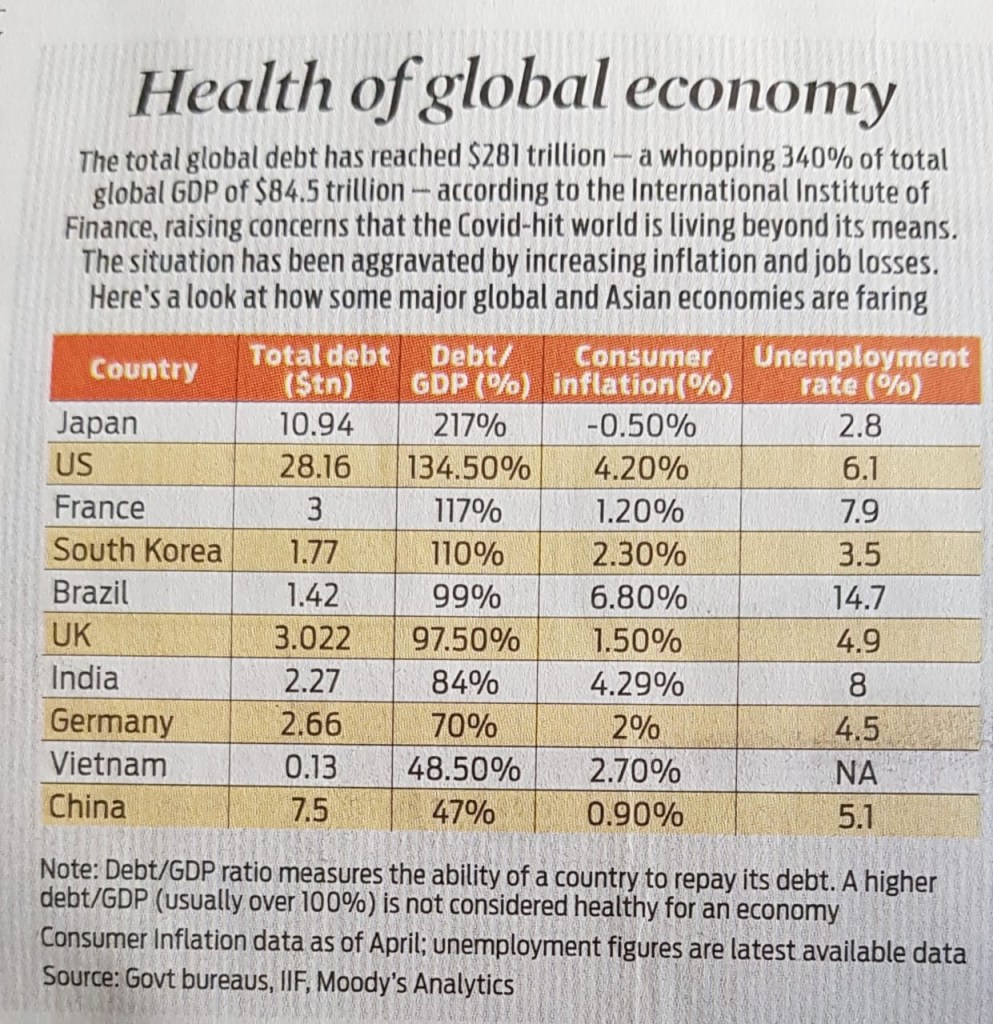
The chart above is a bill of health for the state of the world economy and its finances.

Nothing looks good for several countries of the world … even the so-called “advanced economies”.

In comparative terms , the chart tells me that India is doing no better or no worse than many of the advanced economies. But it is clear to me that, except for the Unemployment figures, on all other metrics India is doing better than its peers.

But then no one in the country at this point in time when we’re still reeling from the terrible impact of the Second Wave of Wuhan Virus is going to be able to derive any comfort from this comparison… and none can blame them for it.

But then there are doomsayers, anarchists and “tool-kit” artisans amongst our political classes who take perverse pleasure in making our economic situation to be even grimmer and pessimistic than it is really. For them, no matter what the ground reality is, the Government is making a mess of the nation’s finances and the ship is sinking like the Titanic.

https://www.hindustantimes.com/india-news/ostrich-reading-economic-data-anurag-thakur-replies-to-chidambaram-on-gdp-101622633517911-amp.html

I’ve decided not to listen to these prophets of economic doom and gloom because they ought to be rightly dismissed or ignored as professional, cynical, congenital Cassandras.

As I see it, in India today there are 3 capable and steady hands wielding the control of the ship of the economy … At the helm is skipper FM Nirmala Sitharaman; at the wheel is RBI Governor Shaktikanta; and as expert navigator at his desk sits Chief Economic Advisor, Krishnamurthi Subramaniam.

The three are the Financial Triumvirate of India at the moment … And I think they can be trusted to steer us all on a safe course through rough and stormy seas over the remaining part of this fiscal year .

I feel I can trust their judgment and competence because so far in this tempestuous journey since 2020 that the economy has travelled, the ship has been rocked very badly at times but not once has it ever stalled or been driven off-course towards uncharted or uncertain waters. The ship sails even now through the storm on a reasonable even keel thanks to this triumvirate.

Let’s give the triumvirate a big hand with loud cheers please ! And a big thumbs down with the loudest boos to the Cassandras!

Sudarshan Madabushi

MORAL HAZARDS FOR AMARTYA SEN IN AVAILING THE PERKS OF A “BHARAT RATNA”

https://in.news.yahoo.com/amphtml/amartya-sen-only-bharat-ratna-112249020.html

I read the above news report with feelings of moral queasiness that often afflict me whenever I know I have to exercise judgment over a matter of ethical relativism … It’s called in Sanskrit as “dharma sankatam” — moral quandary.

The report says according to a finding under the RTI Act (Right to Information Act) , Prof. Amartya Sen , Nobel Laureate, helped himself to a perquisite that goes with his having been awarded the Bharath Ratna Award, the nation’s highest civilian award. The perk he availed is this : 21 free first-class air-tickets on Air India between 2015 and 2019 … the total monetary value of which remains undisclosed. Incidentally , the report finding also confirms that out of 34 other eminent Indians who are Bharath Ratna awardees, Prof. Sen is the only one who has helped himself to this Air India perquisite.

Air India, as we all know, is owned by the Government of India and so the cost of the 21 free-tickets Prof. Sen availed would have had to be wholly absorbed by the airline … which indirectly also gets charged to the Government… and ultimately gets borne by the Indian taxpayer .

The RTI finding says no monetary value can be ascribed to the 21 freebie-tickets provided to Prof. Sen… That’s strange since it doesn’t demand knowledge of rocket science to estimate the cost of a first-class round-trip airline ticket for travel from say Delhi to New York and back . The last time I travelled from Chennai to Newark, a cheap coach-class ticket cost me c. ₹.1.5L. I hear that a First Class ticket on the same flight would’ve cost me thrice as much … say ₹.5 Lacs per ticket including taxes and cess. So, I reckon the value of the 21 tickets Bharath Ratna Prof. Sen availed from Air India would be in the ball-park of a cool ₹. 105 Lacs …

No one should begrudge a country’s Bharath Ratna awardee ₹.105 Lacs. After all it is a perquisite the Government of India has entitled him to enjoy … and he certainly has the right to help himself to the privilege . Nothing wrong at all about it from the standpoint of transactional ethics.

But since the matter verges on pecuniary privileges funded by taxpayer money, I wonder if the matter does not also involve an element of moral hazard.

The commonplace definition of “Moral hazard” is a situation in which one party gets involved in a risky event knowing that it is protected against the risk and the other party will incur the cost. It arises when both the parties have incomplete information about each other.

“Moral hazard” in turn is rooted in fine considerations of what is called “Ethical Relativism””.

When we consider ethics to be not absolute but relative to the situation at hand .. that is called taking a position of “ethical relativism” on the matter.

If we define right from wrong based on how it affects us in a particular situation then we are regarded as conveniently adhering to the principal of ethical relativism and that is a dangerous path to take.

It means anyone can decide to walk away and rationalise an action of his or hers while I do not have the same the same latitude or flexibility.

Relativism holds that all points of view are equally valid and the individuals determines what is true and relative for them. You may have heard the expression: What’s right for you may not be what’s right for me. Ethical relativism ends often in moral chaos…. And that’s precisely why, as I said at the very beginning, it fills me up with moral queasiness …

If Prof. Sen availed the perquisite of the Bharat Ratna 21 times, it is his personal prerogative as a Barath Ratna awardee to do so. If there is nothing in the rule-book that says how many times or up to what limits of monetary value the perquisite can be enjoyed, well, Prof. Sen cannot be faulted at all for anything that may be even remotely suggestive of “moral impropriety” … As for any innuendo of moral turpitude, corruption or lapse … that too is simply out of the question.

The question however remains : Was there an inherent moral hazard in what Prof. Sen chose to do? We may ask ourselves, from the standpoint of ethics, under what circumstances does availing a perquisite become a matter of transactional right and when is it a matter of moral choice?

It is a well known principle in Ethics that it is actually knowing the difference between what you have a right to do …and what is right to do.

No one can question Prof. Sen’s right to have done what he did …But the much larger and far more troubling question is indeed what he must ask himself: WAS WHAT I DID … RIGHT TO DO ? And it is perhaps in how he answers that question will one be able to really measure the difference between an ordinary citizen of India and one who is its Bharat Ratna.

Sudarshan Madabushi