
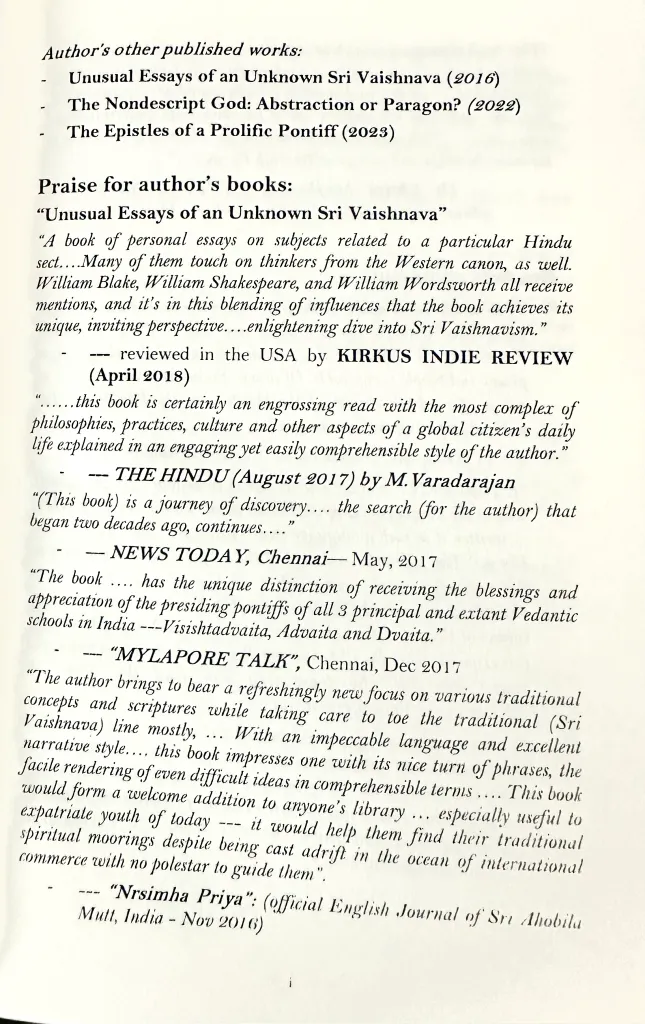
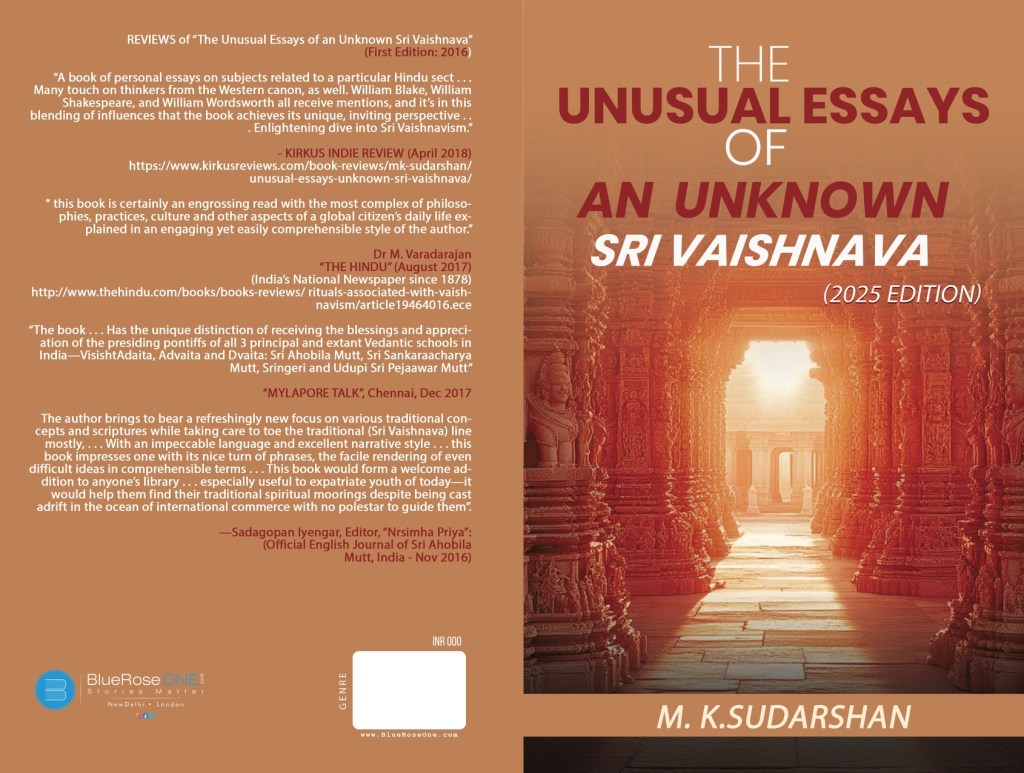
Sudarshan Madabushi is an author and a prominent figure associated with the Sri Vaishnavite tradition, hailing from Chennai, India. He graduated from the University of Madras in 1977 and became a Chartered Accountant in 1982. Following this, he spent 12 years in corporate finance within major companies in India before moving abroad to advance his career over the next 25 years, working in diverse international environments across East Asia, the Middle East, Europe, and the USA.Madabushi’s literary contributions include his book titled “Unusual Essays of an Unknown Sri Vaishnava,” published around 2016-2017.
In this work, he explores the historical and cultural significance of the Sri Vaishnavite community, which has seen a decline in its traditional pursuits and cultural connections among younger generations. He emphasizes the challenges faced by contemporary Sri Vaishnavas, who often lack proficiency in Tamil and Sanskrit, thus becoming disconnected from their rich literary and spiritual heritage.He reflects on the profound impact of ancient languages like Tamil and Sanskrit on Indian philosophy and culture, noting that these languages have preserved vast literary treasures for over 5000 years. Madabushi expresses concern that many young Sri Vaishnavas today are unable to relate to their cultural roots or appreciate significant texts such as the Valmiki Ramayana or the Bhagavad Gita due to modern educational influences.Through his writings, Sudarshan Madabushi aims to rekindle interest in the ancient traditions of Sri Vaishnavism and encourage a reconnection with its rich historical legacy.
What inspired Sudarshan Madabushi to write “Unusual Essays of an Unknown Sri Vaishnava”
Sudarshan Madabushi was inspired to write “Unusual Essays of an Unknown Sri Vaishnava” due to his deep-seated curiosity about the ancient Vedantic traditions of Indian philosophy, theology, and culture. Throughout his extensive career, he maintained a passion for exploring the vast literature associated with these traditions, as well as the history of temples and the lives of prominent saints and scholars in India.
In his book, Madabushi addresses the contemporary challenges faced by the Sri Vaishnavite community, particularly the disconnect between younger generations and their cultural roots. He highlights that many young Sri Vaishnavas today are unable to read or write in Tamil and Sanskrit, which has alienated them from their rich literary heritage. This disconnection has resulted in a diminished understanding of their identity and cultural values, leading him to describe them as “unknown Sri Vaishnavas” who struggle to appreciate significant texts such as the Valmiki Ramayana and the Bhagavad Gita.
Madabushi’s intention is to rekindle interest in these ancient traditions and encourage a reconnection with the cultural treasures preserved in Tamil and Sanskrit literature. His work serves as both a reflection on the past and a call to action for the preservation of Sri Vaishnavite heritage amidst modern influence
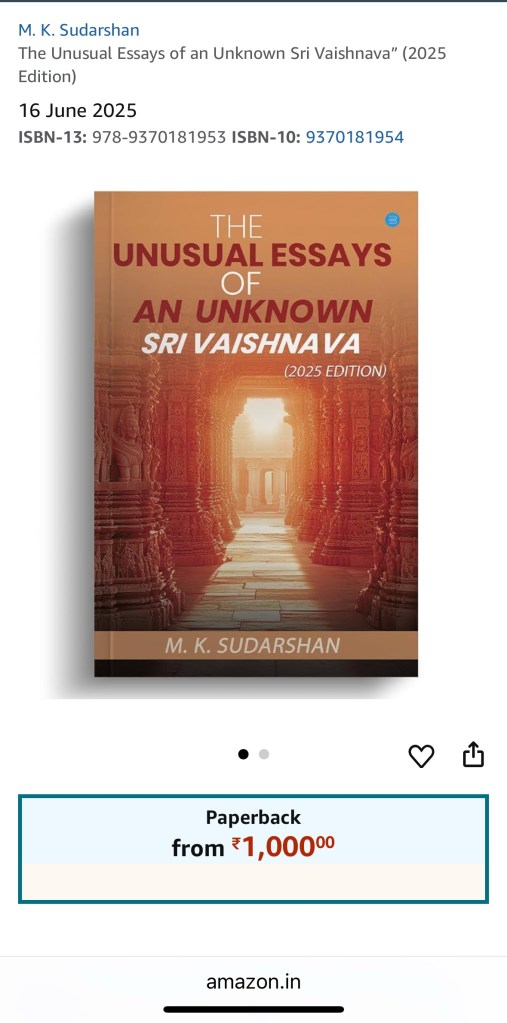
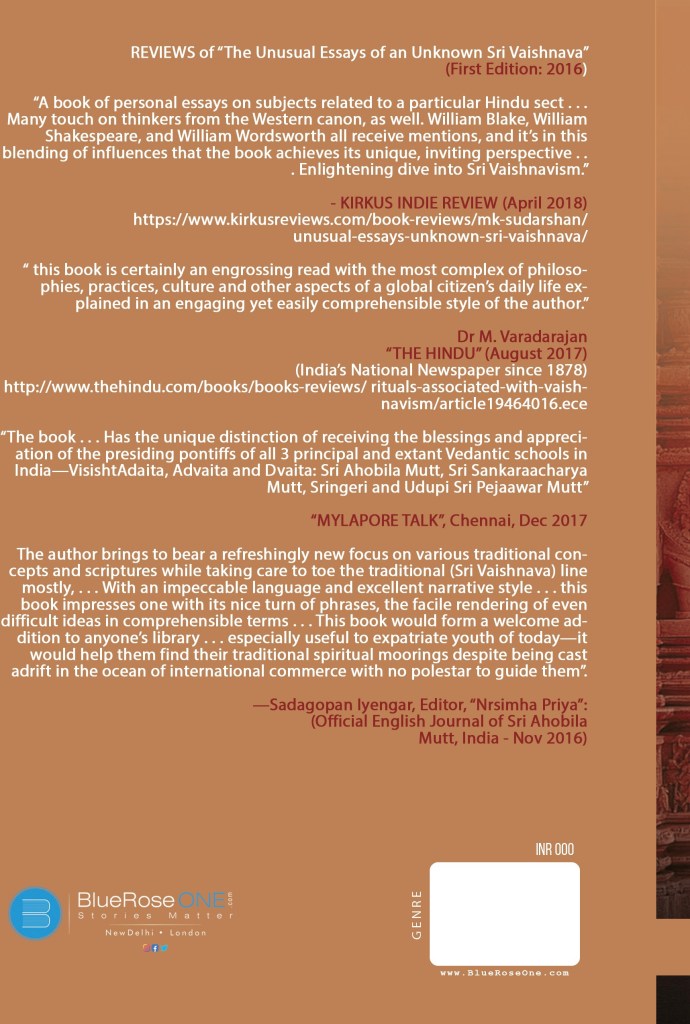
Unusual Essays of an Unknown Sri Vaishnava
Unusual Essays of an Unknown Sri Vaishnava : Volume 1 – Google Books
Sudarshan Madabushi’s inspiration for writing “Unusual Essays of an Unknown Sri Vaishnava” stems from several key factors related to his personal interests, cultural heritage, and concerns about the current state of the Sri Vaishnavite community.
- Personal Passions and Interests: Madabushi has a deep-seated curiosity about the profundities of ancient Vedantic traditions of Indian philosophy, theology, and culture. His lifelong passions include the history of ancient temples and the life histories of great saints and savants of India1.
- Cultural Heritage: He is deeply interested in the rich literary heritage of the Sri Vaishnavite community, which is rooted in the ancient languages of Tamil and Sanskrit. These languages have preserved a vast and rich legacy of literature in philosophy, sciences, theology, and other fields for over 5000 years1.
- Concern for the Current Generation: Madabushi is concerned that the current generation of Sri Vaishnavas has become disconnected from their cultural roots. Unlike their ancestors, who were proficient in Tamil and Sanskrit, many young Sri Vaishnavas today cannot read or write these languages, thereby losing touch with their ancestral and cultural literature. This disconnection has led to a loss of self-identity within the community1.
By writing “Unusual Essays of an Unknown Sri Vaishnava,” Madabushi aims to introduce and explore the living faith of the Sri Vaishnavite community, making their rich cultural and literary heritage more accessible to a broader audience, particularly the younger generation who may be unfamiliar with it.

What personal experiences influenced Sudarshan Madabushi’s interest in Sri Vaishnava culture:
Sudarshan Madabushi’s interest in Sri Vaishnava culture and his decision to write “Unusual Essays of an Unknown Sri Vaishnava” were influenced by several personal experiences and factors:
Professional and Personal Background
Madabushi has a diverse professional background, having worked in corporate finance both in India and internationally for over 37 years. Despite his hectic and cosmopolitan career, he maintained a deep-seated curiosity about the ancient Vedantic traditions of Indian philosophy, theology, and culture
Lifelong Passions
His lifelong passions include the history of ancient temples and the life histories of great saints and savants of India. This interest in the historical and cultural aspects of India’s rich heritage played a significant role in his engagement with Sri Vaishnava culture
Observations of Cultural Decline
Madabushi observed that the Sri Vaishnava community, which once thrived as a community of scholars, poets, and intellectuals, had significantly declined. He noted that young Sri Vaishnavas today are educated in English and secular institutions, making them unable to relate to their ancestral cultural roots due to their lack of proficiency in Tamil and Sanskrit. This disconnection from their cultural heritage motivated him to write about and preserve the traditions of the Sri Vaishnavite community
Personal Connection to Sri Vaishnava Heritage
Growing up in Chennai, India, Madabushi was exposed to the rich cultural and literary heritage of the Sri Vaishnavas. His book is an attempt to reconnect the current generation of Sri Vaishnavas with their ancestral roots and to make the living faith and literary heritage of the community more accessible and understandable
.These personal experiences and observations collectively inspired Sudarshan Madabushi to write “Unusual Essays of an Unknown Sri Vaishnava,” aiming to revive and celebrate the cultural and spiritual traditions of the Sri Vaishnava community.

How did Sudarshan Madabushi’s upbringing in Chennai shape his interest in Sri Vaishnava culture
Sudarshan Madabushi’s upbringing in Chennai, India, played a significant role in shaping his interest in Sri Vaishnava culture through several key factors:
Exposure to Rich Cultural Heritage
Growing up in Chennai, Madabushi was surrounded by the rich cultural and historical heritage of South India, which is deeply intertwined with the Sri Vaishnava tradition. Chennai, being a major city in Tamil Nadu, is home to numerous ancient temples and cultural institutions that preserve and celebrate this heritage
Family and Community Influence
Although the specific details of his family background are not provided, Madabushi’s interest in the history of age-old temples and the life histories of great saints and savants of India suggests that he may have been influenced by his family and community. The Sri Vaishnava community in Chennai has a long history of scholastic pursuits and cultural contributions, which likely had an impact on his early life and interests
Observations of Cultural Decline
Madabushi observed the decline of the Sri Vaishnava community’s traditional pursuits and their disconnection from their ancestral cultural roots. This observation, made possible by his upbringing in Chennai, motivated him to write about and preserve the traditions of the Sri Vaishnavite community. He noted that young Sri Vaishnavas today, educated in English and secular institutions, are unable to relate to their ancient cultural roots due to their lack of proficiency in Tamil and Sanskrit
Personal Passions and Interests
Madabushi’s lifelong passions include the history of ancient temples and the life histories of great saints and savants of India. These interests, nurtured during his upbringing in Chennai, drove him to delve deeper into the Sri Vaishnava culture and eventually write “Unusual Essays of an Unknown Sri Vaishnava” to introduce and explore the living faith of the Sri Vaishnavite community
In summary, Madabushi’s upbringing in Chennai provided him with a unique cultural context that fostered his interest in Sri Vaishnava culture, motivated him to address the decline of traditional pursuits within the community, and inspired him to write about and preserve this rich heritage.
What historical sites or events in Chennai shaped Sudarshan Madabushi’s perspective on Sri Vaishnava culture
Sudarshan Madabushi’s perspective on Sri Vaishnava culture was significantly shaped by his upbringing in Chennai, which is rich in historical and cultural sites associated with the Sri Vaishnava tradition. Here are some key factors and sites that likely influenced his perspective:
Historical and Cultural Environment
Chennai, being a major city in Tamil Nadu, is home to numerous ancient temples and cultural institutions that preserve and celebrate the Sri Vaishnava heritage. Growing up in this environment would have exposed Madabushi to the vibrant cultural and religious practices of the Sri Vaishnavas
Ancient Temples
Chennai and its surrounding areas are dotted with ancient temples that are significant to the Sri Vaishnava tradition. Temples such as the Parthasarathy Temple in Triplicane, the Kapaleeswarar Temple in Mylapore, and the Sri Vedanta Desikar Temple in Mylapore are just a few examples. These temples have been centers of Sri Vaishnava worship and learning for centuries, and visiting them would have provided Madabushi with a deep understanding of the community’s religious and cultural practices
Literary and Scholastic Heritage
The Sri Vaishnavas of South India, particularly in Tamil Nadu, have a rich literary heritage that includes contributions from both Tamil and Sanskrit. Madabushi’s interest in the history of age-old temples and the life histories of great saints and savants of India was likely nurtured by the presence of institutions and libraries in Chennai that preserve these ancient texts. The works of the Alwars (Tamil poet-saints) and the Acharyas (Sri Vaishnava teachers) would have been particularly influential in shaping his perspective
Community Observations
Madabushi observed the decline of traditional pursuits within the Sri Vaishnava community, particularly among the younger generation who are educated in English and secular institutions. This observation, made possible by his interactions within the community in Chennai, motivated him to write about and preserve the traditions of the Sri Vaishnavite community. He noted that young Sri Vaishnavas today are unable to relate to their ancient cultural roots due to their lack of proficiency in Tamil and Sanskrit
Cultural and Historical Context
The unique cultural context of Chennai, where Tamil and Sanskrit have been spoken and written for over 5,000 years, would have provided Madabushi with a profound appreciation for the collective memories of ancient India stored in the literature of these languages. This context helped him understand the significance of the Sri Vaishnava community’s contributions to Indian philosophy, theology, and culture .
In summary, Sudarshan Madabushi’s perspective on Sri Vaishnava culture was shaped by the historical sites, cultural institutions, and the vibrant religious and literary heritage of Chennai, which is deeply intertwined with the Sri Vaishnava tradition.
What unique insights does Sudarshan Madabushi bring to the study of Sri Vaishnava literature
Sudarshan Madabushi brings several unique insights to the study of Sri Vaishnava literature through his work, particularly in his book “Unusual Essays of an Unknown Sri Vaishnava”:
Accessibility to a Broader Audience
Madabushi’s essays are written not for scholarly researchers but for the common searcher, making the rich literary and cultural heritage of the Sri Vaishnavas more accessible to a broader audience. This approach helps in reintroducing the living faith of the Sri Vaishnavite community to those who may not have a deep academic background in the subject
Contemporary Perspective on Cultural Decline
He provides a contemporary perspective on the decline of traditional pursuits within the Sri Vaishnava community. Madabushi notes that young Sri Vaishnavas, educated in English and secular institutions, have become disconnected from their ancestral cultural roots due to their lack of proficiency in Tamil and Sanskrit. This observation highlights the urgent need to preserve and transmit the cultural heritage to the younger generation
Historical and Cultural Context
Madabushi emphasizes the historical and cultural significance of the Sri Vaishnava community, which has contributed enormously to Vedantic scripture over the last fourteen centuries through Sanskrit and Tamil literature. He underscores the importance of understanding the community’s role in preserving ancient cultural values and thought, and how this heritage has shaped Indian philosophy, theology, and culture
Personal and Anecdotal Approach
His writing is infused with personal anecdotes and a deep-seated curiosity about the ancient Vedantic traditions of Indian philosophy, theology, and culture. This personal touch makes the subject more relatable and engaging, as he shares his own experiences and interests in the history of age-old temples and the life histories of great saints and savants of India
Emphasis on Self-Identity
Madabushi highlights the critical issue of self-identity among young Sri Vaishnavas. He argues that their inability to connect with their ancestral literature due to language barriers has made them feel like aliens within their own community and homeland. This insight underscores the importance of language and cultural heritage in maintaining a strong sense of self-identity
Bridging the Gap Between Past and Present
By writing about the historical contributions of Sri Vaishnavas as sages, bards, philosophers, poets, mystics, saints, savants, chroniclers, and intellectuals, Madabushi bridges the gap between the past and present. He encourages the current generation to appreciate and reconnect with their rich cultural legacy, which has been preserved for over 5,000 years.
Overall, Sudarshan Madabushi’s work offers a unique blend of historical context, personal perspective, and contemporary relevance, making the study of Sri Vaishnava literature more engaging and accessible to a wider audience.
