
Having been close witness to a few of the preliminary ritualistic sessions at the Vilanagar temple Samprokshanam during the first couple of days, I was able to gain some broad and clear understanding of what the various rites involved signified but then only in a very broad sense.
Samprokshanam under the Pancharatra Agama is however a little different from the generally practised rituals in other temples. It is marked by rigorous purification, elaborate invocation of deities, detailed kalasha and nyasa rituals, fire offerings, and unique practices like Chatusthanarchana. The rituals are deeply rooted in the theology of surrender (saranagathi) and that of the multi-faceted presence of Vishnu and his vyuhas (cosmic emanations), ensuring both the physical and spiritual sanctification of the temple and its deities. Thus, the temple MahaSamprokshanam conducted under Pancharatra Shastra follows a set of distinctive ritual practices, rooted in the theological and procedural framework of the Pancharatra texts. This Agama’s emphasis is on meticulous ritual fidelity and cosmic harmony.
*************
It was from the Chief Officiating Priest, the “yagnya adhvaryu“, Sriman Rangananatha Bhattar, that I got to know a little more about these Pancharatra consecrational rites. After the culmination of the event, he was kind enough to spare time to patiently explain to me the salient features of the entire samprokshanam sequence as it was performed over the precious three days, forenoon and afternoon.
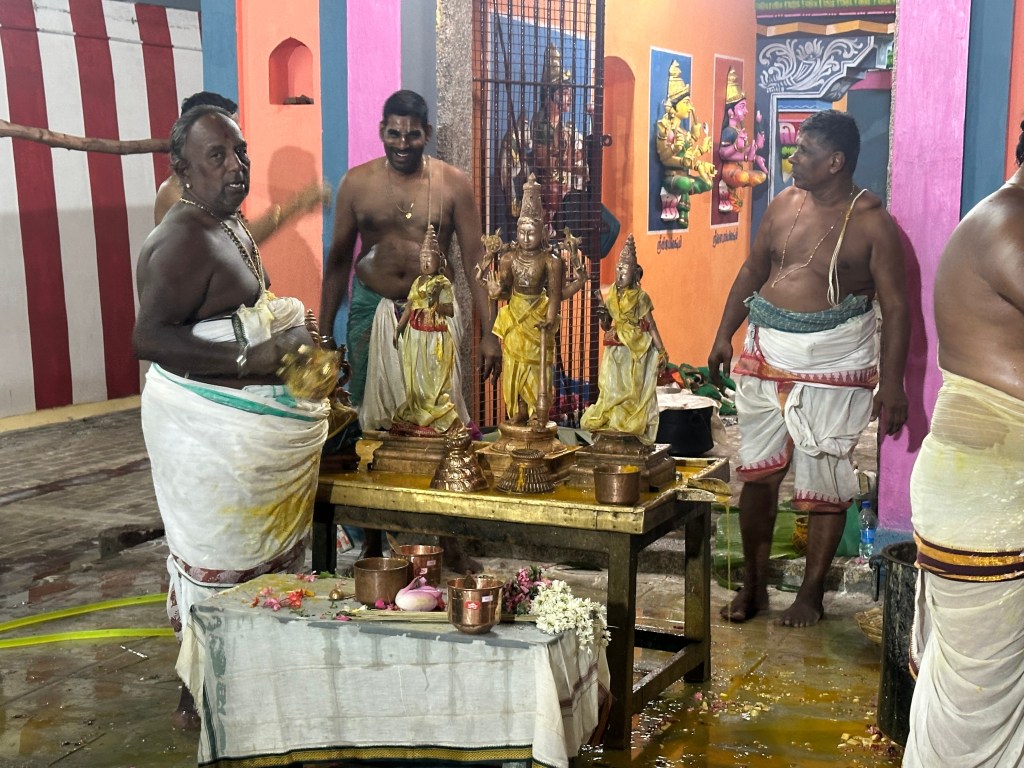
Ranganatha Bhattar is a very unassuming pundit. He went about his job with an air of complete professionalism on all the three days of the Samprokhanam. The conduct of each rite and procedure was meticulously planned and efficiently implemented. He and his team of “kainkarayapaara” — priestly assistants and volunteers — carried out tasks with clockwork precision and promptness. I was keen to know about the Bhattar’s antecedents and credentials and asked him to speak a little about himself. He readily obliged:
“My birthplace was in a tiny hamlet Therapernagar near Appakudathaan village (near Koviladi, Trichy). My family lineage is Kovil Kandadai Vadula Gothra vamsham. After completing my schooling in the nearby government school, I joined college to do B.A. Philosophy. But after 2 years as an undergraduate, I had to discontinue studies due to family circumstances when my father became very ill. To support my family, I took up full-time priesthood. I went to Hyderabad to serve as apprentice priest in a small Perumal temple there known to a relative of mine. A year later I moved to Mumbai to serve again as apprentice priest in the Banasvadi Srinivasa Perumal Kovil. After a few years, I moved then to Melkote where I undertook full-time study in Agama Sastras. After I had qualified in Agama sastra, I got an opportunity to go and serve as temple priest in Port Blair, Andamam Islands for a year. In 1980, I got married and was adopted by my mother’s maternal uncle, who was a chief priest at the Parimala Ranganatha Perumal temple at Indhalur, Mayiladuthurai. I began to serve as an assistant priest at this temple right through 1989…
In 2004, I got an opportunity to go to London, UK, to serve as a chief priest at one of the Vaishnava temples there. After a year, I returned to Indhalur, underwent “prayaschittam” (rite of expiation for having transgressed sastra that forbids overseas travel for a “vaideeka”). I returned to my duties as priest at Parimala Ranganatha Temple. Meanwhile, I also became a “gruhastha” … with one son and a daughter. I got them educated and married. They are well settled in life in vaideeka occupations.
Since 1989, I have without interruption been serving as Chief Priest at the SriParimala Ranganatha temple at Mayiladuthurai as an employee of the Tamil Nadu HR&CE. As per terms of employment, I draw no salary. My only emoluments are from what devotees/pilgrims offer by way of donation at the sannidhi. However, I an entitled to receive from the temple authorities every month a fixed quantity of rice and some grocery.
My connection to the temple at Vilanagar Village of Sri Varadaraja Perumal is more than 3 decades old. It is family lineage connection dating back to 1925 when an ancestor, Sri Ponaapa Bhattar is said to have performed “samprokshanam” for this temple. My “maama-thaatha” (mother’s maternal uncle), Sri Chakrapani Bhattar also for many years was a devoted servitor at this temple. Thus, my family and I are rightful “moraiyaar-s” or “sthalathaar-s” (hereditary “sons-of-soil” temple-rights holders) for several generations through history. It is a fact that apart from my own family ancestry, there were 5 other “moraikaar” families in the local neighborhood who also performed priestly service to this temple of Vilanagar. They belong to the Agama family lineage of:
(1) Kumbhakonam Narayana Bhattar and their 4 siblings
(2) Indhalur Chakrapani Bhattar (my “maama-thaatha”)
(3) Sampath Narayana Bhattar
(4) Nagapattinam Rangaraja Bhattar and their descendents
(5) Gopala Bhattar
(6) Nagai Mukundan (a prominent Agama scholar and kovil-priest who appears today even on popular religious TV channels) and his other family members like Doraiswami Bhattar.
**************
Next, I asked the Bhattar to tell me some important highlights about the Vilanagar temple, its brief history and legends. Again, he was very forthcoming.
“Although I am unable to give you exact Christian Era dating, I know from genealogical sources, that this this temple was erected under a temple-endowment granted during the Chola times… not later than c. 900 CE.
Tamil History records indeed that while Rajaraja Chola’s munificence towards Saiva temples was well known during that period, his sister (Kundavalli or Kundavai nacchiyaar by name) had warm feelings towards Vaishnava deities. Kundavai Pirattiyar, Rajaraja Chola’s elder sister, was a Saivite by birth but showed deep affection for the Vaishnava fold, building Vishnu temples and supporting Vaishnava worship. Her influence is credited with tempering Rajaraja’s Saivite zeal and fostering a spirit of religious inclusivity in the Chola court. She actively promoted and patronized Vishnu temples. Notably, she constructed the Vishnu temple known as Kundavai Vinnagar and also endowed it with gifts and perpetual lamps. Kundavai also built a Jain temple, the Kundavai Jinalaya, at Dadapuram, reflecting her broad religious interests. Her influence on Rajaraja Chola is well documented. While Rajaraja was a devout Shaiva and the builder of the grand Brihadeeswara Temple, he was also known for his patronage of Vishnu temples and Vaishnava devotees, a policy likely encouraged by Kundavai’s example and counsel.
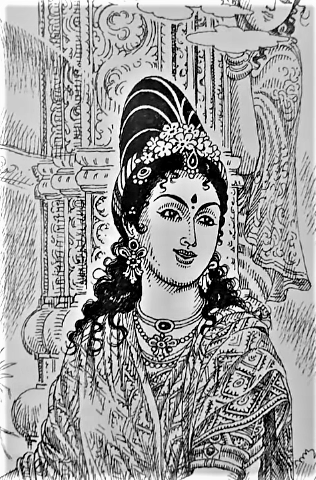
So, wherever her husband the Chozha Raja had ordered Siva temples to be built, this consort of his wife would send out her own orders for a Vishnu temple to also be built nearby. That is how you will find that in Mayiladuthurai so many Sivasthalas being neighbored by Vishnu temples also. This temple of Sri Varadaraja Perumal at Vilanagar is most likely a very good historical example of Kundavai Nacchiyaar’s generous endownment.
I remember that around 20 years ago, I myself participated in the conducting the “samprokshanam” of this temple. But since then, this kovil although being administered by the HR&CE, fell slowly into neglect and disuse. Many pilgrims who came to worship at Parimala Ranganatha Temple knew nothing about this temple here. Traffic of devotees to this temple dwindled and revenues became insufficient for upkeep of the shrines. The bad times continued… Hopefully, now that all you devotees and benefactors have come forward to perform the Mahasamprokshanam again after almost 2 decades, let us hope that Sri Varadaraja Perumal Swamy here will once again bless us all in the years to come”.
**************
Ranganatha Bhattar then proceeded to give me a salient summary of the distinctive ritual procedures for samprokshanam of a Vishnu temple conducted as per PANCHARATRA AGAMA SASTRAS. Below is a paraphrase of his account with a few photos and video-clips attached further below (more in Part-14):
The Mahasamprokshanam ritual involves specific Vedic and Agamic mantras to transfer divine energy during reconsecration. Key mantras include:
1. Vyāhr̥ti Mantras
Recited during energy transfer to kalashas (sacred pots):
- “Bhūḥ, Bhuvaḥ, Svaḥ” (Earth, Atmosphere, Heaven).
These three primordial vibrations purify the ritual space and invoke cosmic energies.
2. Sri Sūktam
Chanted to invoke Goddess Lakshmi’s blessings for prosperity:
- “Hiraṇyavarṇāṁ Harinīṁ Suvarṇarajatasrajām…”.
Used during kalasha sanctification and abhisekam (ritual bath).
3. Puruṣa Sūktam
Central to Vishnu-centric rituals, affirming the Lord’s omnipresence:
- “Sahasraśīrṣā Puruṣaḥ…”.
Recited while pouring mantra jalam (sanctified water) over the vimana (temple tower).
4. Avarana Devata Mantras
24 protective deities encircling the main idol are invoked with specific bījākṣaras (seed syllables):
- “Oṁ Hrīṁ Śrīṁ Klīṁ Nārāyaṇāya Namaḥ” (for Nārāyaṇa).
- “Oṁ Aim Hrīṁ Klīṁ Sauḥ Durgāyai Namaḥ” (for Durgā as dvārapālika).
5. Ashtākṣara Mantra
Core Vaishnava mantra during pratiṣṭhā (installation):
- “Oṁ Namo Nārāyaṇāya”.
Repeated 108 times to re-establish the deity’s presence.
6. Vīrya Mantram
From Pancharatra Agama, chanted during kalasha abhishekam:
- “Vīryaṁ Vasudhā Dhārayā…”.
Strengthens the deity’s spiritual potency (tejas).
7. Sannidhi Mudra Mantras
Accompany ritual gestures (mudras) to re-link the idol with cosmic forces:
- “Āvāhanaṁ Na Mama…” (Invocation)
- “Sannidhānaṁ Na Mama…” (Establishing proximity).
8. Purnāhuti Mantra
Final offering in the homam (fire ritual):
- “Svāhā Pūrṇamadaḥ Pūrṇamidaṁ…”.
Seeks forgiveness for ritual errors and completes the ceremony.
Key Ritual Context
- Mantras are recited in Sanskrit by ordained archakas (priests) trained in Pancharatra Agama.
- Timing: Critical phases (e.g., energy transfer) align with muhūrta (auspicious planetary hours).
- Audibility: Most mantras are chanted aloud, except bījākṣaras (seed syllables) whispered into the kalasha.
This structured recitation ensures the temple’s spiritual axis (skambha) remains aligned with cosmic principles, per Vaishnava Agamic tradition.
Here are the key ritual features and practices specific to Pancharatra Agama:
Core Ritual Practices in Pancharatra Samprokshanam
- Purification (Shuddhi):
- The process begins with purification of the temple premises, ritual implements, and participants using water, mantras, and sometimes fire. This prepares the environment for divine presence and is considered essential in Pancharatra worship.
- Invocation of Deities:
- Special mantras are chanted to invoke Lord Vishnu (Narayana) and his consort Lakshmi into the kalashas (sacred pots) and the main idol. The Pancharatra tradition emphasizes the presence of the deity in multiple forms-Paravasudeva (transcendental), Vyuha (emanations), and Archa (iconic form).
- Kalasha Sthapana and Nyasa:
- Sacred water pots (kalashas) are installed, and specific nyasa rituals (ritual placement of mantras on the body or objects) are performed. For example, mantras such as “oṁ namaḥ sudarśanāya āgaccha āgaccha” and various cakra mantras are recited, and mudras (ritual hand gestures) like cakra mudra, dhenu mudra, and yoni mudra are shown around the kalasha.
- Homam (Fire Ritual):
- Fire offerings (homam) are central, with offerings made to Agni (fire god) and other deities. This is accompanied by recitation of Pancharatra-specific mantras to sanctify the ritual space and invoke divine blessings.
- Prana Pratishtha (Infusion of Life):
- The spiritual energy (prana) of the deity is transferred into the idol through the chanting of Vedic and Pancharatra mantras, and the ritual pouring of sanctified water from the kalashas over the idol and temple towers (vimana and gopuram).
- Chatusthanarchana:
- A unique Pancharatra practice, especially during festivals, is Chatusthanarchana-worship at four designated places using holy water, fire, sacred rice, and the deity’s bimbam (image).
- Chathusthana archana involves deity invoked in four (chathu🙂 places, namely bimba (idol or murthy), mandala ( a platform over which decorated rangoli with multiple colour powders in a specified format), kumba ( pot filled with water and appropriately decorated) and Agni, the fire place. The priests perform puja at all the four places.
- This is performed at specific times (e.g., 5–6 AM and 4:30–5:30 PM) and highlights the intricate nature of Pancharatra rituals.
- Offerings and Aarti:
- Food offerings (naivedya), incense, lamps, and flowers are presented, and the ritual concludes with aarti (waving of lamps), symbolizing the dispelling of darkness and the presence of divine light.
- Philosophical Emphasis:
- The Pancharatra Agama stresses surrender to God (atma-nikshepa), humility, unwavering faith, and the recognition of Vishnu as the sole protector. These attitudes are woven into the prayers and ritual intentions throughout the Samprokshanam.
Distinctive Features of Pancharatra Rituals
| Feature | Pancharatra Agama Practice |
|---|---|
| Deity Focus | Narayana/Vishnu and his avatars |
| Ritual Structure | Highly systematic, with emphasis on purification and invocation |
| Kalasha Rituals | Detailed, with specific mantras and mudras for energizing water |
| Chatusthanarchana | Worship at four stations with symbolic elements |
| Philosophical Foundation | Surrender, humility, and faith as core attitudes |
| Textual Basis | Detailed procedures from Pancharatra Samhitas (e.g., Padma, Prasna) |
Steps Involved in Saparyāsanam
Based on established knowledge of Hindu temple rituals, Saparyāsanam (sometimes spelled Saparyasanam or Saparyāśana) refers to the detailed sequence of worship and offerings performed to the deity, typically as prescribed in Agamic traditions. The core purpose of Saparyāsanam is to offer respectful, completion of worship to the deity, ensuring both ritual purity and spiritual connection.
- Avahana (Invocation): The deity is invoked into the idol or image with mantras and ritual gestures.
- Asana Samarpana (Offering a Seat): The deity is offered a symbolic seat, inviting the divine presence to reside.
- Padya, Arghya, Achamana (Offerings of Water):
- Padya: Water for washing the feet.
- Arghya: Water for washing the hands.
- Achamana: Water for sipping and purification.
- Snana (Bathing): The idol is ritually bathed with water, milk, honey, and other sanctified substances.
- Vastra Samarpana (Offering Clothes): Fresh garments or cloth are offered to the deity.
- Alankara (Adornment): The deity is adorned with ornaments, flowers, and sandal paste.
- Gandha, Pushpa, Dhupa, Deepa (Fragrance, Flowers, Incense, Lamp): These offerings are made in sequence to please and honor the deity.
- Naivedya (Food Offering): Sanctified food is offered.
- Tambula (Betel Leaf Offering): Betel leaves and areca nut are offered as a gesture of hospitality.
- Pradakshina and Namaskara (Circumambulation and Prostration): Devotees circumambulate the sanctum and offer prostrations.
- Mangala Aarti (Final Waving of Lights): The ritual concludes with waving of camphor or lamps before the deity.
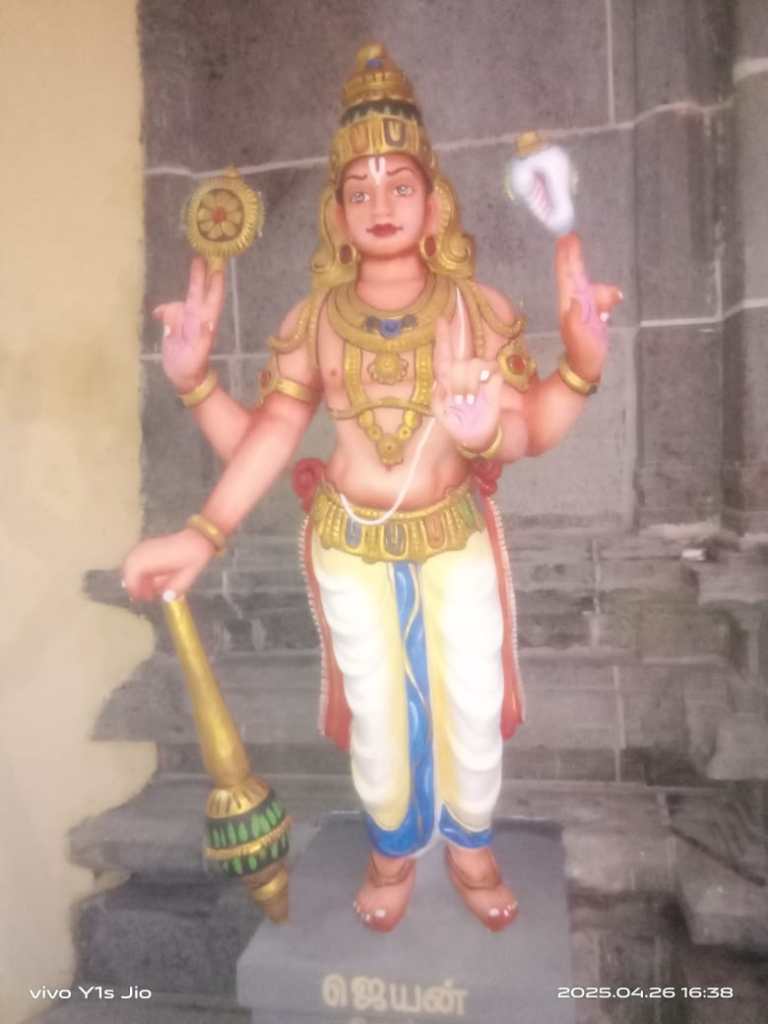
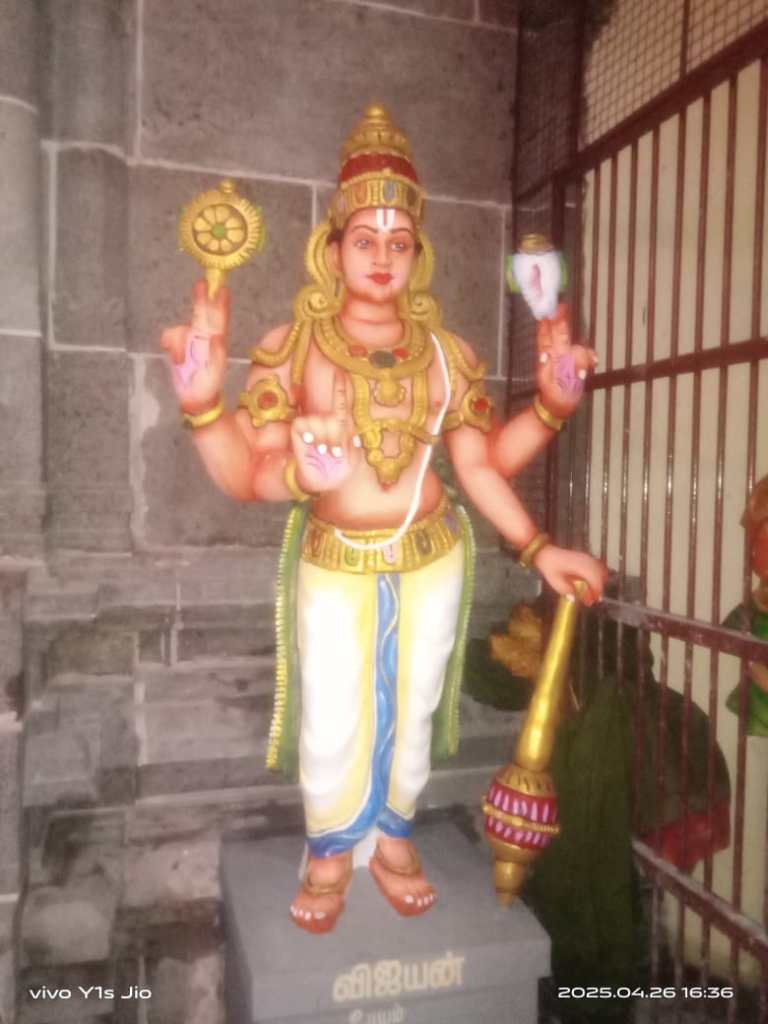

(to be continued)
Sudarshan Madabushi
Thank you for the detailed write up. Chathusthana archana here means deity is invoked in four (chathu:) places, namely bimba (idol or murthy), mandala ( a platform over which decorated rangoli with multiple colour powders in a specified format), kumba ( pot filled with water and appropriately decorated) and Agni, the fire place. The priests perform puja at all the four places. This can be seen even during pavitrotsavam).