
Only a couple of days ago, my wife and I, along with all the rest of our near and dear family members, arranged to organize, perform and celebrate the ritual of “Seemantham” for our dear daughter-in-law. The event was duly conducted in accordance with the prescribed Vedic ‘sastra-s’ under the stewardship of our household “brihaspathi” (chief priest) and the oversight of family-elders.
The “seemantham” rite is a very common one in Sri Vaishnava families. In the past, and within my own extended family, I have witnessed dozens of such occasions. Nonetheless, despite my familiarity with the ritual ceremony, my knowledge about the significance, the mantra, homam and other related procedures of “seemantham” had always remained skimpy or patchy. I had never acquired a full or thorough grasp of what the ritual meant and why it was such an important one in the traditional life of the Sri Vaishnava community.
To make amends to myself for the above grave lapse on my part, when the duty to perform the “seemantham” ceremony for my own daughter-in-law was cast upon me, I resolved to educate myself more deeply about the esotericism of the “samskara“.
As part of the celebrations, therefore, I invited a Sri Vaishnava theological scholar to address the gathering of family, friends and guests on the occasion on the topic of Seemantham, its rationale, significance, benefits and why it has come to be mandated as a “must-do karma” in the general Vedic scheme of “samskara“. The scholar I invited to the event was Sriman Kidambi Narayanan, a popular “upannyasakar” from Chennai whose public religious discourses are very popular in the Sri Vaishnava community. Many of his “upannyaasam” are available for public viewing on Youtube channel.
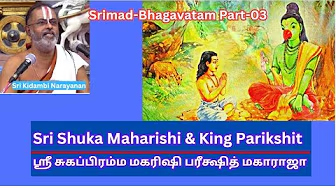
Sriman Kidambi Narayanan was kind enough to participate in the “seemantham” event and gave an hour-long lecture on the subject of “Seemantham and Pumsahvanam samskara”. The audience, my family and guests listened to him in rapt attention. From his illuminating but brief talk on the subject, I was able to fill many big gaps that I knew existed in my own knowledge of this “samskara” and I was at last able thus to gain — after so many years remaining in ignorance — a much deeper understanding of it.
Below in this 4-part series of essays, I am merely recording a detailed paraphrase of the salient parts of Sri Kidambi Narayana’s exposition. Of course, I have taken the liberty to also add a bit of my own flavour to his “upannyaasam“, garnishing it with some select gleanings from my own broad research into the subject.
It is my hope that this series on “Seemantham” will be read by one and all within our Sri Vaishnava community, both in India and abroad, and they will find it useful in further enhancing their understanding of why this ritual is so very important in life.
************
Seemantham is a significant ritual in the Sri Vaishnava tradition and broader South Indian Hindu culture, performed to bless and protect a pregnant woman and her unborn child. It is both a deeply spiritual and social event, rich in symbolism and rooted in Vedic tradition.
Purpose and Significance
- Seemantham is a samskara (rite of passage), traditionally counted among the sixteen major Hindu samskaras that sanctify key life stages.
- The ritual is performed to ensure the health, well-being, and safe delivery of the mother and child, and to invoke divine blessings for the unborn baby’s spiritual and intellectual growth.
- It is believed to ward off evil influences and protect the mother from inauspicious forces, especially during her first pregnancy.
Timing
- Traditionally held during the seventh or eighth month of pregnancy (sometimes sixth or ninth), with the eighth month being especially common in the Sri Vaishnava tradition.
- In earlier times, it was performed for every pregnancy, but today it is often reserved for the first child.
Main Rituals and Customs
- Hair Parting (Seemantham/Seemanthonnayanam): The central act involves the husband parting the wife’s hair three times while chanting mantras. This is symbolic of inviting auspiciousness and divine protection.
- Mantras and Homams: Vedic mantras are recited to purify the fetus and seek blessings from deities such as Brahma, Agni, Vishnu, Soma, and Ganga. The main deity invoked is often Raga (Rika), the presiding deity of the full moon, symbolizing beauty and intellect.
- Special Items: Ritual objects include the quill of a porcupine, an ear of ripe paddy, and Udumbara leaves, each representing specific blessings (e.g., sharp intellect, prosperity).
- Bangle Ceremony (Valaikappu): Women guests adorn the mother-to-be with colorful glass bangles, believed to promote good health and a smooth delivery. Red and green are preferred; black and blue are avoided.
- Floral Decorations: The expectant mother is decorated with flowers, and a garland made of yam sprouts may be placed around her neck.
- “Udakasanti”: The sanctification of water, which the mother bathes in, is intended to remove any negative influences.
- Touching a Male Calf: At the end of the ceremony, the mother may touch a male calf, symbolizing the wish for a healthy male child and overall prosperity.
Additional Practices
- Fasting and Silence: The mother may fast and remain silent until the stars are visible at night, marking the completion of the ritual.
- Charupaka: A ritual meal or offering may be performed, sometimes linked to prayers for future child marriage and family prosperity.
- Music and Songs: In some regions, women sing songs wishing for the birth of heroic sons and a smooth delivery.
Cultural Context
- The ritual is known by different names in various regions: Seemantham or Srimantham in Telugu and Kannada, Valaikappu in Tamil, and Godh Bharai in North India.
- It is a joyous occasion, attended by family and friends, and is as much a celebration of motherhood as a religious rite.
“Seemantham is a celebration of motherhood, praying for the health, prosperity, and safe delivery of both mother and child. Rich in symbolism, emotion, and ritual, Seemantham is a blend of tradition and joy that continues to hold immense cultural significance even today.”
This ritual, especially in the Sri Vaishnava tradition, emphasizes spiritual protection, community support, and the sanctity of motherhood, blending Vedic rites with regional customs and festive celebration.
*************
What is the significance of the ritual squeezing of the seed juice of the banyan tree into the pregnant wife’s nostrils in the seemantham ceremony?
(continued in Part-2)
Sudarshan Madabushi
Where can I get the other parts of the series?
You links are available on this same webpage 🙏
I’ll send links to your Email
Please check your email inbox for links