

Devdutt Pattanaik’s recent framing of “Brahmins as secret Muslims” and his analogy between Brahminical and Islamic ways of life rests on several contestable historical, textual, and sociological assumptions that can be systematically challenged.
The “secret Muslims” thesis collapses very different histories and concepts into a single polemical frame. A counter‑narrative can be built by taking each claim and showing where it is historically, textually, or conceptually flawed.
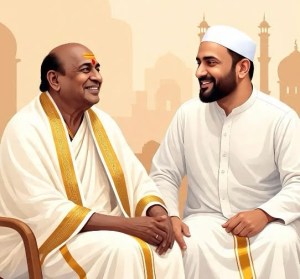
- Devadutt’s narrative: I am convinced that Brahmins function like secret Muslims, separated not by theology but by strategy.
Like the Muslim halal haram divide, Brahmins imposed a satvik tamasik hierarchy, introducing moralised food and behaviour codes that earlier Indian cultures did not emphasise in this way.
Counter narrative: The three guṇas (sattva–rajas–tamas) originate in Sāṅkhya ontology as universal qualities of prakṛti, not as a Brahmin/non‑Brahmin boundary marker; they apply to all beings, foods, mental states, and actions, usually as mixed tendencies, not a binary of saved/damned.
Pre‑modern classification of food as sattvik/rajasic/tamasic is about shaping “svabhaava” or innate mental dispositions (clarity, agitation, dullness) and is not identical to a legal‑theological code like halal/haram that is grounded in divine command and explicit juristic sanction of Islam.
So while both traditions moralise upon Food, one is part of a cosmological psychology (vide.. the “anna suktam” in the Rg Veda which is at least a 10,000-year old revelation) and the other of a revealed legal system called “Koran, Hadith and Sura” which all date back to a mere 800-year past in history. The analogy obscures more than it clarifies.
2. Devdutt’s narrative: Both Brahmins and Muslims entered India from the northwest, following the same geographic corridors into the subcontinent. Brahmins trace their cultural roots to the Eurasian steppe, linked to horse domestication around 4000 years ago, arriving in India roughly 3000 years ago.Muslims followed the same routes about 1000 years ago, spreading north to south, and east to west, mirroring earlier Brahmin movement.
Counter-narrative: Contemporary scholarship (archaeology, historiography etc.) on Indo‑Aryan language and culture speaks of complex migration and interaction over hundreds of centuries; it does not support a simplistic picture of a corporate group “Brahmins” entering as a caste block and then “moving” in the same pattern later followed by Muslims. Devdutt here is perhaps conflating the Muslim “migration” of Prophet Mohammed’s followers and faithful from Mecca to Medina and back with his cocky and less than half-cocked theory about Brahmin migration. Islam’s spread into the subcontinent involved very different mechanisms: military conquest, trade networks, Sufi lineages, and inter‑marriage, often coastal as much as north‑western; this cannot be reduced to “mirroring earlier Brahmin movement”.
3. Devdutt’s narrative: Brahmins insist on one ultimate reality, formless and beyond images, articulated through Advaita Vedanta.This mirrors Islamic monotheism, where God is imageless, absolute, and beyond representation. As a result, gods tied to rivers, rocks, mountains, trees, and villages are downgraded as lesser or folk deities.
Brahmins frame the Vedas as supreme knowledge, dividing the world into astika and nastika, believers and non believers.This parallels how Islam treats pre Islamic practices as jahiliya, a state of ignorance. This mirrors the Islamic division between truth and ignorance, revelation and error.
Counter-narrative: Advaita Vedānta is only one among many Brahminical systems that include dualist (Dvaita) and qualified non‑dualist (Visishtadvaita) Vedāntas, Pūrva‑Mīmāṃsā and Bhakti theologies (including Śrī Vaiṣṇava, Mādhva, Śaiva Siddhānta) that grant real status to personal, image‑worshipped deities (“archa murthy araadana”) and to local forms, and are not reducible to aniconic monotheism which is what Islam is. Amongst Brahmins there is no one or distinctive monotheistic worldview: the “smaartha brahmin” views godhead as “yagnya“; the “saiva” brahmin worships the “linga” as “Isvara“; Sri Vaishnava brahmins worship the form of “Narayana” as Supreme Brahman; the Saaktha brahmins worship Devi or Amba… and so on.
The Monotheism of Brahmins cannot be strait-laced into any one definitive kind as that which characterises Islam. Devdutt Pattnaik seems utterly ignorant of the famous Vedic aphorism: “ekat sath viprah: bahudaah vadanti…”: The Truth is One but conceived of in many ways by men who have realised it.
In the Brahmin view, Truth is Universal but it is neither uni-dimensional, unichrome nor unipedal. Even Advaita’s monistic conception of nirguṇa brahman is arrived at by philosophical or hermeneutical reasoning on Vedic sentences (vaakya), not by prophetic revelation, and it coexists in practice with other Vedanta ‘darsana‘ whose theology is extended upon “visishta-advaita” or qualified monism and temple‑worship — something that Devdutt ought to know is structurally different from Islamic aniconism.
Devdutt’s supposed “downgrading” of river, tree, and village gods can be stoutly contested by the persistence of grāma‑devatā, nāga worship, and tīrtha cults in Brahmin‑led ritual systems up to the present. In the Taittiriya Upanishad (Mahanarayana Upanishad), there is a suktam exclusively devoted to the praise of the Waters as a cosmic elemental deity: “Apah devata” — “aghamarshana suktam“.
Islamic jāhiliyya denotes a specific sacred history of pre‑Qurʾanic Arabia. The expression serves as a form of grand narrative to paint pre-Islamic Arabians as barbarians in a morally corrupt social order. It is anchored in a doctrine of final revelation and prophetic correction of earlier error, for which there is no equivalent claim of chronological finality in Brahminical discourse.
The āstika/nāstika distinction is historically a philosophical category in darśana debates—the āstika accepting Veda as a pramāṇa, the nāstika rejecting it. This is not about salvation/condemnation binary aimed at common people, and is certainly not a unified social policy of “Brahmins”. Equating āstika/nāstika with believer/infidel imports Abrahamic categories back into Sanskrit vocabulary and distorts both.
Devdutt Pattnaik simply doesn’t know what he is talking about. He conflates history, theology, metaphysics, linguistics and religion… and tries to palm off hodge-podge to us in the hope it will be mistaken for exotic delicacy.
4. Devdutt’s narrative: Both Brahmins and Muslims mark themselves physically to signal difference and superiority. The sacred thread functions like Islamic dress codes, separating insiders from outsiders. Bodily marks and ritual symbols reinforce hierarchy and controlled access to the sacred.
Counter-narrative: Marks like the yajñopavīta, “urdhva-pundhram” or tilaka function as saṃskāra‑based identity and ritual readiness; they are not imposed by a central lawgiver nor standardised across all Brahmin groups, and historically many non‑Brahmin communities have worn sacred threads or caste‑marks as well. The “vibhuthi” smears worn across the forehead is a practice of many non-Brahmins as well. Such marks do not denote varna, jaathi or matham… they denote piety, or bhakthi. They are worn purely out of individual choice or in compliance of community’s religious custom.
Islamic dress and beard codes — or the dishdasha and the abbaaya or burqah —derive their authority from scripture and ḥadīth as interpreted by fiqh schools, with explicit legal obligations for modesty; these are structurally different from caste and sectarian insignia tied to life‑cycle rites.
5. Devdutt’s narrative: Both systems are deeply homophobic, treating same sex desire as unnatural or sinful, justified through divine sanction. Both are misogynistic, restricting women from sacred authority. In mosques, prayer leadership is male; in temples, priesthood and core rituals are male dominated.
Counter-narrative: In the Brahminical case, key śruti texts do not legislate explicit punishments for same‑sex behaviour; many dharmaśāstra and purāṇic sources either ignore it or treat it contextually, which has allowed contemporary Hindu bodies to articulate LGBT‑inclusive readings grounded in karma, pluralism, and the four puruṣārthas (dharma, artha, Kama, moksha).
Womanhood holds a unique and central position in the Brahminical way of life. The Upanishad vaakya ” “maatru devo bhava...”Revere your mother as you would God” clearly attests and affirms the status of women in society. No Vedic ritual involving ‘agni’ or Fire can be performed by a Brahmin “gruhastha” (householder) without the presence of his wife beside him. The Brahmin wedding ceremony is solemnized by mantras which hail the woman as “saha-dharmachaarini” : she is the husband’s life-partner in all Dharmic endeavours in life lived together.
The Brahmins adore and worship female saints with equal fervour as male: Andal of Sri Villiputtur is one among the 12 Holy Azhwars.
Once again, Devdutt speaks from utter ignorance.
6. Devdutt’s narrative: The crucial difference is tactical: Muslims seek conversion and expansion; Brahmins seek dominance without conversion. Brahmins prefer rule without inclusion, preserving power by exclusion.
Counter-narrative: Historically, Brahmins have not had a single “tactic”: there were kingdoms where Brahmins were marginal; there were regions where Śaiva or Vaiṣṇava non‑Brahmin ritual specialists dominated; and there were periods where śramaṇa, bhakti, or anti‑Brahmin movements had drastically reshaped religious life of the peoples. Indian History is a multi-mosaic social continuum. It cannot be defined in Marxist terms of class-struggle or dominance … which is precisely (and insidiously) what Devdutt is implying by suggesting Brahminical “strategy of dominance“.
Islamic traditions themselves too cannot be said to be uniformly conversion‑oriented; in many Indian contexts, Islamic rule did not translate into mass conversion, and rulers often governed multi‑religious populations with layered legal structures.
The idea that one civilisational bloc “seeks expansion” and the other “seeks dominance without inclusion” reifies highly contingent or variable historical patterns into essences or certainties, which serious historiography will find untenable.
7. Devduttt’s narrative: The unresolved question remains: who taught whom, or whether both inherited the same patriarchal, monotheistic, control oriented worldview from older West Eurasian traditions.
Counter-narrative: Modern scholarship repeatedly cautions against “single‑source” explanations of patriarchy or hierarchy; both Hindu (or Brahminical) and Islamic patriarchies have been shaped by local economies, state formations, and colonial modernity as much as by any deep origin in a putative Eurasian steppe culture.
Academic or intellectual histories of Vedic–post‑Vedic India, and of Islam in Arabia and even beyond, point to very different genealogies: one centred on śruti, yagnya, karma, rebirth and multiple darśanas; the other founded upon prophetic monotheism, eschatology, and codified law.
A more precise comparative framework would therefore:
- Compare specific institutions (qāḍī vs purohita, madrasa vs pāṭhaśālā, waqf vs temple–maṭha endowments) rather than theorise about entire “worldviews”.
- Track how particular texts and practices changed under concrete pressures—Buddhist competition, bhakti, Islamic rule, imperial-colonial codification—without assuming a specious, vague and timeless “strategy of control“.
Within such a framework, meaningful similarities and borrowings can certainly be discussed, but Devdutt Pattnaik’s slogan that “Brahmins function like secret Muslims” turns a nuanced comparative project into a polemical caricature … if not into clownish antic.
Sudarshan Madabushi
Clear rebuttal point by point