The SWOT-grid and “ARTHA-PANCHAKA”: (Part 2 of 2 – CONCLUDED)

It is only very late in my life today, and I regret to say it, that I have received the Grace of Bhagavan to embark finally upon a serious study of the Rahasyatrayasaram in the traditional learning mode of “grantha kaalakshepam” under an erudite Sri Vaishnava scholar-Acharya.

Because of ageing factor and also the lack of ease of my acquaintance with Manipravala texts, I have found it a little difficult at times to internalise the profundities of doctrine expounded in the Rahasyatrayasaram. The tutoring by my Acharya no doubt follows closely the scriptural text faithfully and, yes, many of the passages in it that reveal concepts such as “artha panchaka” in it do come alive so vividly and with greatly enlightening meaning when explained so well. Nonetheless, there are occasions, when I do find myself stumbling and grappling with the real essence of what is imparted.

On such occasions of relative incomprehension or confusion, arising from my personal indequacies, I often do find myself beginning to muse, with the aid of a bit of “lateral thinking” technique, over that which escapes deep understanding. Edward de Bono (1967: a Maltese psychologist) described the technique of “Lateral Thinking” as “a structured approach for thinking differently“.

With the background and approach of someone who had spent most of my professional life in the contemporary corporate world for several years, in trying to fully understand the doctrine of “artha panchaka“, I knew in my heart that I was always going to be a tad predisposed towards trying to come to terms with the doctrine using the technique of “lateral thinking” — something I had learned before as part of my career higher-education. Therefore, I began mentally to attempt mapping the 5 elements of the “artha panchakam” onto what in the corporate world is called a SWOT-grid… the acronym SWOT standing for “Strength, Weakness, Opportunities, Threats”. It was not that any sudden urge of perverse or maverick thinking which drove me to do so… It was only earnest desire, in fact, “to go from the known to the unknown”

**********

Most of us who have worked in the corporate or business environment, I am sure, already know what SWOT is; nonethless, here below is just a brief recapitulation of the concept and practice.

SWOT analysis is a strategic planning framework used in corporate strategizing to evaluate an organization’s internal strengths and weaknesses alongside external opportunities and threats, enabling informed decision-making and competitive positioning. It supports initial planning stages for business decisions, product launches, or market entry by fostering holistic insights and action plans. SWOT analysis is commonly used in business situations (brainstorming etc.) requiring strategic assessment of internal capabilities and external environments, such as developing new strategies, launching products, or entering markets

Threats: External risks including competition, economic shifts, or supply chain disruptions that could undermine success.

Strengths: Internal attributes like strong brand presence, skilled workforce, or efficient operations that provide competitive edges.

Weaknesses: Internal limitations such as inadequate resources, poor processes, or skill gaps that hinder performance.

Opportunities: External factors like market trends, technological advances, or regulatory changes that can be exploited for growth.

​​SWOT-grid or matrix is typically represented as a 2×2 grid categorizing internal and external factors.

PositiveNegative
InternalStrengths
– Brand equity
– Skilled team
– Cost advantages 
Weaknesses
– Resource gaps
– Process inefficiencies
– Skill shortages 
ExternalOpportunities
– Market growth
– Tech innovations
– Regulatory shifts 
Threats
– Competition
– Economic downturns
– Supply disruptions 

************

The line of reasoning or thought-process that led me to believe mapping the 5 elements of the “artha panchaka” to the SWOT grid made a wee bit of sense was this:

Just as it is important in the world of business to “introspect” upon strengths and weaknesses to be able to “assess” the grid of opportunities and threats before it, in much the same way, the artha-panchaka too offered a similar “framework” of spiritual introspection in the profounder context of Sri Vaishnava soteriology. For the purpose of making the connection of similarity, I thought it appropriate to associate Weakness with Jivatma svarupa; Opportunity with the Upaya svarupa; Threat with the Virodhi-svarupa; Strength with the Paramatma svarupa… and finally, the Phala-svarupa’s association with what in corporate parlance is always recognized as Mission Accomplishment.

***********

As I began to muse and mull more deeply upon the mapping of the two concepts inside my mind — one a profoundly Vedantic idea and the other a run-of-the-mill corporate practice — I gradually began to realise that it was quite a helpful exercise to do mentally but then only as a pedagogical and introspective device, provided however, that I kept its limits clearly in view. In other words, it began to sink into me that the mapping might work only partially but would not serve the full purpose of internalizing the “artha panchaka” doctrine fully. ​

  • Treating jīvātma-svarūpa as “weakness” makes sense in so far as the jīva, left to itself, is dependent, finite, and vulnerable to bondage and error; the whole need for upāya arises from this existential “inadequacy”.
  • Paramātma-svarūpa as strength” also resonates: the only real resource in the system is the Lord’s omnipotence, auspicious qualities, and gracious will,on which the aspirant’s hope strategically rests.
  • Upāya-svarūpa as “opportunity” fits the idea that the Lord has opened a gracious path (especially prapatti) that the jīva can avail, a divinely provided “strategic option” that changes the jīva’s otherwise bleak situation.
  • Virodhi-svarūpa as “threat” is almost exact: Desika’s enumeration of internal and external impediments functions structurally like a risk-register which must be recognized, monitored, and mitigated.
  • Phala-svarūpa as “mission accomplished” mirrors the idea of a clearly defined end‑state: nitya‑kainkarya in Śrī Vaikuṇṭha, with all intermediate metrics (various sādhana‑states) subordinated to that telos.
  • In SWOT, strengths and weaknesses are “internal” factors to the firm, while opportunities and threats are “external”; in Artha‑pañcaka, all five artha‑s are objects of true knowledge, not simply factors to be leveraged in a strategy the jīva designs.
  • Most crucially, the core logic of Śrīvaiṣṇava soteriology is not optimization of one’s own capabilities but relinquishment of self-reliance in favour of sole reliance on divine grace; this decisively undercuts any reading that treats Artha‑pañcaka as a self‑help technique in corporate style.
  • For someone trained in corporate strategy, using a SWOT‑like grid can sharpen attention to the relational structure: “I, as dependent self, face real virodhi‑s; my only ‘strength’ is actually His strength, accessed through the divinely given upāya, for the sake of a clearly defined puruṣārtha.”
  • As long as the analogy is kept consciously provisional and is periodically checked back against the primary categories (sva, para, upāya, puruṣārtha, virodhi) in the text, it can serve as exactly what you call it: a tool‑kit for self‑introspection, not a replacement frame that domesticates the theology into secular management theory.

The mapping of the SWOT GRID to the Doctrine of “artha panchaka” thus has useful but only limited utility and value. It can certainly be quite helpful as a pedagogical and introspective device, provided its limits are kept clearly in view always. It should be always treated as a crutch … a wobbly “walking stick”… that can only help one maybe to heave oneself up intellectually in coming to grips with the doctrine… but which must be abandoned and thrown away as soon as one is fit to stand erect and — with the guidance of one’s “kaalakshepa Acharya” — walk steadily into the realm of internalising “artha-panchaka” not simply as abstact doctrine but as a lived, spiritual experience.

**********

Since modern conceptual tool-kits such as the SWOT etc.. fail to effectively serve as conceptual frameworks to studying Visishtadavaita soteriology, the only fail-safe alternative for a seeker is to study devotional texts in Sanskrit and Tamil.

Traditional hermeneutic frameworks from Hindu theology, such as Vedic śāstric exegesis (tātparya-niyamaktea-lakṣaṇās), offer robust alternatives to business or other modern models for studying devotional texts like Rahasyatrayasāram, since they emphasize layered meanings over so-called “strategic analysis“.

​The more practical contemplative tools for understanding the doctrine of “artha-panchaka” would be “kaalakshepam” mode of learning. During “kaalapshepam” sessions, deeper and contemplative content analysis of the doctrine becomes possible. What helps greatly in the process is the study of Upanishad parables, the Āḻvār bhakthi hymns or even the dialectical maṇḍala-mapping (circling core truths like paramātma around jīvātma) — all of which foster internalization of “artha panchaka” without secular distortion. This is the unique feature, in fact, that is seen in the guru-śiṣya paramparā method of study.​ The method safeguards the sacred text’s anti-autonomous thrust since it invites “surrender over strategy“.

Narrative theology woven during “kaalakshepam” sessions thus effectively reconstructs doctrinal stories forming “artha” soteriological arcs, while the hermeneutic content analysis (vyaakhyaana) identifies recurring motifs like virodhi-obstacles qualitatively.​ All these go to foster truly immersive understanding of Grace-centric themes, avoiding SWOT’s instrumentalism.

Swami Vedānta Deśika’s own tradition employs samaṃvaya (coherence-harmonization), arthavāda (contextual praise), and rahasya-vyākhyāna (esoteric unpacking of mantras) to integrate ontology, devotion, and praxis without reducing them to manipulable factors. He clearly prioritizes śabda-prāmāṇya (scriptural authority) and bhakti-rasa (devotional savoring), revealing Artha-pañcaka as a relational disclosure rather than anything like what the modern (or corporate) mind might view through the lens of a SWOT grid.

Swami Desikan’s core method involves layered interpretation of sacred texts through historical-critical analysis, reader-response, and doctrinal lenses, uncovering contextual meanings without reducing them to intellectual factors or construcgts.​ In the context of Visishtadvaita soteriology, Rahasyatrayasāram applies tātparya (intentionality) and lakṣaṇā (implication) to reveal relational truths such as śeṣa-śeṣi bhaava without imposing external grids.​ The RTS thus focuses on the essence of pure religious experience, such as bhakti-rasa or prapatti-surrender, as they appear in higher human consciousness.

Applied to Sri Vedānta Deśika’s classic work, we see that what constitutes the central aim of the RTS is to examine the jīvātma-paramātma dynamics — expounded long before him by his own Acharya, Bhagavath Sri Ramanujacharya — more as a lived dependence rather than “weakness-strength” binaries of the human existential condition.

(Concluded)

Sudarshan Madabushi

The SWOT-grid and “ARTHA-PANCHAKA” (Part 1 of 2)

What does the Greek derived Biblical word Soteriology mean?

It is the branch of theology that studies “salvation”: i.e. what the human problem is, what it means to be saved or liberated, and by what means and conditions that liberation is effected.

Generally, in religious studies across the board, soteriology covers doctrines about (a) deliverance from a dire existential condition (sin, ignorance, bondage, suffering) and (b) attainment of a final positive state (heaven, nirvāṇa, mokṣa, etc.).
It asks questions about (i) the nature of the saving state, (ii) the role of divine agency (iii) and the human response, and (iv) the processes or paths (grace, faith, works, knowledge, ritual) by which that state is reached.

In Sanskrit, there is no single technical noun exactly parallel to the term “soteriology,” but the closest functional equivalents would be:

  • Mokṣa-śāstra (मोक्षशास्त्र) / mokṣa-vidyā (मोक्षविद्या) – teaching or science of liberation.
  • Mokṣa-tattva-vicāra (मोक्षतत्त्वविचार)– inquiry into the principle/doctrine of liberation.
  • Within Vedānta specifically, discussions of mokṣa-sādhana (मोक्षसाधन, means to liberation) and mokṣa-svarūpa (मोक्षस्वरूप, nature of liberation) together practically constitute “soteriology.”

Tamil also does not have a single fixed coinage, but in usage the following expressions are functionally parallel to soteriology:

  • vīdu-t-tattuva viḷakkam (வீட்டுத் தத்துவ விளக்கம்) / vīdu-nilai viḷakkam (வீடு நிலை விளக்கம்) – doctrinal exposition of “vīdu” (mokṣa) and its state.
  • vīdu-peruvadu eṉṟa neri (வீடு பெருவது என்ற நெறி) – the path/means by which liberation is obtained (i.e., mokṣa-sādhana).

************

In Visishtadvaita Vedanta aka “sri ramanuja darsana“, the most comprehensive and seminal work of soteriology is the Manipravala treatise, “Sri Rahasya Traya Saara” (“The Essence of the Esoteric Three“). It is a 32-Chapter treatise in which Swami Vedanta Desika distilled the very core of Sri Vaishnava doctrines on “”मोक्षशास्त्र” into one comprehensive tome for the benefit of all earnest and genuine seekers of Liberation.

Every chapter in Vedanta Desika’s famous work, “Sri Rahasyatraya Saram” (RTS) is so very profound that even the devoutest student, even while attending “kaalakshepam” sessions (study-circle) to study it humbly under the expert guidance of an erudite “sadhAcharya” — and especially if the former is not fully acquainted with the traditional vocabulary (“paribhaashai“) of Sanskrit and Manipravala “vyaakhyaana” (hermeneutics) style –, can find himself/herself floundering about in trying to grasp and grapple with some of the fine Vedantic concepts or subtle explanations of philosophical nuance espounded in it. The RTS is a “rahasya grantha” that deals with esotericism of salvation … which is a subject of study not recommended for all and sundry but only for those “sishyas” or students whose intellectual aptitute and spiritual attitude the guru is convinced makes him fit and ready to receive the knowledge imparted by the sacred text.

It is precisely for that reason, that in Sri Vaishnava “sampradaya” studies, a student-sishya is advised not to ever venture undertaking the study of the RTS by his own effort and without the gentle and learned aid of a qualified “acharya” or “guru” steeped in the Visishtadvaita school of thought. It would be foolhardy for anyone to ignore such advice and rush into uncharted, unnavigable and that perilous sea of study into matters soteriological.

Arthapanchakaadhikāra” is the 4th Chapter in Rahasyatraya Sāram. It is one such profound chapter. It would normally take a quite a while for ordinary students of RTS — even if they were to learn it in the traditional “guru-sishya kaalakshepam” mode — to grasp the doctrine and internalize it fully. This chapter or “adhikaara” lays out and systematizes five indispensable objects of knowledge for a mumukṣu, the “seeker of salvation”.

The five artha-s” are: (a) the nature of the Supreme (paramātma-svarūpa); (b) the nature of the self (jīvātma-svarūpa); (c) the means (upāya-svarūpa); (d) the end (puruṣārtha / phala-svarūpa); and (e) the impediments (virodhi-svarūpa), and shows how the esoteric “three” (trayi) “rahasyas” of “Tirumantram, Dvaya Mantram and Charama Shloka” encapsulate all five.

Swami Desikan presents “artha-pañcaka” as the minimum doctrinal package every seeker of mokṣa must correctly apprehend, framing it as the operative paradigm of Śrīvaiṣṇava soteriology.

Within Śrīvaiṣṇava teaching, these five “things to be known” are indeed presented as the basic framework within which a mumukṣu is meant open his eyes to see a larger noumenal Reality beyond the sensory self and world i.e. “Who is the Lord?”, “Who am I?”, “What is the means?”, “What is the goal?”, and “What obstructs it?”.Swami Desikan and later authors treat this framework as the operative model for spiritual development and for structuring a life of śaraṇāgati (absolute surrender) and kainkarya (servitude to Bhagavan).

Thus, we may say that “artha-panchaka” is somewhat akin to an “operative paradigm” to understand Sri Vaishnava soteriology. To say so would not be too far from the way the insiders of the “sampradaya” also would describe it in their own “paribhashai“. The doctrine functions also as a sort of normative “tool‑kit” for self‑understanding; but the tool-kit must never be mistaken to be any kind of formal intellectual pre‑requisite in the sense of scholastic mastery needed for mokṣa. From the standpoint of lived practice and experience, Artha‑pañcaka does work precisely only as a self‑introspective tool-kit or grid: in other words, it is something that a seeker keeps at the back of his/her mind always while repeatedly asking, “Do I see Nārāyaṇan and myself rightly? Have I really adopted the right upāya? Am I genuinely aiming at nitya‑kainkarya? What specific virodhi‑s are distorting my life?”

It is through this important doctrine of “artha-panchaka” that Śrīvaiṣṇava theology encourages every serious mumukṣu to internalize “the five” as an ongoing pattern of examination, while still affirming that what finally saves is however only the Lord’s Grace responding to śaraṇāgati, and not the sophistication of one’s conceptual apparatus.

The “Ramanuja darsana” is also very careful not to turn this “arthapanchaka” into imperative tenet or a demand for elaborate doctrinal comprehension as precondition for Grace: explicit Śrīvaiṣṇava manuals state that even one lacking scriptural learning can perform prapatti (the rite of surrender) and attain mokṣa, provided there is present in him/her total awareness of spiritual helplessness (“aakinchinyam“) and exclusively seeks Bhagavān as the one and only saviour (“ananya gati“). Such “heart-felt awareness” … i.e. in Tamil,  “மனமார்ந்த உணர்வு” … presupposed can thus be very minimal and implicit (e.g., “He alone is my refuge, I belong to Him”), even if the same reality is later understood then by the seeker to be systematized for teaching/learning purposes as “Artha‑pañcaka” in works such as the Rahasyatraya Sāram.

************

Very briefly, what are the 5 “things to be known” as “artha-panchaka” — the spiritual “grid or framework of soulful introspection”?

  1. Paramātma-svarūpa: The Supreme to be attained is Śrīman Nārāyaṇa, inseparably united with Śrī, possessing all auspicious qualities, and standing as inner controller of all sentient and insentient entities (śarīra-śarīri-bhāva).​ This Lord alone is both upāya and upeya (the means and the end), the sole saviour and the sole object of eternal service (to His Will), and the three rahasyas (embedded in the “tirumantra”, “dvaya-mantra” and “charama-shloka”) are said to disclose precisely this para-tattva (Supreme Truth).​

2. Jīvātma-svarūpa: The individual self is of the nature of knowledge and bliss, distinct from the body and matter, atomic in size yet capable of dharma-bhūta-jñāna (consciousness) expansion, and eternally dependent (“sesha-bhutha, dasa-bhutha”) on Divine Will. ​Desika stresses the śeṣa–śeṣi relation as primary: the jīva’s essential identity is as servant of the Lord, and ignorance of this dependence underliessaṃsāric bondage mapped under the ontological realities of “tattva-traya” (cit, acit and Isvara), the triad of Matter, Soul and Supersoul.

3. Upāya-svarūpa: Among the means to the end, bhakti-yoga and prapatti are admitted, but prapatti (surrender) is taught as the direct and universally accessible upāya, presupposing the abandonment or subordination of all alternative claims to independent effort.​ Desika links this to the rahasyas by showing how the Tirumantra reveals the dependence, Dvaya articulates surrender with Śrī’s mediation, and Carama-śloka confirms the Lord’s exclusive responsibility for protection.

4. Phala / Puruṣārtha-svarūpaThe fruit or End is not mere escape from saṃsāra but eternal, unobstructed service (nitya-kainkarya) to Śrīman Nārāyaṇa and His Will as He resides in His nitya-vibhūti (the etenal realm) in the company of nityas and muktas (immortals and the liberated souls).​ This state entails the cessation of karma, the non-return to saṃsāra, and the full manifestation of the jīva’s intrinsic nature as Bhagavat-śeṣa, which is already signalled in the Dvaya’s expression of goal-orientation.

5. Virodhi-svarūpa: Desika finally catalogues the various “virodhis” that obstruct correct grasp or effective pursuit of the first four artha-s, such as ego (“ahankaara“) and possessiveness (“mamakaara“), taste for lesser fruits, attachment to other deities as if they were the ultimate, and faith in rival or mixed upāya-s.​ These virodhi-s may delay the enjoyment of promised mokṣa, though they do not destroy it once mokṣārtha-prapatti has been properly performed, thus giving a nuanced account of post-prapatti moral and spiritual failure.

**********

(to be concluded)

Sudarshan Madabushi
“Is there a case for Religion?”: Well… no, not to India and not in the Western sense

https://open.substack.com/pub/jimpalmerauthor/p/is-there-a-case-for-religion?utm_campaign=post&utm_medium=email

I read the Op-Ed above with amused interest… interest because matters of Religion always have stoked my curiosity; and amused because I’m reminded of two old sayings — “The more things change, the more they remain the same” and “What goes round always comes around”.

Religion went out of fashion and favour for the last 300 years ever since the Age of Reason and the Industrial Revolution dawned on Mankind. The idea of God went dead … and large parts populations of the world , especially in the prosperous Western countries, embraced the idea that the “pursuit of Happiness” did not necessarily have to have the permission or blessings of the Almighty.

The fact that religion has generally fallen out of favor with many people in recent history is evidenced by the prevalence of those who identify as “spiritual but not religious” or “nones. Secularization is a measurable global trend. A major 2023 sociological study drawing on 40 years of data across more than 100 societies shows that many countries have experienced dramatic declines in religious affiliation, attendance, and belief. UK church attendance dropped from 50% in the 1950s to under 10% today. In the U.S., monthly religious service attendance fell from 60% in 1981 to 30% in 2024.

However, today in 2025, and as the above book-review tells us even in the most prosperous and most powerful, most materialistic and militaristic society, America, God Almighty and Religion is making a big comeback!

The reasons why the Western societies by and large turned irreligious, agnostic or secular over the last 500 years have been well explained in the book. The author adduces them as follows:

Religion” is a loaded term with lots of baggage. In 2025, the word often carries a negative stigma. People often associate the word “religion” with institutional or organized religion. The institution of religion has a sordid past, and daily headlines are replete with the abuses, atrocities and scandals of religion. 

For example, the Christian religion throughout history has rationalized:

  • persecution of heretics
  • oppression of women
  • religious intolerance
  • divine right of kings against democratic freedoms
  • institution of slavery
  • the Crusades
  • victimization of homosexuals
  • cruelty to animals
  • suppression of civil rights
  • white supremacy
  • racism
  • genocide
  • objectification of unbelievers
  • opposition to scientific progress
  • burning of witches
  • violence and war

The book-review goes on further to what struck me was a very valid point about how our understanding of what the word “Religion” is greatly determined by what connotation or attributes we ourselves give it.

It’s important to note that religion is not a monolithic enterprise. What you associate with the word “religion” is unique to you and not representative of all people’s experience of “religion”. Even within Christianity there are over 45,000 denominations worldwide. 

You can’t entirely avoid the language problem by using the word “religious” (instead of ‘“religion”) as Douthat does in the title, Believe: Why Everyone Should Be Religious. It is well-proven that a person can rationalize the most evil mindsets, actions and campaigns in the name of “God” and “religion”. To “be religious” can mean very different things, ranging from love and compassion to a suicide bombing mission as an act of martyrdom or divine duty.

It’s worth further noting that the word “religious” once carried the same meaning we now equate with the word “spiritual”. Something you discover while reading The Varieties of Religious Experience by William James.

In my undergraduate days in college 50 odd years ago , I remember to have read the profoundly thought-provoking book of William James and hence I’m able to very much appreciate the fact that “the word “religious” once carried the same meaning we now equate with the word “spiritual”. And furthermore that “… to be religious” can mean very different things, ranging from love and compassion to a suicide bombing mission as an act of martyrdom or divine duty”.

As an Indian and as someone who believes I’m a “practising Sri Vaishnava”, I know quite well that Westerners have a very faulty or mistaken idea about Hinduism. And it is because the word has no real or substantive meaning that they tend to place the ageless religion of India along with their own. That misplacement and misunderstanding arises half out of ignorance and half out of bewilderment.

To the Western mind Hinduism is seen to be the “Religion” of 1.5 billion people whereas Hinduism is, really and absolutely, not their “religion” at all …

If you ask me, Hinduism is really a terrible misnomer for what today goes by the name of Hindu Religion. This civilisation called Bharathavarsha knew and believed, in fact, in only one tenet: Dharma. Dharma is not really a closed religious system in the typical sense in which we know the other world religions are. Dharma is a broad System of Order … The faith of India is not so much in a set of “religious beliefs” as it is in a System.

Dharma as a System of Order is aimed principally to bring about orderliness in the Three worlds of Bhu, Bhuvan and Suvah… as roughly to be understood as the Order of the cosmos, of the outer (sensory) world and of the troubled (karma driven) inner, private world of Man. 

Indians are all aware that all our ancient Vedic chants end with the stirring invocation of “Om Shanthi, Shanthi, Shanthi:” We must ask why ? Because, Shanthi or Peace (within and without) is verily the natural , cosmic Order of Equilibrium or Stasis (as symbolised in the Pranava Shabdha of “Om”) to which all Life forms are constantly aspiring to attain….

There is that famous Upanishadvaakya”: 

Tamaso ma jyotirgamaya

It is a Sanskrit phrase meaning “Lead me from darkness to light“. It symbolizes a prayer of Man to be guided from ignorance, confusion, and negativity (darkness) toward knowledge, clarity, and enlightenment (light). The phrase is part of a larger Shanti Mantra from the Bṛhadāraṇyaka Upanishad

The term  “tamas” also includes “disorder”, “chaos”… “the anarchy” of the outer world and of that which we know also roils within the internal world and affairs of Mankind … which are both indeed a state of Adharma from which the constant struggle of all Life doth seek true liberation. 

The above is indeed what to my own understanding is the Religion of Bharathavarsha… if at all it can be called a “Religion” in the ordinary sense in which the columnist of the journalistic OpEd uses it in his book-review of the New York best-seller book :Believe: Why Everyone Should Be Religious”.

So, it is therefore not difficult at all understand why it is so difficult for Westerners to figure out how and why their notion … their idée fixe… of Religion is so fundamentally and so far removed from what they themselves imagine so-called “Hinduism” to be. 

****************

Sudarshan Madabushi

An “Unusual” speculation on the “U” and “Y” symbolism of Sri Vaishnavism

The verdict of the Madras High Court dated November 28, 2025 in the long-standing dispute over which Sri Vaishnava sect has the right to press for and exercise its “mirasi rights” to chant its own sectarian litanies and hymns in the sanctum has ruled wholly in favour of the Tenkalais. The judgement has now left the Vadakalais of Kanchipuram, especially the traditional custodians of the temple, the old Thaathacharya family descendants, feeling bitterly disappointed.

The verdict also seems to have opened up a few old scars of very old wounds that in the past 150 years were inflicted on each other during bruising legal battles between Tenkalai and Vadakalai sects over the question of whose right to helmsmanship of the Kanchi Sri Varadaraja Perumal temple was more legitimate and indisputable. The mood of sombre nostalgia the High Court Judgement has aroused in minds has led also to a bit of pained introspection amongst a few members of the Sri Vaishnava community at large … I say this because a couple of them, all belonging to the Vadakalai sect, have even privately corresponded me with me in the last couple of days on the issue.

The issue triggers once again a few old questions that everyone so far had thought had been settled a long time ago in the courts and were thrown into the dustbin of Sri Vaishnava history. But “No“… this High Court verdict it seems has only lit afresh a flame everyone believed had died out completely.

My private correspondents expressed the following strong sentiments in the aftermath of the court verdict. Some were downcast; many were just curious; and many more to me sounded as though they were still deeply rankled and hurt by inner pain. Without disclosing all their identities, I reproduce below my exchange of messages with them held in the last couple of days.

**********

#1: I am a Hindu and Sanatanist. Period. There is only one ultimate being , call it by any name. All this hair splitting and getting into arguments and legal bickering are for me a waste of time , ignoring the larger threat (to our community). Ask these (quarrelsome) people what are the 18 ( as I understand ) philosophical differences between Thenkalai and Vadakalai, I bet 99.9% won’t know the answer.

Me: This is not about theology or philosophy . This is about control over temple assets. If you care to spend time to read my book A TALE OF TWO CITIES: The Decline and Fall of the “Ubhaya Vedantins”“, you will get an idea of why this power tussle between the two sects in Kanchipuram is mixed up not only with theological incompatibilities but it has a lot more to do too with political history, linguistic and cultural identity . Many people read only newspaper reports and form opinions .

“I did read your book. My point is that we Vadakalais and Tenkalais not caring for the larger threat to our Brahmin way of life… end up fighting within ourselves for identity, albeit cultural,linguistic etc. This only weakens us and we become a laughing stock. This is very painful.

Me: I agree. Going to court to fight in the first place was wholly regrettable!

**********

#2: Who was it that went to the Courts in the first place? The Tenkalai or the Vadakalai sect?

Me: There were two celebrated cases of dispute between Tenkalai and Vadakalai sects in Kanchipuram. One was regarding the “mirasi” right to chant in “goshti” (assembly) the sectarian litany of “sri sailesa daya paatram” Vs “ramanuja daya patram” and the respective concluding hymns known as “vaazhi tirunaamam”.

It was the Thenkalai sect that carried the mirasi dispute all the way to the Privy Council in London and succeeded in having their exclusive Adhyapakamirasi right recognised.

The second case was the famous (infamous!) dispute over which Naamam should the temple processional elephant wear — Tenkalai or Vadakalai. In the Sri Devarajaswami (Varadaraja Perumal) temple at Kanchipuram, both Thenkalai and Vadakalai Śrīvaiṣṇavas participate in worship and processions, with a temple elephant traditionally leading the procession bearing a sectarian nāmam on its forehead. The dispute concerned who had the right to have “their” form of nāmam painted on that temple elephant on festival and other ceremonial occasions.

The Thenkalai party filed the representative suit in the Munsif’s Court, claiming that, by established usage, the temple elephant was to bear only the Thenkalai nāmam and seeking a mandatory injunction to that effect. The Vadakalai side opposed this, asserting their own right to use the temple elephant and paint it with the Vadakalai nāmam, but they were defendants in that suit, not the original plaintiffs.

The original Thenkalai suit in this round of litigation was instituted in the year 1965. This suit then led to the well‑known sequence of trial, appeal and Letters Patent Appeal, culminating in the High Court’s 1976 decision in R. Thathadesika Thathachariar & Another v. K.V. Alagia Manavala Jeerswamy & Others which granted an injunction in their favour at the trial and in appellate stages, subject only to later modifications regarding each sect keeping its own elephant.

***********

#3: So, the inference to be drawn is that it was the Vadakalais who at least in the above 2 cases (leave aside a host of other smaller litigation) who were the principal cause for the Tenkalais being forced to go the Courts for relief and justice?

Me: I don’t know and no one can say which sect is right or wrong since both have fought with conviction for very long for what they believed was their just cause. This matter is not black and white… It’s all grey!.. And that is all what any Sri Vaishnava can in all honesty say about it.

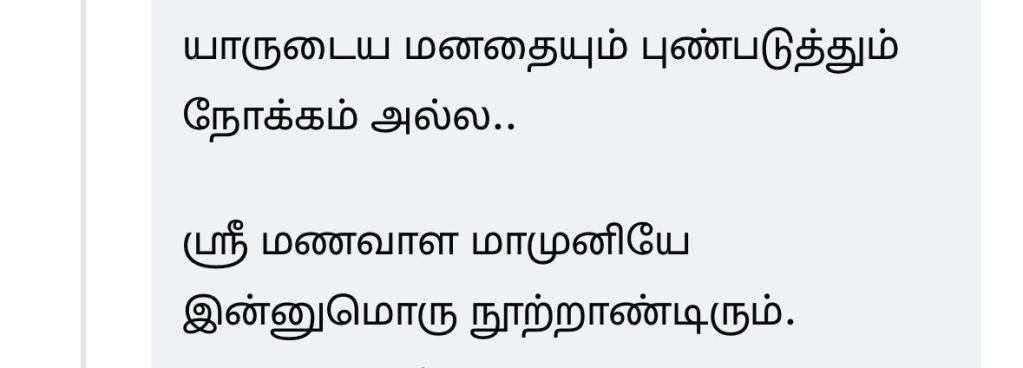
Even amongst the Vadakalai sect, there are a few who openly defend the Tenkalai position much to the chagrin and fury of their sectarian brethren. One Vadakalai member posted his comment on Facebook as follows:

Translation:

What kind of justice is this..?
If there is to be only one “vadakalai”, what is the need for the word “Sri Vaishnava” in the first place..?
Both in Guruparampara works and in the Sri‑Ranga Kovil Ozhugu language say in many places that Sri Vaishnavam is a single tradition, and they keep pointing to only that as one definition of Sri Vaishnavam… So, wherefrom this argument that there were two groups?
The temple whose vimaanam was worshipped by even King Dasaratha, its beautiful ornate halls and pillars… and its sacred shrines … the mādavīdhi streets, the temple ponds and tanks, the sannidhis and everything that stands there, all of them together form the Thirumeni‑svarupa called Sri Vaishnavam.
Even the Muslim descendents of the Khilji invading army that came here long ago proudly recall today their ancestral roots to this tradition of Sri Vaishnavam..
But not the the Vadakalai people!!
They go about breaking and wounding people’s minds! Is it dharma..?
May the memory of Sri Manavala Mamuni live for a hundred more years!

*************

#4: Can you explain to me why the difference of signifying Thenkalai as ‘Y’ and Vadakalai as ‘U’ naamam ?

Me: Well… there are 2 ways to explain the significance. One is the strictly orthodox theology doctrine handed down to us by the Acharyas of both Tenkalai and Vadakalai “parampara”. They each say totally contradictory things about the other’s “naamam” shape and what it signifies. That is the main cause for disputes that few outsiders can really fathom and understand.

Then, there is the unusual, non-sampradaya way of explaining the difference to which no traditional Sri Vaishnava will ever give credence or reverence. However, I will share the same “unusual explanation” with you since I regard myself as a bit of a maverick, “Unusual Sri Vaishnava”, who has never been able to resist in life the temptation to seek “unusual” insights into even the most esoteric aspects of our ancient and most fascinating belief-systems including what I call the “Theo-symbolism” of the “naamam” difference in the Tenkalai and Vadakalai styles that has caused so much ill-will and historical skirmishing between the two.

The naamam (thiruman, तिरुमण्) shape—Y for Thenkalai (toe-tip of nose) and U for Vadakalai (eyebrow junction)—is one visible marker among the Sri Vaishnavas. Vadakalai apply it higher, symbolizing stricter scriptural adherence; Thenkalai lower, aligning with Alvars’ emphasis. Both represent Narayana’s lotus feet (white clay) with Lakshmi’s midline (srichurnam, श्रीचूर्णम्, red/yellow), but the form reflects interpretive variances on Sruti injunctions.

The “U” of the Vadakalais symbolises the “thiruvadi of perumal”, representing only one Sacred Foot of Bhagavan, whereas, it is said, the Tenkalais draw both thiruvadis with lotus-shaped “Y”.

For the Vadakalais, the esotericism of the naamam shape is well-founded in the “pramaanam” (scriptural authority) of the ancient treatise titled “Sath sarithra raksha” authored by Swami Vedanta Desikan. “There are 100+ pramaanams on thiruman-kappu alone that Swami Desikan has referred to and hence there can be no doubts about its authenticity’, says a staunch Vadakalai Iyengar.

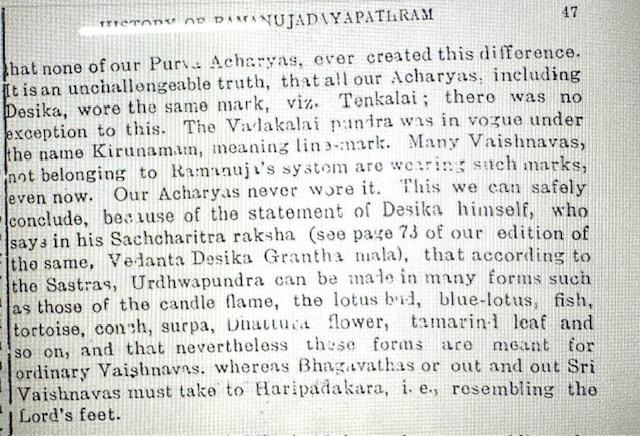
For, the Tenkalai sect, the assertions of the Vadakalais are wholly anathema and false. The noted Tenkalai scholar of Kanchipuram, Sri. Prativadabhayankara Annagarachariar wrote a polemical work titled “Ramanujadayapatram” (1951) in which he claimed that Vedanta Desika himself endorsed only the Tenkalai tiruman and which itself proved that since the days of Sri Ramanuja, the only insignia of Sri Vaishnavism was the Tenkalai naamam with slight variations in form and shape. He implied that the Vadakalai naamam came into vogue only around the 18th century CE when the Vadakalai-Tenkalai sectarian clashes commenced. Below are excerpts from Sri Annangarachariar’s treatise:

**************

#5 : In SriPerumpudur temple, there is the Ramanuja’s statue which is supposed to be the first one installed during his life time (தாம் உகந்த உருவம்). It carrys the ‘thenkalai namam’. How come? And what about all other temples too which all followee suit after his death?

Me: Almost all idols of Ramanuja bear only Y Naamam. Out of 106 Divya desams , only about 10 today belong to Vadakalai sampradayam . So, it’s no surprise that the Y insignia predominates everywhere . The Vadakalais, I am loath to say, have been reduced to a feckless minority sampradayam.

#6 : Thirukkudanthai is a Vadakalai kshetram where Prabhandams were discovered because of the initiative of Sri Nathamuni. I belong to Kudanthai and I am a proud Vadakalai.

#7: According to Bhagavad Ramanuja, a Srivaishnava is one who should shed tears looking at the travails of another Srivaishnava. But look at the fate of Vadagalais, they can’t recite vedanta Desika’s stothras and prabhandams in temples where thengalais have dominance. Stothras of Vedanta Desika cannot be recited in Srirangam ( Bhagavad dhyana sopanam, paduka sahasram, sristhuthi), in Thirukkovilur ( Dehaleesa sthuthi), Thiruppakkutzi (paramartha sthuthi), Thiruvehka (vegasethu sthothram), Ashtabhujam temple ( ashtabhujashtakam), Velukkai (kaamasikaashtakam), Tirumala (Dayasathakam) etc. This speaks volumes about tolerance levels and personalised hatred towards one sect shown by the other. ‎

Me: All the above Vadakalai sentiments of grief and frustration can be sympathised with, no doubt. But unfortunately, in the Courts of Law, the honourable judges will not be moved by them since they have to go strictly by hard evidence and facts. Sentiments have no place in a legal argument.

Furthermore, to the best of my understanding of the Court verdict, there is no bar to the Vadakalai members to assemble in a goshti and chant their litanies in the temple as “ordinary Worshippers” … i.e. so long as it is not at the appointed time when the Tenkalai goshti assembles there in the sanctum or Sannidhi to conduct its own service (“sevakaalam”, “thodakam”, “saatrumarai”).

***********

#8: What is the “unusual and “non-sampradaya” / non-doctrinal explanation for the difference in the significance of “Y” and “U” symbols that you were referring to earlier above?

Me: I don’t claim any originality in offering that explanation since I had learned about it many years ago from a Vadakalai “sampradaya” scholar who possessed great depth of understanding of Sri Ramanuja’s theology and who could— through a bit of lateral thinking— explain the difference in significance to me using the English language. That non-doctrinal, unorthodox explanation helped me, in fact, to better understand what is truly the underlying theologically nuanced explanation for for the “Y” and the “U” symbols of Sri Vaishnavism.

The Pranava mantram (Om) symbol is constituted by 3 syllables — A U M … the English mirrors of what in Sanskrit are अ , उ , and .

“A” signifies Paratattva , “U” signifies Piraatti tattva and “M” signifies Jivatma svarupa.

In the Vadakalai soteriology , salvation (“moksha”) for the jivatma is enabled only through the medium of “Purushaakaaram” — the compassionate interceding or pleading of Piraatti (Lakshmi) with Paramatma for the sake of the jiva who otherwise would not deserve the grace of redemption .

So, in our Vadakalai soteriology , Lakshmi Piraatti, the mediatrix, is at the very core of spiritual salvation .

So , such central tenet is symbolised by the “U” symbol embedded in the Pranava mantra “AUM”. Thus, we bear the symbol “U” on our forehead .

The Tenkalai Y symbol has a more visual than theological significance . For them the Y denotes the shape of the Paduka or sacred feet of Sriman Naaraayana. So, they bear that visual representation upon their foreheads . For, the Tenkalai sampradaya , Piraatti tattva is not the equal of Narayana tattva . For Vadakalais , Piraatti and Narayana tattva are equal and inseparable.

************

The strong objection to the above “non-sampradaya”, most “unusual” explanation was not unanticipated by me. And when it did come as it did from a devout Vadakalai Sri Vaishnava, I knew also that it could not be faulted at all:

#9: For the significance of the U in AUM … it is an English Alphabet. Hence , do you think it is correct to say that we are bearing it on our Foreheads, because it is part of “AUM”? Similarly, by extension, the Principle of 3 Aksharas too?

Me: I do concede that the English U in the AUM is not the same as the Sanskrit syllabled equivalent of उ .

The sacred Pranavam mantra, known as AUM or Omkaara shabdha, the sound of pranavam, breaks down the English alphabets “A U M” into three distinct Sanskrit syllables: अ , उ , and म .

The naamam that we Vadakalais wear on our forehead is certainly not the of the Pranavam but its English equivalent U.

In spite of the above fact, there is one thought to seriously ponder over :

The short vowelis the fifth letter in the Sanskrit vowel alphabets and it is well documented in Sanskrit phonetics and dictionaries.

The 5th place which उ holds is very significant

In Sri Vaishnava theology, the “Panchaakshara mantra” the 5-syllabled mantra — denotes Piraatti tattva (the divine consort Lakshmi’s principle). It is नमो नारायणाय (Namo Nārāyaṇāya). The theological significance of this five-syllable mantra—na-mo nā-rā-ya—invokes Sri Vaishnava reverence for Narayana with his inseparable Piraatti, emphasizing her role as the compassionate mediator in purushaakaara (recommendation for grace).

The Panchaakshara mantra नमो नारायणाय (Namo Nārāyaṇāya), with five syllables (na-mo nā-rā-ya), differs from the Sri Vaishnava Ashtaakshara mantra ॐ नमो नारायणाय (Oṃ Namo Nārāyaṇāya), which adds the Pranava syllable ॐ for eight syllables total (oṃ na-mo nā-rā-ya).

Panchaakshara thus focuses on direct salutation to Narayana and Piratti, together and inseparably, and is used in specific rituals invoking her tattva. Ashtaakshara, the primary rahasya mantra (one of the three secrets), prefixes Pranava to amplify potency, representing complete surrender (upaya) and moksha fruit (phala) per acharyas like Sri Ramanuja.

So, using the 5th vowel of उ and its English equivalent of U as the underlying principle of the Vadakalai U is not wholly inappropriate in my humble opinion. In Andal’s “Tiruppaavai“, you will recall, the 18th Paasuram is famously recognized as “piraatti paasuram“… the hymnal verse signifying “Piraatti tattvam“…. Why?!! ….

ந்து மதகளிற்றன் ஓடாத தோள்வலியன்
நந்தகோபாலன் மருமகளே நப்பின்னாய்
கந்தம் கமழும் குழலீ கடை திறவாய்
வந்து எங்கும் கோழி அழைத்தன காண் மாதவிப்
பந்தல் மேல் பல்கால் குயிலினங்கள் கூவின காண்
பந்தார் விரலி உன் மைத்துனன் பேர் பாடச்
செந்தாமரைக் கையால் சீரார் வளையொலிப்ப
வந்து திறவாய் மகிழ்ந்தேலோர் எம்பாவாய்

Why?!! … Because this verse begins with the syllable “” the Tamil counterpart of the Sanskrit “” … the counterpart of the English “U” …. and all three of which refer to the one and same Piraatti-tattva embedded in the sound of “pranavaakaaram“.

***********

Sudarshan Madabushi

PART- 2 of 2 (CONCLUDED): Did a flawed, ill-conceived legal strategy result in Vadakalais losing their case in the Madras High Court over their rights in Kanchi Varadaraja Perumal temple ?

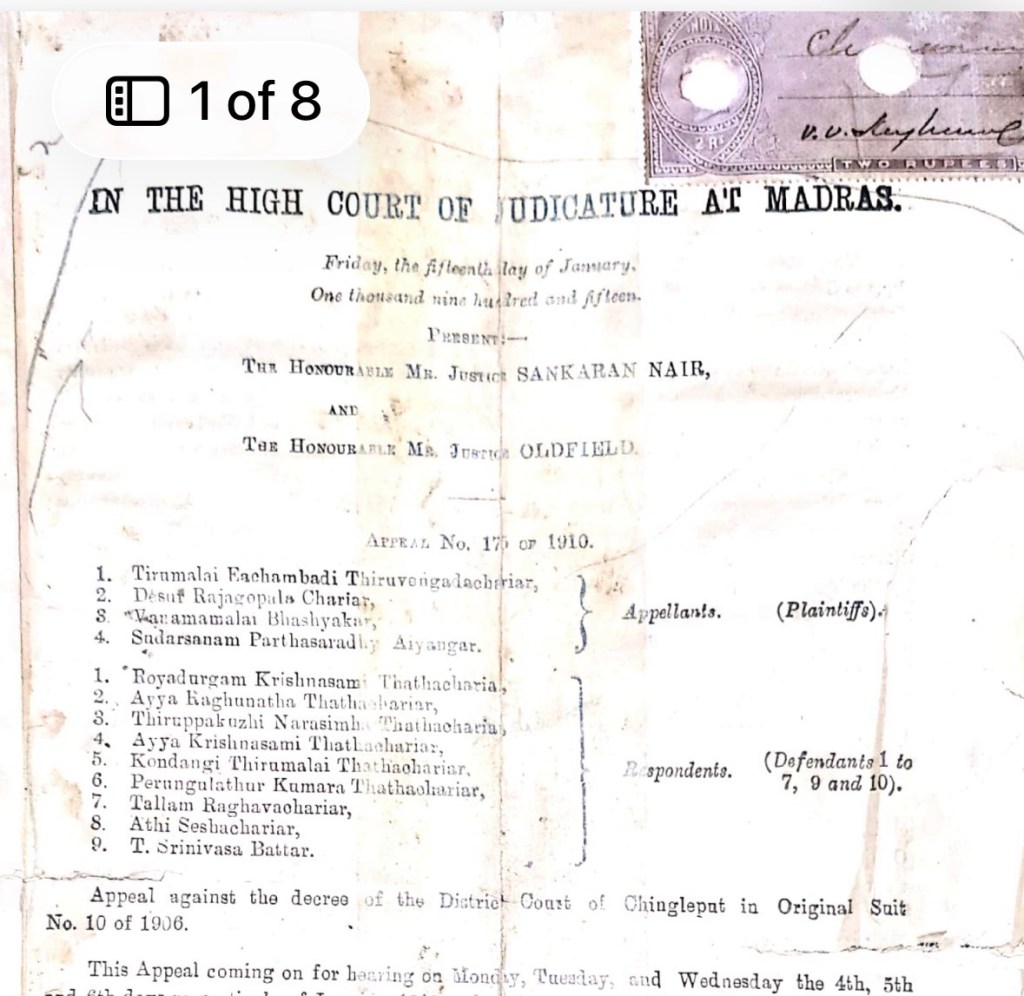
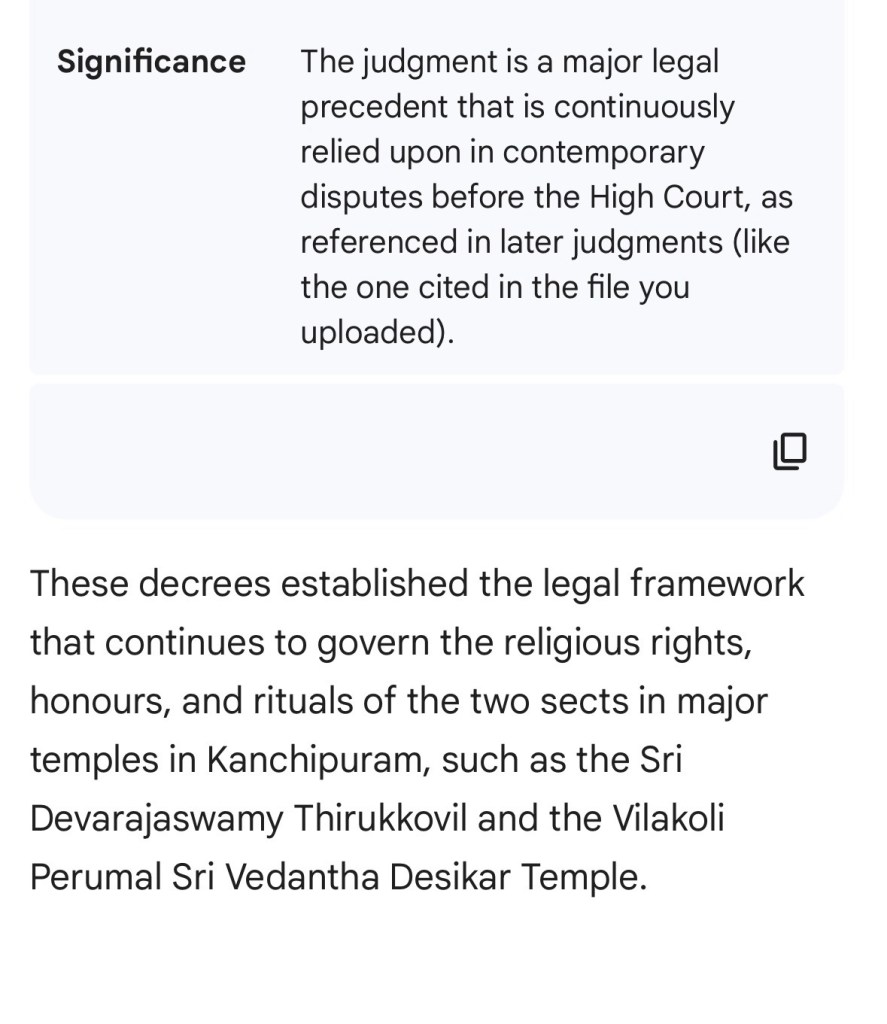
The 1910 decree did certainly establish the legal framework that later, in Kanchipuram right until Nov 28, 2025, became as reported, the single most compelling reason why the Madras High Court relied upon it as overriding precedent governing the religious rights, honours, and rituals of the Tenkalai and Vadakalai sects in all major temples such as the Sri Devarajaswamy Thirukkovil and the Vilakoli Perumal Sri Vedantha Desikar Temple.

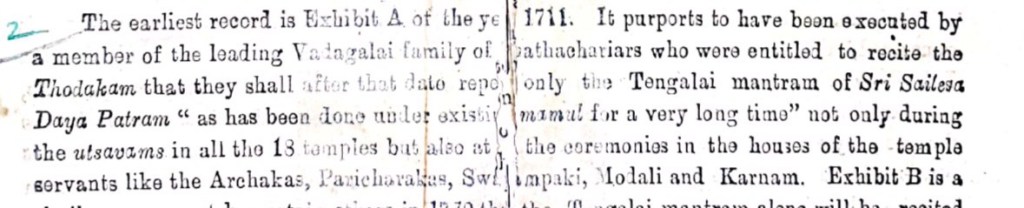
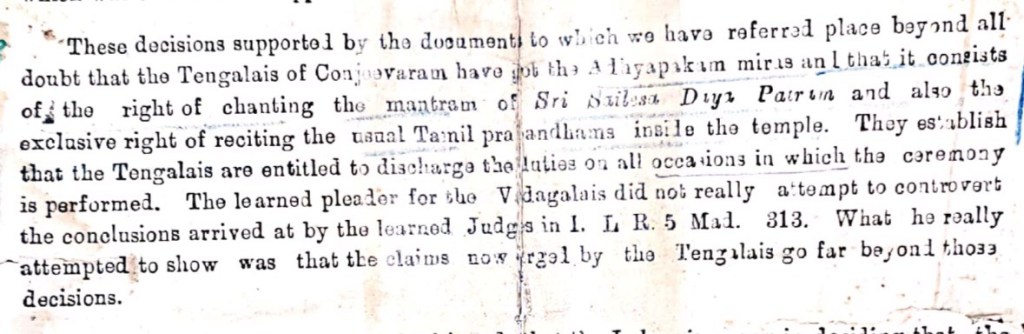
Below is an extract from that 1910-15 Decree that reveals the underlying rationale of the then Court’s Order:

In the above extracts, there is mention of a certain “Exhibit A of the year 1711” which the Court takes cognisance of as being “the earliest record …. (that) purports to have been executed by a member of the leading Vadakalai family of Thathacharisrs who were entitled to recite the “Thodakam” (commencement of ritual ceremony in the temple) that they shall after that date recite the Tengalai mantram of “Sri Sailesa Daya Patram” as had been done under existing “mamul” for a very long time not only during the “utsavams” in all the 13 temples (of Kanchipuram) but also at the ceremonies in the houses of the temple servants like the Archakas, Paricharikas,, Swamipaki, Molali and Karnam (all temple servitors).

It is precisely this “Exhibit A” as so-called purported document of 1711 which the Court then – in 1910 – held to be conclusive evidence of the solemn and legally binding undertaking given by a Thathachari family member to willingly chant only the Tenkalai Tanian litany of “Sri Sailesa Dayapatram” inside the temple and to abandon the Vadakalai Tanian of “Ramanuja Daya Patram Tanian”.

That “purported document” mentioned as “Exhibit A” in the 1910 Court order was really not any sort or form of legal Agreement or Affidavit at all! It was an unverifiable , inauthentic and mere hearsay historical document that came to be called “Atthaan Jeeyar Agreement”.

WHAT IS THE “ATTHAAN JEEYAR AGREEMENT”?

The Atthaan Jiyar Agreement of Kanchipuram refers to a historical agreement associated with the administration and custodianship of the Sri Varadarajaswami Temple in Kanchipuram. This agreement was signed by one Ettur Immadi Lakshmikumara Tatacharya and delivered to one Attan Jiyar, a significant religious figure entrusted with responsibilities in the temple’s management during the tumultuous era of Muslim invasion of South India under the reign of Moghul Emperor, Aurangzeb.

The agreement holds legal significance as it played a role in establishing the authority and rights of the Jiyar (a religious official) and the Tatacharya family in managing the temple’s affairs, including the upkeep, administration, and possibly the distribution of temple assets and endowments.


Legally, the Atthaan Jiyar Agreement became very significant because it was used by the Courts during the British Colonial era as a convenient foundational document in historical disputes and litigations over temple control and management that had continued over the centuries.


The agreement always remained contentious primarily due to its sectarian implications and the complex, long-standing rivalry between Vadakalai and Tenkalai factions associated with the temple. It was part of larger disputes involving religious authority, temple management rights, and interpretations of historical privileges. The contending parties interpreted the agreement and related historical records differently, thus fueling ongoing disagreements about rightful custodianship and control of temple assets, rituals, and property. This sectarian contestation highlighted how historical religious agreements —lacking legal genuineness — nonetheless retained juridical and cultural weight in contemporary temple administration disputes also.

There is no clear public record or evidence to this day that the original Atthaan Jiyar Agreement of Kanchipuram is preserved in any accessible archive. However, attested copies or certified reproductions of older historical agreements related or incidental to religious institutions are sometimes maintained by temple trusts or regional archives, though such documents are often not digitized or publicly available.

Some British-era records and related government documents involving temple affairs from the 19th century had been attested by officials and preserved in local archives or libraries.But a specific attested copy of the Atthaan Jiyar Agreement itself has never been explicitly identified in known public archives or government repositories at any time in history of Kanchipuram.

Even though the original or directly attested copy of the Atthaan Jiyar Agreement is not found today, courts accepted — as in 1910-1915 ! — secondary forms of proof and considered the document’s historical and customary weight, confirmed through community practice and additional or collateral evidence. This blend of legal doctrine and evidentiary flexibility allowed the agreement to be used as a “foundational document” in later ongoing litigation about temple management between the Vadakalai and Tenkalai sects.


In summary:
• The original Atthaan Jiyar Agreement was never publicly available.
• No specific attested copy was or is currently known in archives.
• Courts, including the Court in 1910–1915, however, continued to admit the agreement based on evidentiary rules for ancient documents and secondary proof.
• Notarization and community acknowledgment bolstered the agreement’s legal standing in such disputes.
• Such approach thus explained how the agreement came to influence all contemporary litigation despite original document absence.


This is why the Atthaan Jiyar Agreement played such a legally significant and contentious role in court cases involving the Tenkalai and Vadakalai sects from 1711 onwards right until 1910-1915.

*********

In view of all the above historical and legal developments, the Vadakalais of Kanchipuram came to be left stranded high and dry :

— the Atthaan Jeeyar Agreement “purportedly” became so-called “settled evidence” of the Thathachari family conceding to the Tenkalai sect their right to chant “Ramanuja Daya Patram” litany;

— the 1910-1915 Court Decrees effectively put legal seal of resolution on the matter; and the Tenkalais were held to be the legitimate claimants to all religious rights in the Kanchipuram Varadarajan Temple.

— Now comes the 2025 Madras High Court Order upholding the Decrees of 1910-1915 and 1963 which has finally driven the final nail into the coffin, as it were, of several legal cases that the Vadakalai sect for so many past decades had been filing in courts pressing for and hoping to reclaim their own rights in the temple.

**************

How can the Vadakalais legal counsels revise their strategy now? What strategies can be effective?

The Vadakalais’ legal counsels need to fundamentally revise their strategy away from directly challenging the final, binding civil decrees (the principle of res judicata) and the administrative orders (like the EO’s Notice) that merely enforce them.

The 2025 High Court judgment has upheld the exclusive mirasi right of the Thenkalais during official service, making further direct challenges on this core issue highly unlikely to succeed in appellate courts unless a gross error of law is demonstrated.

An effective, revised strategy must focus on interpretation, scope limitation, and securing rights as ordinary worshippers.


Revised Legal Strategy for the Vadakalais

1. The Direct Appellate Path (To the Supreme Court)

The immediate and primary legal action would be to file a Special Leave Petition (SLP) before the Supreme Court of India challenging the 2025 High Court Common Judgment.

  • Objective: Argue that the High Court failed to adequately address the conflict between the pre-Constitutional decrees (1915 and 1969) and the fundamental right to religious freedom and equality (Articles 25 and 26 of the Constitution).
  • Focus: Counsel must argue that while the hereditary proprietary right to the mirasi(the right to be paid and lead the goshti) may be settled, the blanket prohibition on individual or group worship by the Vadakalais, which involves reciting their own Acharya’s mantram at other times or places in the temple complex, violates their right to practice their religion.
  • CHANCES OF SUCCESS OF THE SUPREME COURT ENTERTAINING an SLP :
  • The 2025 Madras High Court “Common Judgment” (likely akin to June 2025 rulings urging unity between sects as “two petals on one stem”) emphasizes harmony in Kanchipuram temples like Varadaraja Perumal or Vilakkoli Perumal, viewing such conflicts as historical rather than rights violations. No records show an SLP yet filed or admitted in this exact matter, but the Court’s weariness with “never-ending” sect disputes (as noted in High Court observations) may deter admission unless the petition demonstrates interference with core religious practice beyond settled proprietary rights. Strong drafting highlighting equality in general worshipper status and narrow decree interpretation could boost chances to 20-25%, aligning with SLP trends in constitutional religious cases.

    A 15-25% admission likelihood emerges if the SLP stresses unaddressed Article 25 violations in non-seva areas, differentiating it from prior High Court dismissals focused on official goshti. Courts often prioritize public order and mediation in Vaishnava sect clashes, so pairing the SLP with HR&CE SOP requests may indirectly aid by signaling practical resolution efforts. Overall, success hinges on proving “grave injustice” without revisiting factual mirasi findings.

2. Strategy of Narrow Interpretation (Restricting the Decree’s Scope)

This is the most critical strategy for daily practice, aiming to limit the application of the decrees to the narrowest possible circumstances.

  • Limit the Mirasi Right: Argue that the exclusive Adhiapakam Miras only applies to the official, State-sanctioned ceremonial service (Seva Kalam), typically occurring inside the temple near the sanctum sanctorum at specific times.
  • Differentiate Recitation: Clearly distinguish between:
    • (a) Official Service (Prohibited):Where the Thenkalai mirasidar is performing his paid duty.
    • (b) General Worship (Permitted):Where a Vadakalai devotee, acting as an ordinary worshipper, recites the Divya Prabandham or their Guru mantram (like Sri Ramanuja Dayapathramoutside the official goshti, in the temple courtyards, or during non-service hours.

3. Assertion of General Worshipper Rights

The Vadakalais must leverage their undeniable status as members of the Hindu public and as general worshippers of Lord Varadaraja Perumal.

  • Focus on Public Space and Worship: File a fresh civil suit (if necessary) or a representation to the HR&CE Department asserting that:
    • The right to enter a public temple and worship is a fundamental right, and the mirasi decrees cannot restrict individual worship or quiet group recitation by devotees who are not interfering with the main goshti.
    • The 1915 decree on goshti (congregation) applies primarily to the Vedic Goshti during processions on public streets, and should not be stretched to prohibit all forms of recitation within the vast temple complex.

4. Administrative and Mediation Approach

Since the courts are weary of the “never-ending problem,” a diplomatic approach may be beneficial.

  • HR&CE Intervention: Seek mandatory intervention from the Hindu Religious and Charitable Endowments (HR&CE) Department to establish a written Code of Conduct or Standard Operating Procedure (SOP). This SOP should clearly demarcate the time and space for the Thenkalai exclusive mirasi rights and the time and space for general worship by all devotees, including the Vadakalais, ensuring minimal friction.
  • Appeal to Unity: As the High Court has often noted, both sects are “two petals on one stem.” The counsel could advise the Vadakalai leadership to engage in mediationwith the Thenkalai leadership, possibly under the supervision of a revered Acharya or a retired judge, to find a practical, spiritual, and peaceful compromise that respects the historical mirasi while allowing space for both traditions to coexist.

**************

CONCLUDED

Sudarshan Madabushi

PART-1 of 2: Did a flawed, ill-conceived legal strategy result in Vadakalais losing their case in the Madras High Court over their rights in Kanchi Varadaraja Perumal temple ?

This detailed analysis below of the Common Judgment dated November 28, 2025, passed by the Division Bench of the High Court of Judicature at Madras in a batch of cases (including W.A. Nos. 1381 & 1382 of 2022) reveals the plausible story of how and why perhaps a flawed legal strategy adopted by the Vadakalais litigants to secure their priestly rights within the Kanchipuram Sri Varadaraja Perumal temple led to their case coming a cropper .

Disclaimer : I am not a lawyer and do not lay claim to in-depth knowledge of Constitutional Law . The below Notes were generated by me simply by submitting what I considered were relevant and intelligent common man’s prompts/questions to AI tool.

**************

The judgment addresses a long-standing, volatile sectarian dispute between the Thengalai and Vadagalai sects of Sri Vaishnavites over performing ceremonial worship rights at the Arulmigu Devarajaswamy Thirukkovil in Kancheepuram.

  • The Vadagalai Contention: The Vadagalais argued that the old civil judgments (e.g., Appeal No. 175 of 1910 and Appeal No. 283 of 1963) violated their fundamental rights under Articles 25 and 26 (Freedom of conscience and free profession of religion; Freedom to manage religious affairs) and should be set aside in the present writ proceedings.
  • The Court’s Holding: The Court emphatically rejected this challenge, relying on the nine-member Supreme Court Bench decision in Naresh Shridhar Mirajkar (AIR 1967 SC 1). The Court held that judicial orders passed by a competent court, which have attained finality, cannot be challenged in writ proceedings on the ground of violation of fundamental rights and no Writ of Certiorari would lie against them.
  • The Court’s Holding: The Court determined that the ‘Mirasi Right’ of the Tenkalais is a “perfect blend of religious right as well as property right”. This right is protected under Article 26(c) and (d) of the Constitution (right to own and acquire movable and immovable property and to administer such property in accordance with law). The right to the office, having been conferred on Tenkalais residing at Kancheepuram), is a perpetual and heritable one.
  • The Vadagalai Petition was deemed to deserve dismissal as it was an attempt to indirectly challenge final judicial orders on untenable grounds.
  • The Vadakalai sect chose to file a Writ Petition primarily because the Appeal route against the 1910 and 1963 Decrees was legally foreclosed due to the extreme age of the original civil court decrees, and they were attempting a strategy to challenge the continuing effect of these old decrees on modern constitutional grounds.
  • An appeal against a civil court decree must be filed within a strict and relatively short period (usually 30 to 90 days, depending on the court, under the Limitation Act). Since the decrees were passed in 1910 and 1963, the time limit for filing an appeal had already expired decades ago. The 1910 and 1963 judgments had long attained finality, meaning they were conclusive and binding on the parties involved. (Res Judicata).
  • Since a direct appeal was impossible, the Vadakalai sect adopted the strategy of using the High Court’s extraordinary Writ Jurisdiction (Article 226 of the Constitution) to indirectly challenge the validity of the centuries-old decrees.
  • The strategy focused on two main legal arguments:
    Challenging an Executive Order: The Vadakalai W.P. was filed against a recent notice issued by the Executive Trustee of the temple, which sought to restrict Vadakalai recitation rights based on the old civil decrees. The Writ Petition (W.P.) sought a Writ of Certiorari to quash this administrative notice.
  • Violation of Fundamental Rights (Articles 25 & 26): The core Vadakalai argument asserted that enforcing a decree that granted exclusive rights to one sect, while excluding another, violated the fundamental rights of the Vadakalai devotees to:
    Freedom of Conscience and Religion (Article 25).
    Freedom to Manage Religious Affairs (Article 26).
  • The intent was to argue that, regardless of the old civil judgments of 1910 and 1963, the Constitution, being the supreme law, nullified the effect of the discriminatory decrees on the ground that they perpetuate the caste system or violate modern religious freedom rights.
  • The Court however held that judicial orders passed by a competent civil court, which have attained finality, cannot be challenged in writ proceedings on the ground of violation of fundamental rights.
    the Division Bench ruled that the Vadakalai petition was an unsuccessful attempt to reopen settled civil litigation using the pretext of an administrative order and a constitutional challenge.
  • The court, by upholding the Mirasi right and the non-applicability of limitation, necessarily cleared the path for the enforcement of the Thengalai sector’s exclusive recitation rights as originally decreed.
  • Consequently, the Thengalai Petition was disposed of with strict directions to the Temple’s Executive Trustee and Police Dept. to ensure that the temple administration strictly adheres to the terms of the 1910 and 1963 judgments defining the Thengalai sect’s specific rights to Adhiapaka Mirasi.

WHAT WERE THE 1910 and 1963 JUDGMENTS?

Significance of the 1910/1915 Decree:

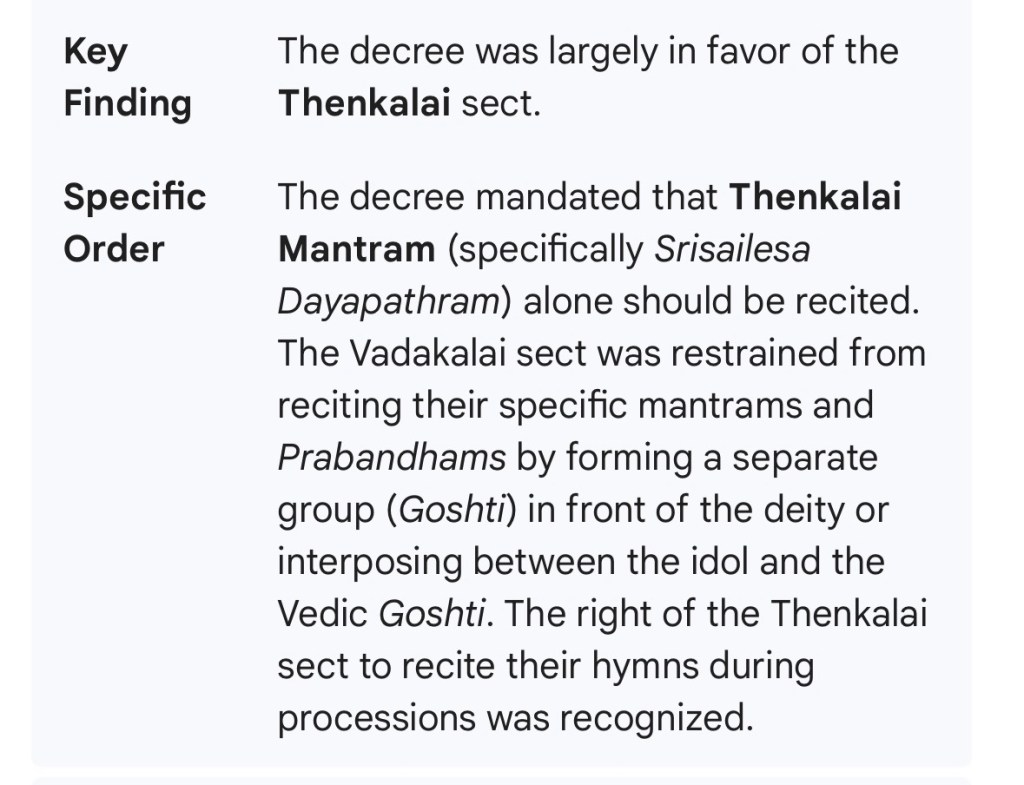
This decree related to the ritual practices at the Sri Varadarajaswami Temple in Kanchipuram and largely settled the question of who had the right to recite certain texts during worship and processions.

  • Recitation Rights: It was a modification of a lower court’s decree, which ultimately:
    • Upheld the Thengalai right to lead the ceremonial chanting (Adhyapakam Miras) by reciting their distinctive mantram (Sreesailesa Dayapathram) in front of the idol during the Pooja/worship period.
    • Allowed Vadakalais to form a separate group (goshti) to sing their own Prabandhams and Mantrams, but mandated that they must do so behind the Vedic goshti and not in front of the idol during the core worship period.

Present Status of the Vadakalais’ Rights under the 2025 Order

The 2025 High Court Common Judgment (pronounced on 28.11.2025) effectively maintains the status quo established by the earlier decrees.

  • The Court’s directive is to implement the decrees passed in both the 1910 and 1963 cases in their “letter and spirit”.
  • The Vadakalais’ rights remain subject to the prohibitions in the earlier decrees: They are generally restrained from reciting their own specific mantram (‘Ramanuja Deyapatram’) or their own Vazhi Thirunamam during the official ceremonial worship (Puja time) and processions, as this is exclusive to the Thenkalai Adhiapaka Miras.
  • The entire litigation in 2025 was an effort to ensure the Adhiapakam service adheres strictly to the earlier judgments, which declared the Thenkalais’ right to commence the recitation with the Thenkalai mantram(‘Sri Sailesa Dayapatram’) and conclude with their Vazhi Thirunamam..

How should/could the Vadakalais have handled the executive order better?

The Vadakalais’ handling of the Executive Officer’s (EO’s) Notice (dated 14.05.2022) ultimately led to the High Court affirming the Notice.

From a purely legal and strategic standpoint, the Vadakalais could have potentially handled the situation better in the following ways, recognizing the difficulty posed by the existing, binding decrees from 1915 and 1969:


Strategic Options for the Vadakalais

1. Avoiding a Direct Challenge (Writ Petition)

The Vadakalais’ primary legal error was challenging the EO’s Notice through a Writ Petition (W.P.No.12955 of 2022) seeking a Writ of Certiorari to quash it.

  • The Problem: The EO’s Notice was an administrative order that merely sought to implement the final, binding judicial decrees of 1915 and 1969. The High Court views such administrative orders that enforce prior decrees as legally sound. Challenging it on constitutional grounds (violation of fundamental rights) was almost certain to fail because the court’s core finding was that the matter was res judicata (already settled by judicial decree).
  • Better Approach: Instead of a direct challenge, the Vadakalais could have sought to clarify, not quash, the EO’s order. They could have filed a representation with the temple authorities or a civil application seeking clarification that the EO’s order:
    • Applies only to the ceremonial Adhiapakam Miras during the official Seva Kalam (worship period).
    • Does not restrict the Vadakalais’ rights as ordinary worshippers at other times, or their right to recite their Prabandhams in their own homes or other public spaces. This would have narrowed the scope of the dispute and might have been partially successful.

2. Focusing on Change of Circumstances or Custom

The Vadakalais’ arguments were heavily focused on constitutional rights and challenging the validity of the older decrees, which the High Court rejected as impermissible in a subsequent proceeding.

  • The Problem: The High Court explicitly stated that the matter of who owns the mirasi is a proprietary right settled by final civil decrees.
  • Better Approach: The Vadakalais could have focused on establishing that the customary practices of the temple had evolved since 1969, and that a co-existing right of recitation had been silently permitted by the temple administration for decades. By proving an established, continuous, and non-controversial new custom, they might have argued for an equitable modification or interpretation of the EO’s enforcement.

3. Proactive Use of Contempt Proceedings (Counter-Contempt)

The Thenkalais filed the original Contempt Petition (Cont.P.No.367 of 2020).

  • The Problem: The Vadakalais were put in a defensive position, arguing against the contempt petition.
  • Better Approach: The Vadakalais could have simultaneously filed their own contempt petition against the Executive Trustee based on the non-implementation of the parts of the 1915 decree that recognized some of their rights (such as the right to form a goshti behind the main Vedic goshti on the public street, as detailed in some earlier rulings). This strategy, sometimes called “counter-contempt,” puts pressure on the administration to implement all parts of the decree equally, potentially creating space for Vadakalai participation.

In summary, the most effective strategy would have been to avoid challenging the EO’s order outright and instead seek an interpretation or clarification that restricted the order’s scope only to the exclusive ceremonial service, thereby preserving their rights as general worshippers. The attempt to quash an order that enforced a final decree was a very high hurdle to overcome.

****************

(To be concluded)

Sudarshan Madabushi
சுஜாதாதனது 70ஆவதுபிறந்ததினத்தைப் (2005) பற்றிக்கூறியது…

இன்னொரு வருஷம் இந்தநாள்… நான் 70 கடக்கப் போறேன். இருப்பேன் இல்லையா? சொல்ல முடியாது. அதான் சுஜாதாவோட 70-யோசனை வாட்ஸ்அப்ப்ல வந்ததை இப்பவே சாப்பிட்டு, எழுபது வயசு கிண்டி ஜெலிப்ரேட் (celebrate) பண்ணிட்டேன். சுகம்!

அவர் டாப்-10 லிஸ்ட்: பேஸிங்ஸ் சில, பயம் சில, விஷ்கள் சில – எல்லாம் கலந்து. எனக்கு? அதே லிஸ்ட்! 70-திசை சூழ்ந்திருக்கே. ப்ளஸ் ஒன்னு: இறப்ப வரை Nithya Sandhyavandanam-உம் Bhagavath Tiruvaaradanam-உம் தொடரணும்.

🙏
எம் கே சுதர்ஶன்

**********

இப்படியும் ஒரு மாறுதலான பிறந்த நாள் குறிப்புக்கள்!

சுஜாதா தனது 70ஆவது பிறந்த தினத்தைப் (2005) பற்றிக் கூறியது.

Sujatha

“மே மாதம் மூன்றாம் தேதி, எனக்கு எழுபது வயது நிறைகிறது. இதற்கான அடையாளங்கள் என்ன என்று யோசித்துப் பார்க்கிறேன்.

மெரீனாவில் நடக்கும்போது எதிர்ப்படுபவர்கள் பெரும் பாலும் என்னைவிட சின்ன வயசுக்காரர்களாகத் தெரிகிறார்கள்.

ஒரு தாத்தா மாட்டினார். நிச்சயம் என்னைவிட மூத்தவர். சிமென்ட் பெஞ்சில், என் பக்கத்தில் வந்து உட்கார்ந்தார்.

“யு ஆர் எ ரைட்டர்! எனக்கு எத்தனை வயசு சொல்லுங்க, பார்க்கலாம்!” என்று கண் சிமிட்டலுடன் கேட்டார்.

நான் யோசித்து, ”கட்டை விரலால் மூக்கைத் தொடுங்கோ” என்றேன்.

“எதுக்குப்பா?”

“தொடுங்களேன்!”

சற்று வியப்புடன் தொட்டார்.

“மத்த விரல்களை றெக்கை மாதிரி அசையுங்கோ!” என்றேன்.

”இதிலிருந்து கண்டுபிடிச்சுட முடியுமா, என்ன? என்று, விரல்களைச் சொன்னபடி அசைத்தார்.

“ரெண்டு கையையும் பரப்பி, ஏரோப்ளேன் மாதிரி வெச்சுண்டு ஒரே ஒரு தடவை லேசா குதிங்கோ. பாத்து… பாத்து…”

“இது என்னப்பா ட்ரிக்கு?” என்று அப்படியே செய்தார்.

“உங்களுக்கு இந்த மே பன்னண்டு வந்தா எண்பத்தோரு வயசு!” என்றேன்.

அசந்து போய், “கை குடு. எப்படிப்பா இத்தனை கரெக்டா சொன்னே?”

“ஒரு ட்ரிக்கும் இல்லை, சார்! நேத்திக்குதான் இதே பெஞ்சில், இதே சமயம் வந்து உட்கார்ந்து, உங்க வயசு, பர்த்டே எல்லாம் சொன்னீங்க. மறந்துட்டீங்க!” என்றேன்.

தாத்தா மாதிரி அத்தனை மோசம் இல்லை என்றாலும், எனக்கும் சமீபத்திய ஞாபகங்கள் சற்றே பிசகுகின்றன.

ஒரு அறையிலிருந்து மற்றொரு அறைக்குச் சென்றால்,எதற்காக வந்தோம் என்பது மறந்தே போகிறது.

பெயர்கள் ஞாபகம் இருப்பதில்லை. ஆந்தைக்கு இங்கிலீஷில் என்ன என்று சட்டென நினைவு வருவதில்லை.

‘படையப்பா’வில் ரஜினிக்கு முன்னால் கால் போட்டுக் கொண்டு உட்கார்ந்தாரே… அந்த நடிகையின் பெயர் என்ன என்று ஒரு நாள் அதிகாலை கண் விழித்ததும், ஒருமணி நேரம் யோசித்தேன், கிட்டவில்லை. மனைவி எழக் காத்திருந்து அவளிடம் கேட்டேன். “ரம்யா கிருஷ்ணன்” என்றாள்.

இம்மாதிரி, நியூரான்கள் களைத்துப் போவது தெரிகிறது. ஆனால், நீண்ட நாள் ஞாபகங்கள் பத்திரமாக இருக்கின்றன. அது மூளையில் வேறு பேட்டை போலும்!

கிட்டத்தட்ட அறுபது ஆண்டுகளுக்கு முன், சின்ன வயசில் கோயமுத்தூரில் அம்மா அப்பாவுடன் ஜட்கா வண்டியில் “ஜகதலப்ரதாபன்” சினிமா போனது,
ஒண்ணாம் கிளாஸ் டீச்சருக்கு ஆனந்த விகடனும், அமிர்தாஞ்சனும் கொண்டு போய்க் கொடுத்தது,
பள்ளி மணியை அகாலமாக அடித்தது,
எனக்குத் தம்பி பிறந்தது…

இதெல்லாம் தெளிவாக ஞாபகம் உள்ளது.

ஸ்ரீரங்கத்துக் கதைகள் அனைத்தும் என் நீண்ட நாள் ஞாபகங்களின் வடிவம்தான்!

டெல்லியில், பெட்ரோல் எழுபத்தைந்து பைசாவும், பால் ஐம்பத்தைந்து பைசாவும் கொடுத்து வாங்கி தாராள மாக வாழ்ந்தது, என் முதல் கதை, முதல் நாவல் பிரசுரமானது, எஸ்.ஏ.பி’யின் கடிதக் குறிப்பு எல்லாம் ஞாபகம் உள்ளது.

ரம்யா கிருஷ்ணன் போன்ற மேட்டர் தான் சட்டென்று வழுக்கிவிடுகிறது. மெரீனாவில், ஷார்ட்ஸ் ஸ்னீக்கரில் ஓடும் இளைஞர்களைப் பார்த்து முன்பு பொறாமைப்படுவேன். இப்போது புன்னகைக்கிறேன்.

பொதுவாகவே, பொறாமைப் படுவதற்கான விஷயங்களும், அதட்டிச் சொல்வதற் கான விஷயங்களும் குறைந்து வருகின்றன.

ஹிந்துவின் “ஆபிச்சுவரி” பார்க்கையில், இறந்தவர் என்னைவிட சின்னவரா, பெரியவரா என்று முதலில் பார்ப்பேன்.

சின்னவராக இருந்தால், ‘பரவால்லை… நாம தப்பிச்சோம்!’ என்றும், பெரியவ ராக இருந்தால் கழித்துப் பார்த்து, ‘பரவால்லை… இன்னும் கொஞ்ச நாள் இருக்கு என்றும் எண்ணுவேன்.

எதிர்காலம் என்பதை இப்போதெல்லாம் வருஷக் கணக்கில் நினைத்துப் பார்ப்பது இல்லை. மாதக் கணக்கில்…ஏன், உடம்பு சரியில்லாமல் இருக்கும்போது வாரக்கணக்கில், நாள் கணக்கில் அந்தந்த நாளை வாழத் தோன்றுகிறது.

Today I am alright, thank God!

ஆரம்பத்தில் இளைஞனாக இருந்த போது, ஏரோப்ளேன் ஓட்டவும், கித்தார் வாசித்து உலகை வெல்லவும், நிலவை விலை பேசவும் ஆசைப்பட்டேன்.

நாளடைவில் இந்த இச்சைகள் படிப்படியாகத் திருத்தப்பட்டு, எளிமைப் படுத்தப் பட்டு, எழுபது வயதில் காலை எழுந்தவுடன் சுகமாக பாத்ரூம் போனாலே சந்தோஷப்படுகிறேன்.

வாழ்க்கையே இவ்வகையில் progressive compromises (படிப்படியான சமரசங்களால் ஆனது).

இன்றைய தினத்தில், என் டாப்டென் கவலைகள் அல்லது தேவைகள் என்றால்…

முதலிடத்தில் –

  • உடல் நலம் / மனநலம்,
  • மற்றவருக்குத் தொந்தரவு கொடுக்காமல் இருப்பது,
  • தெரிந்தோ தெரியாமலோ யார் மனதையும் புண்படுத்தாமல் இருப்பது,
  • இன்சொல்,அனுதாபம்,
  • நல்ல காபி,
  • நகைச்சுவை உணர்வு,
  • நான்கு பக்கமாவது படிப்பது, எழுதுவது

போன்றவை பட்டியலில் உள்ளன….

யோசித்துப் பார்த்தால் “பணம்” அந்தப் பட்டியலில் இல்லை…..

நன்றி: “கற்றதும் பெற்றதும்நூலிலிருந்து.

What’s the hallmark of a Sri Vaishnava “Kovil”? The “Rangarajan Narasimhan Doctrine”!

This debate is old, petty, stale, futile and reflects so poorly on the general cultural traits of the entire Sri Vaishnava community of Tamil Nadu.

Sri. Rangarajan Narasimhan has made his name as an indefatigable firebrand activist for protection of Hindu temples in Tamil Nadu. I have great personal respect for him on that account.

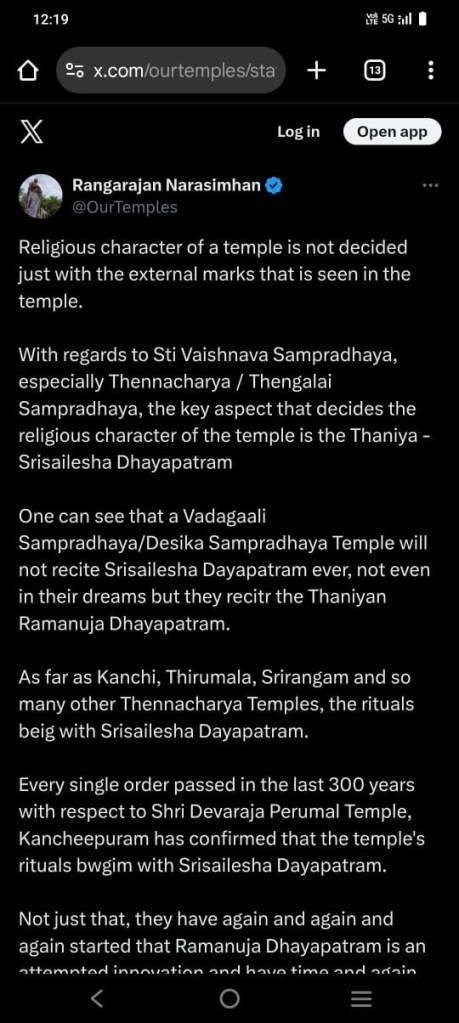
However, his recent public pronouncements on the recent High Court verdict given on the disputed rights of the Tenkalai and Vadakalai sampradayam inside the Kanchipuram Sri Varadaraja Perumal Kovil, all smack of triumphalist intemperance … bordering on arrogance. His X posting as a tweet above on the “Sri Sailesa Dayaapaatram” Vs “Ramanuja Dayaapaatram Tanian” controversy is a clear reflection of such an attitude of religious imperiousness if not imperialism.

This age-old “Tanian” controversy has for the last 200 years been the bane and unmitigated shame of the Sri Vaishnavas of Kanchipuram. The Tenkalai-Vadakalai goshti (priestly assemblies inside the sanctum) have bitterly fought (sometimes even descending to the level of fisticuffs!) for their respective right to sing their own respective Tanian litany as offering of worship to the Deity by chanting aloud the glories of their respective Acharya lineage and pantheon. The two century old dispute has gone to the Courts for resolution dozens of times! The arguments put up by representing lawyers in the various courts for and against each of the Tanians would perhaps indeed fill volumes in a full-sized library! The arguments of both sides have been endless, bitter, cantankerous, pedantic, obtuse, arcane … and, many a time, ludicrous!

Sri Rangarajan Narasimhan’s X post today is thus nothing more than a grand, gloating and culminating reiteration of all such arguments of the Tenkalai litigants made before the honourable judges yesterday and which won the day in court.

This Tanian controversy to anyone who is not a Sri Vaishnava might strike one as just a farce .. a saga of tragi-comedy of epic proportions.

Rangarajan Narasimhan’s own pronouncement on his X post is nothing but a flourish of exuberance being waved about in the digital marketplace in the heady moment of savouring diehard Tenkalai triumph following the Court verdict favouring their sect but it is truly as puerile as two schoolboys arguing over which is a better national anthem ? “Jana Gana Mana…” or “Vande Maataram”?

Both anthems are wonderful patriotic hymns in praise of our country . But then just because the former has been gazetted by the Government to be the official national anthem does it mean “Vande Maataramcannot or should not be sung with fervour and pride by Indians? How then can anyone make the absurd claim that a Sri Vaishnava temple cannot be Sri Vaishnava in character if “Ramanuja Daya Paatram” is sung therein ?

Is Rangarajan Narasimhan’s great Doctrine going to be then extended to its perverse conclusion that those Vadakalais who chant “Ramanuja Daya Paatram” also have all lost their Sri Vaishnava character?! In Vedantic thought, the human Sarira itself is held to be “devaalayam”, isn’t it?

The “Decline and Fall of “ubhaya vedantins” I fear cannot be arrested or reversed so long as this kind of rabid bigotry continues to be practised within this community by such influential insiders and otherwise doughty Sampradaya activists/champions like this Sri Vaishnava gentleman from Sri Rangam.

Adiyen daaaoham 🙏

Sudarshan Madabushi

The morning after Madras High Court verdict on the Kanchipuram Sri Varadaraja Perumal Temple: “Vadakalai” cause finally lost?

Yesterday, November 28, 2025 will go down as a sad, black day of mourning for the Vadakalai Sri Vaishnava sectarian community in India and abroad.

The Madras High Court has legally affirmed that the Kanchipuram Vadakalai temple must be treated as a Thenkalai/Thennacharya Sampradaya temple, with corresponding denominational rights flowing primarily to the Thennacharya group under Article 26 of the Constitution.

It is no surprise that, today, November 29th, being the morning after, sees many hundreds of the Vadakalai Sri Vaishnava sectarian community going numb with shell-shock on reading about the news of the temple now legally going out of their hands into the administrative and managerial reins of the Tenkalai sectarian group. Quite naturally, a pall of hushed anguish and sheer despair seems to have descended upon all Vadakalai devotees of Kanchi Varadar Kovil…. The spirit of “ubhaya-vedanta” seems to have been dealt a grievous if not fatal blow delivered by the secular justice system of the State.

One Vadakalai member of the priestly group in Kanchipuram could not help venting his feeling of defeat and bitterness to me via a WhatsApp message sent this morning. I could gauge the depth of his personal distress since I knew that the Court verdict to him was a negation of the high ideals of “ubhaya-vedanta” traditions that the Vadakalai sect had stood representing for well over 800 years since the time its “paramacharya”, Sri Vedanta Desikan (1268-1368 CE) of Thoopul Village, Kanchi, had first established what is today is known as “Sri Desika Sampradayam“, a school of theology that distinctly dissents from that of the Tenkalai sect. Hence, his lamentations below:

ஸ்வாமி தேசிகனை போல் பரிபவம் எந்த ஆச்சாரியருக்கும் வர கூடாது!:
“May no acharya ever have to suffer the kind of humiliation that Swami Desika has had to face!”

நின்றுபோன பிரபந்தத்தை காப்பாற்றி கொடுத்தது தப்பு!: “It seems it was a ‘mistake’ on his part to have revived a prabandham-chanting tradition amongst Sri Vaishnavas that had (historically already) fallen into disuse.”

வரதன்மேல் அளவுகடந்த ப்ரேமை வைத்து பிரபந்தம் பண்ணியது தப்பு!: “Was it a great ‘mistake’ on his part that, out of boundless love for our Lord Varadan, he composed Tamil prabandhams and celebrated them… (only to be all cast away today by this verdict)?”


ஆழ்வார்களை அபிநவ தஸாவதாரம் என்று தூக்கி பிடித்து தப்பு!: “ Was it a ‘mistake’ on his part that he exalted the Alvars (too highly and too unwisely) as the ‘new’ ten avataras (of Vishnu)?”

பரமபதம் போயும் பல்லாண்டே பல்லாண்டும் பாடுவோமே என்று ஏற்றம் கொடுத்தது தப்பு!: “Was it a ‘mistake’ on his part (in going overboard with his love for the Azhwar prabhandhams) that he went about proudly saying that even in “paramapada” we will go on singing only that (Tamil hymn) of “pallāṇḍu pallāṇḍu”? ”

பாதுகா ஸகஸ்ர வ்யாஜத்தில் ஆழ்வாரை ஆயிரம் ஸ்லோகம் பண்ணியது தப்பு!: Was it a ‘mistake’ on his part that, under the pretext of his (composing the great Sanskrit poetic work, the) “Pāduka Sahasram”, he actually sang a thousand verses eulogising the Alvars too?”

**********

Lamentations of the Vadakalai sect are alright and understandable on the day after the High Court has spoken finally and rendered legal justice. But every Vadakalai knows that they are futile.

In 2023, I had authored a book “A Tale of Two Cities: the Decline and Fall of the “ubhaya-vedantins” (with a Preface written by Aravindan Neelakandan). It makes poetic sense to see this verdict as a “fin” for my own book’s narrative arc. It is also, conceptually speaking, more like a powerful late chapter than a definitive last page. My book’s central thesis had been that ubhaya‑vedantins gradually had lost the capacity to hold a common Sri Vaishnava space above sectarian fractures, under long historical pressures ranging from politics and economics to intra‑Brahmin rivalries. In that frame, the Madras High court judgment of yesterday does crystallise one sub‑sect’s primacy at a major divya‑desam, after a century of litigation, and makes it certainly look like a symbolic sealing of the “Decline” side the story I told in my book. In that sense, I see myself today — and I wish I did not — as a sadly confused but prophetic author. The Kanchipuram Temple verdict today does seem to me ambivalent: it confirms how far ubhaya‑vedantin unity had frayed till date that it still leaves the community wondering if Tenkalai and Vadakalai will step back from perpetual war and rediscover a more constructive, sharable religious life under a clarified legal framework.

So, this judgment of the High Court to me is a striking postscript or an added “Epilogue II” to my “Tale of Two Cities”. It dramatises the costs of sectarian legal warfare at the very temple that anchors so much of its 1000-year and more long history.

*********

Taking an overall view of this very long standing historical dispute between the two sects , and in the light of this now court judgment, could it be said that the Vadakalai cause in Kanchipuram Temple is lost ? Should the verdict be respected and Vadakalais should let bygones be bygones… and move on ?

The Vadakalai “cause” at Kanchipuram is certainly weakened in the narrow, legal sense of priority over certain rituals, but it is not annihilated in the broader spiritual, historical or practical sense. The judgment strengthens the line that, for specific core rites and goshti precedence, the temple is to be treated as Thennacharya‑denominational; yet it does not and cannot erase centuries of Vadakalai presence, scholarship, acharyas, festivals, and shared devotion at Kanchi.

Has the Vadakalai cause been “lost”?

Legally, the balance has tilted further towards Thenkalai primacy in the contested zones that still stand under the bannr of the Vadakalai sect: who leads prabandham, what mantrams are recited inside, and how earlier decrees are to be understood. That makes it much harder for Vadakalai litigants to reclaim the old demands of equal or superior precedence at exactly those points of friction.

At the same time, the temple remains a great pan‑Vaishnava centre visited, served, and ritually engaged by both sub‑sects; the judgment does not ban Vadakalai worship, darshan, or participation as part of the larger devotee‑body, nor does it strip Vadakalai tradition of its theological or cultural stature in Kanchi.

Should Vadakalais “move on”?

From a pragmatic and dharmic standpoint, there is a strong case for accepting the verdict as the working framework and consciously stepping away from further combative litigation over the same points.

Prolonged appeals and periodic street‑level confrontations have repeatedly disturbed utsavams and given both sampradayas an unsavory reputation for quarrelling in front of the deity; that cost, in terms of public perception and internal spiritual focus, is arguably greater than the marginal gains any one side can now extract.

Moving on” need not mean emotional surrender or erasure of Vadakalai identity; it can mean:

  • continuing to serve Varadaraja Perumal through avenues not dependent on leading the goshti or receiving the grace of theertam and sattaari (i.e. via supporting veda‑patasalas, anna‑dana, temple upkeep, cultural work, and above all real and uncompromising scholarship in Ubhaya Vedanta);
  • nurturing Vadakalai ritual and doctrinal life strongly in other Kanchi shrines and mathams where their position is undisputed; and
  • informally negotiating dignified space and honour within the current legal framework, rather than trying to overturn it.

Given the length, cost, and limited success of the litigation history, it is reasonable to say that the phase of “courts as battleground” — as I described it in my book — has run its course and has not delivered the kind of clear victory Vadakalai aspirants once hoped for.

Continuing to fight every inch may only harden sectarian lines and invite stricter state/administrative control and meddling by HR&CE Commission, which ultimately will only constrain both sides. A historically-minded Sri Vaishnava (who has probably read and found my book useful in this regard) could, therefore, see more wisdom in treating this judgment as a closing bracket on one chapter, and re‑centring the shared identity as Sri Vaishnavas at a divya‑desam, rather than as rival law‑parties trying to win the last procedural skirmish that all first began in 1792 CE.

Sudarshan Madabushi

The Kanchipuram Sri Varadaraja Perumal: the Madras High Court passes Judgment : it belongs to “Tenkalai Sampradayam”

The High Court passed its Verdict today on a long simmering dispute between our two great Sri Vaishnava sects over the Kanchipuram Sri Varadaraja Perumal Temple and, not surprisingly, the first person to celebrate the judgment is from the city of Sri Rangam who has tweeted on X below :

The judgment resolves a long‑standing dispute between Vadakalai and Thenkalai sects over ritual and hymn‑chanting rights at the Sri Varadaraja Perumal / related Kanchipuram shrine, holding that the temple’s denominational character is Thennacharya (Thengalai) rather than Vadakalai or “common” Vaishnavite. This means that in matters such as prabandham recitation, sequencing of goshti, and front‑row positions, the Thennacharya/Thengalai customs enjoy primacy, and any participation by others must accommodate that primacy.

The X post above is worded in such a way as to read as if it is a clarion call to the Tenkalai Sampradaya Acharyasto start to establish all their rights as per Article 26 of the Constitution of India, their fundamental right” .

By clarifying the temple as a Thennacharya Sampradaya institution, the court effectively recognizes the sect’s collective right under Article 26 to manage its own religious affairs, rituals, and internal arrangements, subject to public‑order and statutory limits. Practically, the “gravamen” of the judgment is not damages or punishment, but this declaratory recognition of denominational status and ritual precedence, which Thennacharya Acharyas can now invoke to assert or regularize their management and worship practices.

HOW DOES THIS AFFECT THE WORSHIP PRACTICES OF THE TEMPLE ?

This Judgment invokes precedents earlier held per the line of Supreme Court and High Court authority on denominational and temple‑ritual rights under Article 26, to the effect that once a temple or endowment is shown to belong to a particular denomination or sub‑denomination, that group has a protected right to manage essential religious practices, subject only to limited regulation by the State.

So, Rangarajan Narasimhan through his X post is only underscoring the above position to secure to the full hilt the advantage that Article 26 Right bestows.

This hard-ball attitude shown by an activist as aggressive a Sri Vaishnava as Sri Rangarajan Narasimhan is known to be is bound to raise immediately fears in the mind of the Vadakalai sect that has got the wrong end of the judicial stick in this litigation.

The fear uppermost now in the Vadakalai mind is : Does this verdict mean that the Varadaraja Temple will have all its Vadakalai character totally erased ? Will the idol of the main deity now bear the Tenkalai naamam or Vadakalai naamam ? Will all Vadakalai symbolism, sacraments and ecumenical marks inside the temples now be revamped wholesale and replaced with the Tenkalai Sampradaya substitutes?

Prima facie , notwithstanding the invocation of Article 26 rights as consequence of the judgment, the verdict does not mean that the entire Vadakalai character or historical associations of the Varadaraja Temple will be totally erased.

The judgment affirms the temple’s denominational character as Thennacharya (Thengalai) for the purposes of establishing the rights and primacy of Thengalai customs related to certain ritual and management practices, particularly in the conduct of prabandham recitation, processions, and worship protocols. However, it does not order the removal of Vadakalai traditions or practices entirely—existing Vadakalai participation, including the priestly thathacharyar family and some ceremonial rights, have historically coexisted due to the temple’s layered history.


Regarding the naamam (sectarian mark) on the main deity: There is no publicly reported directive from the court requiring a change from Vadakalai to Thengalai style of naamam on the idol, nor any order specifically about the physical marks of the deity. The temple’s iconography, ritual marks, and symbols typically reflect long-standing practice, and changes would likely require further administrative or consensual action, not a single verdict.

Thus, unless the temple management now voluntarily shifts to Thengalai symbolism for the deity’s naamam, the existing Vadakalai or composite features might continue, and disputes on such visible markers may persist, requiring further clarification from HR&CE or civil court.


The fundamental ritual primacy and management is affirmed for Thengalai/Thennacharya Sampradaya; total erasure of Vadakalai features or mandates for iconographic changes have not been judicially ordered at this time.

WILL THE VADAKALAI SECT NOW APPEAL THIS VERDICT ?

There is a strong likelihood it will since this great Temple of Kanchipuram is regarded as the last religious bastion of Sri Desika Sampradayam which is at the very heart of the Vadakalai philosophical and theological tradition. If Kanchipuram is lost, within a few decades, Sri Vaishnavism will soon lose all traces of its unique “ubhaya vedanta” nature — the blended beauty and sublimity of TamilIan and Sanskritic culture.

The Vadakalai camp lawyers will now go into a huddle and probably assess the pros and cons of going on appeal to the Supreme Court . When they will decide on a strategy is anyone’s guess .

WHAT COULD BE THE CONTOURS of AN APPEALS STRATEGY?

The temple authorities (and possibly HR&CE or affected Vadakalai parties) can appeal, and several legal grounds are reasonably foreseeable. None guarantees success, but together they sketch the likely appellate strategy.

Key likely grounds:

  1. Errors in treating temple as “denominational”
  • Argue that Varadaraja Perumal Temple functions as a major public temple with mixed-sect history, not as an institution “belonging” to a single denomination, so Article 26 denominational protection was overstretched.
  • Contend that historical materials show substantial Vadakalai participation and endowments, so exclusivist Thennacharya character is factually overstated and legally unsustainable.
  1. Misreading / overextension of earlier decrees
  • Say earlier civil-court decrees (Srinivasachariar line etc.) were confined to specified mirasi rights and particular festivals or sub‑shrines, not a blanket declaration of Thennacharya control over the whole temple.
  • Argue that the High Court wrongly treated those old findings as conclusively fixing present-day denominational status, instead of allowing for changes in usage and subsequent administrative arrangements.
  1. Failure to consider change of circumstances and practical manageability
  • Plead that over decades, temple practice has evolved with shared or rotational participation, and erasing that in favour of one sect upsets long-settled expectations and public-order concerns.
  • Emphasise that courts should prefer workable power‑sharing or regulatory schemes rather than rigidly re‑imposing century‑old patterns that trigger conflict.
  1. Excessive intrusion into statutory/administrative domain
  • Argue that the High Court stepped too far into prescribing ritual/operational details, which should largely lie with trustees and HR&CE under the TN HR&CE Act, subject only to limited judicial review.
  • Claim that once core rights are recognised, the mechanics of allocation, scheduling, and crowd-management should be left to statutory authorities, not fixed in writ proceedings.
  1. Inadequate consideration of equality / non‑discrimination
  • Though denominational rights are recognised, authorities could plead that granting near‑exclusive primacy to one sub‑sect in a major public shrine indirectly discriminates against other Vaishnavas and undermines Article 25 rights of the wider body of devotees.
  • Frame this not as a direct fundamental‑rights claim between private parties, but as a constitutional limitation on how far Article 26 can be used to constrain general devotees’ access and participation.
  1. Procedural and jurisdictional objections
  • Challenge maintainability of the particular writ (e.g., that issues of title to mirasi/office and detailed facts should only be tried in a civil suit with evidence, not in summary writ jurisdiction).
  • Alleged non‑joinder/mis‑joinder of necessary parties (certain families, mathams, or trustees) whose rights are affected but were not heard.

If an appellate court finds any of these persuasive, it could:

  • Narrow the effect of the present judgment (e.g., uphold some Thenkalai rights but reject exclusivity or whole‑temple denominational branding).
  • Remand issues to a civil court for fresh evidence.
  • Or craft a more balanced, rotational scheme for rituals while affirming that BOTH sects retain a recognised place in Varadaraja Temple’s life.

As a Sri Vaishnava (Unknown) myself , I have long been a votary of amity and accommodation to prevail between Tenkalai and Vadakalai . I am also a devotee of Sri Varadaraja Perumal of Kanchi . Only He must show us all a way out of this new chapter of internecine conflict within the broader Sri Vaishnava community.

Sudarshan Madabushi