Meritocracy as a value in China and India

This morning a very dear friend and ex-colleague of mine and I happened to exchange some views on India and China and their relative achievements as a people in contemporary times. This is what my friend wrote to me:

QUOTE: “I strongly believe in (this line of reasoning):
No Kingdom without Army.
No Army without Wealth.
No Wealth without Material Prosperity.
No Material Prosperity without Justice.
(Therefore) My personal opinion is that;
China is practicing all (of the above) except Justice.
India is (practicing) all of the above but none either completely or perfectly. (As a nation, don’t we hence) Need to overcome the weakness ASAP???” UNQUOTE

My friend’s message provoked in me very deep and troubling thoughts about the comparison between China and India … I tried to recall to mind — in a nutshell, of course — everything that I had read about in the history of both India and China and tried to glean from what I little I knew from it, the reasons why India compares rather unfavorably with China in my friend’s estimate. Finally, I could come up with no other response more genuinely felt by me —I tell that to myself — than the one below which I decided I would send him for whatever it was worth … and which, now, I share below with you all, too, my dear readers … again, for whatever it is worth:

Sir, you are right in the broad point you make — that in the case of India, it seems to be a case of “operation successful, but patient is dying”, and in the case of China, it is a case of “surgery was pretty bloody but the patient, miraculously, has been restored to pink of health”. However, I only wish you had also offered a suggested explanation for why India compares so unfavorably with China in the specific terms that have been framed by you. Let me therefore offer you my own suggestive answer to that important question missed by you.

India in ancient times used to be a knowledge society based on meritocracy alone where members were rewarded purely on basis of true, original achievements, not contrived or imitative ones.

There used to be clarity in our peoples’ minds about what their duty and mission in life were and what level or standards of excellence had to be equaled or exceeded while going about doing their respective duties and obligations, connected with aspiring to earning or deserving outstanding recognition in life.

Historically, we can say that Recognition for Exceptional Achievement did not come to anyone in India on the basis of only birth, caste privilege, community “quota reservations”, political affiliation or family background… or other such kinds of criteria or considerations that we see in play today in our society almost everywhere. Whether it was the Aristocracy or the Proletariat, in historical India, people knew and understood that their place or status in society was founded, clearly and firmly, upon a certain established order of meritocracy … nothing else. One therefore could earn only what one deserved through sheer dint of work and achievement … not through operation of a “socially engineered” scheme of aspirations and entitlement … i.e. not by what one desired. That was the fundamental Dharma that our society used to abide in for many centuries in the past.

All that changed. After Independence our Constitutional values, ideals and priorities changed fundamentally.

In the name of so-called “social levelling” and championing the “remedying of past discriminations and injustices”, and in seeking the utopian goal of “creating equal opportunity for all” in society, our traditional Indian ways of life that depended solely on the value called Meritocracy to create and craft social structures, edifices and matrices— viz.: of individual duties and rights, effort and reward, justice and equity — all of that vanished or got substantially eroded. Today, no direct link seems to exist that people are able to perceive clearly and with which to connect merit with recognition in Indian society.

In China , there is sheer brutality, no doubt, in imposing the Communist social order on the people by the government. But as far as I can see there is no confusion at all in anyone’s mind about how and where meritocracy is placed as a societal value or ethic: It is always being positioned front and centre and high above democracy and even above autocracy. That is why the Chinese nation has succeeded in whatever it has endeavored to do in the last 75 years. Let me hasten to add that I’m not for a moment holding up the Chinese Communist model of governance. I’m only underscoring the element of faith in Meritocracy that is evident in it . I am also drawing attention to the crucial fact that Meritocracy is, plainly and simply, a Value that will brook no ideology or “-ism”. It is an overarching Value that a society can embrace irrespective of its predilection for either this or that political or religious belief-system… At the same time, Meritocracy is a Value that a society can choose to sacrifice , and quite easily too, at the altar of any ideology… just as the history of India tells us she has indeed done.

Take a look at American society at the other end of the comparative spectrum. As we all know, in terms of ideology, American society is the antithesis of the Chinese one. America once used to be a truly democratic meritocracy. That is why it became a great nation of many proud achievements in 200 years. But in the last 50 years, and again in the name of neo-liberal left-wing politics, and in the name of “creating equal opportunity for all”, American society too has been riven by societal divisions of late (with income and wealth-inequalities, in spite of so-called “affirmative action”, being the greatest source of such divisions) and gradually, even there, true meritocracy has suffered a steep fall… And that’s why we all see how the decline of America in many spheres of human activity is beginning to show up.

India once used to be a country ruled by great monarchies through several centuries. But the kings and dynasts, even though they might have been foreigners, understood clearly that no matter what style of governance they adopted, or whatever ideology they preferred (and no matter how many wars they fought amongst themselves), the common cultural trait and basic structure of traditional Indian peoples would always reserve a very high place and a very high value upon Meritocracy. Thus, the rulers ensured that they, or their administrations and governing policies, did nothing to upset or disrupt in any way the delicate social stratification and social ethic or order that had been already in-built into the very fabric of society… that same fabric, in fact, out of which the peoples themselves, for centuries, had stitched and had woven the rich and vast tapestry of Indian achievements — in arts, sciences, crafts, skills and even pre-modern technology — for which India was renowned throughout a millennia and a half after and before the Christian Era.

Sir, given all that I have said above, I have no hesitation to add further, that in my humble (or not so humble) opinion, the very first casualty of the Indian Constitution— the fountainhead of our country’s Justice system — that was first imposed upon the people of India in 1950, and as amended extensively since then in many respects, is what, once upon a time long ago, used to be the Indian people’s Dhaarmic attitude towards Meritocratic values.

To conclude, Sir, in your question posed above, you hold Justice to be the first link in the long chain of nation-building that leads from material prosperity to wealth to army to kingdom or State. So, if we the People of India want change, we should know we have to start right at the beginning — the Constitution of India.


🙏 Sudarshan Madabushi

Bhaarath Maatha ki Jai!! Jai Hind!

Time to restore pride back to our ancient Hindu temples that Hollywood and Bollywood turned into caricatures

magnificent-bharat-1-2.pdf

In the attached PDF file, all the pictures show the truly magnificent temple-architectural wonders to be clear testimony to our country’s glorious heritage . But why in all these years after Indian independence hadn’t they caught — forget the world’s — but even the attention and imagination of our own millions of citizens in our country?

How many of us even know these fabulous structures existed and are worth visiting at least once in a lifetime as at least a tribute to be paid to our ancestral generations that created them ?

On the other hand, we all do know about, and have watched so avidly indeed, several Bollywood and Hollywood movies, of past and present, that that have only caricatured and mocked these ancient temples of India …. The Indiana Jones, series, the James Bond movies and our own Vittalaacharya B-Grade movies were perhaps the most egregious examples of how these ancient temple-structures of our land were projected to the whole world as some kind of garish, grotesque, ridiculous and antediluvian relics of pagan peoples and their pagan past.

It’s time to change the national course and discourse … It’s time for India to restore pride and self-respect back to these great monuments of India’s past. Each one of these ought to be a candidate indeed for world recognition as a UN World Heritage Site that deserves to be preserved and cherished on earth as long as mankind survives upon it.

🙏

Sudarshan Madabushi

WHILE THE WORLD PREPARES FOR THE LOOMING CYBER WORLD WAR amidst a CYBER COLD WAR already raging on now, none of us really knows how India is gearing up!

COVID-19 origin – China’s bogeyman! Dragon, full of bile, may trigger cyber-warfare!

TIOL – COB( WEB) – 774 JULY 29, 2021
By Shailendra Kumar, Founder Editor

EVEN as the world has petrifyingly turned into a ‘Delta’ of swingeing infections, origin of COVID-19 continues to be a riddle, mystery and enigma! It also tends to pose a funny paradox of geopolitical ground realities! Though the community of virologists and epidemiologists does admit that tracing back the origin is critical to look into the likelihood of the future pandemics, but a large swathe tends to believe that it is a natural spillover until there is evidence to prove it otherwise. The most accepted theory is that the ‘spongy’ virus jumped from animals to humans at a wet market in Wuhan. But the city is also home to two labs – Might it have sneaked out of one of them?


The WHO has stated that investigations into the lab-leak theory have not been sprawling enough, and a fresh probe may throw light on such a hypothesis. So, WHO officially sought cooperation from China to conduct the second investigation. And China which follows zero tolerance policy towards any spurt in fresh infections (reported 71 fresh cases on Tuesday), seems to have extended the same zero tolerance response to any demand for fresh study. And its politically-tutored boffins loudly uttered that the issue was being politicised after the Biden Administration expressed its hunches about a possible leak from the research lab. They also scoffed at WHO’s lack of respect for common sense and an arrogant attitude towards science. Though the WHO’s Director General has made a fresh appeal for audit of its labs and pertinent data but China sees it as US-pedalled ‘Fraudit’ and favours no change in its recalcitrance towards second phase of probe.


The White House has termed the Chinese blackballing as ‘irresponsible and dangerous’.

Reacting to the WHO’s fresh appeal, the spokesperson of the China’s Ministry of Foreign Affairs Zhao Lijian has tweeted: “If labs are to be investigated, the WHO experts should go to Fort Detrick.”


Fort Detrick is a high-tech bio-lab housed at the military base at Maryland in the US.
The issue of fresh WHO study was raised by the US delegation led by the Deputy Secretary of State Wendy Sherman with the Chinese Foreign Minister Wang Li at port city of Tianjin last Monday but, going by the China’s official statements on a raft of bilateral and geopolitical issues, the expressions ‘cooperation’ and ‘transparency’ were conspicuously missing in their diplomatic plate!


The Chinese spokesperson Mr Lijian said that China has asked the US to immediately
“stop interfering in its internal affairs, stop harming its interests, and stop stepping on the red line, stop playing on the fire and stop orchestrating group confrontation under the guise of values”!

For the US, apart from the COVID-19 origin cause célèbre , many global and other issues have riled its bilateral relations with China. Institutionalisation of Quad, a grouping of India, Japan, Australia and the US, has also miffed China in a big way.


What has caused fury in the West are the growing number of cyberattacks on large companies and government organisations from China- sponsored non-State actors. The US, the UK, the EU and NATO have recently warned China on this issue.


Though the latest diplomatic efforts were geared to pave the pathway for a critical Biden and Xi meeting at the G7 Summit in October but their relations are apparently going downhill and geopolitical tensions are mounting. Taiwan figures prominently as the rope in the on-going tug-of- war. China has often violated its air space by sending military planes. America had earlier sent its Naval Warships but has now decided to send more than two dozen F-22 stealth fighters to an exercise in the Western Pacific. They will be deployed at Guam and Tinian Islands for Operation Pacific Iron 2021. Even as such showboating continues and China goes for overt pushback on many issues,
a sort of covert war is already on in the Wild West of cyberspace.


COVID-19, a phiserman’s friend, has proved equally convenient for cyber-bandits from Mainland China. Taiwan is on record that it has faced 20 mn to 40 mn cyberattacks every month during the pandemic from China. Even the FBI in May month admitted that cyber-actors affiliated with China tried to steal COVID-related data and IPR from America. China’s close ally North Korea is known to have gone after cryptocurrency stores. China’s new ally in the Middle East, Iran, is known to have second largest cyber army in the world and they recently targeted American drug makers. Russian ransomware outfits like REvil only recently hacked critical public utility service providers and collected huge amount of ransom from the America entities like Colonia Pipeline and JBS.


Page 1 of 3

In a nutshell, China which has hugely ramped up its digital infrastructure and also recruited a large army of cyber scientists-cum-indoctrinated- nationalists to work with the cyber command of the PLA, has almost girded its loins to launch a full-fledged cyberwarfare. Or, should one say that the Third World War is going to be fought in the Fifth Domain – Land, Air, Sea & Space being the conventional four!


Although China has significantly enhanced its military might along with aerial prowess and naval strengths coupled with easy-to-launch nuclear warheads but it would first prefer fighting a battle against the US, the NATO, the UK, the EU, Australia, Japan and India in the cyberspace. With the COVID-19 facilitating rapid expansion of digital economy worldwide, China-affiliated cyber-thugs have been busy testing the waters by hacking critical infrastructure and health services in the West.


In 2014, the Obama Administration had indicted five members of China’s armed forces for hacking into American companies. The larger question is – Is the US-led Western Grouping or Quad equally prepared to ward off or ‘defend forward’ in case of more destructive Cyber World War? But why Cyber-war rather than Nuclear or conventional war? It is largely because it
does not promise mutually-assured destruction! Cyber-weapons are cheap
and lend strength to militarily-disadvantaged and weak adversary. Another inherent advantage is – there is a blurred line between criminality and war!
China is, beyond the pale of doubts, fully-prepared to heap ‘cyber explosives’! Its close allies, Russia, North Korea and Iran, are quite adept at launching spine-chilling cyberattacks. They possess proven skills if one goes by a number of incidents in the past 10 years. China has put in place a cyber-warfare doctrine which does not aim at attacking America but disrupting its forces of development and stealing its intellectual property. Not long back, China had cyber-attacked America’s key F-35 defence contractor Lockheed Martin and even Google in 2009. China specialises in stealing high-tech knowhow but not as subtly as Russia does from the West. China and Russia also have highly-trained cyber- hackers to focus on military computer networks which may defuse even missile launch from the NATO! In a war-like scenario, China may unabashedly shut down critical power and gas supply grids, telecom services, water supply pipelines, airport control towers and even speeding vehicles on the road as most of them are today internet-connected!


What about the US? As per the Belfer Centre at Harvard University which evolved a new National Cyber Power Index, America tops the chart. Its cyber-security budget for 2020 was USD 17 billion. A glimpse into its awesome scale of digital espionage was provided to the world by Snowden leaks. Pentagon houses cyber-command centre but its cyber-warfare is believed to be a bit befuddled and secretive. The Biden Administration is now working on a new set of rules for offensive cyber-warfare.
One vulnerable area for America are the private sector software which need to be brought under the ambit of audit by the revamped command centre. President Biden yesterday urged critical private sector companies to enhance their cyber defences.

The White House may soon be the home for a new cyber-warfare Director attached to the President and a new permanent Senate Committee. The realisation has dawned on America that it has to go for a reset of its policies in the cyberspace at the earliest. Mr Biden while addressing the Office of the Director of National Intelligence (ODNI) yesterday, acknowledged the growing cyber threats from China and Russia.


China is ranked second but is known for its voracious appetite for cyber-espionage. China is also good at camouflaging its real intent. One good instance could be its recent overture to expand its nuclear missile silos but it may be fortifying its cyber capabilities to bite terabytes of pricey Western data! The UK occupies third position. On November 19, 2020, the Boris Johnson Government announced the biggest investment in defence since the Thatcher era. With a budget of 46.5 billion pound, it became the second highest military spender in NATO. The Government also announced that it would set up a new agency for artificial intelligence (AI).


It is committed to enhance nation’s cyber capability in a big way. Russia is ranked fourth and has a large army of dangerous hackers who had allegedly interfered with the US Presidential polls in 2016. The fifth is the Netherlands. Israel is ranked low despite its much-talked about hacking abilities and it is perhaps because of its secrecy. The Western countries do have cyber prowess which may be tested in the new emerging international order. China would prefer responding to the new cold war tantrums, first in the cyber-world and then in other domains.


What about India which is one of the founders of the Quad? Undoubtedly, India has also put in place a command centre in its army intelligence division but it needs to be more aggressively ambitious. With the process of digitalisation of the economy getting hefty nudge from the COVID- 19 and the Digital Mission of the Government, India needs to put in place a forward-looking cyber-warfare command architecture. Ideally, the Prime Minister, Mr Narendra Modi, should first create a dedicated Department of Cyber Policy and Administration by divvying up the Ministry of Electronics and Information Technology and also create a Special Secretary-level post in the PMO for all-round coordination with civil as well as military establishments. Indian political leadership needs to realise that India has no choice but to invest oodles of money in the cyber security sector if India has to grow as a confident digital economy worth USD 10 trillion in 10 years.
India cannot forget the scare of a malware in one of its nuclear plants, installed by the North Korean hackers who were looking for a detailed blueprint for their own use! The ISRO has also gone through similar bouts of jitters! Let’s not forget that India is the butt for more than half a million cyberattacks every quater, three-fold rise during the pandemic period and it costs a fortune to repair a system even if hackers fail to steal data. The latest IBM Report underlines that data breaches cost companies an average of over USD four million. In India, it averages about Rs 16.5 Crore in 2021 – a jump of about 18% from 2020. It is high time that the
Union Budget of the Central Government as well as State Governments should annually earmark certain funds for the cyberspace if digital assets are to be protected.


Ideally, the Government should also go for a uniform and standard security protocol for all critical civilian infrastructure and other vital services


Page 2 of 3

so that India as a Nation is not held to ransom or kneecapped by hostile state actors! In 2019, the Indian banking, financial and insurance sectors spent about USD 500 mn on cyber-security and it may jump to USD 800 mn by next year. India as a whole may spend over USD three billion by 2022. With a crystal-eyed policy in place, all such investments with a foresight may help build towers of impregnable fireballs and also a set of rules to launch counter-offensive in case of a full-fledged cyber-warfare!


The COVID-19 has indeed done both – an incendiary catalyst for the rapid digitalisation of the global economy and also much wider aperture for exposure to cyber-criminals and agents of cyber-warfare! In the eventuality of any sort of cyber-war launched by a country, the frontliners are likely to be civilian organisations – an easy prey to hackers!


The negative perception about China has grown manifold during the pandemic and squirmy Mr Xi has turned into a ‘desperado’ to tee himself up for his place as a major global power alongside the US, the UK and Russia.


At the 100th Anniversary of the CCP on July 1, 2021, Mr Xi indulged in tub-thumping and warned China’s competitors – “will find their heads bashed bloody against a great wall of steel’! Voila! Mr Xi really sounds braggadocious and monstrous to the world, inviting spleen from all quarters! He himself is beleaguered by the unmanageable weight of his own ambitions, political dichotomy in the CCP and the greying population. He is also in fear of rising heft of his own tech companies whose global stocks have completely sunk owing to his crackdown. Profit-making educational companies follow suit as Mr Xi wants to regulate the content by making it non-profit sector – a sign of autocratic governance by the CCP. He also seems to be despaired by his ‘Wolf Warrior’ diplomacy which failed to cash in on the golden era of ‘America First’ Trump and could not win over any of America’s allies to his side! Going by China’s reckless military-cum-foreign policy, world is indeed headed for a period of intense rivalry, acute uncertainty and regionalisation of international trade!
Page 3 of 3

The Village Blacksmith and the Village Music-tutor

Unknown village music tutor somewhere in India

This video-clip held me in absolute thrall this morning! Astounding talent!

If you watch the video fully, you too will feel that this little boy is indeed blessed with precocious musical talent …

The boy probably takes music lessons from a poor, freelancing village music-tutor during after-school hours … notice the school satchel he clings on to even while singing!

The little boy has definitely got a natural and fine sense of melody that’s beyond his age. The way he initially sings out a few lilting phrases of the raaga Kalyaani (raag Yaman in North Indian Hindustani music) clearly shows he has firm understanding of the raaga-structure or svarupa. The boy has also a strong, vibrant , flexible , rural timbre to his voice … He knows how to hit the right notes even on the higher octaves with precision and the right gamakam… And his svara gnyaana comes shining through his mini, cameo prastaara which is impeccable!

All in all, a truly bravura performance from the little rural village-Ustaad.

The beauty of our great country, India, is the deep culture that pervades even the remotest parts of interior rural India where the guru-sishya tradition even today imparts artistic values from one generation to another through simple uncomplicated oral traditions of one-on-one education… No new-fangled, fancy “online lessons” here!

More than to the boy , I for one would give all credit to that village guru who has worked real magic indeed with no more than 2 rudimentary tools in his musical toolkit … a battered harmonium and the patience of a truly committed teacher !

That Unknown Village Music Tutor , whose face, if you noticed, is not even shown in the video-footage, reminds me with his likeness to that anonymous but famous village-blacksmith who was immortalised by the English poet, Henry Wadsworth Longfellow:

Under a spreading chestnut-tree
⁠The village smithy stands;
The smith, a mighty man is he,
With large and sinewy hands,
And the muscles of his brawny arms
Are strong as iron bands.

Week in, week out, from morn till night,
You can hear his bellows blow;
You can hear him swing his heavy sledge,
With measured beat and slow,
Like a sexton ringing the village bell,
When the evening sun is low.

And children coming home from school
Look in at the open door;
They love to see the flaming forge,
And hear the bellows roar,
And catch the burning sparks that fly
Like chaff from a threshing-floor.

It sounds to him like her mother’s voice
Singing in Paradise!
He needs must think of her once more,
How in the grave she lies;
And with his hard, rough hand he wipes
A tear out of his eyes.

Toiling,—rejoicing,—sorrowing,
Onward through life he goes;
Each morning sees some task begin,
Each evening sees it close;
Something attempted, something done,
Has earned a night’s repose.

Thanks, thanks to thee, my worthy friend,
For the lesson thou hast taught!
Thus at the flaming forge of life
Our fortunes must be wrought;
Thus on its sounding anvil shaped
Each burning deed and thought.

Jai Hind , mera Bhaarath Mahaan! 🙏🙏

Sudarshan Madabushi

A 2011 CE “banana republic” that has mutated in 2021 CE into a “banana dictatorship”.

https://indianjournalismreview.com/2011/08/10/n-murali-hindu-is-run-like-a-banana-republic/

The Hindu

I remember reading the above news item in 2011 a decade ago … It was a Letter addressed to the public at large in India by the outgoing Managing Director of THE HINDU group of newspapers bidding farewell to his office in a mood of bitter disappointment, regret and frustration.

Like all morning Hindu-&-cup-of-coffee-addicts, I too rued the day when the Hindu’s reputation and credibility as a national newspaper was laid absolutely low by the unsavoury events that overtook its Board governance. Please open the link above and read details … and you will understand why I was so saddened then.

Today after 10 long years, it seems to me nothing has changed much in the Hindu … and the words of Sri N Murali still seem to resonate and ring true with the same relevance as it did when he signed off his farewell letter back in 2011: “It is indeed unfortunate that editorial primacy has been sacrificed at the altar of excessive commercialism and vested interests to pander to the wishes of some of the directors who have a crass disregard of the values The Hindu has always stood for.”

Sri Murali also said in his letter then that he was sad to see the Hindu being run like a “banana republic”.

Today , we all see the unseemly way in which Malini Parthasarathy , Editor-in-Chief of Hindu is being castigated, hectored and bullied in public by the superannuated Board member, N.Ram, for merely meeting the PM of India and saying something politely positive about it. In N Ram’s papal doctrine of editorial politics, the Hindu’s E-in-C committed a cardinal, unpardonable sin.

What does the ugly public spat between N Ram and Malini Parthasarathy tell us?

It tells us that the Hindu is not even a “republic” anymore but only a mere “banana” fruit-basket … meant for consumption by the very same gang of “vested interests” (both political and commercial) that Sri Murali had, back in 2011, said had firmly gripped and held captive with its tentacles the Hindu’s governance policies and personalities.

That Sri N Ram after 10 long years is still able to cast his long baleful shadow upon the Hindu Board of Directors, both on the editorial and non-editorial side, is a telling testimony indeed to the sort of autocratic, power-hungry mentality which he himself surely possesses and yet, so very ironically, he goes about accusing his bête-noire, Narendra Modi, the Prime Minister of India, of ! It’s not simply Ram telling Malini here how to do her job as E-in-C … it’s he telling her who she can meet and who she cannot!

The Hindu today has come a long way indeed from the “banana republic” Sri N Murali said it was in 2011… In 2021, the Hindu has mutated into a “banana dictatorship”. Thanks not to the “MURDOCHISM”, Sri N Murali alluded to in his 2011 Letter , but to brazen “NRAMISM” as we see it displayed inside the Hindu today .

☹️🥲🙏🙏. Sudarshan Madabushi

In India, are Vegans more in tune than others with the culture of compassion towards Cows?

Who is a Vegan? Lacto vegetarians: Vegetarians who avoid animal flesh and eggs, but do consume dairy products. Ovo vegetarians: Vegetarians who avoid all animal products except eggs. Vegans: Vegetarians who avoid all animal and animal-derived products.

A very dear friend of mine announced today on her Facebook page that she was “going vegan” for both health as well as for reasons of compassionate ethics. This is what she wrote : (Quote):

I was moved and disturbed by seeing the videos of cow slaughter(many times in the past) and was wondering if I can turn vegan..
I used to be so conditioned previously that when someone spoke about being vegan, I felt that is – being extreme..
I can’t take that risk- because u know, I sing, I work.. etc etc.. I am ambitious…
I don’t want to change
How will the world change because of me
How better you can be just by being vegan and so on.
But recently started realising that, to be vegan one needs a great heart to feel compassion to animals, and be ready to even compromise our most fav drinks, coffee or tea, for which we wake up every morning.
I used to be very kind, friendly to people and the moment they spoke abt veganism, I kept them away because I cudnt sacrifice my tea or cudnt answer my family why there is no curd for meal.
First step I took was to stop taking panneer and cheese, next was butter milk ghee..
Milk became the hardest thing for me.
Today I am seing substitutes for milk, to make tea and I am feeling as if a big burden has left me..
Even though we argue abt how we need ghee or we take only desi ghee and desi milk, our subconscious knows the truth.
In olden days milk was equal to amritam, but not anymore.
ANY KIND of harm to that animal for milking is a sin.
We take away their babies from them and if it’s a male cow, then it has no shelter and goes to the butcher shop later..
We can see roaming male cows in and around mada veedhi, they r all abandoned just because they r useless to humans.
I have seen very close relatives of me and neighbours of me, selling their cows to butcher shop(thru a broker-who directly doesn’t reveal where the cow goes)inspite of we telling them that we can pay for tempo, and u can leaveit in Go ashrama.
Definitely we r all bound to face the karma for this work, directly or indirectly..
When we change bit by bit, we are changing the whole consciousness..
This Guru poornima day I am sure Guru is showing me the right path to follow..
Live and let live
🙏 (UNQUOTE)

The above words surely revealed the genuinely tender compassion my friend had in her heart for cows. And I lauded her for it. However, I cautioned her against over sentimentalising the issue and advised her to temper her Compassion with a bit of Wisdom derived from our own ancient Vedic cultural roots.

Here below is what I wrote to her: (QUOTE)

Milking cows by itself is not cruelty.

But industrial-scale milking for commercial purposes does entail element of abuse of various sorts … artificial insemination, synthetic feeds, use of steroids, so-called “value-added dairy products” (cheese with calf-rennet etc.), unauthorised, black-market abattoirs and abandonment of sterile or overaged cows.. etc.etc.

Our Vedic culture is very kind towards cows which are called “go-maathaa”. We see cows as mothers since they give us sustenance in life long after we as infants have been weaned away from mother’s milk. So, we are instructed by our “saastra” to treat cows like our mother … and give her the respect and care in return for the rich nourishment she generously provides us. “Go-hathya” (cow-slaughter”) in our culture is regarded as terrible “paapam” for which there is no “”praayaschittham” or atonement.

So, while there is no cruelty in we depending on cows for our nourishment, at the same time, subjecting cattle to industrial-scale abuses and commercially-motivated exploitation is certainly sinful.

As ordinary individuals I know we are caught in a “dharma sankatam… moral dilemma.

Our first dharma is “svayam-paripaalanam”…. we must first take good care of what God has given us as gifts: our body and mind and their health. In our daily diet we must include all sources of nourishment needed by body and mind… and in typical Brahmin diet , milk products are very common … milk, curd, butter, ghee (which is also used for religious purpose).

But we also have the other “dharma” to abide by … it is “go-samrakshanam” … protection of cows and providing proper care for them.

As per “saastra” , we humans must perform both “dharma” … We cannot give up one for another. We must ensure both “svayam paripaalanam” and “go-samrakshanam” at the same time.

If we all turn vegans , then cows may be treated even worse than they are today. If dairy products are to be banned for human consumption, then Cows will no more be seen as a source of nutrition. They will then be seen as mere beasts of burden … and will therefore be exploited for that very same purpose .. as mere modes of transportation, tools of farming and finally as sources of meat.

Our compassion for cows must be wise not blind or over-emotional.

We must be true to both dharma-s, towards ourselves as well as towards cows. The cow our dear mother … she is indeed so ready and willing to give us copious milk for our own good and well-being … We must gratefully accept her gift of natural love and kindness … her “vaatsalya” towards us is no less than what she shows her own calf.

But in return we must all abide by the dharma of “go-Samrakshanam” … Wherever we see the sad plight of cows, or they being treated badly, we must all come forward as individuals to do the best we can possibly do to alleviate the cow’s condition and to contribute our own little bit to see that due care is provided for her. How we do it and in what ways we contribute to that effort is each individual’s choice.

“Go-rakshana” and “manushya svayam-rakshanam” go hand in hand in this world. (UNQUOTE)

Sudarshan Madabushi

“vairaagya” and Steve Jobs, Bruce Lee and Nassim Taleb

Below is a Whatsapp Forward received by me yesterday 20 July … which was my birthday … from a dear friend of mine. And to which my reply was sent immediately this morning… and you can read it further below :

Subject: Subtract. Subtract. Subtract

I read somewhere that we spend the first half of our lives adding things, and the second half subtracting most of them.

I recently crossed another year and I realized that the answer to most of our problems is indeed found in subtraction, not addition.

Bruce Lee got it dead right when he said –“It is not daily increase but daily decrease, hack away the unessential”.

There is, in fact, a term for such a subtractive process. It’s called Via Negativa, which is a Latin phrase used in Christian theology to explain a way of describing God by focusing on what he is not, rather than what he is.

Even as per some theories in Hinduism, the word “Shiva” means literally, “that which is not.”

Nassim Taleb has a chapter in his fascinating book “Antifragile” on this topic of “Via Negativa”. Therein, he argues that the solution to many problems in life is by removing things, not adding things. Like, avoiding the doctor for minor illnesses or removing certain food from one’s diet to improve health.

Taleb writes – “I would add that, in my own experience, a considerable jump in my personal health has been achieved by removing offensive irritants: the morning newspapers, the daily commute, air-conditioning, television, emails from documentary filmmakers, economic forecasts, gym “strength training” machines etc.

He further adds, “If true wealth consists in worriless sleeping, clear conscience, reciprocal gratitude, absence of envy, good appetite, muscle strength, physical energy, frequent laughs, no meals alone, no gym class, some physical labor (or hobby), good bowel movements, no meeting rooms, and periodic surprises, then all of it is largely subtractive.”

Steve Jobs would agree with the concept of Via Negativa too, given what he once said –“People think focus means saying yes to the thing you’ve got to focus on. But that’s not what it means at all. It means saying no to the hundred other good ideas that there are. You have to pick carefully. I’m actually as proud of the things we haven’t done as the things I have done. Innovation is saying ‘no’ to 1,000 things.

Looking back at my life over the past few years, Via Negativa is one of the most critical lessons I have learned and practiced, and that has helped me simplify my life considerably and brought me tremendous peace.
Saying NO to blame game, negative news, toxic people, and anxiety, and worried sleeping, and fear, and self-doubt, and the need to be liked, and victim’s mentality, and fear of failure, and perfectionism, and multitasking, and the need to control everything, and saying yes often; it seems this journey has brought me a really long way.

I am still far from good, and that’s fine for I have something to work on for the next few years that I may have left. In the story of this life, I’m sure there still are many chapters – happy and sad – to be unveiled, many new characters – good and bad – to be met, and many new lessons – right and wrong – to be learned.

These, I look forward to with open heart and arms.

As I look back at the past years, I have run into quite a few bumps and climbed over a few mountains. And who hasn’t? But the fact that I have survived to tell you the tale makes me realize how lucky I am to be here, right now, writing these words.

And how grateful I should be, every waking moment, for this miracle called “life.”

Thank you for being a part of this journey.

Thank you God for this wonderful life and the wonderful people to share life with!

Stay Blessed Forever.

*************************

Dear friend,


Thank you for sharing this … it’s a well written forward , and everything in it is well said .. whoever the author may be…🙏

You might want to know that every thought, idea and sentiment expressed in the fwd. above … of Bruce Lee, Nassim Taleb and Steve Jobs … had long ago, in ancient India, been summed up by the great rishis in just one single , simple Sanskrit word: “vairaagya”.

Vairāgya (वैराग्य) as a concept refers to “dispassion”, “aversion” or “freedom from passion”.—Vairāgya is distate or disgust for worldliness because of spiritual awakening. Also, the constant voluntary and willing renunciation of obstacles on the path to liberation.

Every spiritually awakened man or woman in every generation, at some point or other in life, re-discovers Vairaagya in his or her very own personal ways. It then comes to be seen as if it were some new revelation.

But then … as the great rishis tell us .. that too happens only because the fundamental, and tad ironical principle of Life casts its magical spell on on us all—- for doubt not that Life itself indeed remains the same at all times… it only appears new or renewed, every now and then, just so that we can all tell ourselves, with every passing day, that we will go on re-living it!

🙏🙏
Sudarshan Madabushi

For God’s sake, please don’t shove the Constitution of India down my throat even if it is your great new “Manu Smriti”!

I read this news item with great interest and great sense of worry!

https://indianexpress.com/article/india/justice-dy-chandrachud-constitution-majoritarianism-7409742/

Chief Justice in waiting of the Supreme Court of India, Sri Chandrachud, delivered a speech to a group of enlightened students of Shikshan Prasarak Mandali (SPM), a Maharashtra-based organization that works in the field of education, on the 101st birth anniversary of his father Justice Y V Chandrachud, who was the longest-serving Chief Justice of India. Why is the group “enlightened“? Because it calls itself the “Vanguards of the Indian Constitution”.

In his stirring speech, the Justice is reported to have said this: “… in times of peace or crisis, irrespective of the electoral legitimacy of the government, the Constitution is the North Star against which the conformity of every state action or inaction would have to be judged“. He further went on to tell the students that India’s Constitution “represents the dreams of our ancestors“! Woww! The Justice through some miraculous and magical powers of the spirit can travel back in time to read the dreams of our ancestors!

What is this North Star to which the Justice compares the Indian Constitution? The North Star is said to be the anchor of the northern sky. It is a landmark, or sky marker, that helps those who follow it determine direction as it glows brightly to guide and lead toward a purposeful destination. It also has a purely symbolic meaning, for the North Star depicts a beacon of inspiration and hope to many who see themselves as mariners out at sea.

The homily delivered by Justice Chandrachud to the students calling themselves the “vanguards of the Indian Constitution” is nothing new. It is merely a reaffirmation of a cliché and mantra that has been repeated a zillion times since India’s Independence by leaders, tall and small, coming from across the entire spectrum of politics, judiciary and civil society in the country…

Almost any one who is ambitious and out to make a mark in public life, who happens to be a relative nobody but then who feels he has something terribly important to say to anybody, and if listened to by enough numbers of people, might hope thereby to become somebody, would first make sure to sound off on the Indian Constitution… He or she would say just about anything at all that sounded sufficiently pious, platitudinous, prim and politically correct.

Narendra Modi before becoming Prime Minister of India in 2016, of course, was neither “relative nobody” nor just “somebody“… After all today he is Narendra Modi, the tallest leader in the country! And even he made sure he was making all the right noises and chanting loudly too the most apt lines of the holy gospels and psalms from India’s Constitution that were first composed by its great ancestral framers since the days of Jawaharlal Nehru and Ambedkar… the same gospels that Justice Chandrachud evangelises. Addressing the Lok Sabha in April 2016 when it was commemorating the Constitution to mark the 125th birth anniversary year of the chairman of its drafting committee Dr. B.R. Ambedkar, PM Modi made this remark: the “religion of the government is “India first” and the Constitution is its “holy book.”

The mantra in praise of the Indian Constitution that both Justice Chandrachud and PM Narendra Modi chant are really the same, but then each chants it very differently and, as in all Vedic chanting, it is the intonation which makes all the difference to both its purport and its efficaciousness . What is that difference?

The Justice said this: “Majoritarian tendencies, whenever and however they arise, must be questioned against the background of our constitutive promise,” while the Prime Minister back in 2016 said this: “In a democracy, true strength does not come from an assertion of numbers but from consensus, and only when attempts to do that fail, then as a last resort, a majority is asserted” .

We cannot fail to notice the difference between how the two pronouncements are intoned– one judicial and the other parliamentarian. It is stark and vast. For the Chief Justice, the Constitution is a solemn “constitutive promise” which in fact, is fine legalese to denote that it must be used as a weapon of not just defense but also destruction — if destruction becomes necessary — against “majoritarian tendencies whenever and however they arise“. The Constitution is seen thus to be a weapon of ultimate or “last resort

For the Prime Minister, on the other hand, the Constitution is a tool and not a weapon. It is only a tool of persuasion, not coercion — and a great and versatile one, no doubt, which the old, wise men and toolmakers, in 1950, had forged in their hallowed workshop called the Constituent Assembly of India, and had handed it down to us. It was, primarily and essentially, intended as an instrument to produce democratic consensus in a country as vast and diverse as India.

The purpose of the Constitution of India, if understood as Modi does, in the most platonic sense, is therefore only to strengthen India’s Unity in Diversity and not to be used as judicial weapon to ideologically diversify or dissipate it which only ends up dividing its vast peoples.

Implicit in Modi’s stance is the ideological conviction that the Constitution is the “holy book” of India by which all must abide at all times but then that must be subject to the important caveat that a consensus through due democratic processes or dynamics is reached. If, alas, such consensus-building for any reason were unachievable, then in a democratic polity, the only real and workable “last resort” for the people is “assertion of the majority“. In the workshop of Democracy, the Constitution is tool; Consensus is the final handiwork. Should the tool fail, it is with the hands of the Majority itself that the handiwork must be manufactured.

The pronounced difference between the way we now see the Justice and the Prime Minister chant the same mantra in glorying the Indian Constitution leads us to ask ourselves: who is the so-called “Majority” invoked by both in their respective utterances?

Now, for a common man like me on the street, the only majority in the country I really know is that of the vast population called “economically backward”, also otherwise called “the Poor“. (In 2014, the Rangarajan Committee Report said that the population in India below the “poverty line” was 454 million (38.2% of the population) in 2009-2010 and was 363 million (29.5% of the population) in 2011–2012. And although I have no ready access to updated post-Covid 2021 figures, I suspect they are probably no great improvement on the earlier dated one). So, one may well ask if the single largest “majority” group that Modi and Chandrachud have in mind while speaking about “majoritarian tendencies” is actually the Poor of India making up c. 30% of the country’s total population? If the answer is a categorical Yes, the debate on the matter, most decidedly, should end right there, at least at the level of dialectical reasoning.

In a democracy like India, the “majoritarian Poor” possess a weapon that can and does help force, forge and engender “consensus” in the body politic… more powerfully and emphatically, in fact, than perhaps either Parliament or Judiciary… or for that matter, the Constitution too. The Poor of India vote in and vote out politicians at will don’t they? And in accordance with the larger popular “consensus” which they separately, jointly and severally, arrive at through the institution called the ballot-box, they manage to exercise sovereignty that often prevails over both Parliamentarian and Judge, don’t they?

One of the most fascinating features of India’s Democracy is that the Poor of the Land, the single largest majority in the country, have a rather uncanny way of electorally ensuring every five years, that it is their Will, their own “majoritarian tendencies” and their very own “consensus” of ordinary citizen-individuals that ultimately prevails over every other instrument or institution of both the State and Constitution.

Now, when you go back to re-reading what Justice Chandrachud has said (quoted right at the beginning above), you will easily understand why, in decorating himself as a “vanguard of the Constitution“, he actually ends up revealing his resentment towards the Majority Poor of India wielding the power and sovereignty it does through the electoral vote. The Justice aggressively proclaims that it is the Constitution that is superior to the Will of the People and that too “irrespective of the electoral legitimacy of the government, the Constitution is the North Star ! In India thus, we are told there is an unelected Church, the Judiciary, which must hold itself superior to the State, “irrespective of its electoral legitimacy”.

Justice Chandrachud is clearly saying — in his own behalf, on behalf of his departed father, the venerable Justice Y.V.Chandrachud, and perhaps on behalf of many quarters within the fraternity of the Indian Judiciary too — that “We the People” who, when we first “gave to ourselves” the Constitution of the Republic of India, without demur or ado, have also signed away and handed over our sovereignty to the high-priests of Constitutionalism — a cabal of jurists presiding, nay, lording over the majestic benches of the Supreme Court of India.

Now, of course, there is another view of the matter, a more obvious one, in fact, which takes the position that what Justice Chandrachud means by “Majority” is not the economic group but the religious one viz. the Hindus of India.

If that is indeed the case, then that complicates the issue for reasons that have been been so very forcefully explained in a recent article in the SWARAJYA by the noted journalist, Sri R. Jagannathan.

https://swarajyamag.com/ideas/a-future-cjis-empty-rhetoric-woke-liberalism-and-why-we-should-worry.

Below is an extract of the relevant passages from his Op-Ed:

QUOTE: “The term majoritarian is not relevant to the Indian context, where Hindus are not organized under one church or agreed on one set of fundamental laws. There is nothing majoritarian about Hinduism, which is a ground-up set of ideas that grew autonomously on this soil. You can be Hindu without having to subscribe to any set of ‘fundamentals’ or believing in one prophet or one son of God. You can even junk the idea of god. Hinduism has elements that we can call religion, but it is not a religion as defined by Abrahamic standards. So, one wonders where Justice Chandrachud got his idea that the Supreme Court needs to stand against majoritarianism in the Indian context.

“More objectionable, is the suggestion that the court must tilt in one direction, in favor of ‘socio-economic minorities‘. This is no different from Manmohan Singh saying that the first right on state resources must be the minorities.

“In theory, one need not object to helping those who are in minority and unable to defend their interests, but underlying this is the assumption that if you are not a ‘socio-economic minority’, your claims to justice are secondary to the primary focus of the highest court”. UNQUOTE

On balance after considering both views above, one can say that this ongoing debate on why and how the Indian Constitution must be held to be sacrosanct in our country, is nothing but mere intellectual farce except that it turns out it is a dangerous, divisive and rabble-rousing farce. Both professions of Politics and Law merrily thrive on it. It is nothing but a conspiracy of the educated, professional elites of India against the common man. It is farcical because both parties, Parliament and Judiciary, find it very profitable to swear, in one breath, by both the Constitution, which has become the most sacred “holy book” for all politics of Secularism, and by the “North Star” of Constitutionalism which has indeed been raised to the status of religious gospel! In this debate, even the Secular-Liberalists of India cannot help using religious metaphors to claim that it is all about the “very soul of India”… and since souls have eternal life, this cynical debate of modern India too lives on eternally… with no meaningful resolution or end to it in sight … but only constant conflict between Parliamentarian and Judge. As for as the common man like you and I are concerned, we are in the sorry position best described in the poet’s lines:

Myself when young did eagerly frequent Doctor and Saint, and heard great argument about it and about: but evermore, came out by the same door as in I went.(Omar Khayyam)

At the level of ab initio philosophical premises, this whole debate, between Doctor and Saint, about the Constitution of India — about it being the “soul of India” or the “very Idea of India“! — which has both badly divided and fractured Indian polity as well as reduced it at times to political pantomime, is a deeply flawed and thoroughly misconceived one. Why? Because the entire edifice of India’s Constitution is built upon a rather narrow, shallow and utterly alien notion of Equality that had at first been thrust down the throats of the Indian peoples by British colonial ideologues, “Orientalists”, historians and propagandists and then, later, by post-colonial Western/American and home-bred ne0-colonial Left-liberal-secularist disrupters.

Equality for these motley ideologues is nothing but a Procrustean ideal, whereas in the native soil and culture of India, the land where the tenets of Sanatana Dharma were inhered in the DNA and very bones of its peoples for countless centuries, Equality as a social and political ideal, meant far more than what its temporal and physical sense connotes for us all today… viz. the many battles for “equality” we see raging continually around us between minorities and majorities, between castes, between regions, between linguistic or ethnic groups, between rich and not so rich

I am reminded now of a remarkable passage in a memorable lecture given on Manu-smriti and ancient Indian polity in 1949 at Lucknow University by Prof. Sri K.V. Rangaswami Aiyyangar, historian and scholar extraordinaire (b. 1880-d.?). In that published lecture he expatiated so very eloquently upon the fundamental flaw — the original sin, one may call it — that had by then crept into the philosophical discourse on Equality in post-colonial politics of modern India. It is worthwhile reproducing and recollecting here at length:

In a universe in which uniformity and law dominate there can be no assertion of natural equality. The concept of equality is a deduction not from facts but from aspiration or supposed needs. Enforcement of equality will be putting every one in a Procrustean bed. Inequality, not equality, is what is found in nature. No two persons are exactly equal to each other, physically, mentally and spiritually. The sexes have different functions, often different psychological traits, and differences of physical strength and constitution. Even in the field of politics, the application of the principle of counting heads or votes, has been condemned by political thinkers, like Burke and J.S. Mill. Men and women do not start with the same initial equipment in strength or intelligence. Men are not placed, all in the same condition, to make a universal rule applicable to them all. Conditions change, and require re-adjustments to suit them… No two persons are constituted in the exactly the same way. Their requirements are not always identical. Their psychological make-up is often different; their physiological needs vary. We have to allow for for inequalities springing from age, education, health and disease. Glib references to “equality before law” fail to take note of inequalities for which the judge who enforces the law has to allow. A minor, an idiot, and a person sunk in senility are not to be treated as equal to healthy persons in maturity. In administering penal law, note has to be taken of varying degrees of consciousness. In spite of the slogan of equality of every one before the law, differentiation has to be made on one ground or another. Even as an ideal in the administration of justice, equality can work wrong.

In the scheme of society envisaged in Manusmriti, equality, in a civil sense, is treated as a myth. There is no equality in status and emoluments. Human needs, no less than human powers, emphasize inequality. The recognition of the fact is essential to advancement of the individual (self) and the group (community).

Equality exists only in one sense: cosmic equality. The self is basically the same in all; its ultimate need of liberation is the same for all. The route it has to follow, through endless time, is the same, and the basic features of Dharma enjoined for every one are the same. To the Highest Reality and His inexorable law, all selfs are equal. Redemption is the ultimate destiny of every one, and it springs in every case from the same instrument, the discharge of duty (“sva-dharma”). It is only before the Infinite that the fundamental equality of every self emerges. There is no exception, and there will be no omission. If even one soul is unredeemed eventually, there will be a failure of cosmic justice. In the long march to self-realization, the marks of inequality drop off, one by 0ne, till the released “aatman” attains the perfection which is the mark of the Divine”.

Manu’s world view is a despised and villainized one today in India. In fact, Manu’s ancient Laws have for long been decried in India from Ambedkar to now Justice Chandrachud’s moment in history as the very antithesis of the Indian Constitution. After Manu’s own time, for centuries thereafter, in fact, his laws represented the “tyranny of the Brahminical elites” over the common people and against which the later religions of Buddhism and Jainism actually revolted. Manu’s laws have been described by modern Indian historians as a system of injustice that rejected all notions of human equality as we know it today and as outrageous assault by the community on the individual.

Today when I read what R. Jagannathan writes in his Op-Ed piece criticizing Justice Chandrachud’s views on the gospels of the Indian Constitution as being “woke liberalism“, I cannot help smiling wryly to myself realising that, indeed, what goes around in life and human history does ultimately come around! The shoe is now on the other foot! If Manu’s Laws had put the interests of the community over that of the individual, the Indian Constitution today does the same in exact reverse order — it is letting the individual destroy society with a weapon of coercion (not persuasion) called the Indian Constitution! Let me quote Jagannathan of Swarajya:

QUOTE: “The problem with such woke liberalism is that it is writing its own death sentence. Liberalism was good as long as its purpose was to protect the individual against the vagaries of older institutions like the family, tribe, religion, race, etc.

But now that this objective has largely been achieved, liberalism is likely to lose traction as it has turned the individual into an enemy of the society at large.

The balance between individual rights and collective community interests, where rights are balanced with responsibilities to the larger society we are part of, is making the state larger and larger than ever at the cost of community.

In the name of protecting individual human rights, liberalism has dug its own grave by destroying the community on which the individual depends for making social life meaningful. Man is a social animal, and his individuality has to have some respect for the larger interests of society. And vice versa. UNQUOTE

Many centuries ago in India’s history, Buddhist India had risen in protest against the “Brahminical” Manu-smriti being shoved down the throats of the common man, as if it were some sort of wrought-in-iron divine commandment. Today in Ambedkarite India, where the likes of Justice Chandrachud are the newly self-appointed Brahminical “vanguards of the Indian Constitution“, it is society itself that is crying out again in desperation: “For, God’s sake! Please don’t shove the Constitution of India down my throat even if it is your great new Manu Smriti!

Sudarshan Madabushi

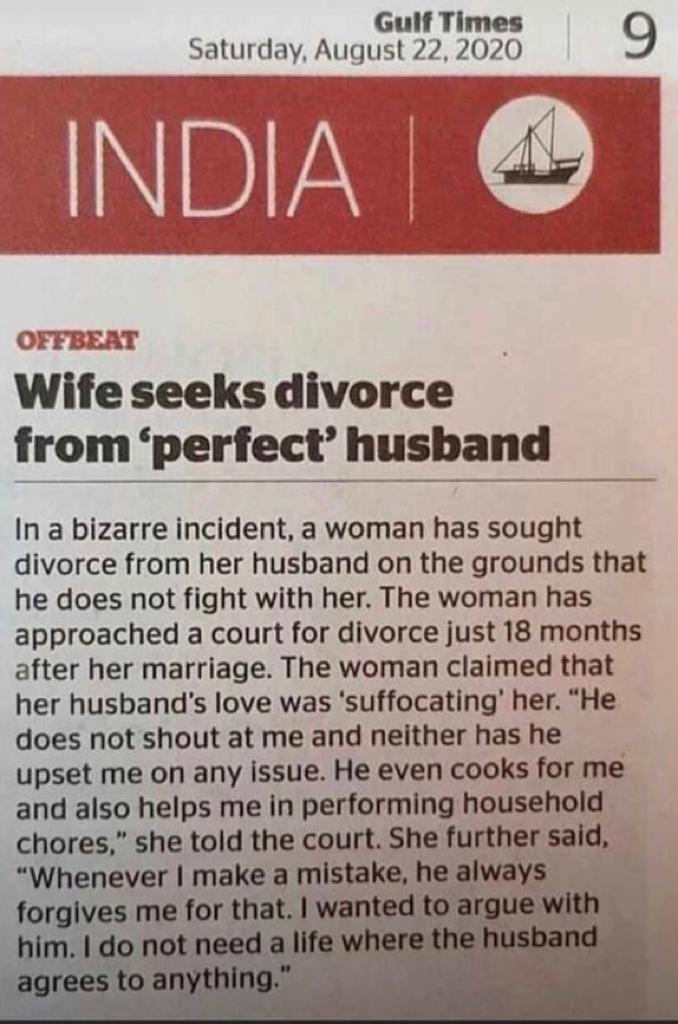
THE PERILS OF PERFECTION IN MARRIAGE

Marriage has no guarantees. If that’s what you’re looking for, go live with a car battery.” —Erma Bombeck

“We were married for better or worse. I couldn’t have done better and she couldn’t have done worse.” —Henry Youngman

“You know there is a name for people who are always wrong about everything all the time… Husband!” —Bill Maher

Beware and take care please! Do take time to pick a fight with your wife now and then and throw a few verbal rocks at each other … just to … er… make sure the marriage doesn’t go on the rocks.

Good luck !

Sudarshan Madabushi