There are 3 types of pilgrims in the Sri Vaishnava fold who go visiting the 106 Divya Desam temples located all across India.
- The first type of devotee is the one who performs his or her ‘yaathra‘ by going on what has nowadays come to be fashionably called “religious tourism package tours“. There are so many commercial/professional tour-operator outfits today that offer “exciting” package tours to various “divya desam” temples of choice at a fixed contractual lump-sum price covering transportation, boarding and (even “3-to 5-star rated“) lodging at those selected temple-sites. It is a menu-based service offering and it assures the pilgrim pleasureable “trouble free divine tour” of the temples — in both comfort and style.
1.1 There is one problem though with these professional religious tours. The operators compete aggressively for custom. So, the group numbers of religious tourists they canvas for are so large and so diverse in backgrounds that what is conceived and programmed initially as a “yaathra” eventually turns out to be not very different from a point-A to point-B kind of sight-seeing tour. The pilgrimage becomes no more than a hectic whistle-stop, frenzied religious tour — a la hop-on-hop off “London redbus city tour” !
The pilgrim finds himself or herself rushing from one divya desam to another without having much time to leisurely pause at will at each temple and try to soak in and absorb its holy ambience, its history, mythology, folklore and scriptural connections. The pilgrim at the end gets to have really no holistic experience of worshipping at a Divya Desam.
2. The second type of Sri Vaishnava pilgrim is one who is unwilling to join the “religious tourism” bandwagon. Instead he or she prefers instead to join the elite “bhagavatha group tours to Divya Desam temples that are organized/curated periodically during the year by certain well-known religious scholars, vidwans, pundits and “upannyaasakar-s” who are happy to double-up as “kshetraadanam” tour-guides.
There are very distinguished such persons like Sri Velukkudi Krishnan, Sri Dushyanth Sridhar, Sri APN Swami and a few notable others whose curated religious “yaathras” have become very popular and sought after. For a not-so-hefty “reasonable” fixed remuneration, these tours are conducted by these eminent gentlemen exclusively for the more discerning Sri Vaishnava “bhaagavata” pilgrim-groups who not only are promised all the swanky creature comforts on the yaathra journey that the commercial tour-operators of the first type provide on more pricey terms but also, more importantly, they promise to deliver the invaluable benefit of their own in-depth knowledge about temples on the group’s itinerary. Thus, the “yaathri” can be assured that at each temple Velukkudi Krishnan swami or Dushyant Sridhar swami will explain to them in very great detail everything important there is to know about the history and lores of the divya desam visited.
3. Lastly, the third type of Sri Vaishnava pilgrim is the “lone-wolf” kind of religious traveller who prefers to plough the lonely furrow … i.e. he likes to prepare his own “yaathra” itinerary to suit his own whim and fancy. He also makes his own travel arrangements all along the way. He prepares his daily route plan too. And before he sets out to visit the temples, he does his own independent research about the Divya Desam kovils he is about to tour.
3.1 In this mode of “yaathra“, the pilgrim is able to enjoy the advantage that the other two types cannot: he can set the pace and time of the journeys all by himself. And he can gather up uniquely personal experiences along the way which would be quite distinctly different from the rather “group-centric curated common-denomintor experiences” available to the other two types of pilgrim touristers.
3.2. The greatest drawback this third type of Sri Vaishnava ‘yaathri‘ will however face is that he would be denying himself the benefit of availing from the likes of eminent pundits like Velukkudi Krishnan or Dushyant Sridhar the large amount of information and intimate knowledge about divya desams that they as tour-curators would be able to offer. In this mode of “yaathra“, the pilgrim will be left to his own devices and initiatives in getting to know all that would be important to know about a particular divya desam kovil… viz. reading up books, articles and blogposts, visiting websites on the internet etc. ….
************
Now, I belong to the third category of pilgrim. As I journeyed by road that day to the Divya Desam temple, situated in the little village of Tirukannangudi, dedicated to Sri Damodara Perumal, all I knew about the kovil was nothing more than what I had been able to gather from browsing a few relevant website on the Internet.
The information I did gather was rather run-of-the-mill, dry and so factual to the point of being insipid for a visitor like me who was headed there on a yaathra for the very first time in my life. Secretly, I found myself wishing for the distinguished company of either a Velukkudi Krishnan or a Dushyant Sridhar travelling with me to Tirukannangudi and enlightening me with everything to be known about the holy kshetram….
The temple of Sri Damodara Perumal (aka Sri Neelamegha Perumal) is not far from Nagapattinam. But it is not easy to spot the site since is tucked away deep into virtually a corner inside no-mans land away from the highway. This spot is about 1 to 2 km away from Keezh Velur railway station on the Tiruvarur-Nagapattinam railway line. The temple is believed to have been built by the Medieval Cholas of the late 9th century CE, with later contributions from Vijayanagara kings and Madurai Nayaks.
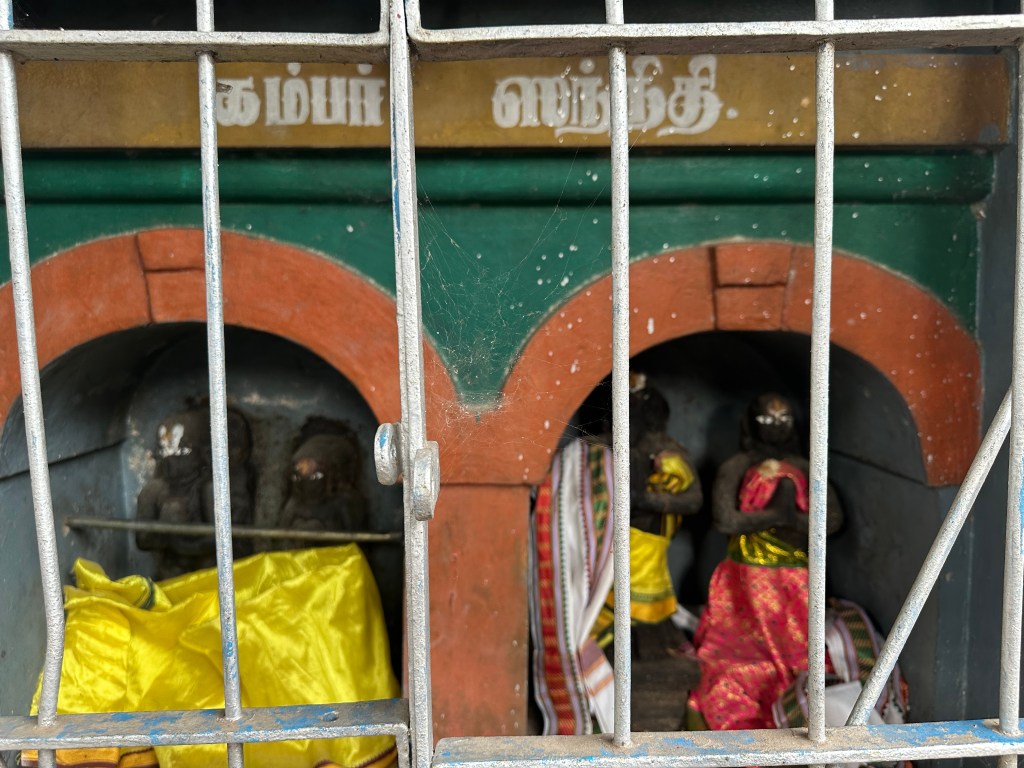
The moolavar in the sanctum is called Sri Loganatha Perumal. Sridevi and Bhoodevi can also be seen with the Moolavar. On one side are the statues of Gowthama rishi and Uparisaravasu. On the other side, one can see the idols of Brahma and Brighu Maharishi.
The idol of the “utsavar” is called Damodara Narayananan. The vimaanam or cupola is called Utpalavadaka vimanam. The “sthala puranam” of this temple is said to be found in the larger work called the Garuda Puranam. The location is known as “pancha badra” in the Garuda Puranam.
*************
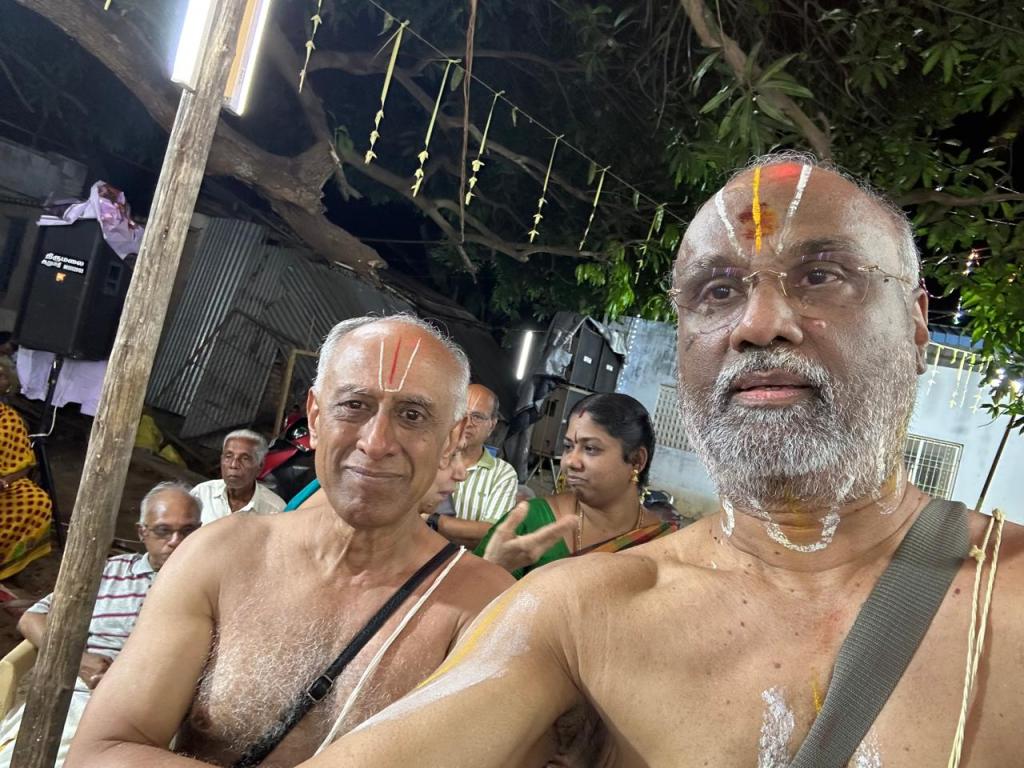
When I entered the temple precincts, it was already half-past noon. The priest, Archaka Sri Prabhakar, was already winding up the forenoon services and preparing to leave. Fortunately, I reached the sanctum in the nick of time.
I feared that the archaka would frown upon me for turning up for darshan at such a late hour of the day when the kovil doors were about to be shut. But to my surprise I found the archaka showing me all courtesy due to a yaathri who had travelled miles to come and worship at the temple….
He politely conducted me into the sanctum and performed “archanai” and then offered me sacred “theertham” and “sataari“. And “maalai maryaadai” too! I felt very humbled and happy at my good fortune and I thanked him profusely for his goodness.
As we both exited the sanctum, and Prabhakar Bhattar locked up the “sannidhi“, I confessed to him that I was a first time yaathri to the divya desam. So, “Swami, would you be kind enough to spend a few minutes to tell me about the history and traditional lores associated with this beautiful kovil?”.
Prabhakara Bhattar readily obliged and gave me a short but sweet summary of the highlights of the temple’s interesting antecedents and notable features. Here are two video-clips below in which I recorded his authentic narrations first-hand. After listening to the Bhattar, I felt that I could not have been given a better curated tour-guide telling me a few exciting things about this beautiful little divya desam:
**************
Getting to know about a divya desam kshetra direclty from the kovil archaka himself is a very valuable experience for a “yaathri” if only because it sounds so much more authentic and sincere than any other person’s curated, mechanical and well-rehearsed drone of a tour-operator guide or … even, I daresay… that of a learned pundit.
However, I am mindful of the fact that I was fortunate at Tirukannangudi temple to have arrived there at an hour when the kovil archakar was not hard pressed for time nor pressured by other routine ‘kainkaryam” temple duties and thus could spare time to enlighten me with narrations of the temple sthala purana and other nuggets of knowledge. At normal times, when the sanctum is filled with a crowd of other devotees and pilgrims, it would never have been possible for archaka Prabhakara Swami to spare time for me.
Which is why I believe that it would not be impractical to moot the idea of instituting the post of designated “temple curators” to be appointed by the temple administrators or trustees at each of the Sri Vaishnava divya desams. These curators (call them “upa-archakas”) would be able to render a very useful service to “yaathris” who, coming out after worshipping the deity, might wish to be enlightened with good and all relevant knowledge about the divya kshetram and then go back home satisfied that they were far more knowledgeable about the kovil than they ever were before they went in.
**************
The narrative of Prabhakara Bhattar about the litigation dispute which Tirumangai Azhwar got embroiled in was a fascinating legend indeed! It was also so very intriguiging to me to hear that many pilgrims and devotees came to offer worship at this divya desam to beseech the Almighty for relief from legal distress suffered in the law courts of the land and the harassment of lengthy and costly judicial processes that are the norm in India.
After I returned from the yaathra, my curiosity led me to dig a little deeper into the story I had heard from Archakar Prabhakara Swami. And briefly, this is what I came across below:
Thirumangai Mannan (the last of the 12 Azhwars) went on a long journey across India to see the different divya desams.
In North India, he visited Badarikasramam and many other important places. On the way back, he stopped in Tirupati on his way to Srirangam, Thirukkannangudi, and other temples in the south. Mangalasasana pasurams are the songs he wrote to honor each of these gods. He wanted to make a lot of improvements to the temple at Srirangam. That he knew would however cost a lot money for him.
On one of his journeys, he saw a gold idol in Nagapattinam. Four of his accomplices were going to help him bring that gold idol to Srirangam with the sale proceeds of which they would commence the renovation works of the temple.
Some local people tried to stop him from taking the idol with him. By stealth he still manage to take the image away and left Nagapattinam at night.
The Azhwar got to Thirukkannangudi in the morning. A place called Puliadi Vayal is where he got to. He hid the gold statuette in a dug-out hole in the fields and then went into the temple to sleep under a large tree — a makizha maram, which means “little flower tree.”
The farmer-owner of the field brought a bagful of seeds the next morning and was getting ready to till the ground to plant them.
Thirumangai Mannan was afraid that his secret would be found out. He had to stop the farmer from working the land lest he come across the buried gold idol.
The Azhwar decided on brinkmanship. He got in the way of the farmer and told him he was tresspassing on land that belonged to him. The farmer was aghast! And a heated dispute arose between the two.
The argument got very heated and might have come to blows. As usual, a lot of curious villagers gathered to watch. Thirumangai Mannan offered to show the farmer and the villagers the necessary papers the next day to prove his title to the land. So, the Village Panchayat agreed to give both sides a day to talk about their case and come to some peaceful accommodation.
The Azhwar became very exhausted at this point in time. Wanting to pause the disputations, he took a break under the magizha maram.
Suddenly, he espied a village woman passing by carrying a pot of water drawn from a nearby well, which too he was able to see in the distance. Feeling thirsty, he asked the woman for water. She replied to him nonchalantly, “Just as you claimed that the farmer’s fields belongs to you, I am afraid you may similarly claim that this vessel too I am carrying to draw water belongs to you… So I am reluctant to oblige you”. She refused Tirumangai Mannan water.
The Azhwar became enraged with her cast a curse saying that the well from which she drew water would dry up.
The events above have, in Sri Vaishnava hagiographic literature, led to a few very archaic but quaintly delightful Tamil phrases: “Tholaa vazhukku, uranga puli, oora kinaru thirukkangudi.”
Thirumangai Mannan cursed the well to dry up, which is what the word “Oora kinaru” is as it relates to the village of Thirukkannangudi.
Although Thirumangai Mannan had told the Panchayat that he would show the papers to prove his title to the land on the following day, he instead changed his mind and showed up that very night itself, bringing along with him the gold idol he had kept hidden in the field. That became what the phrase, “tholaa vazhakku” means! When he acted thus, the litigation between him and the village farmer went into a further round of litigious bickering! The dispute never settled and that was why it came to be referred to by the quaint phrase “tholaa vazhakku Thirukkannangudi”.
The “kaaya maram” or “urangaa Maram” word refers to the Magizha maram tree that Thirumangai Mannan sat down under that day and carried on his legal wrangling. The tree never withers.
So, these events in Thiruman-gai Mannan’s life led to the three events listed above, which are what people think of whenever they hear the word “divya desam” attributed to this temple. Those who undergo many a trial and tribulation at the hands of lawyers and judges of the legal or judicial system, come to worship here at this temple seeking relief from the same closure of disputations which Tirumangai Mannan himself never saw or realised in his own affairs !
What a delightful, wry tale of irony indeed! But it is what makes this Tirukannangudi divya desam unforgettable to a Sri Vaishnava yaathri! And it is also a legend that makes Tirumangai Azhwar’s life-history such a colourful and memorable one!
(to be continued)
Sudarshan Madabushi