Kannada’s parentage: Kamal Haasan won’t apologise for his comment because he’s so intellectually lazy

On a day when Kamal Haasan was nominated by his party, Makkal Needhi Maiam (MNM) to the Rajya Sabha, after the DMK in Tamil Nadu charitably allotted one seat in the Upper House to MNM in return for its support in the 2024 Lok Sabha polls, the ageing actor made a thoughtless comment about the Kannada language, which has since stoked controversy, with irate political parties in Karnataka demanding the actor apologise for his statements.

Kannada pride has been deeply hurt. Yet, Kamal Haasan has today stubbornly refused to apologise for his own self-admitted ignorance about the origins of the Kannada language.

This below was Kamal Haasan’s public statement yesterday (made in Bangalore at the launch of his latest movie “Thug’s Life” at which was present the actor-son of yesteryear’s Kannada matinee-idol Rajkumar, an icon of Kannada pride).
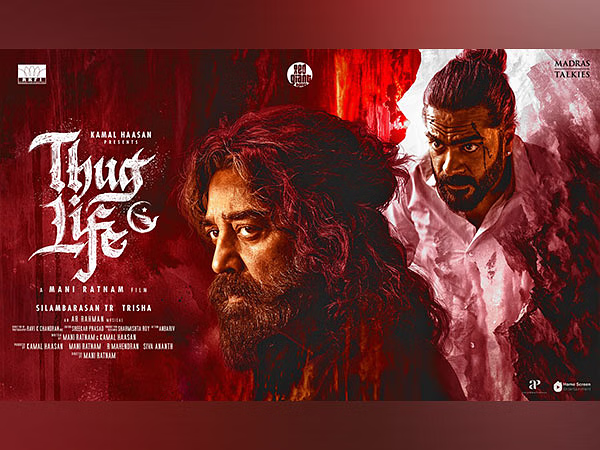
When I was 21 years, Rajkumar anna would praise me for my performance. And every time I met him, he would praise me in front of others. When I made Raja Paarvai, he clapped for the first shot. He did the same for Pushpak, which was shot in Bangalore. This is my family that lives in Bangalore. When I began my speech, I said, ‘Uyire, Uravey, Tamizhey’. Your language came from Tamil…so you are also a part of it””.

Kamal Haasan thought he would say something nice about the long gone cinema icon Rajkumar, his son present in the audience and about the consanguinity of Kannada and Tamil languages. He could have phrased it all differently but in his eagerness to say something cloyingly complimentary to the Kannada people at large, he ended up putting his foot in his mouth.

The stark fact of the matter is that Kannada language did not come from Tamil. And it is not language that binds Kannada and Tamil people to each other but simply Geographical contiguity and common Cultural history.

Soon after he made that clumsy remark about Kannada’s parentage, Kamal Haasan faces now a backlash from Kannada people. They are outraged and want him to issue an apology. But Kamal Haasan is a politician today and will soon a Rajya Sabha MP be! For a politician to eat crow in public and be forced to issue an apology for a mistake can be fatal to his image and gravitas. So, rushing into damage-control-mode Haasan has now issued an explanation to the public again which he has said clearly is not an apology:

“Politicians are not qualified to talk about language, they do not have the education to talk about it and that includes me. Let us leave these in depth discussions to historians, archaeologists, and language experts. We are a family and so are the languages. This is not an answer but an explanation. Love will not apologise”.

Kamal Haasan now ends up putting both feet into his mouth.

He now admits that he belongs to the tribe of politicians in the country “who do not have the education talk about” and engage in “in-depth discussions” on matters such as Linguistics, Archaeology, Culture etc.! The implication is that his fellow-politicians and colleagues … in Karnataka, in Tamil Nadu and yes, in the rest of the country too… are all as ignorant as he is about these subjects! But then because he loves them all … please, they shouldn’t judge him harshly! He, after all, loves them and all Kannadigas, and so “Love will not apologise”!

All these theatrics and political acrobatics of Kamal Haasan amuse me and make me hum to myself the old famous Elton John song, “Sorry seems to be hardest word….”:

What do I do to make you want me?
What have I gotta do to be heard?
What do I say when it’s all over?
And sorry seems to be the hardest word

It’s sad, (so sad) so sad
It’s a sad, sad situation
And it’s getting more and more absurd
It’s sad, (so sad) so sad
Why can’t we talk it over?
Oh, it seems to me
That sorry seems to be the hardest word

***************

Kamal Haasan says that he does not “have the education to talk” competently about the subject of the linguistic origins of the Kannada language. Come on, Mr. Haasan, you can’t be serious!

As a politician you ought to know that the old Latin maxim, “ignorantia juris non excusat”, applies not only to knowledge of the Law. We live today in the age of the Internet, AI search engines and Google online-self-education schools. Not only about Law but any subject on earth, any legal-age adult, and an ordinary, educated citizen of India — who has had at least a secondary school education and wants to get at least acquainted with it — can easily enlighten himself simply by the touch of a key on a laptop keyboard and going online.

If only before making such arrantly nonsensical comment about how “Kannada came from Tamil” you, Kamal Haasan, had not been so intellectually lazy, and if only you had taken the trouble and time to ask just a few sensible questions about the matter on any AI search-engine, you could have avoided the nasty public embarrassment that you face today.

Well, Mr. Haasan, just to jolt you out of your intellectual sloth, let me tell you that on the question of Kannada’s linguistic parentage, I posed only three elementary questions to an AI engine. I was able to instantly obtain answers which I thought I will share with you here for your edification.

Please read the Q&A below and educate yourself…. You will be soon entering the Rajya Sabha as an MP from Tamil Nadu. As A Tamil Nadu citizen I shudder to think that you may in your ignorance and out of the same intellectual laziness, cause us embarrassment there in Parliament in that august Hall of the Peoples’ Assembly of Elders just as equally as you have left us red-faced today in Karnataka.

QUESTION #1: Is Tamil the origin of the Kannada language or Sanskrit ?  

Kannada did not originate from Tamil or Sanskrit. Instead, Kannada and Tamil are both independent branches of the Dravidian language family, which means they share a common ancestor known as Proto-Dravidian. Kannada evolved from this Proto-Dravidian root around the 3rd century BCE, just as Tamil did, but each developed separately over time.

Sanskrit, on the other hand, is an Indo-Aryan language and not related genetically to Kannada or Tamil, though it has influenced Kannada (and other Dravidian languages) in vocabulary, grammar, and literary style due to long historical contact. However, Kannada’s core structure and origin are Dravidian, not Sanskritic.

In summary:

• Kannada and Tamil are sister languages, both descending from Proto-Dravidian, not from each other.

• Sanskrit is unrelated in origin but has influenced Kannada through cultural and literary contact. 

*********************

QUESTION #2: What is this so-called Proto-Dravidian language ? Where are its origins ? 

Proto-Dravidian is the reconstructed ancestor language of the Dravidian family, which includes modern languages like Tamil, Kannada, Telugu, and Malayalam. While not directly attested in historical records, its existence is inferred through linguistic reconstruction based on similarities across Dravidian languages.
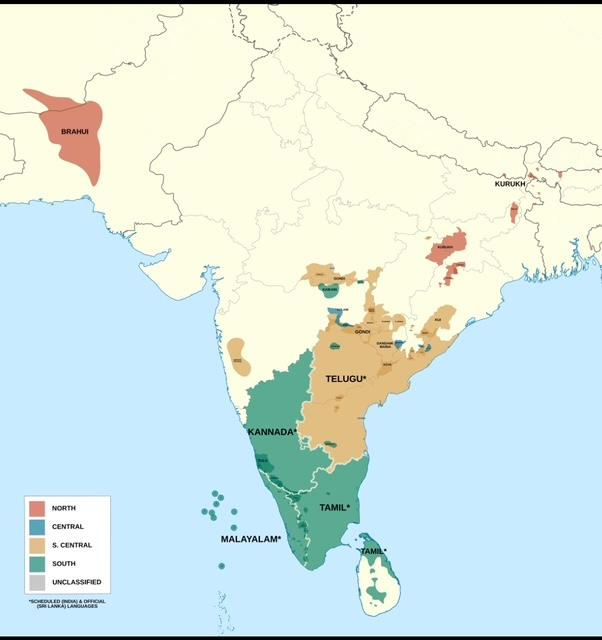
Origins and Homeland

• Timeline: Proto-Dravidian is estimated to have been spoken around 4,500–4,000 years ago (3rd–4th millennium BCE), with diversification into branches beginning by the 3rd millennium BCE.

Geographical Debate:

Indus Valley Hypothesis: Some scholars link Proto-Dravidian to the Indus Valley Civilization (IVC). Evidence includes Dravidian-like loanwords in Mesopotamian texts (e.g., pīlu for “elephant” and “toothbrush tree”) and potential connections to the Meluhha people mentioned in Sumerian records.

Peninsular India Hypothesis: Reconstructed Proto-Dravidian terms for flora/fauna (e.g., Salvadora persica, a toothbrush tree) suggest origins in the dry deciduous forests of central or southern India. Genetic studies also associate Dravidian speakers with the Ancestral South Indian (ASI) population, which may have formed in peninsular India.

Key Linguistic Features

Proto-Dravidian had:

Agglutinative structure: Words formed by adding suffixes to roots.

Subject-Object-Verb (SOV) syntax: A feature retained in modern Dravidian languages.

Phonology: A five-vowel system and consonants like retroflex stops (e.g., ṭ), absent in Indo-European languages.

Cultural and Historical Context

Society: Vocabulary indicates a rural-agrarian economy with elements of trade, metallurgy, and social stratification.

Interaction with Indo-Aryan Languages: Dravidian loanwords in the Rigveda (e.g., words for “peacock” and “ivory”) suggest early contact between Proto-Dravidian and Sanskrit speakers in the Indo-Gangetic Plain. By the 5th century BCE, Dravidian languages in southern India remained largely unaffected by Sanskrit.

While the exact homeland remains debated, combined linguistic, genetic, and archaeological evidence points to Proto-Dravidian’s emergence in northwestern or central India, with subsequent spread southward.  

*********************

QUESTION #3: What clinching linguistic proof or evidence is there to establish the fact that Proto-Dravidian language predated Sanskrit language? 

Proto-Dravidian predates Sanskrit by several millennia, with linguistic, phonological, and chronological evidence supporting this timeline.

 Here’s the key proof:

1. Dravidian Loanwords in Early Sanskrit

The Rigveda (c. 1500 BCE), the oldest Sanskrit text, contains over 80 loanwords from Dravidian languages, including terms for flora, fauna, and cultural concepts absent in Indo-European languages:

mayūra (peacock) ← Dravidian mayil .

phaṇa (hood of a snake) ← Proto-Dravidian paṇ (to spread) .

ulūkhala (mortar) ← Proto-Dravidian uḷakkai .

These borrowings indicate prolonged contact between Dravidian and early Indo-Aryan speakers, with Proto-Dravidian already established before Vedic Sanskrit emerged.

2. Retroflex Consonants in Sanskrit

Sanskrit’s retroflex consonants (e.g., ṭ, ḍ, ṇ) are absent in other Indo-European languages but central to Dravidian phonology. Their presence in the Rigveda suggests:

• Dravidian speakers influenced Sanskrit’s sound system during its formative period .

• This structural borrowing implies a substrate effect, where Dravidian-speaking populations adopted Indo-Aryan languages but retained phonological habits .

3. Chronological Reconstructions

Proto-Dravidian: Linguistic reconstruction dates it to ~4,500–4,000 BCE, with diversification into branches (e.g., Tamil, Kannada) by 3,000 BCE .

Sanskrit: The earliest form (Vedic Sanskrit) emerged ~1,500 BCE, with Classical Sanskrit codified by 500 BCE .

This gap of 2,500–3,000 years underscores Proto-Dravidian’s antiquity relative to Sanskrit.

4. Indus Valley Civilization Link

The Indus Valley Civilization (IVC) (3300–1900 BCE) is increasingly associated with Proto-Dravidian:

Lexical matches: IVC artifacts (e.g., ivory, sesame) correspond to Proto-Dravidian terms like pīlu (toothbrush tree) and eḷ (sesame), later loaned into Mesopotamian texts .

Script analysis: Computational studies suggest the undeciphered Indus script may encode a Dravidian language, with signs like “fish” matching Proto-Dravidian mīn .

5. Genetic and Cultural Evidence

Ancestral South Indian (ASI): Genetic studies tie Dravidian speakers to the ASI population, which diverged from Ancestral North Indians (linked to Indo-Aryans) ~2,000 BCE .

Agricultural terms: Proto-Dravidian vocabulary reflects a Neolithic agrarian society (e.g., nel for paddy), predating the Bronze Age Indus Valley era .

Conclusion

The convergence of loanwords, phonological influence, reconstructed timelines, and archaeogenetic data confirms Proto-Dravidian’s precedence over Sanskrit. While Sanskrit later influenced Dravidian languages culturally, their core structures diverged millennia earlier. 

***************

Good luck to you, Mr Kamal Haasan in your parliamentary career!

Sudarshan Madabushi
THE END of a memorable “yaathra’ : Six “divya-desams” and one “maha-samprokshanam” – Vilanagar Varadaraja Perumal Temple (Part-15) : CONCLUDED

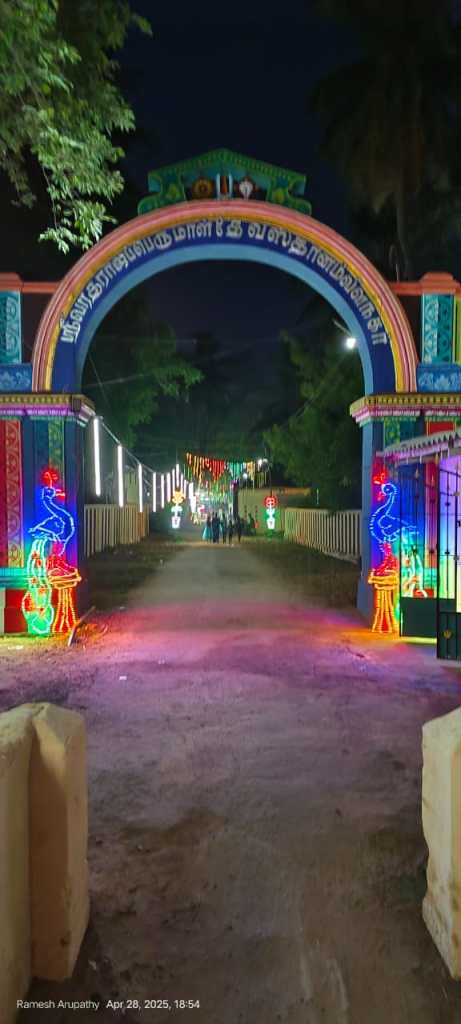
This is the last and 15th instalment in this series of essays on my 3-day pilgrimage to 6 Divya Desam temples in and around the town of Mayiladuthurai in Tanjore and to the Tharangambadi-taluka village of Vilanagar where the grand Mahasamprokshanam of a c.900-year old temple of Sridevi Perundevi Thayar sametha Sri Varadaraja Perumal was celebrated over three full days, all filled with the joyous religious fervour of nearly five thousand devotees who had thronged there on the final day of April 30, 2025.

***************

The day dawned auspiciously. It was warm, sunny and a morning breeze wafted into the temple precincts. The village wore a vividly festive look. festoons, colourful pandals. The sound of chants and devotional songs was everywhere. An unending stream of villagers — women, children, men, young and old, all excited and eager — was flowing in from the neighbouring hamlets.

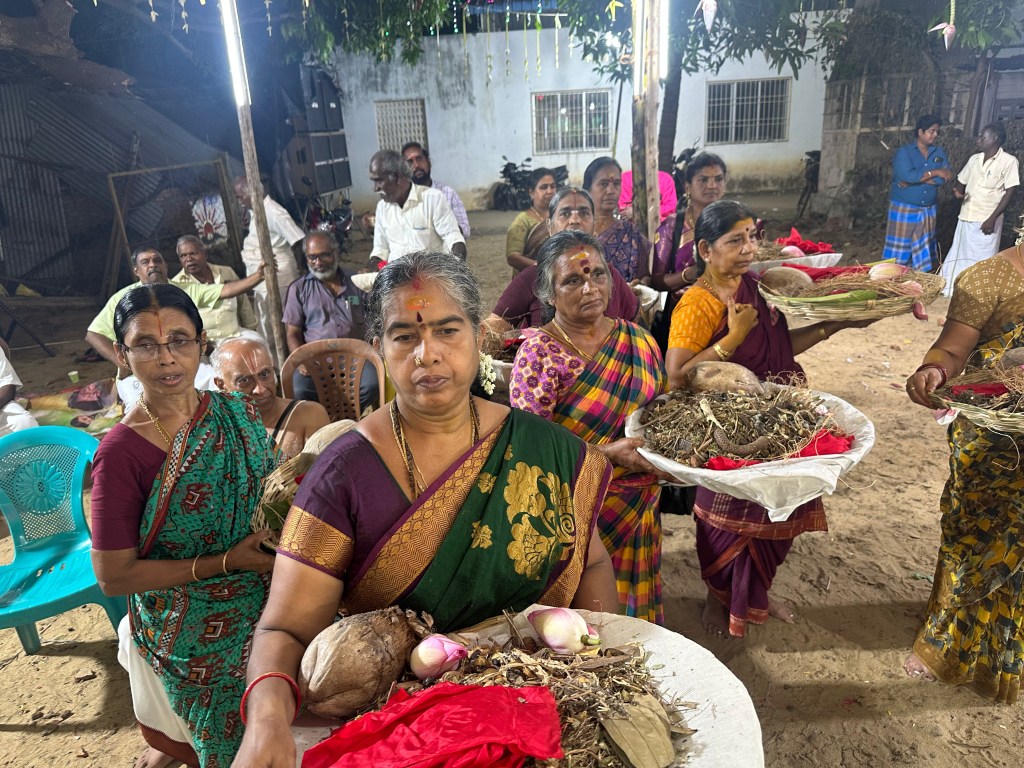
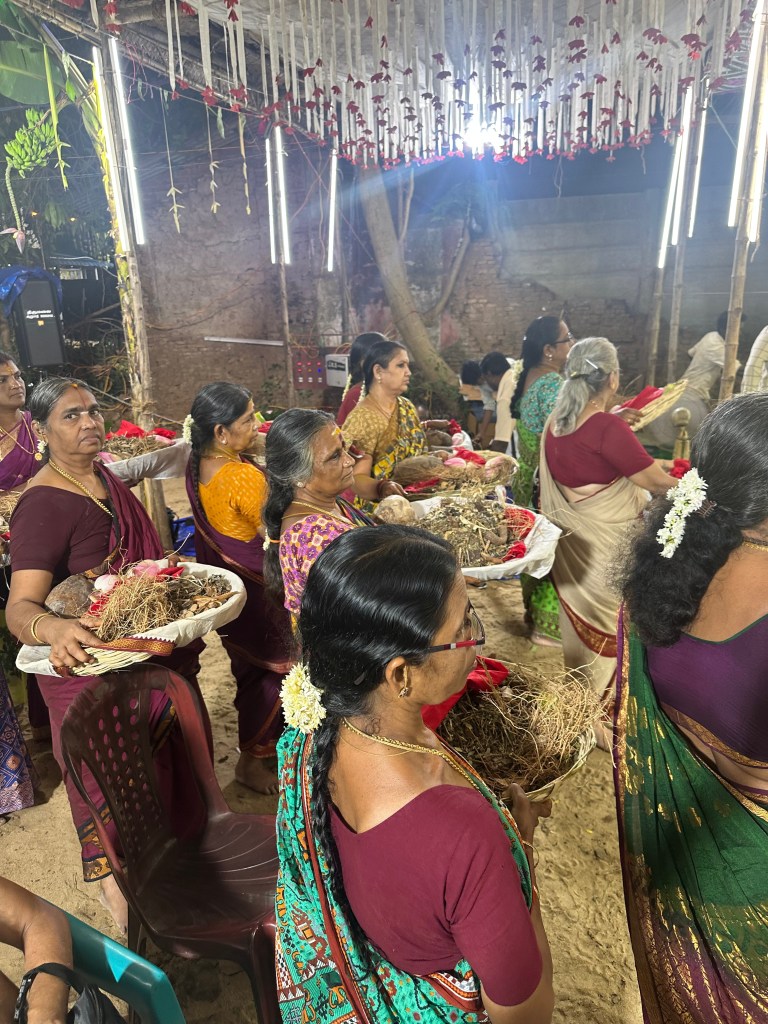
Earlier that morning, the Deity’s idols were carried around the village streets in a grand ceremonial procession accompanied by a lot of fanfare, music and nagagawaram pipers and drummers leading the “utsava purappaadu”. And even earlier, the village womenfolk, all dressed in their fine silks, were coming into the temple in droves, holding plates in their hands carrying various offerings of fruits, flowers, ‘saamagris‘, nuts, grains, spices, condiments etc… for the occasion.

The “purappaadu” procession filled the morning air with merriment and surcharged it with tremendous spiritual energy and expectation.

************

Once the Deity’s idols were carried aloft reverentially into the temple interior, they were duly restored into the sanctum, the inner “sannidhis“.

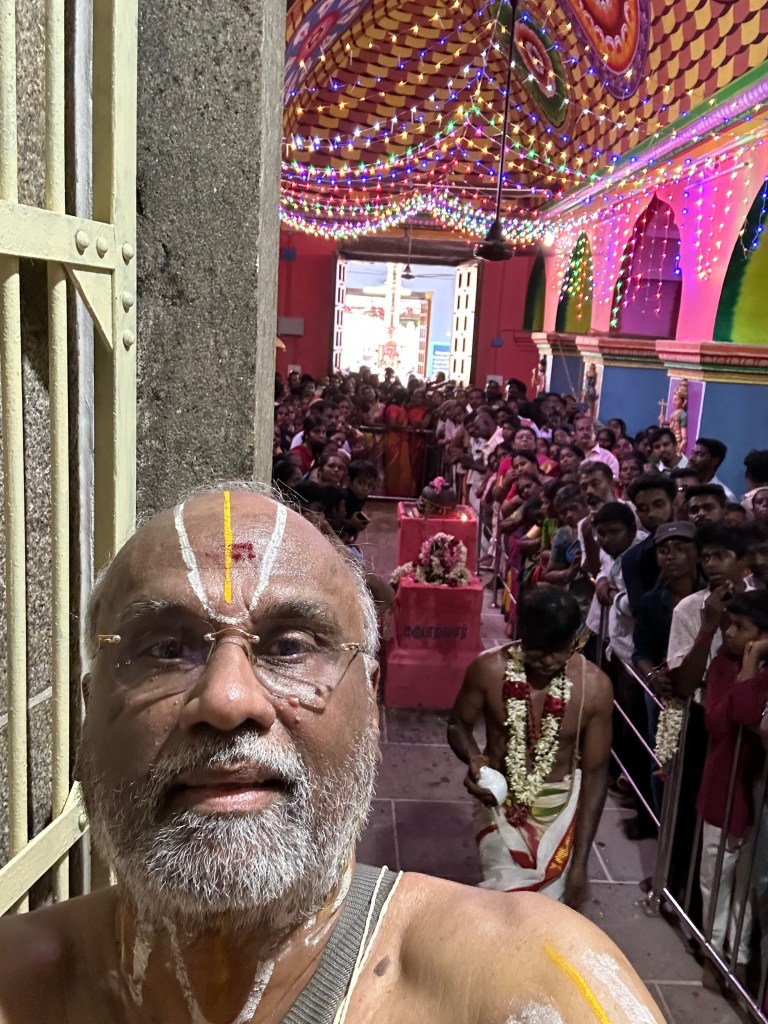
The crowds of devotees now surged into the temple antechambers and outer ‘mantapams‘ to have darshan of the Almighty’s new archa form, all bedecked now with new and fine silk raiments (pattu-pithaambara vastra), jewellery (aabharana) and bright, fresh floral garlands (pushpa, tiruthuzhaai malai) …. All in all, a truly breathtakingly beautiful sight! Of course, as I stood in the sanctum, I was allowed to feast my eyes upon the idols but forbidden to take any photos of the “garba-griha“.

*****************

However, the event that hundreds of villagers had come to witness with great expectation … and many hundreds more were all slowly assembling too to witness that morning … was the grand climactic event of the Mahasamprokshanam which was the Vimana Kalasha Tirumanjanam! It was the glorious event that signified the culmination of the 3-day “yagnya” (fire rituals) and all Vedic rites. The crowds of worshippers were keen to watch the ceremonial bathing of the kalashas (finials) that were erected upon the summit of the kovil cupola (vimana). When the sacred water then cascaded down the tower onto the ground, they would all rush forward to catch a few sprinklings of the same upon their heads. It is Hindu belief that such consecrated water contains divine and cosmic energy that gets recharged into the garbha-griha (the sanctum) and into the “archa-murthy” (the idols of the Deity) now re-sanctified therein already by the samprokshanam rituals.

**************

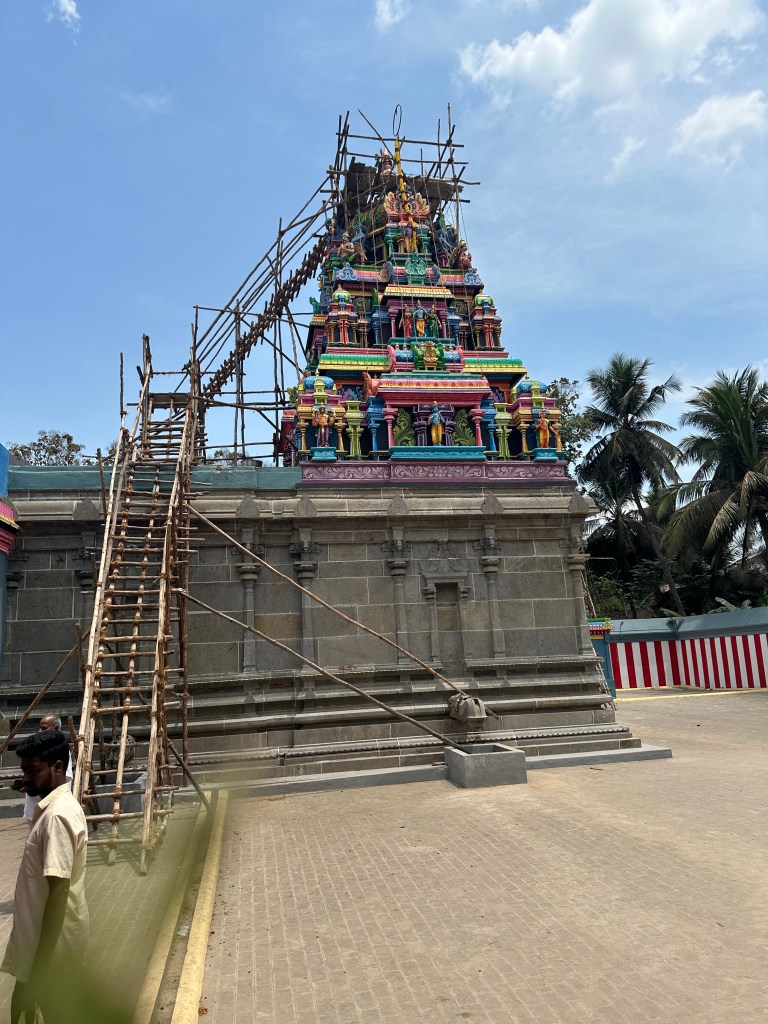
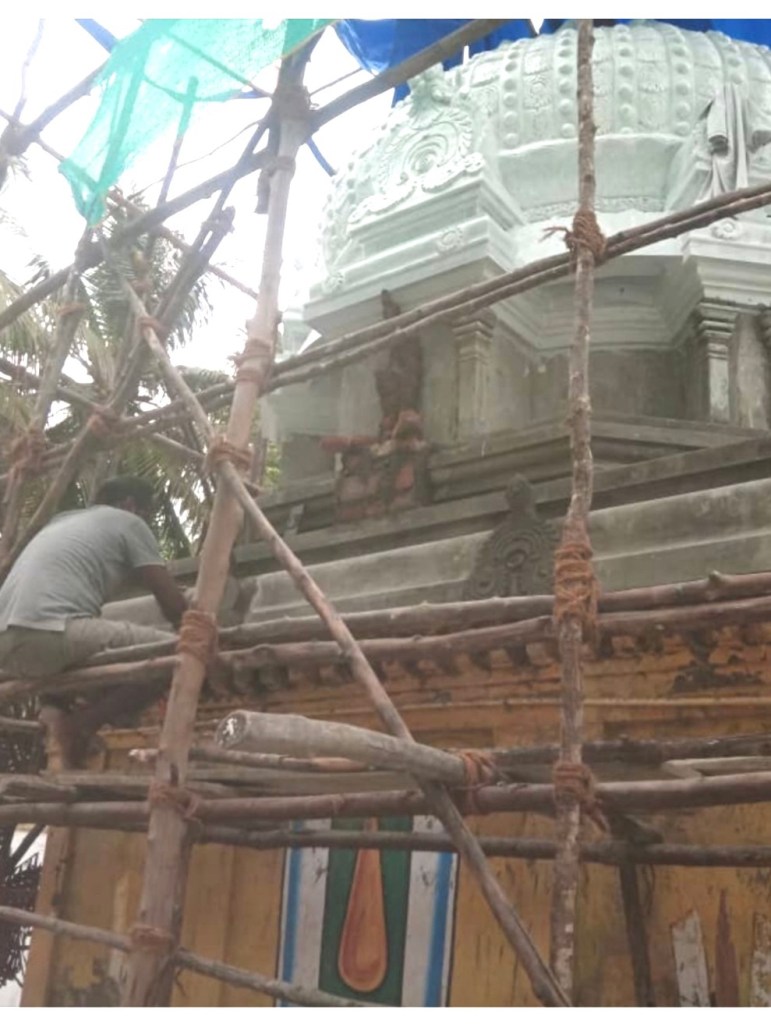
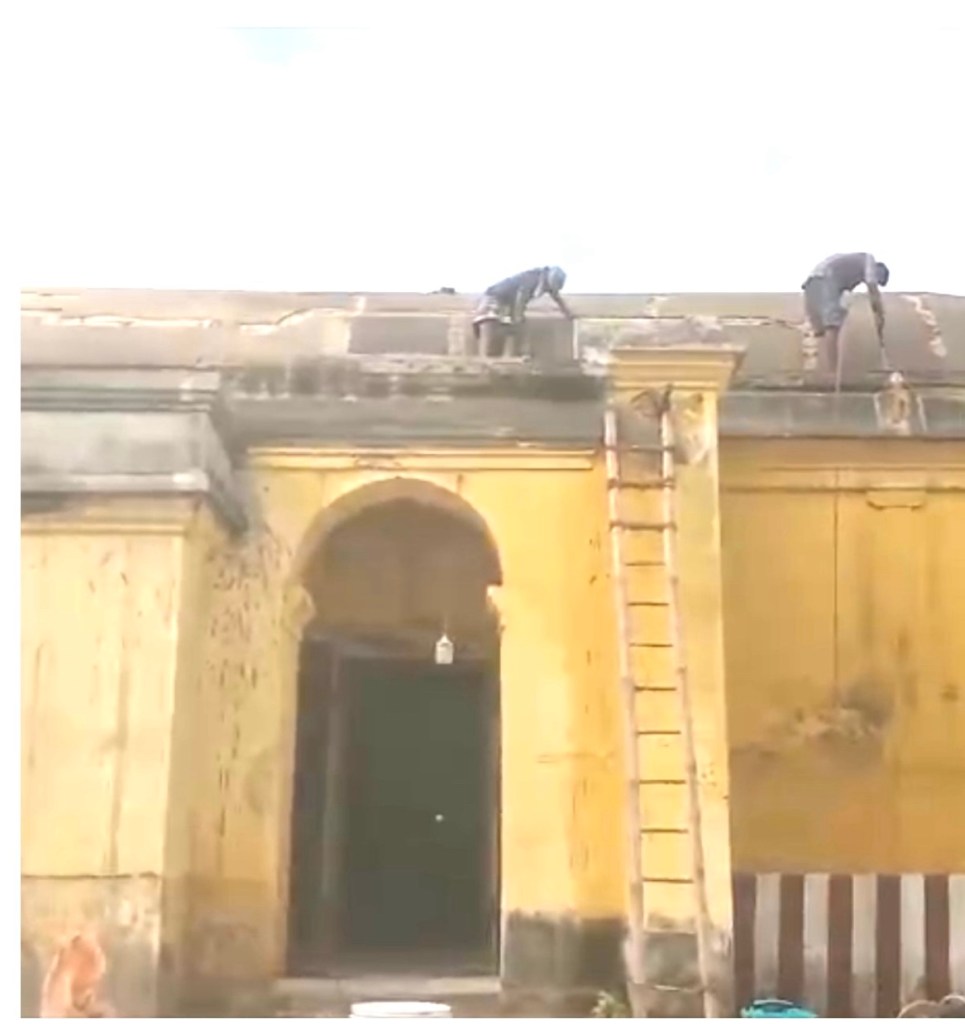
Earlier that morning, I had seen a makeshift scaffolded ladder already erected. It led from the ground up to the very summit of the “gopura vimaana” of the temple. It was quite a steep ladder. The priests would all be soon climbing up its gradient to perform the grand finale of the samprokshanam while the great gathering of crowds standing below watched in awe and “bhakthi“.

To me personally, the experience of climbing up along with the Vedic priests right to the very top of the cupola and to be present along with them when they duly performed the “kalasha tirumanjana” ritual was going to be a most thrilling, first-time-in-life ever religious experience.

Thanks to my good friend and the event “yajamaanar” and principal “ubayakarta“, Sri.Kothandaraman, I too was permitted by the priests to ascend by scrambling over the scaffolding that had been fastened, rather precariously, to the ‘gopuram‘ and to reach the sacred “kalashasa-s” atop the “vimaana“.

I seated myself on the makeshift ledge at the top and watched the priests begin the “kalasha tirumanjanam”. It was truly a unique experience for me to be seated beside the sacred vimaanam at the very moment of its “samprokshanam“.

As the ritual ended, and the sacred waters poured down the cupola, down the sides of the temple ‘gopuram‘ and fell in a cascade of sprinklings upon the surging, roaring crowd of devotees below on the ground, it seemed as though, through some inexplicable mysterious and mystic event of the cosmos, the heavens and earth had, momentarily, merged together.

For the very first time in life, I too was a participating witness to the sacred, auspicious ritual of “kalashaabhishekam” from the closest possible quarters. For me, it was a rare moment when absolute, sheer exhilaration of spirit at once coursed almost electrically, as it were, through body and mind! I felt I was in a daze caught in the middle of a whirlwind of spiritual wonder….

*************

Indeed, it was a whirlwind of spiritual wonder.

Although I was no total stranger to the temple rite of “mahasamproshanam“, having witnessed quite a few of them from afar …… and also gathered many impressions about them from news reports, TV channel reportage and word of mouth, still there were so many unanswered questions about this Agama-centric ritual that still kept me wondering about its significance, symbolism and esotericism. And some of those niggling questions roiling my mind were:

Why the use of water as a medium of sanctification? Why the “Kumbha”? Why the “kalashas”? Why at all the “vimaana”? And the crowds of devotees! What makes them all so eagerly and excitedly throng, hustle and jostle to catch the sprinklings of the “abisheka” water from the vimaana top? Was it blind faith? Do they know why they do it?….

Later, I was able to gain much needed clarity on all the above questions from a brief but very informative conversation I had with Sri. Ranganatha Bhattar, the chief officiating priest, and from a little bit of follow-up reading on my part independently . Let me share below a paraphrase of what the Bhattar explained to me and what I supplemented with a bit of of my own reasearching on the subject.

*************

  1. The Kalasha Abhishekam ritual, particularly when performed on the temple Vimana (tower above the sanctum), holds profound significance in Agamic traditions. This ceremony marks the grand culmination of Maha Samprokshanam, symbolizing the infusion of divine energy into the sacred structure.
  2. Significance of Kalasha Abhishekam in Agama:
  3. Divine Invocation and Purification: The ritual involves pouring sanctified water from 1,008 Kalashas (sacred pots) over the Vimana. Each Kalasha is filled with water infused with Vedic mantras, herbs, and offerings, representing the essence of holy rivers and cosmic energies. This act symbolizes the purification of the temple’s spiritual infrastructure and the reawakening of the deity’s presence (Prana Prathishta).
  4. Union of Cosmic Energies: The Kalashas embody Purna Kumbha (the “complete vessel”), symbolizing the union of divine energies. The water’s flow during Abhishekam represents the descent of divine blessings into the physical world.
  5. Renewal of Temple Power: Agamic texts prescribe this ritual to rejuvenate the temple’s spiritual potency, ensuring it remains a vibrant center for worship. The ceremony is believed to neutralize negative energies and restore cosmic balance.

There are rituals uniquely Vishnu-centric within the Pancharatra tradition.

Pancharatra Puja Vidhi: The entire structure of worship, including specific mantras, mudras, and iconography, is centered on Vishnu and his manifestations durng the entire “samprokshanam” event. It is the “mantra shakthi” that is central to the entire ritual procedure as it generates the desired spiritual energies and vortices.

Vyuha worship: The worship of Vishnu in his fourfold emanations (Vasudeva, Sankarshana, Pradyumna, Aniruddha) is a hallmark of Pancharatra, not found in Shaiva or other Agamic systems.

Sahasra Kalasha Abhishekam: While abhishekam is common in many traditions, the Pancharatra’s detailed prescriptions for Vishnu’s abhishekam—especially involving the Vyuha deities—are unique in their theological context. These rituals and theological emphases set Pancharatra apart as a distinct, Vishnu-focused tradition within the Agamic corpus. 

Why the Vimana is Central to the Ritual?

1. Architectural and Cosmic Symbolism: The Vimana is not merely a tower but a cosmic axis (Axis Mundi) linking the earthly realm to the celestial. Its intricate design mirrors the universe’s structure, with the Kalasha at its apex symbolizing the pinnacle of spiritual attainment.

2. Abode of the Deity: In Agama, the Vimana is considered the deity’s celestial residence. Consecrating it through Abhishekam reinforces the divine presence, ensuring the temple remains a conduit for blessings.

3. Energetic Circuit: The Vimana acts as a “spiritual antenna,” channeling energy downward to the sanctum and devotees. Pouring sanctified water over it completes the circuit, allowing divine energy (shakti) to circulate throughout the temple.

Agamic Foundations: The ritual aligns with Agamic injunctions that prioritize the temple as a microcosm of the universe. The Kriya Sakanda section of Agamas details the use of Kalashas to invoke deities, purify spaces, and amplify rituals.

• The Vimana’s sanctification ensures the temple’s alignment with cosmic laws (rita), making it a perpetual source of spiritual nourishment for devotees.

In essence, Kalasha Abhishekam on the Vimana is both a metaphysical reset and a celebration of the temple’s role as a bridge between humanity and the divine

***************

Temple iconography and architecture in the Pancharatra tradition are meticulously designed to reflect Vishnu’s cosmic supremacy and theological centrality. These elements are governed by Agamic prescriptions, transforming the temple into a microcosm of divine order and a conduit for devotion.

1. Architectural Symbolism of Vishnu’s Cosmic Role

Vimana as Cosmic Axis: The Vimana (temple tower) symbolizes Mount Meru, the axis mundi connecting earthly and celestial realms. In Vishnu temples, its design often incorporates three sanctums representing Vishnu’s three postures: seated (Vasudeva), reclining (Anantasayana), and standing (Trivikrama).

Mandala-Based Layout: The temple’s ground plan follows a mandala (sacred geometric diagram), mirroring the unfolding of Vishnu’s energy from a central Bindu (point). This design, rooted in Pancharatra Agamas, positions the Garbhagriha (sanctum) as the cosmic womb from which divine power radiates .

Vertical Hierarchy: The temple’s tiers symbolize Vishnu’s transcendence. The lower sanctum represents his earthly presence (leela vibhuthi), while upper levels signify celestial realms (nithya vibhuthi), culminating in the Kalasha (finial), embodying his ultimate sovereignty .

2. Iconography Embodying Pancharatra Theology

Vyuhas and Divine Emanations: Sculptures and reliefs depict Vishnu’s four Vyuhas (emanations)—Vasudeva, Sankarshana, Pradyumna, and Aniruddha—arranged directionally to reflect their cosmic functions. For example, Vasudeva faces west (earth), Sankarshana north (human life), and Aniruddha south (ancestral realm) .

Narrative Panels: Walls feature scenes from the Ramayana, Mahabharata, and Vishnu’s avatars, reinforcing his role as sustainer and protector. These carvings serve as visual theology, guiding devotees through his leelas (divine plays) .

Symbolic Attributes: Vishnu’s icons hold the Shankha (conch) and Chakra (discus), representing cosmic sound and divine order. His reclining form on Ananthasesha signifies the dissolution and renewal of creation .

3. Ritual Integration with Architecture

Kalasha Abhishekam: The Vimana is bathed with sanctified water during Maha Samprokshanam, a ritual prescribed in Pancharatra texts to rejuvenate Vishnu’s presence. The Sahasra Kalasha (1,008 pots) ritual underscores his all-pervading nature .

Garbhagriha as Divine Body: The sanctum is designed as Vishnu’s physical form, with the Sukanasi (antechamber) as his nose and the Shikhara (spire) as his crown. This anthropomorphic symbolism aligns with Agamic analogies of the temple as a “body of God” .

Pancharatra Puja: Daily worship follows Agamic protocols, including specific mudras (gestures) and mantras invoking Vishnu’s Vyuhas. The temple’s orientation (often eastward) and proportional design ensure alignment with cosmic principles (rita) .

4. Distinctive Pancharatra Features

Temple as Visual Theology: The Vishnu temple exemplifies Pancharatra’s visual theology,” where sculptural arrangements encode doctrines like the Chatur-Vyuha (fourfold emanations) and Dvadasa-Namas (twelve names of Vishnu) .

Integration of Human and Cosmic: The temple’s corridors and mandapas (halls) symbolize the journey from mortal existence (samsara) to liberation (moksha), guided by Vishnu’s iconography .

In essence, Pancharatra temple architecture and iconography are not merely aesthetic but deeply doctrinal, embedding Vishnu’s centrality into every stone and ritual. The structures serve as both a map of the cosmos and a medium for devotees to commune with the divine. 

***************

The curtains on the grand finale and climax of the Mahasamprokshanam of Sri Perundevi Thaayaar sametha Sri Varadaraja Perumal at Vilanagar Kovil came down at last at around noon that day after an elaborate “saatrumarai” service (plenary, valedictory ritual of chanting select breviaries from Vedic, Vedantic and puranic scriptures and select litanies in praise of “sampradaaya acharyas lineage“).

It was time for me to leave Mayiladuthurai, catch a train and return home to Chennai after what truly had been a memorable “yaathra“.

*************

There was however one more last stop on my yaathra which I felt I must not miss since I did not know when again I might have the chance to pass by these southern provinces of Tamil Nadu again.

It was my desire to visit the nearby the great temple-town of Thiruvarur, one of the most well-known Shivasthala-s in Tamil Nadu, presided over by the Deity worshipped as Sri Thyagaraja Iswara.

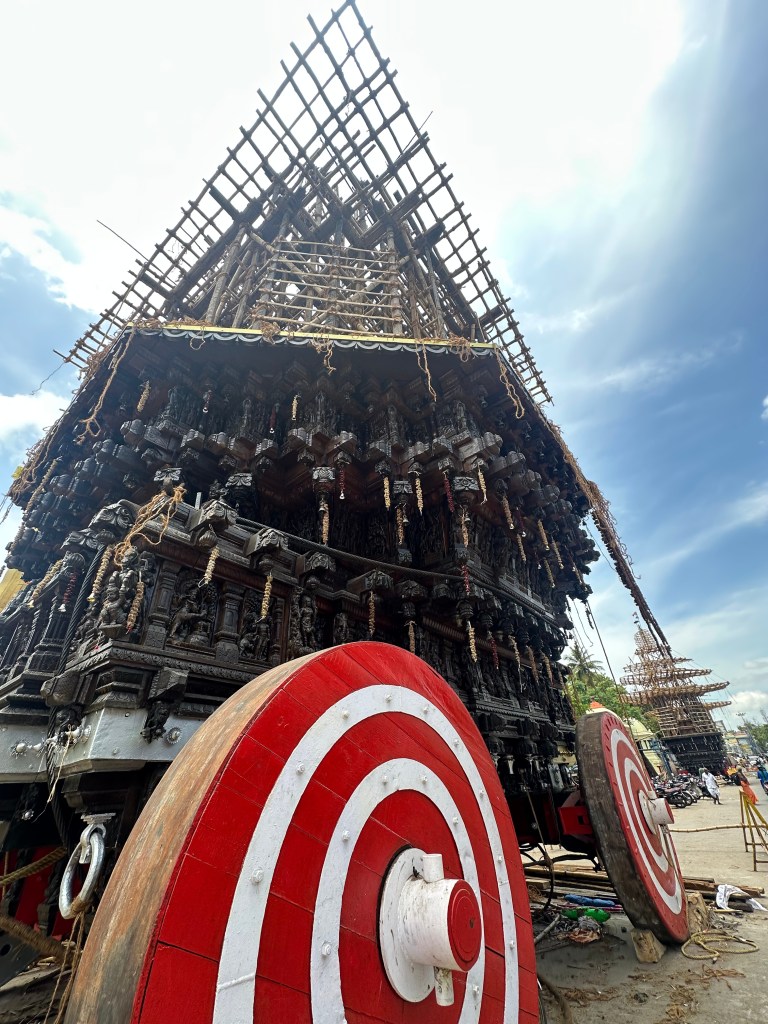
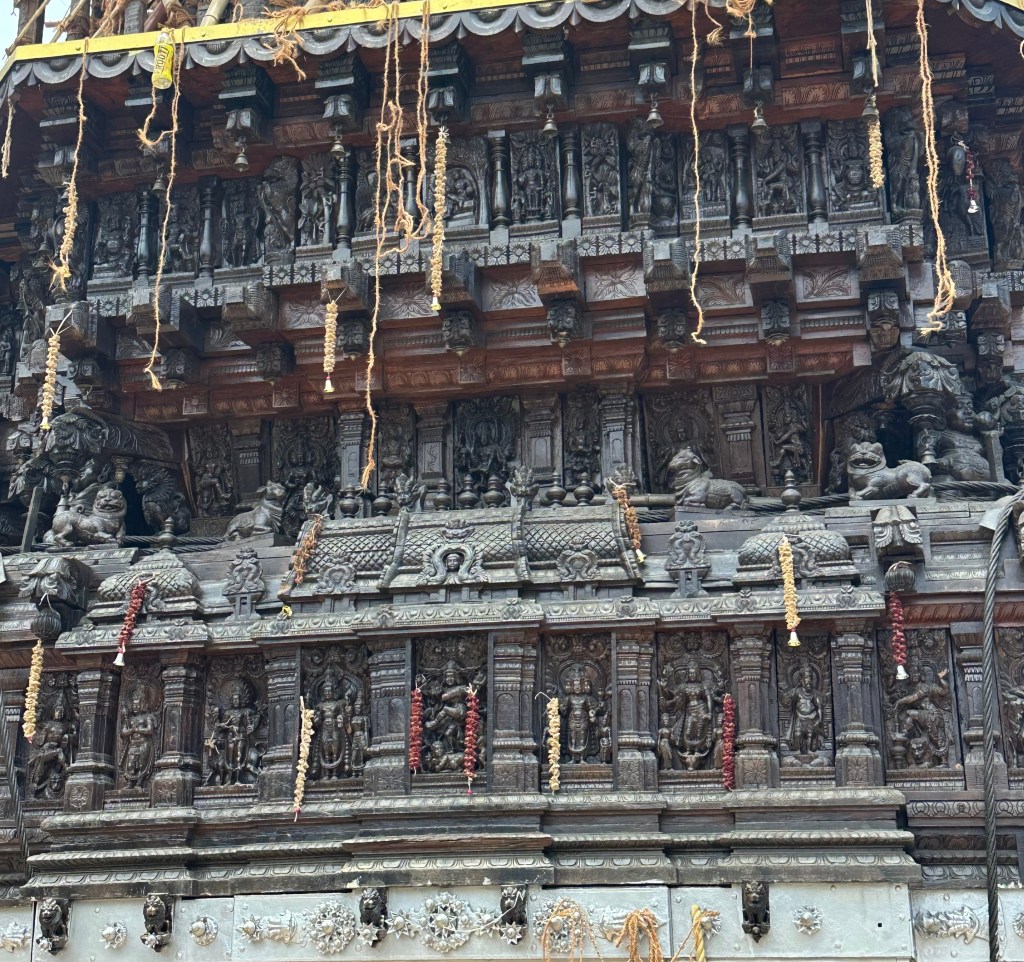
Since I was racing against time to catch my train to Chennai, I decided I would postpone the temple visit to a later date sometime in the future but then I would stop by just to get a good look at the famous Thiruvarur Temple chariot, a magnificent temple “vaahana“, the mighty vehicle of the Deity carved in wood… truly a masterpiece and enduring classic of traditional temple craftmanship and carpentry artisanship. I had read so much about the magnificence of this chariot that it was my desire to set eyes upon it at least once in my lifetime.

The temple chariot of the Thyagaraja Temple in Tiruvarur, the largest temple chariot of its kind in India and Asia. It weighs around 300 to 360 tonnes and stands about 90 to 96 feet tall. This massive chariot, known as “Aazhi Ther,” is pulled through the four main streets surrounding the temple during the annual chariot festival held in April–May. It is renowned for its size, intricate wood carvings, and the grandeur of the procession, attracting lakhs of devotees every year. The chariot stands out as the largest traditional temple chariot in India, weighing about 300–360 tonnes and reaching a height of 90–96 feet.

In comparison to other Major Temple Chariots: the Tiruvannamalai (Annamalaiyar Temple) is significantly smaller. So is Chidambaram Natarajar Temple chariot. The Udupi Krishna Temple (Brahma Ratha) is notably large but is much lighter and shorter than Tiruvarur’s. The tallest Chariot is the Thottuva Sri Bharanikavu & Kannambillil Devi Temple, Kerala—150 feet tall, but it is said to be lighter and not as massive as Tiruvarur’s chariot.

I was so very keen to see this chariot because I had read that it was an engineering marvel!

The construction of this massive temple chariots at Tiruvarur — 300–360-tonne, 90–96-foot-tall “Aazhi Ther” — involved overcoming significant engineering challenges, particularly in structural design, material durability, mobility, and cultural preservation.  It also demanded interdisciplinary solutions—from structural innovations inspired by skyscrapers to modular designs and crowd management—all the while honoring centuries-old traditions of native craftsmanship about which so little is known or appreciated today. 

I would not pass up an opportunity to go and take a look at this chariot. I drove into Thiruvarur and there it stood…. the magnificent “vaahana” of Sri Thyagaraja Ishwarar! What an awesome sight indeed! What a aesthetic treat to the senses and spirit!

************

Chariots are such a central cultural feature of the temples of both Vishnu and Shiva in Tamil Nadu. A great temple will always boast of itself as possessing a great chariot for its great Deity.

On the train journey back from Mayiladuthurai to Chennai, my mind dwelt upon two beautiful verses of the Tamil saints of yore who had sung praises to the Almighty with references to their “ther vaahana”.

The hymn known as “Tiruttontattokai” (Hymn 39) was sung by Appar while he was living at Thiruvarur:

“ஆரூரில் அப்பனென் றடியேன் அடைந்தேன்
ஈரூரும் பைங்கழல் ஏத்தி யிருந்தேன்
சீரூரும் செந்தேர் திருவாரூர் எங்கள்
சீரூரும் செல்வச் சிவனே யவனே”

“In Arur (Thiruvarur), I sought refuge at the feet of the Lord;
I praised and worshipped His golden ankleted feet with devotion.
In glorious Thiruvarur, where the grand chariot rolls,
He is our Lord Shiva, the embodiment of all prosperity and glory.”

Then there is the beautiful verse Periya Thirumozhi (7.11.9) of Thirumangai Azhwar who also sang in praise of the great chariot of Sri Ranganathar of Sri Rangam Temple.

சங்கம் உடையான் திருவரங்கன் தன்னை
அங்கம் அழகாகத் தேரோட்டும் அணி
பொங்க அரங்கத்து எம்பெருமான் தன்னை
எங்கும் எளியேன் வணங்கும் இடம்

“The Lord of Srirangam, adorned with conch, who rides the beautiful chariot with grace,
That glorious Arangan, my Lord, is the One whom I, the humble one, worship everywhere.”

As the train sped past many cities on my way to Chennai, I thought to myself, “Maybe, some day in the future, sooner than later, a great Chariot may get constructed for Sri Varadaraja Perumal at Vilanagar temple too?!”

****** Shubhamasthu*******

Sudarshan Madabushi

With the 11-Year “Narendra Modi Report Card” of Anand Ranganathan, I concur and say, “This was India’s Finest Hour”!

The Modi Era: 2014-2025

Magnificent achievements indeed !

This past 11 year period will certainly have to be reckoned by historians of the future as India’s “finest hour” heralding a golden era in the life of the nation.

Anand Ranganathan’s one glaring omission of India’s achievements in the last 11 years is the great strides the country made in Space Exploration— who can forget the Vikram Lander successfully landing on the Moon on August 23, 2023, near the South Pole?

Of course there will nitpickers and naysayers who will start detracting from the big picture …

In addition to the 11 failures of Modi that Ranganathan lists, they’ll add their usual , stale griping about:

  1. rising mammoth unemployment,
  2. the tottering, floundering justice delivery system,
  3. the massive corrupting and uncheckedly growing influence of money power on the entire electoral system of the country
  4. the enormous continuing problem of child malnutrition,
  5. the pathetic state of primary education and health-care infrastructure,
  6. the burgeoning level of economic wealth and income inequality among society at large
  7. increasing centralisation of political and administrative power in the central government through the creeping but steady politicisation of key constitutional posts/ offices such as state governors, election commissioners , the bureaucracy and others

However, despite all the above negative markings , in my opinion, there can be no doubt that under PM Modi’s stewardship of the country in the last 11 years, India, more than ever it did in the previous 60-odd years , has certainly undergone a transformation that every Indian ought to be proud of.

Jai Hind 🇮🇳
Sudarshan Madabushi

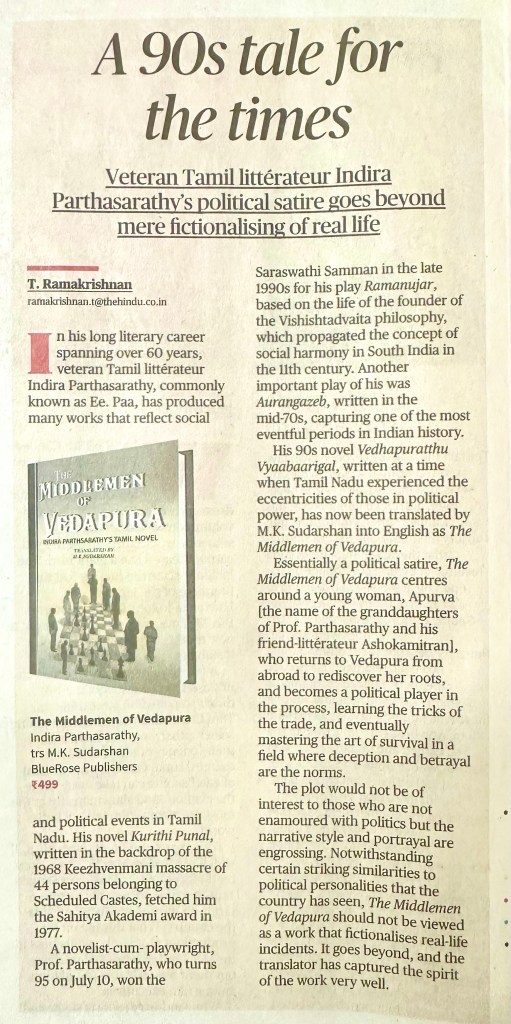
The HINDU LITERARY REVIEW OF “THE MIDDLEMEN OF VEDAPURA”, my English translation OF Sri. Indira Parthasarathy’s satirical novel “வேதபுரத்து வியாபாரிகள்வியாபாரிகள

Hello everyone ,

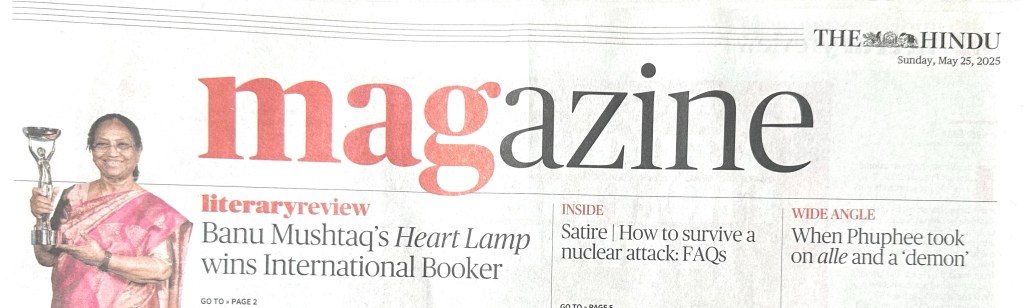
THE HINDU LITERARY REVIEW DT. May 25, 2025 published a review of my book “THE MIDDLEMEN OF VEDAPURA” , my English translation of the Tamil satirical novel “வேடபுரத்து வியாபாரிகள்” of the doyen of Tamil literature “Eepa”, Sri Indira Parthasarathy .
— M. K. Sudarshan

https://www.thehindu.com/books/book-review-indira-parthasarathy-the-middlemen-of-vedapura-translation-mk-sudarshan-satire/article69589643.ece

Sudarshan Madabushi
A memorable “yaathra’ : Six “divya-desams” and one “maha-samprokshanam” – Vilanagar Varadaraja Perumal Temple (Part-14)

The Pancharatra Agama stresses surrender to God (atma-nikshepa), humility, unwavering faith, and the recognition of Vishnu as the sole protector. These attitudes are woven into the prayers and ritual intentions throughout the Samprokshanam.

Vastra Samarpana (Offering Clothes): Fresh garments or cloth are offered to the deity.

Alankara (Adornment): The deity is adorned with ornaments, flowers, and sandal paste.

Gandha, Pushpa, Dhupa, Deepa (Fragrance, Flowers, Incense, Lamp): These offerings are made in sequence to please and honor the deity.

Naivedya (Food Offering): Sanctified food is offered.

Tambula (Betel Leaf Offering): Betel leaves and areca nut are offered as a gesture of hospitality.Food offerings (naivedya), incense, lamps, and flowers are presented, and the ritual concludes with aarti (waving of lamps), symbolizing the dispelling of darkness and the presence of divine light.

*************

During the course of all these elaborate and intensely emotive sessions of ritual procedures of “bhagavath upachaara” (ardent hospitality shown to the Deity), I was witness to truly heart-warming rite. It involves devoteess imagining Perumal and Thaayar to be relaxing in a state of divine repose in their heavenly realm and after having partaken of all the “upachaara” duly offered to them, the Divine Couple is now in an expansive mood of pleasantry. That is the moment being recreated here on earth when they are both treated to a musical treat! The musical feast is a soft and melodious playing on the “nagaswaram” windpipe-instrument of what is called traditional “mallaari” notes. Being witness to this extrordinary ritual as part of the Mahasamprokshanam was for me by itself an intensely emotional experience.

Mallari is a distinctive musical form played on the nagaswaram (a traditional South Indian wind instrument) during important temple rituals, including samprokshanam.

Symbolic Role: Mallaari serves as a ceremonial signal marking sacred processions or major ritual moments. Its majestic and rhythmic music signifies the divine presence and the formal beginning of the deity’s movement or ritual, making it clear to devotees that a significant event is underway. In the case of the Vilanagar temple, it was a prologue event signalling the climactic event of Vimaana Kalasha samprokshanam to be held the following day.

  • Musical Features: Mallaari is typically rendered in the raga Gambheera Nattai, chosen for its grandeur and ability to evoke a sense of majesty and heroism, reflecting the lord’s majestic appearance during rituals. On this occasion that I witnessed, the Raga which the temple pipers played were the melodious strains in four more different movements as per the Agama sequence on cue given by the officiating priest. The Raga-s were Saaranga, Ananda Bhairavi, Desh and Neelaambari.
  • Agamic Importance: According to temple traditions and agamas, rituals should begin with auspicious sounds and numbers, and Mallaari’s pentatonic structure (five notes) aligns with this principle, symbolising cosmic elements like the five elements (panchabhootha).
  • Types of Mallaari: There are different Mallaaris for different ritual contexts—such as “Theertha Mallari” during tirumanjanam (ritual bathing), “Thaligai Mallari” during food offerings, and “Ther Mallari” during chariot (juggernaut) processions. Here I was witnessing the first two types.

In the context of samprokshanam, playing Mallaari heightens the sanctity of the event, announces the ritual’s commencement, and invokes an atmosphere of spiritual grandeur, aligning the senses of the devotees with the sacredness of the proceedings. Mallaari is associated with specific mantras and rituals in temple energization because both serve to invoke and channel spiritual energy during sacred ceremonies. Just as mantras resonate with particular energy centres and promote spiritual awakening, mallaari’s structured, auspicious music creates a vibrational atmosphere that aligns with the ritual’s intent. Together, the sound of mallaari and the chanting of mantras enhance the sanctity of the space, help focus collective devotion, and symbolically mark the transition of the temple into an energised, divine abode for the deity.

If you watch the below video-clips, you will understand what I mean.

****************

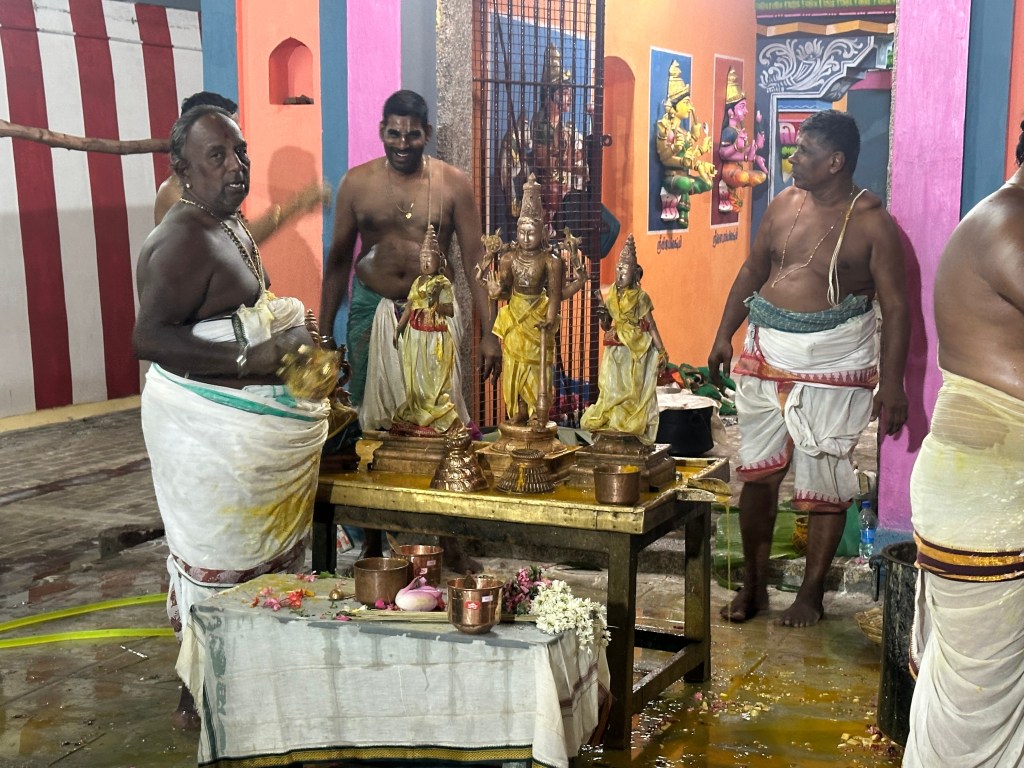
While the Mallaari and other cermonial upachaara for the deity was being conducted, I could not take my eyes away from the utterly bewitching beauty of the idols that were being consecrated.

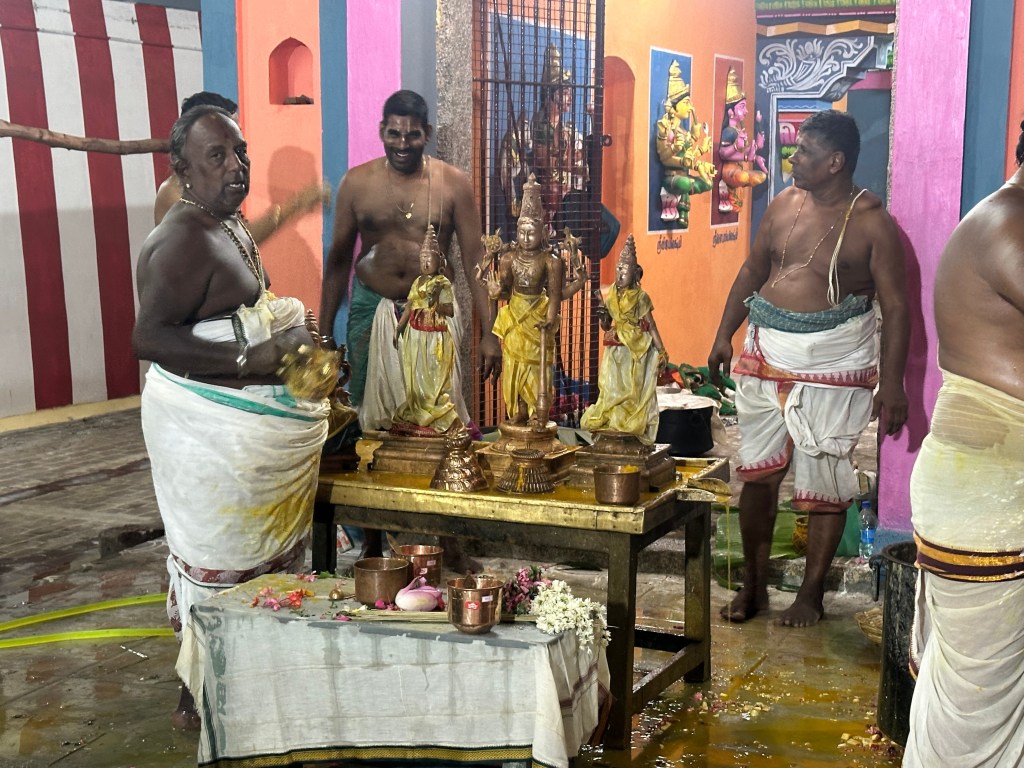
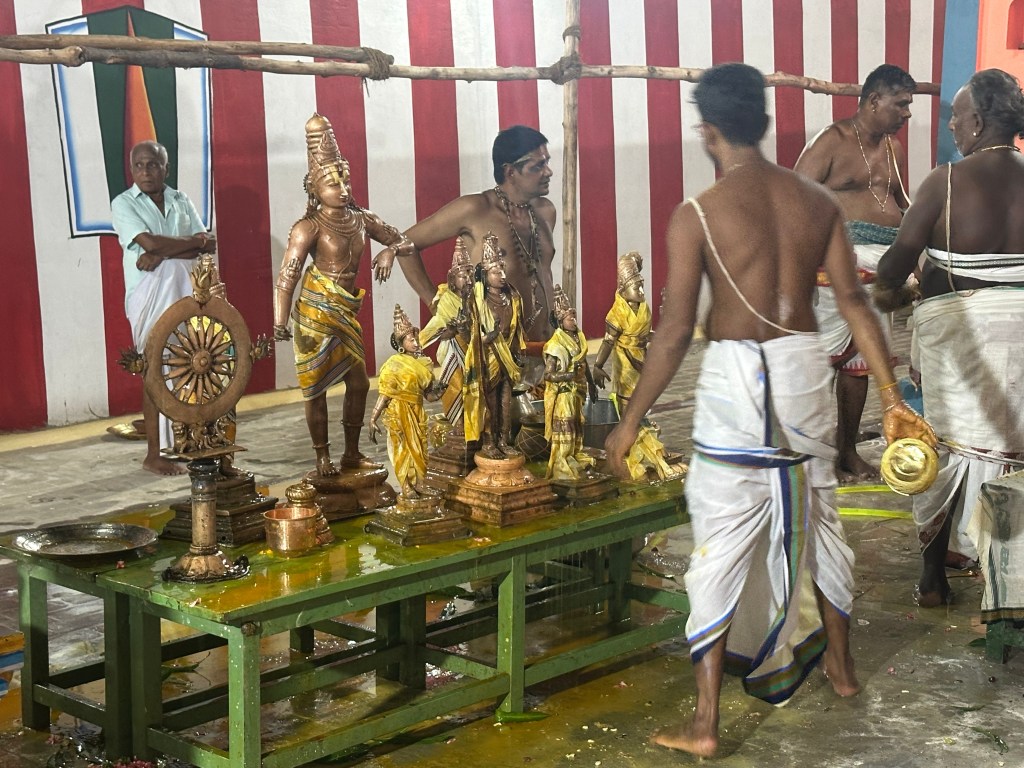
The sight of the Sri Rama, Sita-piraatti and Sri Lakshmana’s idols were marvelous and intriguing at the same time since the iconography revealed that the statuettes were not as usual sculpted to show them in finery, jewelry and regal attire (as one normally sees in the iconography of Patabhisheka (coronated) Rama. They were instead dressed in bare, rough-hewn hemp or tree-bark clothes. Their hairdress too consists of unkempt matted locks.

The sannidhi bhattar (priest) explained to me that the idols of Rama, Sita and Lakshmana here are to be visualised as representing the moment when, after being banished in the Ramayana from Ayodhya to go into the forests for a period of 14 years in exile, the divine trio were just about to set foot out of the palace to depart.

Rama’s visage on the idol is unperturbed and pleasant. The idol of Sita appears demure, a little nervous but very self-determined. But the face on the idol of Lakshmana appears surly, ill-tempered and smoldering with pent-up fury.

**************

Watching the three beautifully sculpted “archa-murthy-s”, my mind was flooded with recollections of those few “shloka-s” from Valmiki “Ramayana” Ayodhya Kanda, cantos 19, 23 and 27, which captured those fateful moments when Rama, Sita and Lakshmana each reacted in their own differennt way to the devastating news that Rama had been exiled by King Dasaratha and Queen Kaikeyi.

How did Sri Rama react?

तदप्रियममित्रघ्नो वचनं मरणोपमम्। श्रुत्वा न विव्यथे रामः कैकेयीं चेदमब्रवीत्।।2.19.1

Rama did not feel distressed to hear these words painful like death. To Kaikeyi he said:

एवमस्तु गमिष्यामि वनं वस्तुमहं त्वितः। जटाजिनधरो राज्ञः प्रतिज्ञामनुपालयन्।।2.19.2।।

Be it so I shall go from here to the forest and live there with matted hair and deerskin to keep the promise of the king.

मन्युर्न च त्वया कार्यो देवि ब्रूमि तवाग्रतः। यास्यामि भव सुप्रीता वनं चीरजटाधरः।।2.19.4।।

O Devi, you should not grieve. I declare in your presence that I shall go to the forest wearing tattered clothes (bark) and matted locks. So, rejoice (to hear this).

How did Sita react?

भर्तुर्भाग्यं तु भार्यैका प्राप्नोति पुरुषर्षभ। अतश्चैवाहमादिष्टा वने वस्तव्यमित्यपि।।2.27.4।।

A wife alone shares the destiny of her husband. I am also therefore, ordered to dwell in the forest; if a command has been given to you, it is a command to me too).

यदि त्वं प्रस्थितो दुर्गं वनमद्यैव राघव। अग्रतस्ते गमिष्यामि मृद्नन्ती कुशकण्टकान्।।2.27.6।।

O son of the Raghus if you set out for the impenetrable forest now itself, I shall also go, walking ahead of you and crushing the thorns and (spiky) kusa grass (rendering the path comfortable for you to walk).

प्रासादाग्रैर्विमानैर्वा वैहायसगतेन वा। सर्वावस्थागता भर्तुः पादच्छाया विशिष्यते।।2.27.8।।

Every woman, everywhere be it on the top of mansions or in lovely palaces or flying in the sky should take shelter at his (her husband’s) feet (by following his footsteps).

Finally, what was Lakshmana’s reaction?

तदा तु बध्द्वा भ्रुकुटीं भ्रुवोर्मध्ये नरर्षभः। निशश्वास महासर्पो बिलस्थ इव रोषितः।।2.23.2।।

Lakshmana, frowning between his eyebrows, hissed like a great serpent seized with anger in its hole.

तस्य दुष्प्रतिवीक्षं तद्भ्रुकुटीसहितं तदा। बभौ क्रुद्धस्य सिंहस्य मुखस्य सदृशं मुखम्।।2.23.3।।

With his face fuming with a malevolent frown, he looked like terrible as a lion provoked.

In the sculpted beauty of the three idols did I see being so accurately and poignantly reflected all three different moods above of Sri Rama, Sita-piraatti and Lakshmana in their respective faces!

***************

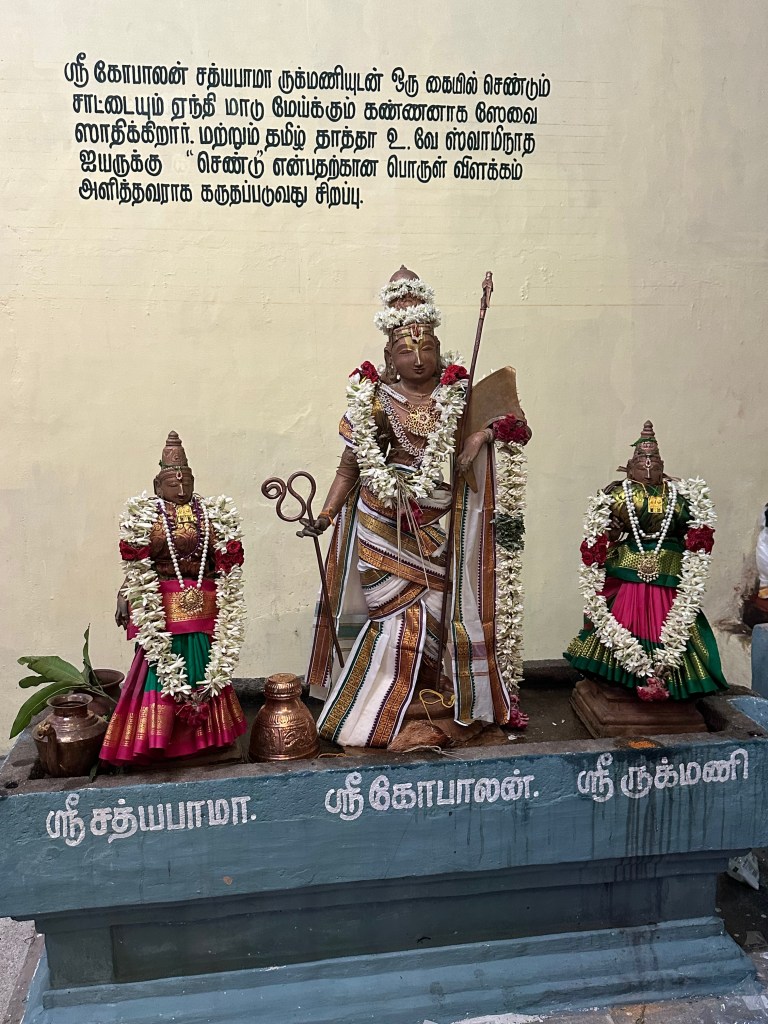
The “sannidhi bhattar”, Sri, Vijay, a young priest who I had been told had just about begun his career as an assistant to Sri Ranganatha Bhattar, who had taken him under his wings, further explained to me an even more intriguiging fact about the other equally enchanting idol of Sri Gopala Krishnan (see below). The anecdote he narrated to me about this captivating idol … it simply took my breath away!

We all know the great Tamil scholar-extraordinaire, Sri. U.Ve. Swaminatha Iyer (19 February 1855 – 28 April 1942). He was an indefatigable researcher who was instrumental in bringing many long-forgotten works of classical Tamil literature to light. His singular efforts over five decades brought to light major literary works in Tamil and contributed vastly to the enrichment of its literary heritage. Iyer published over 90 books in his lifetime, on a variety of matters connected to classical Tamil literature, and collected over 3,000 paper manuscripts, palm-leaf manuscripts and notes of various kinds. He is affectionately remembered today as “Tamil Thatha.

It is believed that during his long travels through many parts of Tamil Country in search of ancient long-bured palmleaf manuscripts, Tamil Thaatha came upon one with a strangely scripted Tamil word “chendu“. He was unable to find a suitable equivalent lexicographical explanation for the word. One night, in his sleep, this idol of Sri Gopala Krishnan appeared in his dream and told him to come to the Vilanagar and offer worship to him at the temple and he would then know what the Tamil word “chendu” meant.

U.Ve. Swaminatha Iyer, next day, hastened to Vilanagar kovil and there he beheld the idol of Sri Gopala Krishnan who wielded a whip and a goading instrument in his hands that was meant to gently goad herds of grazing cow to get a move on. In a flash of intuition, it was revealed to Tamil Thaatha that “chendu” was really an archaic Tamil word for the cowherd’s goad!

****************

What was major revelation for Tamil thaatha many years ago, had become somehow a minor epiphany for me too at Vilanagar on that auspicious penultimate day of the Mahasamprokshanam.

(to be continued)

Sudarshan Madabushi
A memorable “yaathra’ : Six “divya-desams” and one “maha-samprokshanam” – Vilanagar Varadaraja Perumal Temple (Part-13)

Having been close witness to a few of the preliminary ritualistic sessions at the Vilanagar temple Samprokshanam during the first couple of days, I was able to gain some broad and clear understanding of what the various rites involved signified but then only in a very broad sense.

Samprokshanam under the Pancharatra Agama is however a little different from the generally practised rituals in other temples. It is marked by rigorous purification, elaborate invocation of deities, detailed kalasha and nyasa rituals, fire offerings, and unique practices like Chatusthanarchana. The rituals are deeply rooted in the theology of surrender (saranagathi) and that of the multi-faceted presence of Vishnu and his vyuhas (cosmic emanations), ensuring both the physical and spiritual sanctification of the temple and its deities. Thus, the temple MahaSamprokshanam conducted under Pancharatra Shastra follows a set of distinctive ritual practices, rooted in the theological and procedural framework of the Pancharatra texts. This Agama’s emphasis is on meticulous ritual fidelity and cosmic harmony.

*************

It was from the Chief Officiating Priest, the “yagnya adhvaryu“, Sriman Rangananatha Bhattar, that I got to know a little more about these Pancharatra consecrational rites. After the culmination of the event, he was kind enough to spare time to patiently explain to me the salient features of the entire samprokshanam sequence as it was performed over the precious three days, forenoon and afternoon.

on the left: Sri Ranganatha Bhattar of Mayiladhuthurai Indhalur Parimala Ranganatha Perumal Temple

Ranganatha Bhattar is a very unassuming pundit. He went about his job with an air of complete professionalism on all the three days of the Samprokhanam. The conduct of each rite and procedure was meticulously planned and efficiently implemented. He and his team of “kainkarayapaara” — priestly assistants and volunteers — carried out tasks with clockwork precision and promptness. I was keen to know about the Bhattar’s antecedents and credentials and asked him to speak a little about himself. He readily obliged:

“My birthplace was in a tiny hamlet Therapernagar near Appakudathaan village (near Koviladi, Trichy). My family lineage is Kovil Kandadai Vadula Gothra vamsham. After completing my schooling in the nearby government school, I joined college to do B.A. Philosophy. But after 2 years as an undergraduate, I had to discontinue studies due to family circumstances when my father became very ill. To support my family, I took up full-time priesthood. I went to Hyderabad to serve as apprentice priest in a small Perumal temple there known to a relative of mine. A year later I moved to Mumbai to serve again as apprentice priest in the Banasvadi Srinivasa Perumal Kovil. After a few years, I moved then to Melkote where I undertook full-time study in Agama Sastras. After I had qualified in Agama sastra, I got an opportunity to go and serve as temple priest in Port Blair, Andamam Islands for a year. In 1980, I got married and was adopted by my mother’s maternal uncle, who was a chief priest at the Parimala Ranganatha Perumal temple at Indhalur, Mayiladuthurai. I began to serve as an assistant priest at this temple right through 1989…

In 2004, I got an opportunity to go to London, UK, to serve as a chief priest at one of the Vaishnava temples there. After a year, I returned to Indhalur, underwent “prayaschittam” (rite of expiation for having transgressed sastra that forbids overseas travel for a “vaideeka”). I returned to my duties as priest at Parimala Ranganatha Temple. Meanwhile, I also became a “gruhastha” … with one son and a daughter. I got them educated and married. They are well settled in life in vaideeka occupations.

Since 1989, I have without interruption been serving as Chief Priest at the SriParimala Ranganatha temple at Mayiladuthurai as an employee of the Tamil Nadu HR&CE. As per terms of employment, I draw no salary. My only emoluments are from what devotees/pilgrims offer by way of donation at the sannidhi. However, I an entitled to receive from the temple authorities every month a fixed quantity of rice and some grocery.

My connection to the temple at Vilanagar Village of Sri Varadaraja Perumal is more than 3 decades old. It is family lineage connection dating back to 1925 when an ancestor, Sri Ponaapa Bhattar is said to have performed “samprokshanam” for this temple. My “maama-thaatha” (mother’s maternal uncle), Sri Chakrapani Bhattar also for many years was a devoted servitor at this temple. Thus, my family and I are rightful “moraiyaar-s” or “sthalathaar-s” (hereditary “sons-of-soil” temple-rights holders) for several generations through history. It is a fact that apart from my own family ancestry, there were 5 other “moraikaar” families in the local neighborhood who also performed priestly service to this temple of Vilanagar. They belong to the Agama family lineage of:

(1) Kumbhakonam Narayana Bhattar and their 4 siblings

(2) Indhalur Chakrapani Bhattar (my “maama-thaatha”)

(3) Sampath Narayana Bhattar

(4) Nagapattinam Rangaraja Bhattar and their descendents

(5) Gopala Bhattar

(6) Nagai Mukundan (a prominent Agama scholar and kovil-priest who appears today even on popular religious TV channels) and his other family members like Doraiswami Bhattar.

**************

Next, I asked the Bhattar to tell me some important highlights about the Vilanagar temple, its brief history and legends. Again, he was very forthcoming.

“Although I am unable to give you exact Christian Era dating, I know from genealogical sources, that this this temple was erected under a temple-endowment granted during the Chola times… not later than c. 900 CE.

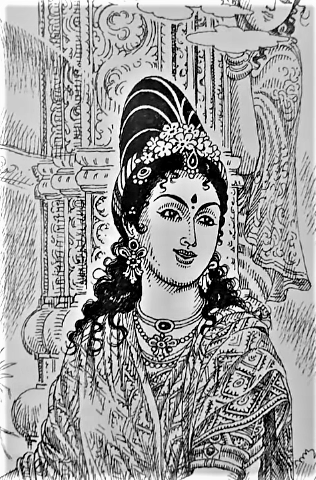
Tamil History records indeed that while Rajaraja Chola’s munificence towards Saiva temples was well known during that period, his sister (Kundavalli or Kundavai nacchiyaar by name) had warm feelings towards Vaishnava deities. Kundavai Pirattiyar, Rajaraja Chola’s elder sister, was a Saivite by birth but showed deep affection for the Vaishnava fold, building Vishnu temples and supporting Vaishnava worship. Her influence is credited with tempering Rajaraja’s Saivite zeal and fostering a spirit of religious inclusivity in the Chola court. She actively promoted and patronized Vishnu temples. Notably, she constructed the Vishnu temple known as Kundavai Vinnagar and also endowed it with gifts and perpetual lamps. Kundavai also built a Jain temple, the Kundavai Jinalaya, at Dadapuram, reflecting her broad religious interests. Her influence on Rajaraja Chola is well documented. While Rajaraja was a devout Shaiva and the builder of the grand Brihadeeswara Temple, he was also known for his patronage of Vishnu temples and Vaishnava devotees, a policy likely encouraged by Kundavai’s example and counsel.

So, wherever her husband the Chozha Raja had ordered Siva temples to be built, this consort of his wife would send out her own orders for a Vishnu temple to also be built nearby. That is how you will find that in Mayiladuthurai so many Sivasthalas being neighbored by Vishnu temples also. This temple of Sri Varadaraja Perumal at Vilanagar is most likely a very good historical example of Kundavai Nacchiyaar’s generous endownment.

I remember that around 20 years ago, I myself participated in the conducting the “samprokshanam” of this temple. But since then, this kovil although being administered by the HR&CE, fell slowly into neglect and disuse. Many pilgrims who came to worship at Parimala Ranganatha Temple knew nothing about this temple here. Traffic of devotees to this temple dwindled and revenues became insufficient for upkeep of the shrines. The bad times continued… Hopefully, now that all you devotees and benefactors have come forward to perform the Mahasamprokshanam again after almost 2 decades, let us hope that Sri Varadaraja Perumal Swamy here will once again bless us all in the years to come”.

**************

Ranganatha Bhattar then proceeded to give me a salient summary of the distinctive ritual procedures for samprokshanam of a Vishnu temple conducted as per PANCHARATRA AGAMA SASTRAS. Below is a paraphrase of his account with a few photos and video-clips attached further below (more in Part-14):

The Mahasamprokshanam ritual involves specific Vedic and Agamic mantras to transfer divine energy during reconsecration. Key mantras include:

1. Vyāhr̥ti Mantras
Recited during energy transfer to kalashas (sacred pots):

  • “Bhūḥ, Bhuvaḥ, Svaḥ” (Earth, Atmosphere, Heaven).
    These three primordial vibrations purify the ritual space and invoke cosmic energies.

2. Sri Sūktam
Chanted to invoke Goddess Lakshmi’s blessings for prosperity:

  • “Hiraṇyavarṇāṁ Harinīṁ Suvarṇarajatasrajām…”.
    Used during kalasha sanctification and abhisekam (ritual bath).

3. Puruṣa Sūktam
Central to Vishnu-centric rituals, affirming the Lord’s omnipresence:

  • “Sahasraśīrṣā Puruṣaḥ…”.
    Recited while pouring mantra jalam (sanctified water) over the vimana (temple tower).

4. Avarana Devata Mantras
24 protective deities encircling the main idol are invoked with specific bījākṣaras (seed syllables):

  • “Oṁ Hrīṁ Śrīṁ Klīṁ Nārāyaṇāya Namaḥ” (for Nārāyaṇa).
  • “Oṁ Aim Hrīṁ Klīṁ Sauḥ Durgāyai Namaḥ” (for Durgā as dvārapālika).

5. Ashtākṣara Mantra
Core Vaishnava mantra during pratiṣṭhā (installation):

  • “Oṁ Namo Nārāyaṇāya”.
    Repeated 108 times to re-establish the deity’s presence.

6. Vīrya Mantram
From Pancharatra Agama, chanted during kalasha abhishekam:

  • “Vīryaṁ Vasudhā Dhārayā…”.
    Strengthens the deity’s spiritual potency (tejas).

7. Sannidhi Mudra Mantras
Accompany ritual gestures (mudras) to re-link the idol with cosmic forces:

  • “Āvāhanaṁ Na Mama…” (Invocation)
  • “Sannidhānaṁ Na Mama…” (Establishing proximity).

8. Purnāhuti Mantra
Final offering in the homam (fire ritual):

  • “Svāhā Pūrṇamadaḥ Pūrṇamidaṁ…”.
    Seeks forgiveness for ritual errors and completes the ceremony.

Key Ritual Context

  • Mantras are recited in Sanskrit by ordained archakas (priests) trained in Pancharatra Agama.
  • Timing: Critical phases (e.g., energy transfer) align with muhūrta (auspicious planetary hours).
  • Audibility: Most mantras are chanted aloud, except bījākṣaras (seed syllables) whispered into the kalasha.

This structured recitation ensures the temple’s spiritual axis (skambha) remains aligned with cosmic principles, per Vaishnava Agamic tradition.

Here are the key ritual features and practices specific to Pancharatra Agama:

Core Ritual Practices in Pancharatra Samprokshanam
  • Purification (Shuddhi):
    • The process begins with purification of the temple premises, ritual implements, and participants using water, mantras, and sometimes fire. This prepares the environment for divine presence and is considered essential in Pancharatra worship.
  • Invocation of Deities:
    • Special mantras are chanted to invoke Lord Vishnu (Narayana) and his consort Lakshmi into the kalashas (sacred pots) and the main idol. The Pancharatra tradition emphasizes the presence of the deity in multiple forms-Paravasudeva (transcendental), Vyuha (emanations), and Archa (iconic form).
  • Kalasha Sthapana and Nyasa:
    • Sacred water pots (kalashas) are installed, and specific nyasa rituals (ritual placement of mantras on the body or objects) are performed. For example, mantras such as “oṁ namaḥ sudarśanāya āgaccha āgaccha” and various cakra mantras are recited, and mudras (ritual hand gestures) like cakra mudradhenu mudra, and yoni mudra are shown around the kalasha.
  • Homam (Fire Ritual):
    • Fire offerings (homam) are central, with offerings made to Agni (fire god) and other deities. This is accompanied by recitation of Pancharatra-specific mantras to sanctify the ritual space and invoke divine blessings.
  • Prana Pratishtha (Infusion of Life):
    • The spiritual energy (prana) of the deity is transferred into the idol through the chanting of Vedic and Pancharatra mantras, and the ritual pouring of sanctified water from the kalashas over the idol and temple towers (vimana and gopuram).
  • Chatusthanarchana:
    • A unique Pancharatra practice, especially during festivals, is Chatusthanarchana-worship at four designated places using holy water, fire, sacred rice, and the deity’s bimbam (image).
    • Chathusthana archana involves deity invoked in four (chathu🙂 places, namely bimba (idol or murthy), mandala ( a platform over which decorated rangoli with multiple colour powders in a specified format),  kumba ( pot filled with water and appropriately decorated) and Agni, the fire place. The priests perform puja at all the four places.
    • This is performed at specific times (e.g., 5–6 AM and 4:30–5:30 PM) and highlights the intricate nature of Pancharatra rituals.
  • Offerings and Aarti:
    • Food offerings (naivedya), incense, lamps, and flowers are presented, and the ritual concludes with aarti (waving of lamps), symbolizing the dispelling of darkness and the presence of divine light.
  • Philosophical Emphasis:
    • The Pancharatra Agama stresses surrender to God (atma-nikshepa), humility, unwavering faith, and the recognition of Vishnu as the sole protector. These attitudes are woven into the prayers and ritual intentions throughout the Samprokshanam.
Distinctive Features of Pancharatra Rituals
FeaturePancharatra Agama Practice
Deity FocusNarayana/Vishnu and his avatars
Ritual StructureHighly systematic, with emphasis on purification and invocation
Kalasha RitualsDetailed, with specific mantras and mudras for energizing water
ChatusthanarchanaWorship at four stations with symbolic elements
Philosophical FoundationSurrender, humility, and faith as core attitudes
Textual BasisDetailed procedures from Pancharatra Samhitas (e.g., Padma, Prasna)
Steps Involved in Saparyāsanam

Based on established knowledge of Hindu temple rituals, Saparyāsanam (sometimes spelled Saparyasanam or Saparyāśana) refers to the detailed sequence of worship and offerings performed to the deity, typically as prescribed in Agamic traditions. The core purpose of Saparyāsanam is to offer respectful, completion of worship to the deity, ensuring both ritual purity and spiritual connection.

  • Avahana (Invocation): The deity is invoked into the idol or image with mantras and ritual gestures.
  • Asana Samarpana (Offering a Seat): The deity is offered a symbolic seat, inviting the divine presence to reside.
  • Padya, Arghya, Achamana (Offerings of Water):
    • Padya: Water for washing the feet.
    • Arghya: Water for washing the hands.
    • Achamana: Water for sipping and purification.
  • Snana (Bathing): The idol is ritually bathed with water, milk, honey, and other sanctified substances.
  • Vastra Samarpana (Offering Clothes): Fresh garments or cloth are offered to the deity.
  • Alankara (Adornment): The deity is adorned with ornaments, flowers, and sandal paste.
  • Gandha, Pushpa, Dhupa, Deepa (Fragrance, Flowers, Incense, Lamp): These offerings are made in sequence to please and honor the deity.
  • Naivedya (Food Offering): Sanctified food is offered.
  • Tambula (Betel Leaf Offering): Betel leaves and areca nut are offered as a gesture of hospitality.
  • Pradakshina and Namaskara (Circumambulation and Prostration): Devotees circumambulate the sanctum and offer prostrations.
  • Mangala Aarti (Final Waving of Lights): The ritual concludes with waving of camphor or lamps before the deity.

(to be continued)

Sudarshan Madabushi
IQ, EQ, AI … and the future of the corporate workplace

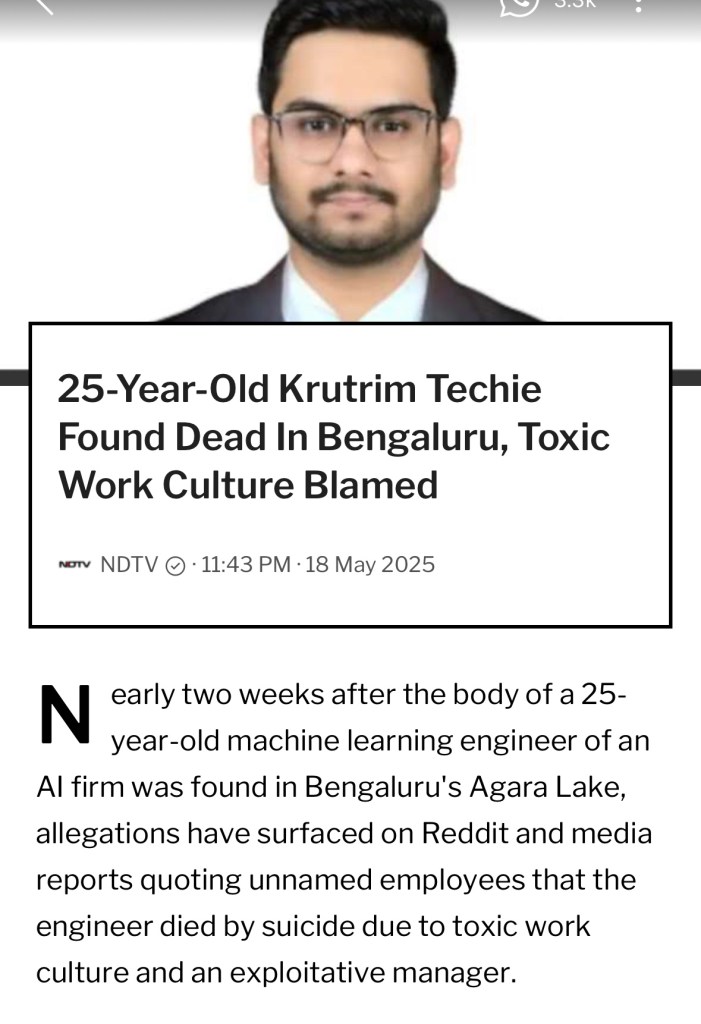
25-Year-Old Krutrim Techie Found Dead In Bengaluru, Toxic Work Culture Blamed: By NDTV via Dailyhunt
http://dhunt.in/10ndaZ

😞💐

When I read the above news item I felt very sorry for the young man… what a wasted precious life … !

But what I don’t understand is why did this guy have to take such an extreme step ?!! He after all was a super intelligent guy … securing super GP score in academics ! … But he seems to have lacked the guts to stand up for himself !

Young people these days assert themselves so boldly in other areas of their life … e.g. home , fraternity, consumer, other relationships … why do they buckle to bullying at workplace ?

It’s not enough to be educated . It’s important to show character and possess self-esteem too .

I’ve had a 37 year long career in the corporate world. I too have had to deal with difficult bosses from time to time … but even at the risk of losing my job I managed somehow always to make clear it clear to abusive authority figures that I’d take pressure, workload and deadlines … but never abuse .

Just as no married woman these days has to put up with domestic abuse by the spouse , there’s no need for youngsters like this poor chap to have to put up with workplace abuse by his boss.

Go in peace young man ! God bless .

Now, when I forwarded the above news item with a few of my old good friends who are retired/ semi-retired corporate executives like me , and they had read my reactions to it, it set off immediately a very thoughtful discourse on the larger dimensions of the widespread problem afflicting the contemporary corporate workplace in India : Work-life balance and the place of IQ and EQ (or EI) (Intelligence/ Emotional Quotient/Intelligence) in today’s corporate jungle .

Here is a transcript of our friendly conversation:

Friend 1: Proves the point- IQ and EQ operate on different planes — excelling in one doesn’t ensure strength in the other.

Me: True … our whole school and higher education system is equipped only to develop IQ in our youngsters … for EQ development they’re left on their own . Family these days with both parents busy pursuing their own career and other dreams also are unable to provide the much needed inputs for EQ development . Quite sad !

Friend 1: Totally agree. Our education system is brilliantly designed to sharpen IQ — but leaves EQ to chance. Emotional intelligence isn’t taught, it’s assumed — and in today’s world, that’s a critical gap. With families stretched thin and schools focused on scores, children all over the World grow up intellectually capable but emotionally undernourished. 

It’s time we realized that IQ may help you succeed by getting you into the right schools, landing prestigious jobs, or excelling in technical tasks — but it’s EQ that sustains that success over time. Emotional intelligence governs how you navigate stress, handle failure, lead teams, build trust, and maintain relationships — all of which are essential in the real world, especially in leadership and collaborative roles. Without EQ, even the most intellectually gifted individuals can struggle with burnout, conflict, or isolation. Success achieved through IQ can open doors, but without EQ, those doors often close just as quickly.

Me: Yes, good point . But you know I see some correlation between EQ and family antecedents — size, close-knitted-ness, values and stability. In my case, growing up in a large family environment I feel definitely did much to nourish EQ development . Today’s nuclear families unfortunately don’t provide that … That’s sad, if you ask me.

Friend 2: Well, what can be said? … That is the whole story of our generation, isn’t it? The decline of traditional family structure…”

Me: No… not really , I’d say… It is the story that we have told our children in their generation … But it wasn’t the story that our parental generation told us .. was it?

Friend 2: Well… that’s difficult to say conclusively but yes, I do agree, there was a certain firm grounding in our family religious practices, meditation, music -— and all that somehow perhaps did do it’s bit to nurture our EQ …. Let’s say it was some kind of in-built family system or ecology that nourished our EQ. And in the background, of course, given the hard economic circumstances in which TAMBrahm families found themselves in, it was also dire necessity to financially come up in life – so, there was pressure on us to develop our IQ too … EQ was thus left to God and IQ was in our DNA perhaps, who knows? The EQ part was imperceptible but the family liked it to be that way … Like ADHD – syndrome … just recognizing it was Ok, but attending to it and lavishing too much attention to it was some seen as some sort of luxury. Most times, our success in our careers was because of the brute force of IQ that we had to exert in life and not so much due to development of our EQ….

Me: You’re right … And what we experienced in our generational growth-years we simply passed on to our children, didn’t we? We wanted them too to know and be able to exercise the “brute force of IQ” to get ahead and become high-achievers in life.

At any average CBSE school or even State high school, children are burdened with only with heavy-duty, burdensome IQ-driven syllabus… the rigour of tests, exams and academic grilling they are subjected to leaves very little time for teachers or parents to see if they are at the same time getting EQ-fortified life-experiences.

The whole education-system has only one aim: to put the student onto the treadmill of IQ-designed curricula … and keep turning up the gear-speeds. As for EQ fulfilment needs, the student simply has to take recourse to the cinema, smartphone screen-time, Instagram and other online content like Netflix.

Also, when it came to our professional growth-up years … For some inexplicable reason, always in the professional environment in which we worked, emotion was looked upon as weakness of character … “oh, stop… don’t bring emotion into this issue …. Let’s look at it rationally , please. Hang your emotions outside the conference”.

That would always be the manner how executive-C-suite room meetings we know would always be held … Emotion was bad , it always leads to bad decision making … cold rational thinking was business virtue … emotion clouded everything .. 

So, when emotion was always denigrated thus and rationality idolised … what happened is that no one even wanted to know or understand what EQ really is.

Moreover, IQ is quantifiable . EQ is always airy fairy … So , that’s why EQ is never regarded as anything to worry about as much as IQ.

Even philosophy , our own Vedanta system, is very partial towards the intellect (buddhi) … while the mind , manas, is always considered to be a monkey … “asthiram” ( restless) and “chanchallam” (capricious) . So, even philosophically, we are all attuned more towards the buddhi than our manas … The EQ is relegated to a lower position than IQ .

The tragedy of it all is also that IQ is statistically determined whereas EQ is behaviourally evaluated. And, if you ask me, the term Quotient is a total misnomer for both. Because “quotient” is a static mathematical concept! It’s not a dynamic function . IQ can be taught to reach it’s full potential… But EQ, it can only be imbibed… and yet no one can tell if it has reached it’s full potential.

******* ********* ********* ********

Then, later in the day, I came upon this other but closely related news-item which also got me thinking hard about the looming crisis ahead for our youngsters in our country… so much like the young man in Bangalore who took his life out, above .

Zoho CEO Sridhar Vembu’s warning to software engineers: Don’t take high salaries for granted, jobs could be destroyed
http://dhunt.in/10mQJy

By The Financial Express via Dailyhunt

Another friend of mine reacted to this story with this view:

While it is true that AI will take away most of the grunt work, there will still be a growth in demand for software engineers. Way back in 1971 this Company X got an IBM 1301 mainframe computer. Basically to do payroll and some accounting. The union went on strike immediately and we engineers were blocked from entering the office. Eventually some agreement was reached. Instead of jobs being lost (as feared by the union) multiple new jobs were created. All the fuss about computers raised by the Commie unions across India vanished”.

And my reaction to him was this ⬇️ below:

Yes … this narrative did turn out to be true … more computerisation resulted in more jobs of different kinds . 

The question is whether AI is just another phase of computerisation or if it’s a beast unlike any other seen in the history of automation of the workplace . 

Let us not forget that the biggest expansion of “computer land” and computerisation revolution began with shopfloor CNCs, Y2K , then dot.com, then ERP, CADCAM, … and then again came Internet, and the great worldwide telecom revolution … 

All that happened in the time of Globalisation, Freemarket expansion, multilateralism, booming financial markets and not too fettered global immigration. 

For 30 years the global environment was such that Technology and Demography did not clash . They were friendly to each other . 

That benign environment no longer exists today .

Instead of globalisation we are back to protectionism. Freemarkets are gone , tariffs are in. Technology competition is no longer collaborative but has become adversarial . Immigration is hateful . Job markets are fiercely protected . Intellectual property like AI or Semiconductor manufacturing is jealously guarded . The open system concepts are gone … And the elapse time (for countries keen to catch up in the technology race) between investment and realising outcomes will get longer and longer … unlike in the past when nations did not face many entry-barriers to technology … 

In the current state of affairs , new skilling is the buzzword , but it does not guarantee gainful employment for the mass of people in the world. Jobs for people will expand only to fill the space allowed for them by protectionist, xenophobic governments.

Technology and People are no longer friendly … From now onwards, it’s going to be purely transactional relationships between the two . 

We live in a Trumpian MAGA world . … remember, and he himself has said , that all the world’s rare earth , semiconductor and AI technology will be for America … and no other countries will be allowed to compete with America .

So, while not disagreeing with your view , I don’t however feel as sanguine about job-markets in the world as you do and much less optimistic about the salubrity of the future corporate workplace.

The motto of IBM once used to be “The purpose of a Company is to enable ordinary people to do extraordinary things”. Well… as I see the future, AI would more likely be doing much of both the ordinary and the extraordinary stuff as well.

Sudarshan Madabushi
A memorable “yaathra’ : Six “divya-desams” and one “maha-samprokshanam” – Vilanagar Varadaraja Perumal Temple (Part-12)

The Mahasamprokshanam ritual (also known as Kumbhabhishekam or Samprokshanam), holds significant historical importance in Hindu temple tradition. Its primary purpose is to “homogenize, synergize and unite the mystic powers of the deity” — essentially, it is a reconsecration ceremony that recharges and revitalizes the spiritual energy of the temple and its deities.

Historically, this ritual has been performed at regular intervals (often every 12 years) or after major renovations, repairs, or the installation of new idols. It serves to reaffirm the sanctity of the temple, ensuring that the divine presence and energy remains potent and accessible to devotees. The ritual is deeply rooted in Agama traditions and has been observed for centuries, as seen in ancient temples where Mahasamprokshanam marks key milestones in their history and continuity of worship.

The ceremony also fosters community participation, bringing together devotees, priests, and local residents in a collective act of devotion and celebration, thereby reinforcing the temple’s role as a center of cultural and spiritual life.

************

The Mahasamprokshanam (Kumbhabhishekam) in Vilanagar Sri Varadaraja Perumal Kovil, began as prescribed by Agama, involving a multi-stage ritual to rejuvenate the divine energy of the deities in the temple.

The following is an overview of the key procedures:

1. Preparatory Rituals
  • Invocation of Deities: The process begins in the yagashala (sacrificial hall) with the invocation of Sri Paravasudeva in holy water and Sri Mahalakshmi in a sanctified kalasam (pot). Agni (fire god) is invoked in the homam (fire altar), and divine energy is infused into sacred rice (akshata) and the Yaga Bera (ritual idol).
  • Purification: The temple site is cleansed with cow dung, and protective mantras are recited to ward off negative influences. Dhvāra pālakas (gatekeeper deities) like Chandan and Prachandan are installed at the temple entrance.
2. Energy Transfer to Kalashas
  • Ashta Bandhana Removal: The moola vigraha (main deity) is detached from its pedestal by dissolving the Ashta Bandhana paste (a blend of eight herbs and resins). This adhesive is ritually replaced every 12 years.
  • Mantra Jalam: The deity’s spiritual essence (sannidhyam) is transferred into kalashas filled with sanctified water through Vedic chants. These pots serve as temporary abodes for the divine energy during temple renovations.
3. Temple Renovation & Renewal
  • Structural Repairs: Renovations to vimanas (tower structures), gopurams (gateways), and dwaja sthambams (flagpoles) are completed. Damaged idols are repaired or replaced in accordance with Agamic specifications.
  • Snapana (Sacred Bath): The deity undergoes abhisekam (ritual bath) with varying numbers of kalasams (1, 5, 9, 12, etc.), depending on the occasion. This is accompanied by recitations of Stotras and dhyana (meditation) on the Lord’s form.
4. Reconsecration Rituals
  • Kalasha Abhishekam: The sanctified water from the kalashas is poured over the vimana and gopuram while chanting the Sri Mantram and Virya Mantram. This transfers the deity’s energy back into the moola vigraha.
  • Mudra and Offerings: Priests perform shadanga nyasam (ritual gestures) and present upacharas (offerings) like arghya (water), pushpa (flowers), and dhupa (incense). Specific mudras like Aavahana (invocation) and Sannidhi (proximity) are shown to re-establish the deity’s presence.
5. Final Rites & Blessings
  • Bali and Tarpanam: Offerings (bali) are made to ancillary deities and ancestors. The Acharya performs Purnahuti (final oblation) in the fire altar, seeking forgiveness for any ritual errors.
  • Pradakshina: Devotees circumambulate the temple three times, reciting hymns to secure liberation from the cycle of rebirth.
Key Considerations
  • Timing: Rituals are conducted at auspicious intervals (e.g., every 12 years) and during specific daytime windows (e.g., 5–6 AM or 4:30–5:30 PM).
  • Materials: Sacred items like darbha grassakshata, and ashta bandhana paste are essential for maintaining ritual purity.

This structured renewal ensures the temple remains a potent center of divine energy, aligning with the Agama.

***************

ASHTA BANDHANA RE-APPLICATION RITUAL

As described above, the removal and re-application of the Ashtabandhana paste on the main idol (moola archamurthy) is one of the most important procedures in the ritual of “samprokshanam”. It has not only tremendout religious significance but actually also serves as a very powerful means of social and community bonding.

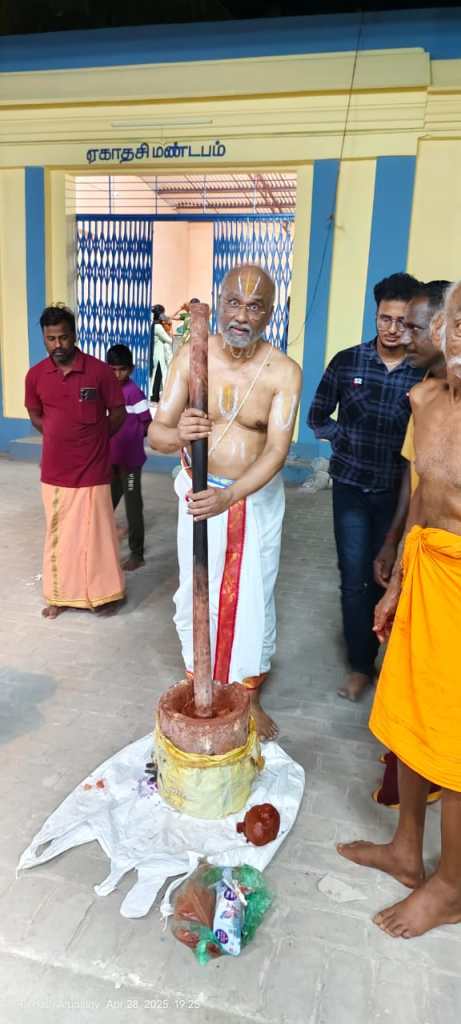
The Ashtabandhana paste is a traditional adhesive used to affix the main idol (moola vigraha) to its pedestal (peetham) in Hindu temples. This paste is actually prepared by priests in a ceremonial manner using pestle and mortar to grind a thick paste. After the paste has been formulated, using the pestle and mortar ritual it has to be ground into a highly adhesive admixture — a kind of cementing medium . The grinding is done my pounding the adhesive repeatedly. The whole village community in Vilanagar was invited to participate in the ritual grinding of the Ashtabandhana paste, each devotee taking turns to repeatedly pound it with pestle and mortar.

The opportunity for me to join the village community in the ritual was really a God-sent one for me as it was the first time ever in my life that I had the experience.

**************

There are specific rituals performed during the re-application of the Ashtabandhana paste:

  • Collection and Sanctification of Ingredients: Eight traditional ingredients (“ashta“) are collected and assembled in the yagasala (ritual hall) with religious rituals. Priests chant verses that eulogize the deities associated with each ingredient, seeking their blessings for the successful preparation and application of the paste.
  • Puja and Mantra Chanting: Vedic pundits perform special pujas and chant mantras as the paste is prepared and before it is applied to the idol and pedestal. This sanctifies both the materials and the process, reinforcing the spiritual connection.
  • Application Ceremony: The actual affixing of the idol to its pedestal with the Ashtabandhana paste is performed with great reverence, as part of the larger Maha Samprokshanam ritual. The process is overseen by priests, ensuring all ritualistic requirements are fulfilled.

These rituals highlight both the sacredness of the materials and the importance of the act, symbolizing the spiritual and physical bonding of the deity to the temple sanctum.

Specific mantras and prayers are recited then during the re-application of the Ashtabandhana paste, as this act is considered highly sacred and central to the consecration process.

I had the wonderful divinely ordained experience of personally applying the “ashtabandhana paste” to the base of the magnificent 12-foot main moolavar idol of Sri Varadaraja Perumal in the “garba-griha”. It was a truly horripilating experience for me as I began applying the paste below the sacred feet of the Almighty! Involuntarily, I began to recite the Sanskrit verses from Swami Vedanta Desikan’s “Nyaasa Dasakam” which express “prappati” or absolute surrender to Lord Varadaraja!

**************

While the exact mantras can vary based on tradition and Agama followed, the general practice includes:

  • Invocation of Vishvaksena: Before starting, priests chant mantras in praise of Vishvaksena to remove obstacles, such as:
    These mantras invoke auspiciousness and smooth conduct of the ritual.
  • Sankalpa (Statement of Intent): The priest formally declares the purpose of the ritual, asking for blessings and success in affixing the idol.
  • Purification and Kalasha Mantras: Mantras invoking sacred rivers and purifying the ingredients are recited, such as:gange cha yamune chaiva godāvari sarasvati… These invite the presence of holy waters into the ritual.
  • Application Mantras: As the paste is applied, priests chant Vedic and Agamic mantras specific to the deity being installed, seeking the deity’s presence and requesting that the idol be firmly established. These may include:
    • Ashtakshara Mantra (for Vishnu): Om Namo Narayanaya
    • Gayatri Mantra or other core Vedic hymns.
  • Prayers for Sanctification: Additional prayers are offered to sanctify the act and ensure the idol’s spiritual energy is preserved and enhanced.

These mantras and prayers, recited with devotion and precision, ensure the physical act of applying the paste is also a profound spiritual event, establishing the idol as a true seat of divine presence.

The classic formulation for the Ashtabandhana paste includes eight key ingredients, though exact recipes may vary slightly by region or tradition. Commonly cited ingredients are:

  • Wood lac (shellac)
  • Resin (such as Shorea robusta or sarja resin)
  • Red ochre (hematite)
  • Beeswax
  • Buffalo butter (clarified butter)
  • Conch shell powder
  • Gall nut (kaduka/Terminalia chebula)
  • Cotton

Other variations may include:

  • Limestone powder
  • Fine sand or special clay
  • Kolarakku (lac resin)
  • Amla (dried gooseberry).
Purpose of Applying Ashtabandhana
  • Adhesive Function: Ashtabandhana acts as a strong, watertight adhesive, binding the idol securely to the pedestal so that ritual liquids (like water, milk, ghee) poured during abhishekam do not seep underneath and dislodge the idol.
  • Ritual Sanctity: It preserves the sanctity and spiritual potency of the idol by sealing the base, protecting any sacred yantras or mantras placed beneath.
  • Longevity: The paste is believed to keep the idol rejuvenated and spiritually potent for up to 12 years, after which it is traditionally renewed during Mahasamprokshanam/Kumbhabhishekam.

The historical significance of using the specific ingredients in the Ashtabandhana paste lies in their functional, ritual, and symbolic roles within temple tradition:

  • Functional Durability: The eight ingredients-such as wood lac, limestone powder, resin, red ochre, aloe vera, papaya leaf, bitter gourd leaf, and beeswax-were selected for their adhesive, waterproofing, and flexible properties. This ensured the idol remained firmly fixed to the pedestal despite constant exposure to ritual bathing substances (abhisheka dravyams) like water, milk, and oils. The paste’s flexibility, akin to rubber, allowed it to absorb minor movements and prevent cracks, which could otherwise allow liquids to seep in and damage sacred yantras or mantras beneath the idol1.
  • Ritual Protection and Sanctity: The ingredients also serve a sacred function, forming a watertight seal that protects the yantra (mystical diagram) and bijakshara mantras (sacred syllables) placed under the idol. This preservation is crucial for maintaining the pranic (spiritual) power of the deity, as any breach could diminish the idol’s spiritual potency over time.
  • Symbolic and Traditional Value: The use of eight (ashta) ingredients is itself symbolic, representing auspiciousness and completeness in Hindu ritual practice. The tradition of using these natural substances dates back centuries, reflecting an ancient understanding of both material science and spiritual symbolism in temple construction and maintenance.
  • Cyclical Renewal: The gradual hardening and cracking of the paste over years necessitated its periodic renewal (typically every 12 years), reinforcing the cyclical nature of temple sanctification and the ongoing rejuvenation of divine energy.

The Ashtabandhana paste maintains the idol’s spiritual energy by creating a watertight and airtight seal between the idol and its pedestal, which is crucial for several reasons:

  • Prevents Ritual Liquid Seepage: During daily and special rituals, liquids like water, milk, and ghee are poured over the idol. Ashtabandhana ensures these do not seep beneath the idol, which could otherwise disturb or dislodge sacred items (such as yantras or mantras) placed under the idol that are essential for maintaining the deity’s spiritual presence.
  • Secures the Idol’s Position: Temple scriptures emphasize that once an idol is installed, it should not be moved, as its location is determined by precise spiritual calculations. The strong adhesive property of Ashtabandhana keeps the idol immovable, preserving the sanctity of the consecrated spot and the uninterrupted flow of spiritual energy.
  • Preserves Spiritual Power: By sealing the idol and protecting the sacred contents beneath, Ashtabandhana helps maintain and enhance the spiritual energy (prana or shakti) of the deity, which is further supported by constant worship and ritual practices.
  • Ensures Longevity of Sanctity: The paste’s effectiveness typically lasts about 12 years, after which it is renewed to ensure the continued potency of the idol’s spiritual energy and the temple’s sanctity.

In summary, Ashtabandhana is both a physical and spiritual safeguard, ensuring the idol remains a powerful and unbroken conduit for divine energy within the temple. Ashtabandhana is both a practical and sacred compound, essential for the stability and sanctity of temple idols throughout the many centuriesthat they have been worshipped in our country.

Personally, I felt that my participation in the Ashtabandhana ritual, had resulted in a strange soulful “bonding” with the presiding deity of Vilanagar! It reminded me of the same sentiment of “bonding” that Sri Andal in her Tiruppaavai had alluded to in a simple but profound Tamil phrase:

குறைவொன்றும் இல்லாத கோவிந்தா! உன்தன்னோடு
உறவேல் நமக்கிங்கு ஒழிக்க ஒழியாது

“There is only one thing we know for certain. By having you as our Lord, we have gained Vaikuntha (the ultimate spiritual abode) as the fruit of our birth. That is all we know. No one can ever break the bond we have with you.”

(to be continued)

Sudarshan Madabushi
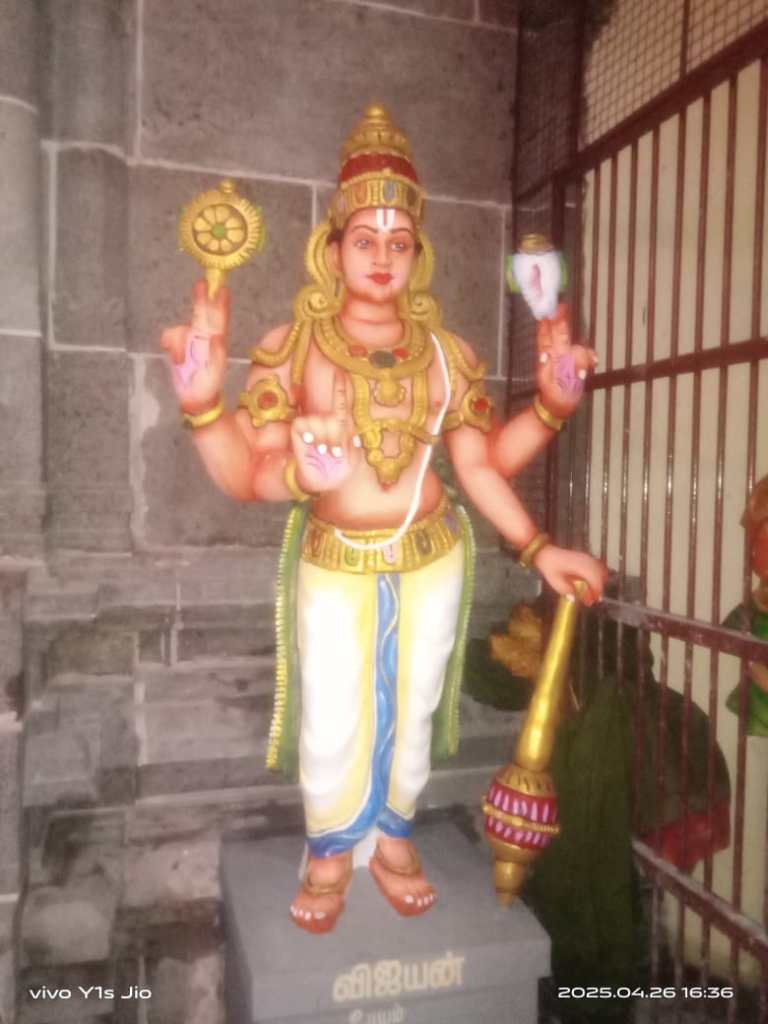
The future of Indo-Pak relations: “Hyphenation” out and “Conjugation” in

https://thefridaytimes.com/15-May-2025/the-pahalgam-attack-and-the-return-of-the-india-pakistan-hyphenation?version=amp

This tag of “hyphenation” in global diplomacy is as old as the hills and doesn’t apply to India – Pakistan alone. It’s been turned into some scary foreign policy phobic doctrine by the mandarins of India’s MEA over several decades now since Bill Clinton as POTUS first tried to hyphenate all of South Asia as “Afghanistan-Pakistan-India” and pinned a United States Marshal or Sheriff’s star on the chest of a US State Department diplomat, Richard Holbrook, and tasked him with taking charge of the town here. India growled. And Holbrook best a hasty retreat from New Delhi.

Thirty years later , after many bloody wars, Afghanistan too finally managed to de-hyphenate itself from the Holbrook doctrine with Joe Biden beating a hasty, ignominious retreat in 2021 from Afghanistan.

Hypenation is an imperialistic trick always kept hidden up the sleeve of Western powers and is often used to keep the pot boiling in every hotspotand choke point across the world wherever their own strategic interests lie . 

Hyphenation is a very useful tool to make Siamese Twins of two belligerent antagonists to tango while being joined at the hips in a slow dance of death. It’s a game. Very effective in setting one against the other in a slow-motion embrace of mutual destruction.

Look closely at the history of many of the world’s hotspots or perennial conflict-zones … and you’ll see hyphenation play a key role in everyone of them: 

– Israel-Palestine 

– China-Taiwan 

– Ukraine-Russia 

– South Korea- North Korea 

– Sunni Arabia- Shia Iran 

After May 2025 Pakistan-India clash in the aftermath of the heinous and tragic Pahalgam terror attack, for Indian foreign-policy the diplomatic choreography going forward has become much clearer now than it was ever before. And in PM Modi’s address to the nation a few days ago that clarity of direction and resolve was conveyed stridently and eloquently.

What came through loud and clear, to me at least, from the PM Modi stirring speech was this:

There’s now only way to survive hyphenation ….It’s called conjugation.

In biological science,  Conjugation is the combination of two substances by which major horizontal gene transfer mechanism takes place through which DNA is transferred from a donor to a recipient bacterium by direct contact and by which process  toxic compounds are  eliminated from the body of the donee organism by the donor organism through conjugation”.

In India – Pakistan relations, going forward, Conjugation will mean DNA transfer of sorts: i.e. inevitably, on the one hand, the transfer of PoK to India; and on the other, the de-conjugating of Baluchistan from Pakistan. 

Hyphenation out. Conjugation in

Such conjugation will now have to be the the “new normal” in Indio-Pak relations that PM Modi spelt out in his speech. It is the only way to get rid of all traces of “hyphenation” and eliminate all traces of “toxic compounds” that India now knows are resident in that present host-organism, Pakistan’s body politic and its deep state.

Sudarshan Madabushi

What’s the possible reason for Trump’s volte-face ?

The United States has foolishly given Pakistan more than 33 billion dollars in aid over the last 15 years, and they have given us nothing but lies & deceit, thinking of our leaders as fools. They give safe haven to the terrorists we hunt in Afghanistan, with little help. No more!”

— Donald Trump : POTUS January 1. 2018

“We have been paying Pakistan billions and billions of dollars at the same time they are housing the very terrorists that we are fighting. It is time for Pakistan to demonstrate its commitment to civilisation, order, and to peace”.

— Donald Trump POTUS : August 2017

In May 2025, after boasting that it was he who brokered a ceasefire between the India and Pakistan conflict following a deadly terrorist attack in Pahalgam, Kashmir, Trump refers to Pakistan now as a “great nation” without directly accusing Pakistan of having supporting terrorism!

What’s the possible reason for Trump’s volte-face?

Trump’s appears intoxicated by the “MAGA” cocktail he has brewed for America — a mix of diplomatic, economic, and strategic considerations aimed at bolstering the sagging US ability to influence and bring about a new world order. Trump sees no stability in Europe (Ukraine- Russia), in South America (Panama- Venezuela) , in East Asia (China and tariffs) , in Middle East (Iran/Israel) and in South Asia (India-Pakistan). This POTUS has figured out that unless he figures out a way to make America great again in world affairs is to go back to the old tried and tested imperialist policy of sowing seeds of conflict between regional powers ( both major and minor ones too like Pakistan) in every corner of the world.

Sowing Chaos is the best way to make America great again in the eyes of the world.

Several factors therefore likely explain Trump’s volte face on Pakistan’s terrorist involvement:


Diplomatic Priorities: After brokering a ceasefire between India and Pakistan, Trump thinks shifting focus to promoting peace and stability between the two nations in the region, will position the U.S. as a political mediator rather than as anti-terrorism crusader.


Economic Interests: Trump has publicly stated that increased trade between countries can be a major reason for reducing hostilities, and he has expressed intentions to boost US trade with both India and Pakistan.


Strategic Calculations: The U.S. recently exempted $397 million in security assistance to Pakistan for so-called counterterrorism cooperation which must be prioritized if it serves U.S. interests and even if Pakistan might again give in return only “ lies and deceit”. In this context the “New Normal” Modi-enunciated Doctrine of Zero Tolerance for Pakistani Terrorism queers the pitch for America’s (CIA) own strategic interests and manoeuvre room here in West Asia (Taliban, Iran, Yemen and Palestine).


Changing Regional Dynamics: With Pakistan strengthening ties with China and the U.S. recalibrating its South Asia policy post its withdrawal from Afghanistan, Trump’s administration may be now seeing engagement with Pakistan as necessary for broader strategic goals. India is not as easy as Pakistan to browbeat and pressure into abiding by US foreign policy dictates in South Asia. Even within the QUAD, America has found India to be often testing its patience. And it certainly greatly irks America that India’s ties with Russia remain much warmer and far more durable than they ever were with the USA .

All the above factors may be leading gradually to some kind of a broad level of rehabilitation setting into US- Pakistan relations which since 2016 had gone a bit rancid.

This imperceptible but definite diplomatic shift that is taking place right under their noses is a development which both India and China will have to monitor closely and very concernedly in the years ahead.

The bottom-line : Let’s face reality India ! Terrorism means different things to different people . In Pakistan it is a cottage industry. For India , it is a scourge. For America , it is strategic portfolio investment.

Sudarshan Madabushi