IQ, EQ, AI … and the future of the corporate workplace

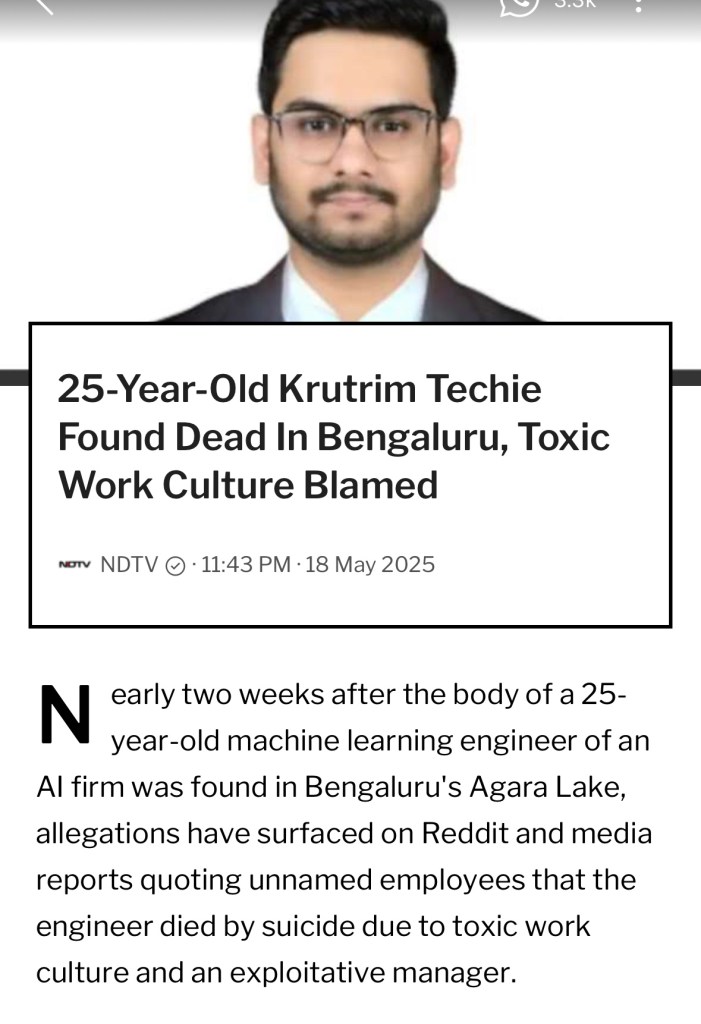
25-Year-Old Krutrim Techie Found Dead In Bengaluru, Toxic Work Culture Blamed: By NDTV via Dailyhunt
http://dhunt.in/10ndaZ
😞💐

When I read the above news item I felt very sorry for the young man… what a wasted precious life … !

But what I don’t understand is why did this guy have to take such an extreme step ?!! He after all was a super intelligent guy … securing super GP score in academics ! … But he seems to have lacked the guts to stand up for himself !

Young people these days assert themselves so boldly in other areas of their life … e.g. home , fraternity, consumer, other relationships … why do they buckle to bullying at workplace ?

It’s not enough to be educated . It’s important to show character and possess self-esteem too .

I’ve had a 37 year long career in the corporate world. I too have had to deal with difficult bosses from time to time … but even at the risk of losing my job I managed somehow always to make clear it clear to abusive authority figures that I’d take pressure, workload and deadlines … but never abuse .

Just as no married woman these days has to put up with domestic abuse by the spouse , there’s no need for youngsters like this poor chap to have to put up with workplace abuse by his boss.

Go in peace young man ! God bless .

Now, when I forwarded the above news item with a few of my old good friends who are retired/ semi-retired corporate executives like me , and they had read my reactions to it, it set off immediately a very thoughtful discourse on the larger dimensions of the widespread problem afflicting the contemporary corporate workplace in India : Work-life balance and the place of IQ and EQ (or EI) (Intelligence/ Emotional Quotient/Intelligence) in today’s corporate jungle .

Here is a transcript of our friendly conversation:

Friend 1: Proves the point- IQ and EQ operate on different planes — excelling in one doesn’t ensure strength in the other.

Me: True … our whole school and higher education system is equipped only to develop IQ in our youngsters … for EQ development they’re left on their own . Family these days with both parents busy pursuing their own career and other dreams also are unable to provide the much needed inputs for EQ development . Quite sad !

Friend 1: Totally agree. Our education system is brilliantly designed to sharpen IQ — but leaves EQ to chance. Emotional intelligence isn’t taught, it’s assumed — and in today’s world, that’s a critical gap. With families stretched thin and schools focused on scores, children all over the World grow up intellectually capable but emotionally undernourished. 

It’s time we realized that IQ may help you succeed by getting you into the right schools, landing prestigious jobs, or excelling in technical tasks — but it’s EQ that sustains that success over time. Emotional intelligence governs how you navigate stress, handle failure, lead teams, build trust, and maintain relationships — all of which are essential in the real world, especially in leadership and collaborative roles. Without EQ, even the most intellectually gifted individuals can struggle with burnout, conflict, or isolation. Success achieved through IQ can open doors, but without EQ, those doors often close just as quickly.

Me: Yes, good point . But you know I see some correlation between EQ and family antecedents — size, close-knitted-ness, values and stability. In my case, growing up in a large family environment I feel definitely did much to nourish EQ development . Today’s nuclear families unfortunately don’t provide that … That’s sad, if you ask me.

Friend 2: Well, what can be said? … That is the whole story of our generation, isn’t it? The decline of traditional family structure…”

Me: No… not really , I’d say… It is the story that we have told our children in their generation … But it wasn’t the story that our parental generation told us .. was it?

Friend 2: Well… that’s difficult to say conclusively but yes, I do agree, there was a certain firm grounding in our family religious practices, meditation, music -— and all that somehow perhaps did do it’s bit to nurture our EQ …. Let’s say it was some kind of in-built family system or ecology that nourished our EQ. And in the background, of course, given the hard economic circumstances in which TAMBrahm families found themselves in, it was also dire necessity to financially come up in life – so, there was pressure on us to develop our IQ too … EQ was thus left to God and IQ was in our DNA perhaps, who knows? The EQ part was imperceptible but the family liked it to be that way … Like ADHD – syndrome … just recognizing it was Ok, but attending to it and lavishing too much attention to it was some seen as some sort of luxury. Most times, our success in our careers was because of the brute force of IQ that we had to exert in life and not so much due to development of our EQ….

Me: You’re right … And what we experienced in our generational growth-years we simply passed on to our children, didn’t we? We wanted them too to know and be able to exercise the “brute force of IQ” to get ahead and become high-achievers in life.

At any average CBSE school or even State high school, children are burdened with only with heavy-duty, burdensome IQ-driven syllabus… the rigour of tests, exams and academic grilling they are subjected to leaves very little time for teachers or parents to see if they are at the same time getting EQ-fortified life-experiences.

The whole education-system has only one aim: to put the student onto the treadmill of IQ-designed curricula … and keep turning up the gear-speeds. As for EQ fulfilment needs, the student simply has to take recourse to the cinema, smartphone screen-time, Instagram and other online content like Netflix.

Also, when it came to our professional growth-up years … For some inexplicable reason, always in the professional environment in which we worked, emotion was looked upon as weakness of character … “oh, stop… don’t bring emotion into this issue …. Let’s look at it rationally , please. Hang your emotions outside the conference”.

That would always be the manner how executive-C-suite room meetings we know would always be held … Emotion was bad , it always leads to bad decision making … cold rational thinking was business virtue … emotion clouded everything .. 

So, when emotion was always denigrated thus and rationality idolised … what happened is that no one even wanted to know or understand what EQ really is.

Moreover, IQ is quantifiable . EQ is always airy fairy … So , that’s why EQ is never regarded as anything to worry about as much as IQ.

Even philosophy , our own Vedanta system, is very partial towards the intellect (buddhi) … while the mind , manas, is always considered to be a monkey … “asthiram” ( restless) and “chanchallam” (capricious) . So, even philosophically, we are all attuned more towards the buddhi than our manas … The EQ is relegated to a lower position than IQ .

The tragedy of it all is also that IQ is statistically determined whereas EQ is behaviourally evaluated. And, if you ask me, the term Quotient is a total misnomer for both. Because “quotient” is a static mathematical concept! It’s not a dynamic function . IQ can be taught to reach it’s full potential… But EQ, it can only be imbibed… and yet no one can tell if it has reached it’s full potential.

******* ********* ********* ********

Then, later in the day, I came upon this other but closely related news-item which also got me thinking hard about the looming crisis ahead for our youngsters in our country… so much like the young man in Bangalore who took his life out, above .

Zoho CEO Sridhar Vembu’s warning to software engineers: Don’t take high salaries for granted, jobs could be destroyed
http://dhunt.in/10mQJy

By The Financial Express via Dailyhunt

Another friend of mine reacted to this story with this view:

While it is true that AI will take away most of the grunt work, there will still be a growth in demand for software engineers. Way back in 1971 this Company X got an IBM 1301 mainframe computer. Basically to do payroll and some accounting. The union went on strike immediately and we engineers were blocked from entering the office. Eventually some agreement was reached. Instead of jobs being lost (as feared by the union) multiple new jobs were created. All the fuss about computers raised by the Commie unions across India vanished”.

And my reaction to him was this ⬇️ below:

Yes … this narrative did turn out to be true … more computerisation resulted in more jobs of different kinds . 

The question is whether AI is just another phase of computerisation or if it’s a beast unlike any other seen in the history of automation of the workplace . 

Let us not forget that the biggest expansion of “computer land” and computerisation revolution began with shopfloor CNCs, Y2K , then dot.com, then ERP, CADCAM, … and then again came Internet, and the great worldwide telecom revolution … 

All that happened in the time of Globalisation, Freemarket expansion, multilateralism, booming financial markets and not too fettered global immigration. 

For 30 years the global environment was such that Technology and Demography did not clash . They were friendly to each other . 

That benign environment no longer exists today .

Instead of globalisation we are back to protectionism. Freemarkets are gone , tariffs are in. Technology competition is no longer collaborative but has become adversarial . Immigration is hateful . Job markets are fiercely protected . Intellectual property like AI or Semiconductor manufacturing is jealously guarded . The open system concepts are gone … And the elapse time (for countries keen to catch up in the technology race) between investment and realising outcomes will get longer and longer … unlike in the past when nations did not face many entry-barriers to technology … 

In the current state of affairs , new skilling is the buzzword , but it does not guarantee gainful employment for the mass of people in the world. Jobs for people will expand only to fill the space allowed for them by protectionist, xenophobic governments.

Technology and People are no longer friendly … From now onwards, it’s going to be purely transactional relationships between the two . 

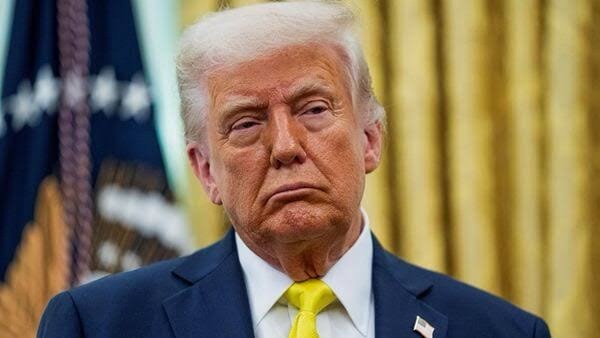
We live in a Trumpian MAGA world . … remember, and he himself has said , that all the world’s rare earth , semiconductor and AI technology will be for America … and no other countries will be allowed to compete with America .

So, while not disagreeing with your view , I don’t however feel as sanguine about job-markets in the world as you do and much less optimistic about the salubrity of the future corporate workplace.

The motto of IBM once used to be “The purpose of a Company is to enable ordinary people to do extraordinary things”. Well… as I see the future, AI would more likely be doing much of both the ordinary and the extraordinary stuff as well.

Sudarshan Madabushi
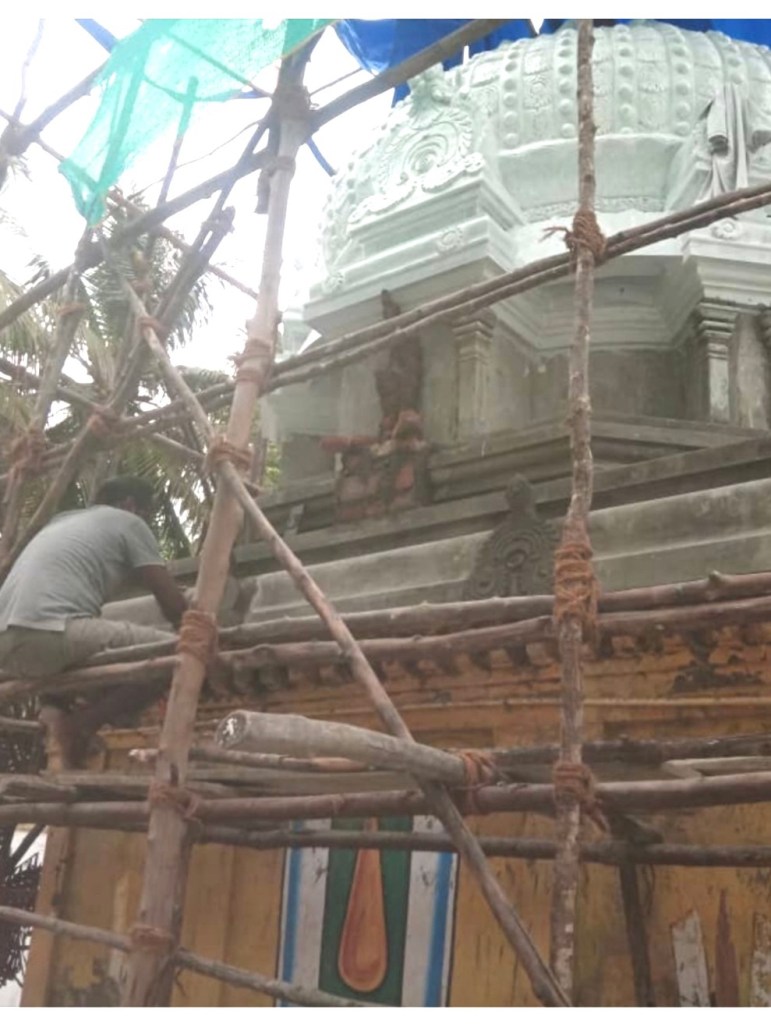
A memorable “yaathra’ : Six “divya-desams” and one “maha-samprokshanam” – Vilanagar Varadaraja Perumal Temple (Part-12)

The Mahasamprokshanam ritual (also known as Kumbhabhishekam or Samprokshanam), holds significant historical importance in Hindu temple tradition. Its primary purpose is to “homogenize, synergize and unite the mystic powers of the deity” — essentially, it is a reconsecration ceremony that recharges and revitalizes the spiritual energy of the temple and its deities.

Historically, this ritual has been performed at regular intervals (often every 12 years) or after major renovations, repairs, or the installation of new idols. It serves to reaffirm the sanctity of the temple, ensuring that the divine presence and energy remains potent and accessible to devotees. The ritual is deeply rooted in Agama traditions and has been observed for centuries, as seen in ancient temples where Mahasamprokshanam marks key milestones in their history and continuity of worship.

The ceremony also fosters community participation, bringing together devotees, priests, and local residents in a collective act of devotion and celebration, thereby reinforcing the temple’s role as a center of cultural and spiritual life.

************

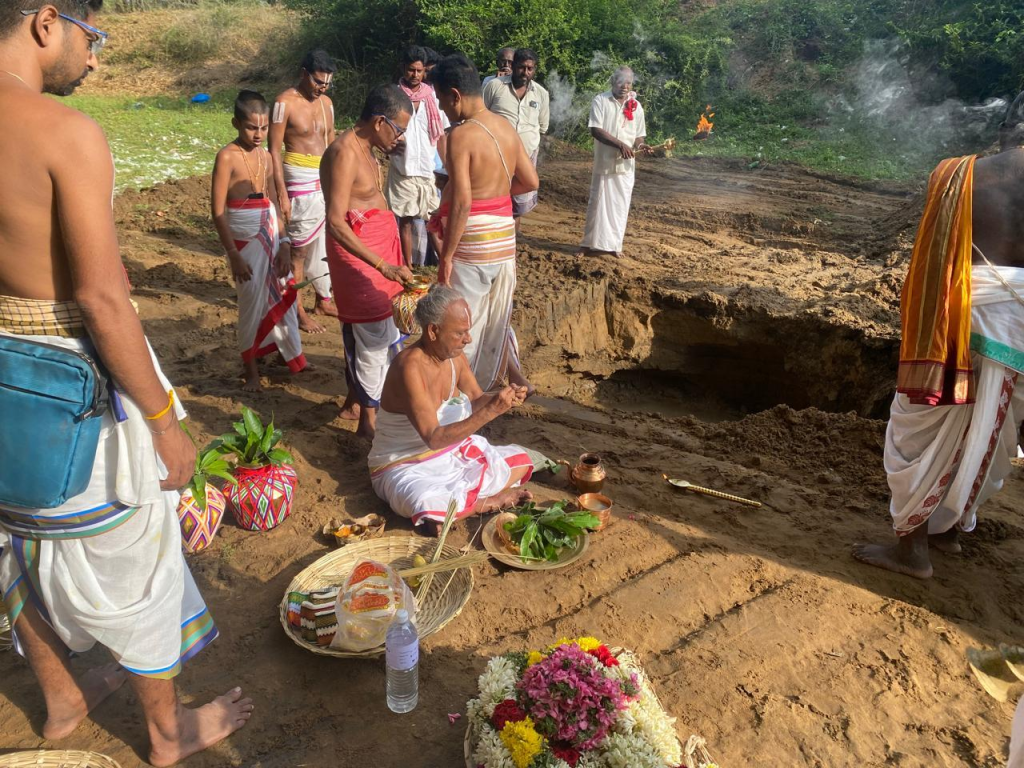
The Mahasamprokshanam (Kumbhabhishekam) in Vilanagar Sri Varadaraja Perumal Kovil, began as prescribed by Agama, involving a multi-stage ritual to rejuvenate the divine energy of the deities in the temple.

The following is an overview of the key procedures:

1. Preparatory Rituals
  • Invocation of Deities: The process begins in the yagashala (sacrificial hall) with the invocation of Sri Paravasudeva in holy water and Sri Mahalakshmi in a sanctified kalasam (pot). Agni (fire god) is invoked in the homam (fire altar), and divine energy is infused into sacred rice (akshata) and the Yaga Bera (ritual idol).
  • Purification: The temple site is cleansed with cow dung, and protective mantras are recited to ward off negative influences. Dhvāra pālakas (gatekeeper deities) like Chandan and Prachandan are installed at the temple entrance.
2. Energy Transfer to Kalashas
  • Ashta Bandhana Removal: The moola vigraha (main deity) is detached from its pedestal by dissolving the Ashta Bandhana paste (a blend of eight herbs and resins). This adhesive is ritually replaced every 12 years.
  • Mantra Jalam: The deity’s spiritual essence (sannidhyam) is transferred into kalashas filled with sanctified water through Vedic chants. These pots serve as temporary abodes for the divine energy during temple renovations.
3. Temple Renovation & Renewal
  • Structural Repairs: Renovations to vimanas (tower structures), gopurams (gateways), and dwaja sthambams (flagpoles) are completed. Damaged idols are repaired or replaced in accordance with Agamic specifications.
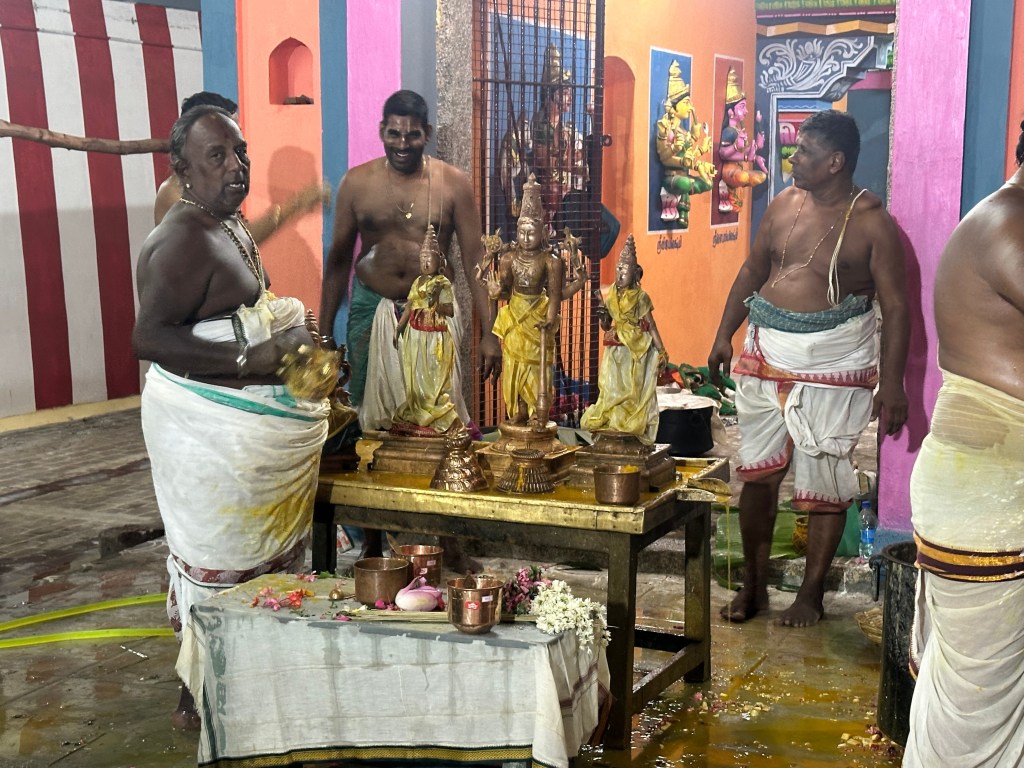
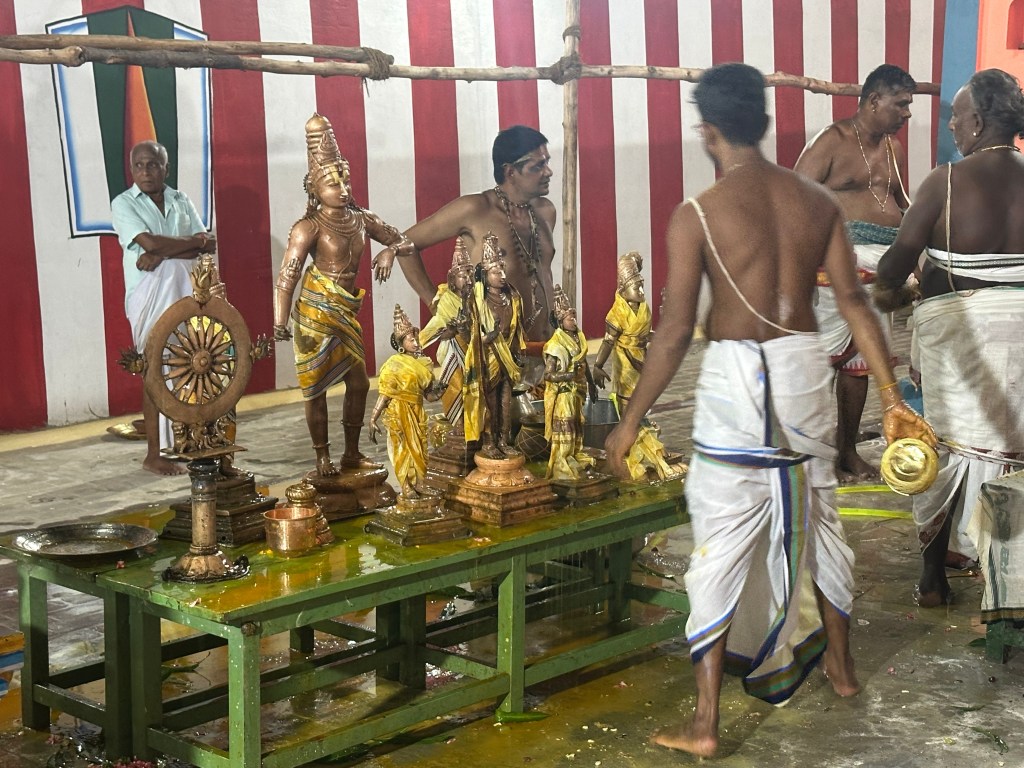
  • Snapana (Sacred Bath): The deity undergoes abhisekam (ritual bath) with varying numbers of kalasams (1, 5, 9, 12, etc.), depending on the occasion. This is accompanied by recitations of Stotras and dhyana (meditation) on the Lord’s form.
4. Reconsecration Rituals
  • Kalasha Abhishekam: The sanctified water from the kalashas is poured over the vimana and gopuram while chanting the Sri Mantram and Virya Mantram. This transfers the deity’s energy back into the moola vigraha.
  • Mudra and Offerings: Priests perform shadanga nyasam (ritual gestures) and present upacharas (offerings) like arghya (water), pushpa (flowers), and dhupa (incense). Specific mudras like Aavahana (invocation) and Sannidhi (proximity) are shown to re-establish the deity’s presence.
5. Final Rites & Blessings
  • Bali and Tarpanam: Offerings (bali) are made to ancillary deities and ancestors. The Acharya performs Purnahuti (final oblation) in the fire altar, seeking forgiveness for any ritual errors.
  • Pradakshina: Devotees circumambulate the temple three times, reciting hymns to secure liberation from the cycle of rebirth.
Key Considerations
  • Timing: Rituals are conducted at auspicious intervals (e.g., every 12 years) and during specific daytime windows (e.g., 5–6 AM or 4:30–5:30 PM).
  • Materials: Sacred items like darbha grassakshata, and ashta bandhana paste are essential for maintaining ritual purity.

This structured renewal ensures the temple remains a potent center of divine energy, aligning with the Agama.

***************

ASHTA BANDHANA RE-APPLICATION RITUAL

As described above, the removal and re-application of the Ashtabandhana paste on the main idol (moola archamurthy) is one of the most important procedures in the ritual of “samprokshanam”. It has not only tremendout religious significance but actually also serves as a very powerful means of social and community bonding.

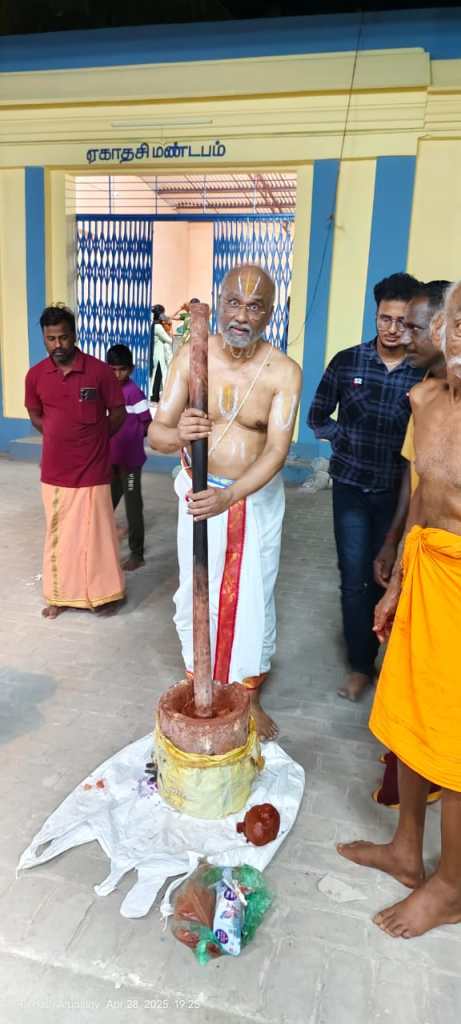
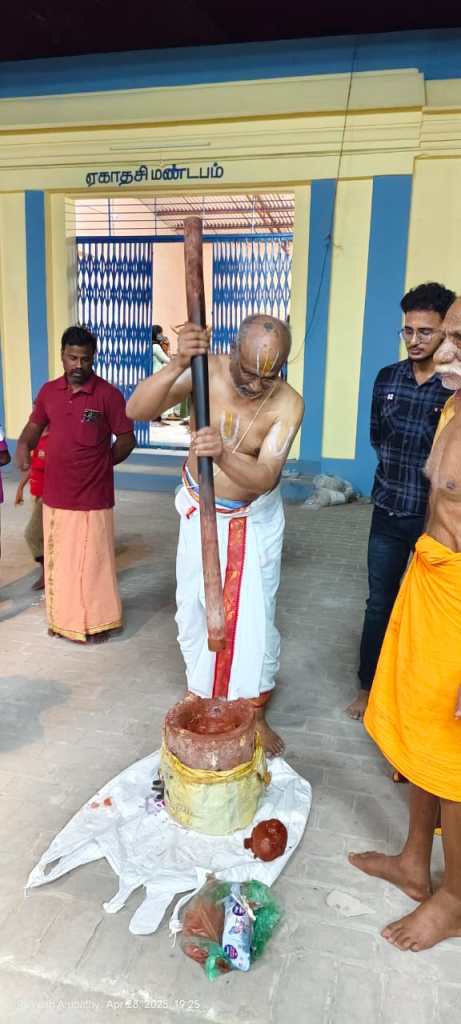
The Ashtabandhana paste is a traditional adhesive used to affix the main idol (moola vigraha) to its pedestal (peetham) in Hindu temples. This paste is actually prepared by priests in a ceremonial manner using pestle and mortar to grind a thick paste. After the paste has been formulated, using the pestle and mortar ritual it has to be ground into a highly adhesive admixture — a kind of cementing medium . The grinding is done my pounding the adhesive repeatedly. The whole village community in Vilanagar was invited to participate in the ritual grinding of the Ashtabandhana paste, each devotee taking turns to repeatedly pound it with pestle and mortar.

The opportunity for me to join the village community in the ritual was really a God-sent one for me as it was the first time ever in my life that I had the experience.

**************

There are specific rituals performed during the re-application of the Ashtabandhana paste:

  • Collection and Sanctification of Ingredients: Eight traditional ingredients (“ashta“) are collected and assembled in the yagasala (ritual hall) with religious rituals. Priests chant verses that eulogize the deities associated with each ingredient, seeking their blessings for the successful preparation and application of the paste.
  • Puja and Mantra Chanting: Vedic pundits perform special pujas and chant mantras as the paste is prepared and before it is applied to the idol and pedestal. This sanctifies both the materials and the process, reinforcing the spiritual connection.
  • Application Ceremony: The actual affixing of the idol to its pedestal with the Ashtabandhana paste is performed with great reverence, as part of the larger Maha Samprokshanam ritual. The process is overseen by priests, ensuring all ritualistic requirements are fulfilled.

These rituals highlight both the sacredness of the materials and the importance of the act, symbolizing the spiritual and physical bonding of the deity to the temple sanctum.

Specific mantras and prayers are recited then during the re-application of the Ashtabandhana paste, as this act is considered highly sacred and central to the consecration process.

I had the wonderful divinely ordained experience of personally applying the “ashtabandhana paste” to the base of the magnificent 12-foot main moolavar idol of Sri Varadaraja Perumal in the “garba-griha”. It was a truly horripilating experience for me as I began applying the paste below the sacred feet of the Almighty! Involuntarily, I began to recite the Sanskrit verses from Swami Vedanta Desikan’s “Nyaasa Dasakam” which express “prappati” or absolute surrender to Lord Varadaraja!

**************

While the exact mantras can vary based on tradition and Agama followed, the general practice includes:

  • Invocation of Vishvaksena: Before starting, priests chant mantras in praise of Vishvaksena to remove obstacles, such as:
    These mantras invoke auspiciousness and smooth conduct of the ritual.
  • Sankalpa (Statement of Intent): The priest formally declares the purpose of the ritual, asking for blessings and success in affixing the idol.
  • Purification and Kalasha Mantras: Mantras invoking sacred rivers and purifying the ingredients are recited, such as:gange cha yamune chaiva godāvari sarasvati… These invite the presence of holy waters into the ritual.
  • Application Mantras: As the paste is applied, priests chant Vedic and Agamic mantras specific to the deity being installed, seeking the deity’s presence and requesting that the idol be firmly established. These may include:
    • Ashtakshara Mantra (for Vishnu): Om Namo Narayanaya
    • Gayatri Mantra or other core Vedic hymns.
  • Prayers for Sanctification: Additional prayers are offered to sanctify the act and ensure the idol’s spiritual energy is preserved and enhanced.

These mantras and prayers, recited with devotion and precision, ensure the physical act of applying the paste is also a profound spiritual event, establishing the idol as a true seat of divine presence.

The classic formulation for the Ashtabandhana paste includes eight key ingredients, though exact recipes may vary slightly by region or tradition. Commonly cited ingredients are:

  • Wood lac (shellac)
  • Resin (such as Shorea robusta or sarja resin)
  • Red ochre (hematite)
  • Beeswax
  • Buffalo butter (clarified butter)
  • Conch shell powder
  • Gall nut (kaduka/Terminalia chebula)
  • Cotton

Other variations may include:

  • Limestone powder
  • Fine sand or special clay
  • Kolarakku (lac resin)
  • Amla (dried gooseberry).
Purpose of Applying Ashtabandhana
  • Adhesive Function: Ashtabandhana acts as a strong, watertight adhesive, binding the idol securely to the pedestal so that ritual liquids (like water, milk, ghee) poured during abhishekam do not seep underneath and dislodge the idol.
  • Ritual Sanctity: It preserves the sanctity and spiritual potency of the idol by sealing the base, protecting any sacred yantras or mantras placed beneath.
  • Longevity: The paste is believed to keep the idol rejuvenated and spiritually potent for up to 12 years, after which it is traditionally renewed during Mahasamprokshanam/Kumbhabhishekam.

The historical significance of using the specific ingredients in the Ashtabandhana paste lies in their functional, ritual, and symbolic roles within temple tradition:

  • Functional Durability: The eight ingredients-such as wood lac, limestone powder, resin, red ochre, aloe vera, papaya leaf, bitter gourd leaf, and beeswax-were selected for their adhesive, waterproofing, and flexible properties. This ensured the idol remained firmly fixed to the pedestal despite constant exposure to ritual bathing substances (abhisheka dravyams) like water, milk, and oils. The paste’s flexibility, akin to rubber, allowed it to absorb minor movements and prevent cracks, which could otherwise allow liquids to seep in and damage sacred yantras or mantras beneath the idol1.
  • Ritual Protection and Sanctity: The ingredients also serve a sacred function, forming a watertight seal that protects the yantra (mystical diagram) and bijakshara mantras (sacred syllables) placed under the idol. This preservation is crucial for maintaining the pranic (spiritual) power of the deity, as any breach could diminish the idol’s spiritual potency over time.
  • Symbolic and Traditional Value: The use of eight (ashta) ingredients is itself symbolic, representing auspiciousness and completeness in Hindu ritual practice. The tradition of using these natural substances dates back centuries, reflecting an ancient understanding of both material science and spiritual symbolism in temple construction and maintenance.
  • Cyclical Renewal: The gradual hardening and cracking of the paste over years necessitated its periodic renewal (typically every 12 years), reinforcing the cyclical nature of temple sanctification and the ongoing rejuvenation of divine energy.

The Ashtabandhana paste maintains the idol’s spiritual energy by creating a watertight and airtight seal between the idol and its pedestal, which is crucial for several reasons:

  • Prevents Ritual Liquid Seepage: During daily and special rituals, liquids like water, milk, and ghee are poured over the idol. Ashtabandhana ensures these do not seep beneath the idol, which could otherwise disturb or dislodge sacred items (such as yantras or mantras) placed under the idol that are essential for maintaining the deity’s spiritual presence.
  • Secures the Idol’s Position: Temple scriptures emphasize that once an idol is installed, it should not be moved, as its location is determined by precise spiritual calculations. The strong adhesive property of Ashtabandhana keeps the idol immovable, preserving the sanctity of the consecrated spot and the uninterrupted flow of spiritual energy.
  • Preserves Spiritual Power: By sealing the idol and protecting the sacred contents beneath, Ashtabandhana helps maintain and enhance the spiritual energy (prana or shakti) of the deity, which is further supported by constant worship and ritual practices.
  • Ensures Longevity of Sanctity: The paste’s effectiveness typically lasts about 12 years, after which it is renewed to ensure the continued potency of the idol’s spiritual energy and the temple’s sanctity.

In summary, Ashtabandhana is both a physical and spiritual safeguard, ensuring the idol remains a powerful and unbroken conduit for divine energy within the temple. Ashtabandhana is both a practical and sacred compound, essential for the stability and sanctity of temple idols throughout the many centuriesthat they have been worshipped in our country.

Personally, I felt that my participation in the Ashtabandhana ritual, had resulted in a strange soulful “bonding” with the presiding deity of Vilanagar! It reminded me of the same sentiment of “bonding” that Sri Andal in her Tiruppaavai had alluded to in a simple but profound Tamil phrase:

குறைவொன்றும் இல்லாத கோவிந்தா! உன்தன்னோடு
உறவேல் நமக்கிங்கு ஒழிக்க ஒழியாது

“There is only one thing we know for certain. By having you as our Lord, we have gained Vaikuntha (the ultimate spiritual abode) as the fruit of our birth. That is all we know. No one can ever break the bond we have with you.”

(to be continued)

Sudarshan Madabushi

The future of Indo-Pak relations: “Hyphenation” out and “Conjugation” in

https://thefridaytimes.com/15-May-2025/the-pahalgam-attack-and-the-return-of-the-india-pakistan-hyphenation?version=amp

This tag of “hyphenation” in global diplomacy is as old as the hills and doesn’t apply to India – Pakistan alone. It’s been turned into some scary foreign policy phobic doctrine by the mandarins of India’s MEA over several decades now since Bill Clinton as POTUS first tried to hyphenate all of South Asia as “Afghanistan-Pakistan-India” and pinned a United States Marshal or Sheriff’s star on the chest of a US State Department diplomat, Richard Holbrook, and tasked him with taking charge of the town here. India growled. And Holbrook best a hasty retreat from New Delhi.

Thirty years later , after many bloody wars, Afghanistan too finally managed to de-hyphenate itself from the Holbrook doctrine with Joe Biden beating a hasty, ignominious retreat in 2021 from Afghanistan.

Hypenation is an imperialistic trick always kept hidden up the sleeve of Western powers and is often used to keep the pot boiling in every hotspotand choke point across the world wherever their own strategic interests lie . 

Hyphenation is a very useful tool to make Siamese Twins of two belligerent antagonists to tango while being joined at the hips in a slow dance of death. It’s a game. Very effective in setting one against the other in a slow-motion embrace of mutual destruction.

Look closely at the history of many of the world’s hotspots or perennial conflict-zones … and you’ll see hyphenation play a key role in everyone of them: 

– Israel-Palestine 

– China-Taiwan 

– Ukraine-Russia 

– South Korea- North Korea 

– Sunni Arabia- Shia Iran 

After May 2025 Pakistan-India clash in the aftermath of the heinous and tragic Pahalgam terror attack, for Indian foreign-policy the diplomatic choreography going forward has become much clearer now than it was ever before. And in PM Modi’s address to the nation a few days ago that clarity of direction and resolve was conveyed stridently and eloquently.

What came through loud and clear, to me at least, from the PM Modi stirring speech was this:

There’s now only way to survive hyphenation ….It’s called conjugation.

In biological science,  Conjugation is the combination of two substances by which major horizontal gene transfer mechanism takes place through which DNA is transferred from a donor to a recipient bacterium by direct contact and by which process  toxic compounds are  eliminated from the body of the donee organism by the donor organism through conjugation”.

In India – Pakistan relations, going forward, Conjugation will mean DNA transfer of sorts: i.e. inevitably, on the one hand, the transfer of PoK to India; and on the other, the de-conjugating of Baluchistan from Pakistan. 

Hyphenation out. Conjugation in

Such conjugation will now have to be the the “new normal” in Indio-Pak relations that PM Modi spelt out in his speech. It is the only way to get rid of all traces of “hyphenation” and eliminate all traces of “toxic compounds” that India now knows are resident in that present host-organism, Pakistan’s body politic and its deep state.

Sudarshan Madabushi
What’s the possible reason for Trump’s volte-face ?

The United States has foolishly given Pakistan more than 33 billion dollars in aid over the last 15 years, and they have given us nothing but lies & deceit, thinking of our leaders as fools. They give safe haven to the terrorists we hunt in Afghanistan, with little help. No more!”

— Donald Trump : POTUS January 1. 2018

“We have been paying Pakistan billions and billions of dollars at the same time they are housing the very terrorists that we are fighting. It is time for Pakistan to demonstrate its commitment to civilisation, order, and to peace”.

— Donald Trump POTUS : August 2017

In May 2025, after boasting that it was he who brokered a ceasefire between the India and Pakistan conflict following a deadly terrorist attack in Pahalgam, Kashmir, Trump refers to Pakistan now as a “great nation” without directly accusing Pakistan of having supporting terrorism!

What’s the possible reason for Trump’s volte-face?

Trump’s appears intoxicated by the “MAGA” cocktail he has brewed for America — a mix of diplomatic, economic, and strategic considerations aimed at bolstering the sagging US ability to influence and bring about a new world order. Trump sees no stability in Europe (Ukraine- Russia), in South America (Panama- Venezuela) , in East Asia (China and tariffs) , in Middle East (Iran/Israel) and in South Asia (India-Pakistan). This POTUS has figured out that unless he figures out a way to make America great again in world affairs is to go back to the old tried and tested imperialist policy of sowing seeds of conflict between regional powers ( both major and minor ones too like Pakistan) in every corner of the world.

Sowing Chaos is the best way to make America great again in the eyes of the world.

Several factors therefore likely explain Trump’s volte face on Pakistan’s terrorist involvement:


Diplomatic Priorities: After brokering a ceasefire between India and Pakistan, Trump thinks shifting focus to promoting peace and stability between the two nations in the region, will position the U.S. as a political mediator rather than as anti-terrorism crusader.


Economic Interests: Trump has publicly stated that increased trade between countries can be a major reason for reducing hostilities, and he has expressed intentions to boost US trade with both India and Pakistan.


Strategic Calculations: The U.S. recently exempted $397 million in security assistance to Pakistan for so-called counterterrorism cooperation which must be prioritized if it serves U.S. interests and even if Pakistan might again give in return only “ lies and deceit”. In this context the “New Normal” Modi-enunciated Doctrine of Zero Tolerance for Pakistani Terrorism queers the pitch for America’s (CIA) own strategic interests and manoeuvre room here in West Asia (Taliban, Iran, Yemen and Palestine).


Changing Regional Dynamics: With Pakistan strengthening ties with China and the U.S. recalibrating its South Asia policy post its withdrawal from Afghanistan, Trump’s administration may be now seeing engagement with Pakistan as necessary for broader strategic goals. India is not as easy as Pakistan to browbeat and pressure into abiding by US foreign policy dictates in South Asia. Even within the QUAD, America has found India to be often testing its patience. And it certainly greatly irks America that India’s ties with Russia remain much warmer and far more durable than they ever were with the USA .

All the above factors may be leading gradually to some kind of a broad level of rehabilitation setting into US- Pakistan relations which since 2016 had gone a bit rancid.

This imperceptible but definite diplomatic shift that is taking place right under their noses is a development which both India and China will have to monitor closely and very concernedly in the years ahead.

The bottom-line : Let’s face reality India ! Terrorism means different things to different people . In Pakistan it is a cottage industry. For India , it is a scourge. For America , it is strategic portfolio investment.

Sudarshan Madabushi
A memorable “yaathra’ : Six “divya-desams” and one “maha-samprokshanam” – Vilanagar Varadaraja Perumal Temple (Part-11)

A “kovil samprokshanam” is a very uniquely Hindu religious concept and grand ritual indeed.

Although in the the past, I had witnessed (from only afar though) an event of a samprokshanam being conducted at a temple, I confess that like so many thousands of ordinary pilgrims or temple-goers in the country, I too was woefully uninformed about the various ritual processes involved in the consecration, their real significance and esotericism and why a “samprokshanam” is such a central and integral part of all temple-worship and ‘kovil‘ traditions in our Hindu religion.

All that I did know about the ritual of “mahasamprokshanam” was no more than what I had occasionally seen of it on TV news-channels (SVBC or SankaraTV channels) covering some neighbhourhood temple event, or what I had been able to no more than merely catch glimpses of the ceremonies when I myself in person was present at the event and watched it from a very long distance away, standing amongst onlooking street-side bystanders.

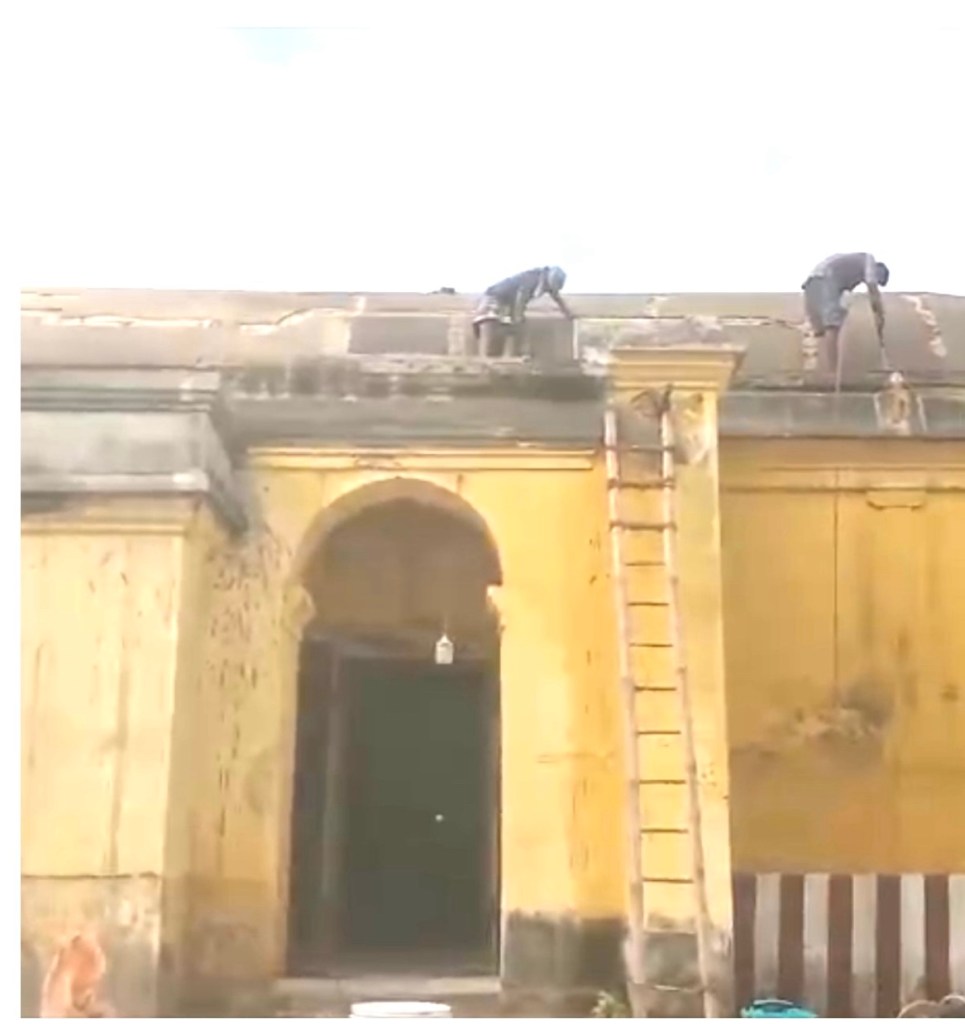
All I saw then were priests climbing up a makeshift ramp atop the temple “vimana” or cupola aka dome (‘gopuram‘) to carry out purificatory rites wherein several pots of water duly sanctified by the chant of elaborate Vedic mantras were ceremoniously poured over the “kalasha-s” (narrow pointed spire fixed upon the apex of the cupola top) — which procedure is actually what the Sanskrit word “samproshanam” means.

“A kalasha pot’s shape — as per Puranas and Agamas — symbolizes the potentialities of life. The bud which is the topmost portion signifies new life and growth. From a distance the shape of the Kalasha looks like that of a flower bud or pot… “kumbha” … Which is why the other common name for the ritual of samprokshanam is “kumbhaabhishekam“.

“Some temples have stone-block as Kalasha. But most are either made of copper or bronze and in some temples (like Tirumala Venkateshwara’s or Sri Rangam’s) they are even gold plated. Cereals and precious stones are placed inside the Kalasha before it is sealed and erected upon the cupola. 

Another important hidden component inside the Kalasha is the ‘the golden person’ (Suvarna Purusha) who is kept inside the pot ( i.e. after the rite known as ‘pratishta‘ is conducted). The icon of the ‘Suvarna Purusha’ kept inside the pot is Divine Cosmic Energy personified”.

Once the pots of sanctified water are decanted and poured over the “kalasha-s”, a great roar of excitement rises from the surging, lunging crowds of hundreds of devotees standing below, thronging, shoving and jostling against each other to catch the shower of sacred water-drops drizzling down upon themselves. That is precisely the moment in the “samprokshanam” ceremony which is its rousing climax. It signals the completion of the temple renovation, re-sanctification and re-energisation.

It is through the temple’s own divine rejuvenation that thousands of devotees then experience their own individual, vicarious spiritual upliftment.

**********

The above was about everything that I really did know about how a kovil samprokshanam gets conducted.

It was all very scant and very superficial and I felt inwardly ashamed of my ignorance. Here I had been going about strutting all these past years, thinking myself to be an ardent temple-worshipper but then knew virtually nothing about the religious rites of temples except whatever I had been able to inform myself through vague and patchy hearsay. I knew so little about a great ritual ceremony that, as per the Agama sastra, was the very life-source, the terrestrial and temporal dynamo without which divine energy could not be infused into and made to reside inside the sanctum-sanctorum of a kovil … or a devaalayam.

Thus, it was for that reason that I found myself hastening to the tiny village of Vilanagar to be present there at the “mahasamprokshanam” of Sri Varadaraja Perumal Kovil. It was an opportunity for the very first time in my life to be present first-hand, close and upfront to get a truly ring-side eye-witness view of its ritual-processes, from start to finish.

My good friend, and the main “ubaya-karta” and “yajamanar” (the principal sponsor) of the entire festival, Sri. S.Kothandaraman (and his gracious Devi, Smt. Vyjayanthi about whom I have already earlier in Part-1 written about), had kindly promised me that he would personally arrange for me to be present at very close quarters at all the important ritual sequence of events leading right up to the climactic moment of the “kalasha samprokshanam” atop the “gopuram” spires! I was keen therefore not to be late in seizing the opportunity to deepen my skimpy knowledge about “kovil samprokshanams“.

***********

Although I reached the Vilanagar temple-village early enough, my friend Sri Kothandaraman told me that I had already missed two preliminary ritual events that had already been completed by way of solemnly commencing the “samprokshanam” at the designated “muhurtha” (auspicious) time that had been scheduled by the chief officiating priest, the “yagnya hota” or “purohita/brihaspati“, Sri. Ranganatha Bhattacharya.

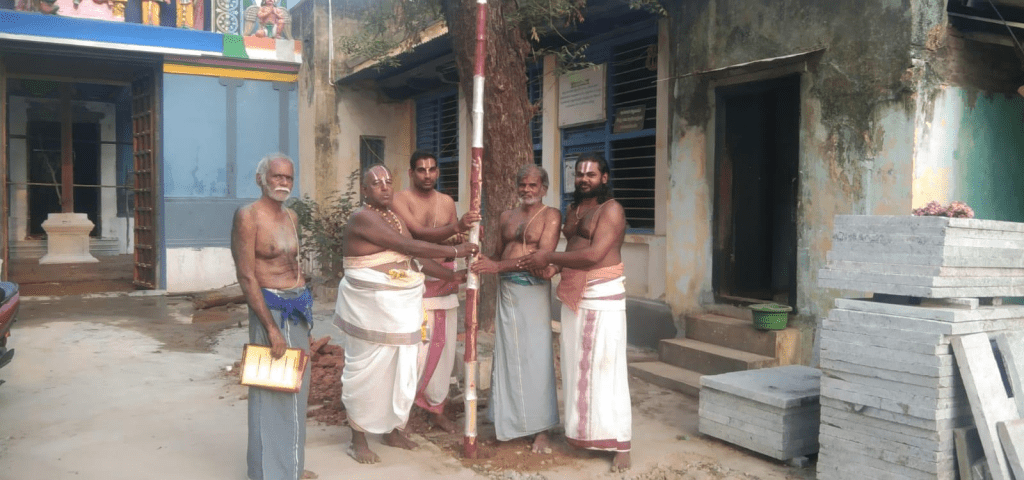
However, Kothandaraman assured me that I had not really missed much since both the hoisting of the “pandhakaal” (flagstaff hoisting marking the inauguration of the 3-day “yagnya” sacrificial proceedings) and the ritual collection of “kalasha theertha (water from the nearby River Cauvery) in “kumbham” for ritual purposes were only inaugural processes. He sent me the following photos of the same simply by way of information:

Pandhakaal” installation for samproshanam (April 27, 2025):
Sri Ranganatha Bhattar, the Chief Priest, is seen second from left
Ceremonial procession to the River Caurvery to collect “kalasha theertha” for the samprokshanam yagnya-shaala; Sri Kothandaraman is in the foreground, third from right
On the banks/riverbed of River Cauvery

***************

Sri Kothandaraman explained to me that if I was so very keen to gather authentic and detailed information about the various rituals that were going to be performed during the course of the “samprokshanam“, then the best resource person I should be contacting was the Chief Officiating Priest, Sriman Ranganatha Bhattar himself, who as and when time permitted, would be able to enlighten me on some important aspects of the main rituals. I thanked Kothandraman for the arrangement made with the Bhattar but not wishing to waste the priest’s time asking him inane or trivial questions about the “samprokshanam“, I jotted down a few key questions for which I wished him to provide answers.

The following were those questions for each of which, much later, the Bhattar gave patient and very clear answers. I was able to audio-record him on my Sony recorder-device.

1. உங்கள் சுய அறிமுகம் குறுகியவகையில்:
உங்கள் தொழில்/கல்வி/பணி) செய்கிறேன். உங்கள் ஊர்; “poorvikam”


2. கோயிலின் ஸ்தல புராணம்: “கோயிலின் வரலாறு மற்றும் முக்கியத்துவம் கல்வெட்டுகளில் காணப்படுகின்றன.”


3. சோழர் வம்சத்தின் தொடர்பு மற்றும் கோயிலுக்கு வழங்கிய உதவிகள்: “சோழர்கள் கோயிலுக்கு பல்வேறு காணிக்கைகள் அளித்ததற்கான சான்றுகள் கல்வெட்டுகளின் மூலம் நிரூபிக்கப்பட்டுள்ளன.”


4. கோயிலை பல நூற்றாண்டுகள் பாதுகாத்தவர்கள்:
“கோயிலை பாதுகாத்தவர்களின் பெயர்கள் மற்றும் பங்களிப்புகள் கல்வெட்டுகளின் மூலம் அறியப்படுகின்றன.”


5. கோயில் புறக்கணிக்கப்பட்டதற்கான காரணங்கள்:
“சமூக, பொருளாதார அல்லது அரசியல் காரணங்களால் கோயில் புறக்கணிக்கப்பட்டது.”


6. கோயிலின் கடந்த கால மற்றும் தற்போதைய சொத்துக்கள்:
“கோயிலின் சொத்துக்கள் மற்றும் ஆவணங்கள் பதிவுகளில் உள்ளன.”


7. கோயிலில் பின்பற்றப்படும் ஆகமம்:
கோயிலில் _____ ஆகமம் பின்பற்றப்படும்; அதன் முக்கிய அம்சங்கள் _____ ஆகும்.”


8. தினசரி பூஜைகள், திருவிழாக்கள் மற்றும் எதிர்கால திட்டங்கள்:
“கோயிலின் வழிபாட்டு முறைகள் தொடர்ந்து நடைபெறுவதற்கான திட்டங்கள் உருவாக்கப்பட்டுள்ளன.”


9. கோயில் சொத்துக்கள் எவ்வாறு பயன்படுத்தப்படும்?:
“கோயிலின் சொத்துக்கள் வழிபாட்டு மற்றும் திருவிழாக்களுக்கு பயன்படுத்தப்படும்.”


10. தமிழ்நாடு அரசு HRCE ஆணையத்திடம் எதிர்பார்ப்புகள்:
“HRCE ஆணையத்திடம் நிர்வாகம், பராமரிப்பு மற்றும் நிதி ஆதரவு ஆகியவற்றில் உதவி எதிர்பார்க்கப்படுகிறது.”

English translation of the above:

Brief self-intro
Sthala purana of temple: Is any Epigraphy available?
Chola dynasty connection and proof of the endowments made by those kings to the temple

Who preserved the temple through the centuries ? Names , if possible

What were reasons for temple falling into neglect ?

What are past and present assets networth of the temple ? Records … if any

Which Agama is going to be observed for rituals ? Main features .

What is the future plan for continuous conduct of daily rites, festivals , pavithrotsavam, adhyaayana and Brahmotsavam

How will temple assets be put to use for above ?

What expectations from HRCE ?

**************

What I will be penning in the ensuing essays in this series, will all based upon the answers and information that were kindly provided to me by Sri Ranganatha Bhattar at Vilanagar. I will be paraphrasing in English, to the best of my ability, all the wonderful explanations about the “mahasamprokshanam” given about this ancient temple and as well as about a few glimpses into its long history.

(to be continued)

Sudarshan Madabushi
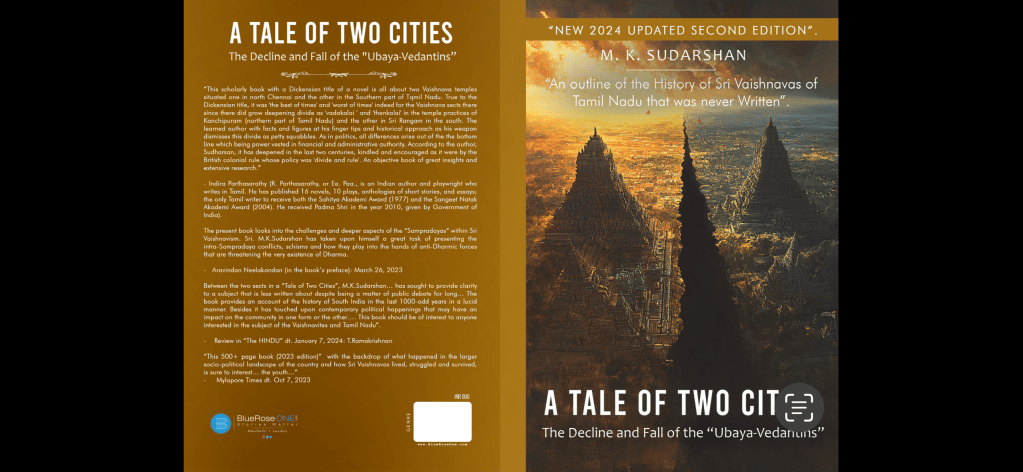
If you want to understand why this “Tenkalai – Vadakalai” skirmish happens every year at the Kanchipuram Temple’s Annual “Brahmotsavam”, buy a copy of this book

May 13, 2025: Kanchipuram

Vadakalai, Thenkalai sects face off again during Brahmotsavam of Sri Varadharaja Perumal temple

The Hindu Bureau

CHENNAI

Tempers flared between the Vadakalai and Thenkalai sects of Vaishnavites at the annual Brahmotsavam of the Sri Varadharaja Perumal temple, one of the 108 Divya De-sams, in Kancheepuram on Monday.

A source in the Vadakalai sect said devotees belonging to the Thenkalai sect chanted verses from Divya Prabandam even as representatives of the Thathachariars, who belong to the Vadakalai sect, performed Mantra Pushpam to the utsava idol of Sri Varadharaja Perumal at Gangai Kondaan Mandapam.

During the Brahmotsavam, the idol is brought in a procession to the Gangai Kon-daan Mandapam twice daily during which the Thathachariars perform Mantra Push-pam, a ritual of offering tulsi and flowers to the deity, along with chants in Sanskrit.

“It is the right of the Thathachariars to offer Mantra Pushpam while chanting verses from various texts, including the Vedas, the Puranas, and the Stotrapadam, during all pujas conducted daily. The Thenkalai-yars are trying to prevent them from doing so. They began this on day one of the Brah-motsavam. I wonder how eight more days of the festival will be conducted,” said a representative of the Vadakalai sect.

A representative of the Thenkalai sect said the Thathachariars have the right to offer Mantra Pushpam only at the Moolas-thanam (the sanctum sanctorum) and, that too, on court orders.

“When they chant, they can chant only verses from the Vedas and not from other texts. Also, there is no official order permitting them to chant at the Mandapam. If they are allowed, so can we. If they stop chanting at the Mandapam, the festival will be conducted in a smooth manner,” he said.

Official sources in the Hindu Religious and Charitable Endowments Department, under whose control the temple is, said they held separate meetings with both groups and secured a promise that they would ensure that the festival went on without any disturbance.

****** *********** ********* *****

If you want to understand why this Tenkalai – Vadakalai skirmish happens every year at the Kanchi Temple’s Annual Brahmotsavam, you should buy a copy of this book and get the answers . Click on the Amazon link below ⬇️

https://amzn.in/d/hxeWvsn

Sudarshan Madabushi
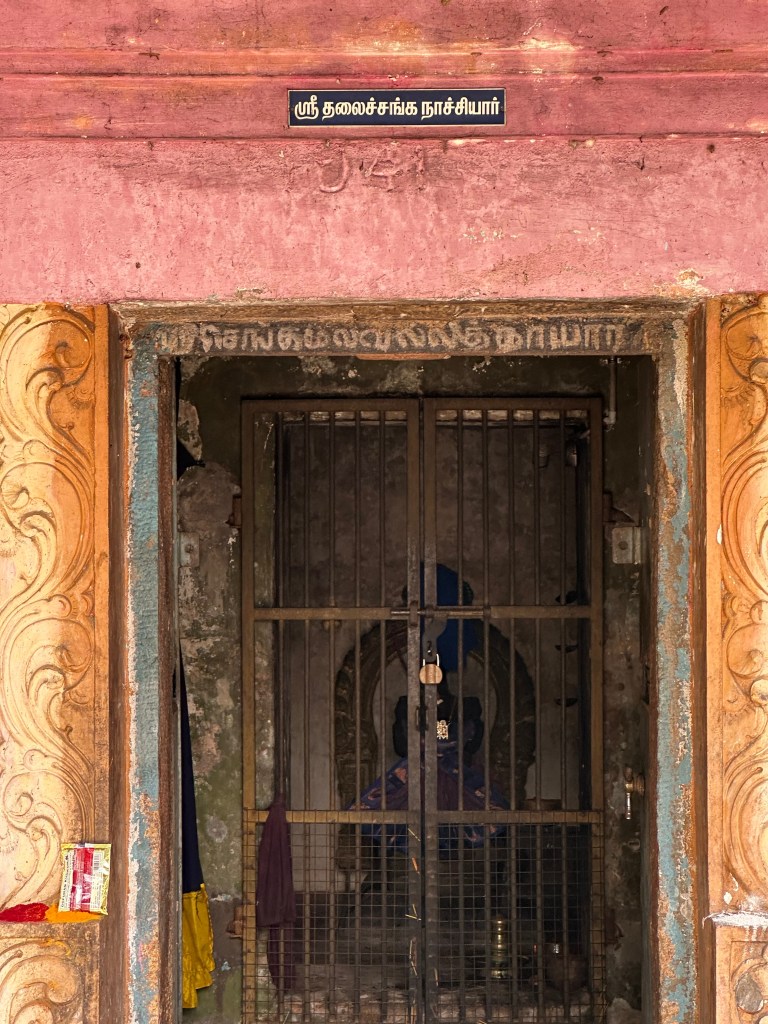
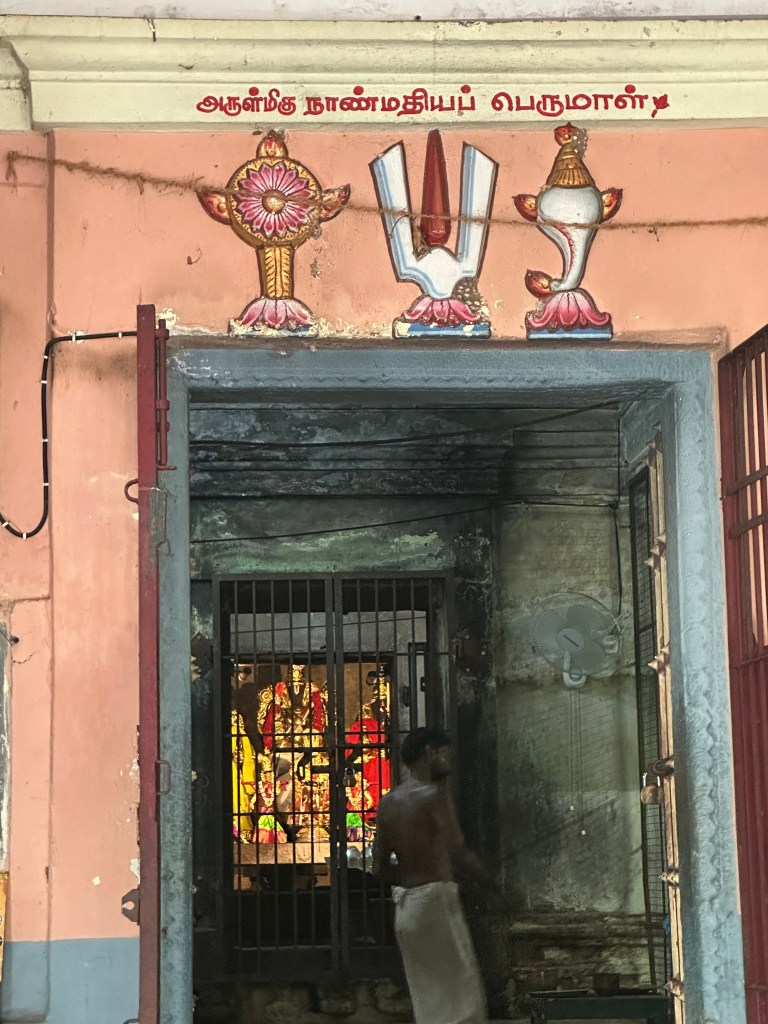
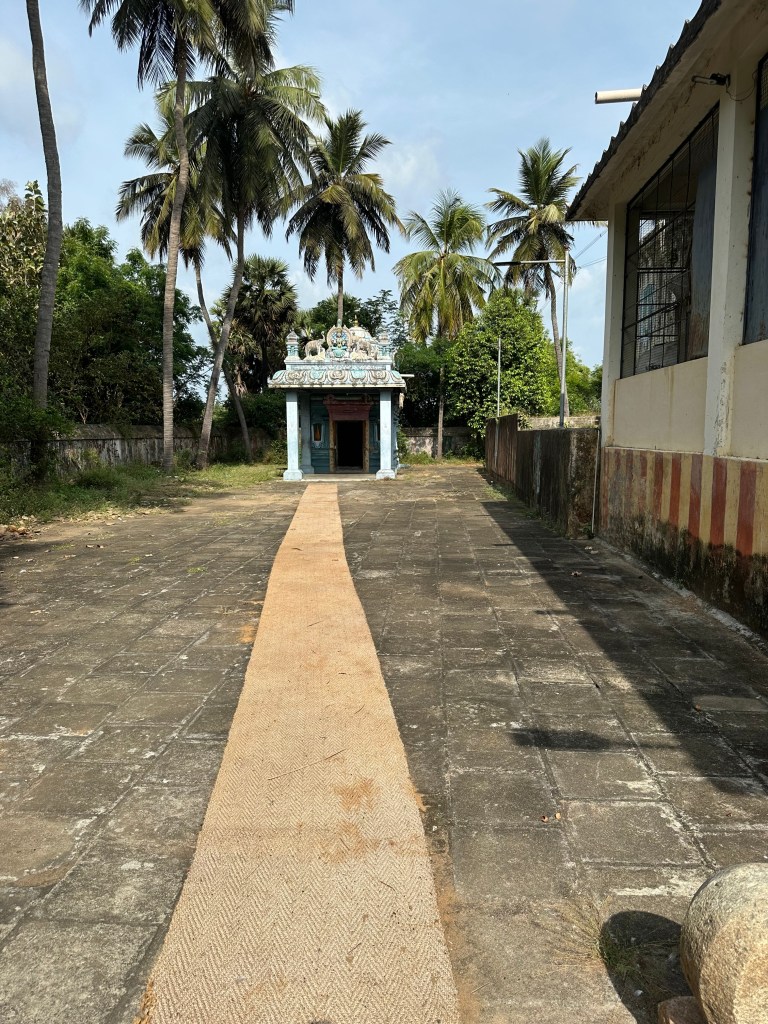
A memorable “yaathra’ : Six “divya-desams” and one “maha-samprokshanam” – Thalacchanga Nanmathiyam Temple (Part-10)

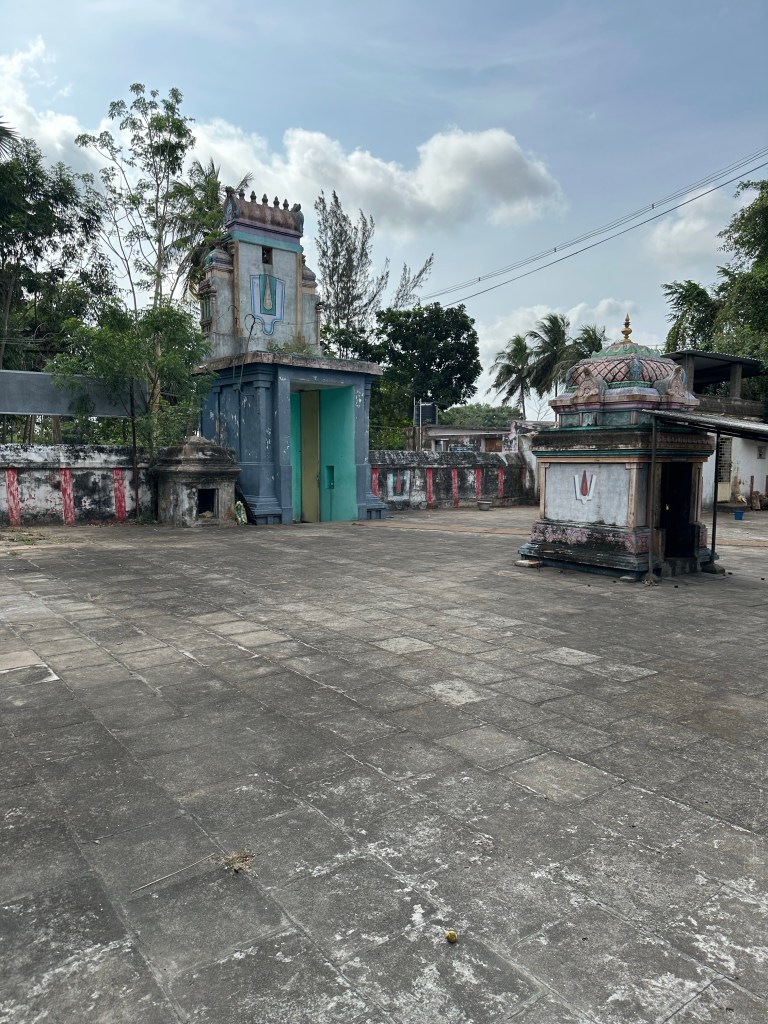
The Naanmadhiya Perumal Temple (also called Thalachanga Nanmathiyam) is a Hindu temple situated in the village of Thalaichangadu, near Akkur in Mayiladuthurai district in the South Indian state of Tamil Nadu.

Constructed in the Dravidian style of architecture, the temple is glorified in the Nalayira Divya Prabandham, the early medieval Tamil canon of the Alvar saints from the 6th–9th centuries CE. It is one of the 108 Divya Desams dedicated to Vishnu, who is worshipped as Nanmadhiya Perumal and his consort Lakshmi as Talaichanga Nachiar.

Thalaichanga Nanmadhiyam Temple is architecturally modest but historically and mythologically rich, making it one of the most unique and significant temples among the 108 Divya Desams of Tamil Nadu. Its combination of ancient literary references, Chola patronage, and rare iconography that sets it apart from other temples in the region.

The temple stands out for its blend of Saiva and Vaishnava iconography (crescent moon on Vishnu), its role in the ancient conch-shells trade, and its deep roots in both Sangam literature and Vaishnavite tradition.

The temple is believed to have been constructed during the Chola reign. It stands on the southern bank of river Cauvery and was near Poompuhar, the famous port town of the Chola times. This place was so well-known for its conch-shells, that even in the famous Tamil literary work, Silappadikaram, the fact finds a mention.

Inside the temple sanctum, the idol of Sri Naanmadiya Perumal is in the standing posture, with the crescent Moon on his head. Chandra Vimanam is the tower above the sanctum. There are shrines for the Goddess and other deities, while the temple tank, Chandra Pushkarini, can be found outside the complex.

The temple’s vimana is of the Ekatha Vesara type, referred to as Chandra Vimanam, which is architecturally unique compared to the more common multi-tiered vimanas in other Divya Desams.

As per the legend of the “sthala purana“, the temple is associated with the Planet Chandra (the moon god) being relieved of a terrible curse afflicting him curse by the grace of Vishnu here. It’s a very unique ‘sthala purana‘ narrative about the sin of adulterous relationships.

Legends Associated with Thalaichanga Nanmadhiyam Temple

1. Chandra’s (Moon God) Curses and Redemption

  • The primary legend centers on Chandra, the moon-god, who was afflicted by multiple curses due to his lascivious actions. Chandra, regarded in the pantheon of Hindu gods, as the brother of Goddess Lakshmi, and is second in rank only to Surya (sun-god) among the Navagrahas (the nine planetary demigods) was cursed on two major occasions:
    • Tarakamaya War and Guru’s Curse: Chandra developed an illicit relationship with Tara, the wife of his guru Brihaspati (Jupiter), leading to the birth of Budha (Mercury). Brihaspati cursed Chandra to be afflicted by an incurable disease of the skin, specifically leprosy.
    • Dhara, also known as Tara, was the wife of Brihaspati (Guru), the preceptor of the Devas (other gods and celestials). In the legend involving Chandra, Tara played a central role that was no less culpable than his. Chandra and Tara developed a mutual attraction, and Tara then deserted her husband Brihaspati to go and live with with Chandra. Despite Brihaspati’s efforts and appeals to the gods to reclaim his wife, Tara remained with Chandra for some time, leading to a major conflict among the gods and asuras who took sides in it.
    • This episode culminated in a cosmic war, which got only resolved when Brahma the Creator intervened and restored Tara to Brihaspati. However, Tara by then became pregnant, and after initial reluctance, she had no choice but to reveal the truth that the child, Budha (Mercury), was fathered by Chandra.
    • Thus, Tara’s relationship with Chandra not only triggered a divine conflict but also resulted in the birth of Budha, also an important planetary deity in Hindu mythology. Her actions were pivotal in the unfolding of the legend of the purana and its consequences for Chandra, Brihaspati, and the cosmic order.
    • Daksha’s Curse: Chandra married the the 27 daughters of Daksha Prajapati, promising to treat them all equally. However, he was especially fond of and favored only Rohini, which caused a lot of heartburn and grief among his other wives. Daksha, angered by this, cursed Chandra so that his lustre and lunar brightness would wane day by day fortnightly … This resulted in the waxing and waning phases of the Moon.
  • Redemption through Vishnu: To relieve himself from the above curses, Chandra was advised to perform penance at several sacred sites. As part of a three-phased atonement, he worshipped Vishnu at Srirangam, at Thiru Indhalur, and finally at Thalaichanga Nanmadhiyam. Here, after bathing in the temple tank (Chandra Pushkarani) and performing severe penance, Vishnu appeared as Nanmadiya Perumal and completely liberated Chandra from his afflictions. This is why the deity here is also called “Chandra Saabha Haran” (Remover of Chandra’s Curse).

2. The Sacred Conch and the Name of the Place

  • The temple’s name, Thalaichanga Nanmadhiyam, is derived from the word “cankam” (conch). The presiding deity holds a unique and precious conch, denoting the surrounding area which was historically renowned for its conch-shell trade during the Chola period. This association with the conch is both a physical and mythological hallmark of the temple.
  • Vishnu adorning himself with the Moon on his head, which is usually seen only in the images of Lord Shiva is symbolic of Vishnu having worshipped Shiva here and obtaining the great conch Panchajanyam. A mention of this conch is found even in the Bhagavath Gita when Sri Krishna used it to announce commencement of the War of Kurukshetra.

3. Connection with Other Temples

  • The legend of Chandra’s redemption links Thalaichanga Nanmadhiyam with two other prominent Divya Desams: Srirangam Ranganathaswamy Temple and Parimala Ranganathar Temple at Thiru Indhalur. Chandra’s penance at these three temples forms a spiritual circuit for those seeking relief from “Chandra Dosha” (afflictions caused by lunar influence).
  • After I completed my journey here at this kovil, I was able to consider myself blessed by all three Perumals since I had received their grace having complegted the pilgrimage to all three kshetrams.

*****************

The “sthala purana” of this temple is about the planetary god Chandra’s sexual misdeed and his adulterous relationship with the wife of another planetary demigod, Brihaspati.

Hindu Puranic lore is full of othjer similar candid narratives about sexual promiscuity. There are stories where the gods’ and goddesses’ chastity or that of rishi patni-s (wives of sages) are tested or challenged. Such purana legends are symbolic narratives. When viewed through the lens of modern, contemporary secular social mores they might seem extremely offensive … reeking of patriarchy, misogny and sexual licentiousness.

But these purana narratives have to be understood correctly in the perspective and context of the ancient times in which they were authored and not transplant them all in the here and now and subject them to modern-day critiques.

These puranic tales associated with the temple legends only emphasise the immense spiritual power attributed to a woman’s chastity and conjugal devotion.

Such tales as the story of Anasuya and Tara, often depict the gods themselves being humbled or transformed by the virtuous or unvirtuous conduct of their women. Their underlying message is that purity and fidelity in holy matrimony possess a force so great that even lesser deities of the celestial world must acknowledge and respect it, sometimes resulting, in fact, in miraculous or divine events…. such as, for example, the birth of another planet Budha, the offspring of an adulterous relationship between Chandra and Brishaspati’s spouse.

Such stories as this of Nandmadhiyam Thalaichangangudi are not merely about chastity or marital fidelity, but really more about highlighting the significance and the reverence that monogamy (“ekapatni” and “ekapati vrata“) commands in the spiritual hierarchy of Hindu thought.

The core moral of the story is that if the wages of the sin of adultery are sure to befall even the powerful gods such as Chandra, what then is to be said of mere humans who might be all too easily tempted to transgress sexual morality in this world?

*************

The Kovil here in this divya desam is said to have become dilapidated once long ago. It was renovated by a devotee Suntara Ramanuja.

Sundara Ramanujan (also spelled as Suntara Ramanuja) is noted in temple records as the individual who renovated the Thalaichanga Nanmadhiya Perumal kovil. The temple is ancient, dating back to before the 8th century CE, and is said to have been originally constructed by the Chola king Chengkotta Chozhan, with subsequent contributions from later Chola and Maratha rulers.

However, the specific date or period when Sundara Ramanujan undertook the renovation is not mentioned in the available sources. The only clear information is that the temple was in a dilapidated condition at some point and was renovated by him. 

Today, the temple is supposedly being maintained by the Tamil Nadu State Hindu Religious and Endowment Board (HR&CE). But as I surveyed its desolate state that morning, I imagined that its state of dilapidation today was perhaps no less grievous as what it might have been during the time of Sundara Ramanujan.

***************

My pilgrimage to the 6 Divya Desams now stood completed.

I prepared next to travel to Vilanagar, Sri Varadaraja Perumal Kovil “mahasamprokshana utsavam”. I hastened forth to that village.

(to be continued)

Sudarshan Madabushi

The toughest part of Modi’s job as PM: It’s not Pakistan’s “death to India by a thousand cuts”… it’s “the most unkindest cut of all” dealt by churlish citizens

Prime Minister last evening’s May 12 2025 address to the nation — in the immediate aftermath of the Pahalgam Terror attack and India’s resounding anti-terrorist response to Pakistani sponsorship for the same — was a historic one indeed and truly deserved the appreciation of the whole nation.

A few people I know are dissatisfied with Modi’s speech and historic announcements for the simple reason that he did not directly refute Donald Trump’s claim made on international stage that it was he and his threat to declare a trade embargo on both India and Pakistan which effectively and promptly brought both antagonists to their senses and meekly submitted to his Majesty, the POTUS’s command to announce a ceasefire.

However , in our country , we have thousands of “Monday morning quarterbacks” who hate Narendra Modi so viscerally that they cannot and will not resist the temptation to nitpick on him and churlishly, uncharitably find fault with him on the most trivial and inconsequential pretext.

Why didn’t Modi refute Trump ? The silence means that Trump claim is true, doesn’t it? It means that India is now a subservient state to America , doesn’t it? Why doesn’t Modi come out in the open to admit as much to the nation? Instead why make other brave and chest-thumping sound and fury in his speech last night TV appearance all of which signifies nothing if the Trump boast is true?”

Such are the churlish words with which some people in India stick a dagger into the Prime Minister’s 56 in. chest from behind his back to deliver the Shakespearean “most unkindest cut of all”.

Now, I for one do not agree at all with such people with narrow petty strategic perspectives who choose to only nitpick and remain blind to other truly momentous announcements made in the PM’s speech relating to ground-breaking new doctrines of India’s foreign policy and future stances vis-a-vis not only Pakistan but whole of South Asia and West Asia.

PM Modi’s speech has to be finely parsed and read between the lines to be be able to appreciate the big picture nature of his pronouncements. If one cannot do that , one will only start nitpicking … in other words, “bleed Modi to death through a 1000 cuts”…

Why must an Indian PM who is addressing his nation to show them a new strategic direction he is charting have to respond to what the POTUS said or did not say in a moment of wonted, wanton bravado somewhere in America? Surely, our Indian PM Modi has more class than the crass chap Trump in the White House.

Instead of directly refuting Trump boasts and veiled threats to India , Modi said the world (duniya) is being given notice through his baryon-wide address… So, hear Ye One and All ! :

  1. India will not hold talks with Pakistan except terrorism and PoK .
  2. India will no longer kowtow to any nuclear threat from Pakistan (and that means, tacitly, China too ).
  3. Henceforth, both non-state and state-actors in Pakistan’s complicit in terror activities will now be targets for India’s military strikes … make no bones about it .

The above is a clear and courageous message to not only to Pakistan but also to Trump and to America and China .

Modi has spoken well indeed, like how a great nation’s head ought to speak … with authority , clarity and gravitas … all of which Donald Trump lacks .

Our PM Modi did well not to stoop to the low level of trumpery that the cheap grandstanding that Donald the POTUS we see has been ever since assuming office engaging in almost everything he does from the White House … be it the Ukraine war , Gaza genocide or the botched up tariff war .

Come on, people, show some discernment! Please don’t expect the Prime Minister of India to deign to sparring with fools .

Some other people … right on the other extreme end of the spectrum of Modi-haters and Modi-bhakths … are a little disappointed with his speech for yet another kind of trifle :

I watched his address in full. One aspect he should have mentioned but didn’t is, it is not just a terrorist attack at Pahalgam or terrorist camps in Pak. He should have categorically nailed jihadi terrorism…

This in fact is really another Shakespearean way of saying “I come not to dishonour Caesar but to bury him!”.

In his speech the PM specifically mentioning the category of “jihaadi terrorism” would’ve needlessly given rise at once to frenzied discourse in the islamic world as a veiled accusation against Islam itself . The international media would then have played it up to such a level of amplification that Modi’s main focus on terrorism per se in all its forms would’ve have got utterly lost in distraction. Just think of this : India supports the Palestine 2 state solution. Is the PLA not working with Hamas which has a jihadi orientation?

So , the matter does become very complicated if Modi had used the word jihadi to qualify terrorism .

My perspective therefore is slightly different:

Terrorism in the modern context also includes tariff terrorism and deadly media misinformation terrorism

So, while Modi’s strong message to Pakistan was about conventional terrorism which it incites and sponsors, the message he sent was also loaded with a clear signal to America and the West about how their media-orchestrated propaganda terrorism is frequently inflicted upon India .

That is why the PM made that very significant statement at the end of his speech : the country’s strength lies in our unity, he said. If we are united as a people , no form of terrorism can hurt or damage us …. That was the sense and context in which I thought his statement was made .

There are so many intellectuals , academicians , historians , journalists and university students in India amongst us today who get seduced by media-propaganda terrorism that gets fomented from abroad …

They are not killed but they suffer an even worse form of victimhood. They get seduced intellectually and morally by non-conventional media-generated/aided terrorism .

But then after being thus intellectually seduced, they gradually get transformed psychologically into fourth and fifth estate voices that begin working for and on behalf of regular conventional terrorism … as either undercover defenders or skilful, powerful apologists or influencers for it .

Jai Hind ! 🙏


Sudarshan Madabushi

A memorable “yaathra’ : Six “divya-desams” and one “maha-samprokshanam” – Thalacchanga Nanmathiyam Temple (Part-9)

May 1, 2025: Early in the morning I prepared to travel from Mayavaram to attend the grand “kovil mahasamprokshanam” of Sri Varadaraja Perumal Temple at Vilanagar. But then first, I wanted to complete my planned pilgrimage to the 6th and final “divya desam” viz. Thalacchanga Nanmathiyam Perumal Kovil in the tiny, virtually un-locatable village of Thalacchangadu near Akkur in Mayiladuthurai District. My plan was to have darshan of the Deity there by 8 AM that morning and thereafter reach Vilanagar Village, about 20 Kms away, by around 10 AM so as to be on time for the ritual commencement of the “mahasamprokshanam“.

On the road to Thalaicchangadu Village, I was suddenly asked by the driver of my hired rental taxi-cab, Pachiappan, to turn on the GPS map on my mobile. I was taken aback by his request and asked him, why, didn’t he know the route to the this temple?! His reply both amazed and disturbed me.

Sir, I’m a native settled with my family in Mayavaram for over 30 years now. I’ve always made my livelihood as a cab-driver. I’ve ferried thousands of pilgrims like you over the years… and their families too… to the scores of kovils in this and neighboring districts… Tanjore, Seerkazhi, Nagapattinam… One thing I have noticed is that the pilgrim traffic varies greatly in density. The number of pilgrims I have driven to the various “navagraha sthalam-s” (temples for the planetary gods like Guru, Rahu, Budha etc…) by far outnumbers others. Next, I find that the numbers of pilgrims doing the rounds of various Shiva-sthalam-s also is considerable. To all these oft-visited temples in these districts, I am very familiar with the road routes. I know exactly the way to even remote villages where these “graha” and “shiva sthalams” are situated. So, I drive there without any difficulty.

“However, Sir, I have to tell you that the general pilgrim traffic to “Vishnu-sthalam-s” in these districts is really no more than a trickle, comparatively speaking. The numbers of Vaishnavas who hire my services to drive them to various Divya Desams located around here is very small indeed… So, since I drive so few pilgrims to Vishnu-sthalam-s so infrequently, often I lose my way to these kovils… I forget the route and which is why I request my customers to please help me stay on course through the use of their own GPS system on their mobiles.

“I am very sorry to trouble you, Sir, but this Thalacchangangudi Kovil is one of those rarely visited temples… I remember having driven there several years ago. It is tucked away somewhere deep inside a nondescript village several kilometers off the main highway. Which is why I am aksing you to use the GPS navigation system”.

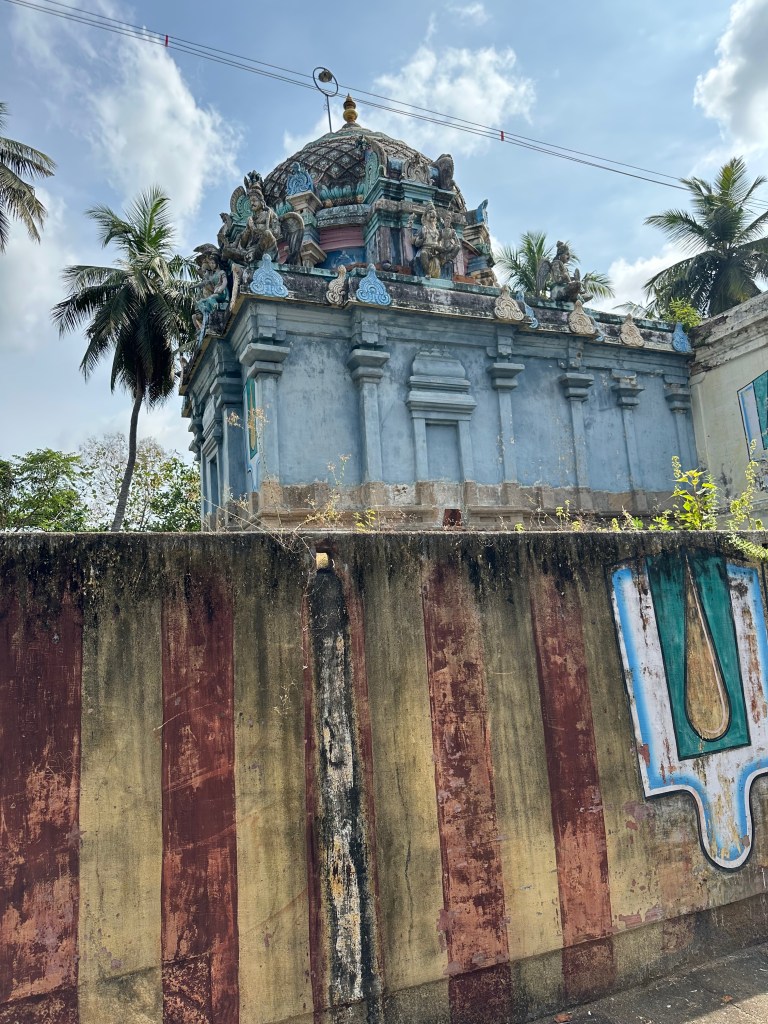
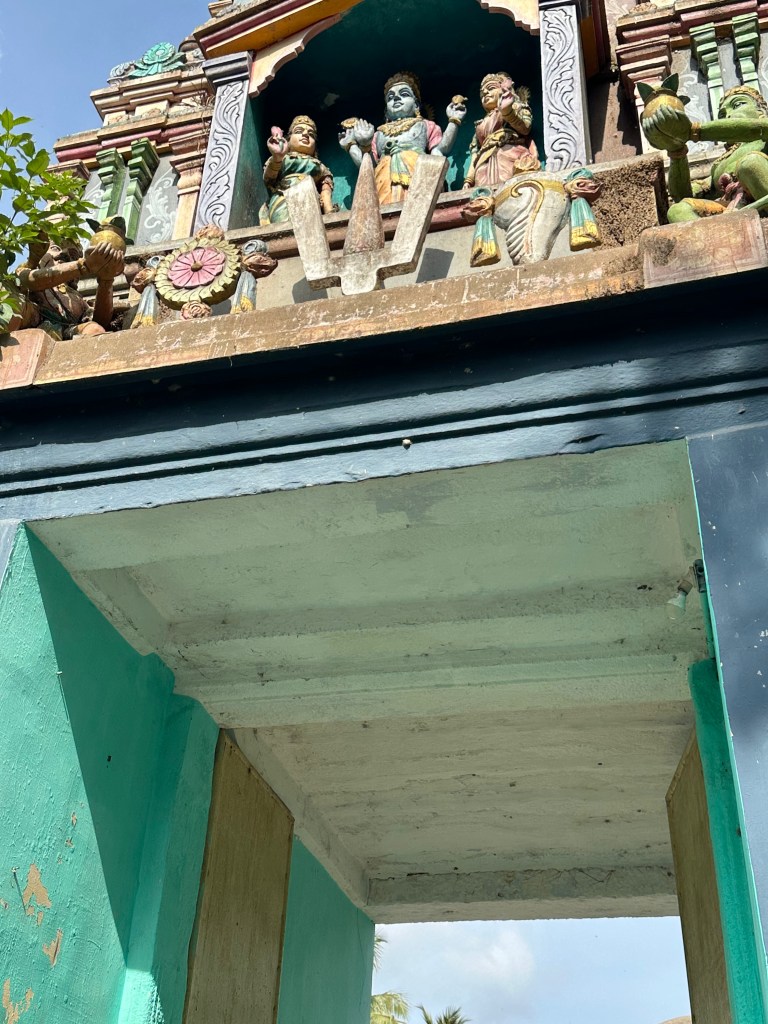
When after much touble locating the village driving through narrow, kuccha, winding rural roads, we finally reached the gates of the temple, indeed, I was sad to see how forlorn and deserted the ‘kovil‘ looked.

When I entered the temple under its main archway and gopuram, I noticed there was not a soul to be seen anywhere inside.

Inside the main sannidhi, I saw a lone man — he seemed to be a watchman — seated on ricekty old chair, writing up what I presumed was an accounting ledger. He looked up to see me with a quizzical look and said:

“It’s too early for darshan… The Bhattachari of the temple usually comes here only around 10 AM to open the sannidhi and perform the morning rites. You can wait if you wish. Otherwise, you can walk up to the doors of the sanctum and have a look at perumal through the grill doors”.

“Yes, please I would like that”, I said and my voice echoed off the desolate walls and roof of the temple.

While the temple forecourt itself was dim and musty, surprisingly, when I went closer to the sanctum and began peering through the grill-framed door, I could see the deity bathed in a bright, brilliant swathe of light. The archamurthy was beautiful to behold ! The “vadivu azhagu” in fact took my breath away.

I recited a few stature verses and a prabhandam paasuram and slowly walked out of the main shrine, asking the watchman the way towards the Thaayaar Sannidhi, the shrine for the Lord’s Consort. I was shown the way:

As I ambled across the outer courtyard slowly towards the shrine, my heart truly bled while seeing the generally unkempt, drab and poorly maintained ambience of this ancient, beautiful temple. When I strode into the sannidhi of Thaayaar and peered into the darkness, to my shock and distress I saw that not even a garland or bare ornament adorned her archa-svarupam…. Again, I felt myself choking on a lump of glum emotion rising inside my throat…

As I peformed the customary circumambulation (“pradakshina“) of the temple, there was one thought that kept nagging my mind. Given what I had seen to be the general state of neglect and desolation of this Sri Vaishnava divya desam, still the sanctum sanctorum I had seen was nonetheless brilliantly lit and shone indeed in a strange divine luste. I wondered how that could be possible… It did seem rather strange.

The answer I found when I came upon a commemorative plaque — a small stone tablet that had been cemented into the wall on the north-eastern corner of the outer “praakaram“.

The plaque told me that back in 2019, a group of Sri Ahobila Muttam sishyas had collected funds to the tune of Rs. 184,000/- to install a solar-energy equipment that would keep the interior of the temple — especially at least the “garbha-griham”, the sanctum — well and brilliantly lit on most days of the year when the sun shone. It also made me surmise how sorry might have been the situation otherwise if the solar-equipment had not been installed! No grid power or else only erratic grid-power to the temple would have perhaps kept it plunged in semi-permanent darkness …. or more often than not….

What a pathetic state of affairs for a Sri Vaishnava Divya Desam!

If a premier religious institution like the Sri Ahobila Mutt can raise resources to install a solar-equipment for a poorly maintained temple like Thalacchanga Nanmathiyam temple in remote Akkur village taluk, why could it also not come forward to take the initiative to repair and renovate the temple, perform its “mahasamprokshanam” and encourage its vast following of sishyas worldwide to actively contribute to its ongoing upkeep?

Surely, wouldn’t that at least improve what my rental cab-driver, Pachiappan of Mayavaram, had earlier complained to me about — that the Vaishnava pilgrim footfall into this famous, lovely Perumal Kovil was virtually NIL throughout the year?

(to be continued)

Sudarshan Madabushi

Pakistan is not a nation. It is really the badlands of the “Wild West”… So, let’s not second-guess our Prime Minister or doubt his judgment

Many people in India today are upset over PM Modi’s perceived pullback on an all-out attack on Pakistan after having successfully degraded if not destroyed its inland terror infrastructure.

They are further infuriated that Modi was upstaged by Donald Trump in the declaration of ceasefire between Pakistan and India . “Trump claims he stopped war between India and Pakistan and Modi has no guts to refute it strongly if what Trump said was not true!”.

My counter question to them is this:

Why should Modi do it ? 

From India’s point of view, it will pay to simply pander to Trump’s egotism… make him feel deluded about his megalomaniac self-image as a great world leader who keeps the world peace …. 

To keep Trump onside and humoured is IMHO good clever policy for India for the next 4 years when India can try and wring out several strategic benefits from America : trade deal, tariff concessions, technology transfer, bulwark against Chinese dominance, diplomatic support … to name only a few … 

So, please let’s give credit where it is due … PM Modi knows how to play the long game . He doesn’t let street-level jingoism dictate policy making. 

But Modi-haters and baiters still will not concede to him good judgment and foresight. Modi for them can do nothing right …

So they now are screaming :

When IMF gave that huge loan to Pakistan and no member of IMF protested including his Rafael bosom pal he got scared that’s true.”

No one knows really what happened within the IMF but Modi baiters are quick to jump to uncharitable and presumptuous conclusions.

In my own view this is perhaps what might have happened at IMF . I could be wrong or I could be dead right … who knows ?

That IMF loan was really Pakistan’s lifeline … to save it from sinking into default and bankruptcy … If the loan had been rejected , the miltary lunatics of Rawalpindi Army HQ would’ve have still further got the upper hand over Pakistan civilian government. Lunatics in desperation with their fingers on the Pakistan nuclear button might have done anything unpredictable . 

India IMHO wisely abstained at the IMF on the vote for loan to Pakistan … Further, it was a loan that had already been initiated and processed under the regime of the India-hater Joe Biden ; Trump has least leverage to do otherwise and upturn the loan approval .

Again the anti-Modi arguement goes like this : Really it is difficult to argue with one who says that Pakistan would have used nuclear weapons if it had not been given a loan by the IMF! That’s ridiculous!

The harsh undeniable reality is that India has a rogue state as a neighbour in Pakistan . We can’t try mindless heroics with a homicidal maniac. All I’m saying is that the IMF loan carried a condition … either Pakistan agrees to cease fire , or it gets no loan … If the loan had not gone through , the civilian govt . would’ve likely gone too. The new Army General Syed Asim Munir Ahmed Shah, a certifiable madman, would’ve been sorely tempted to stage a coup and seize power … . Anything could’ve happened thereafter . … including a tactical threat of a nuclear confrontation that would have immediately brought the big boys , the big powers like America and China into the game .

PM Modi wisely averted all that …knowing fully well how the law of unforeseen consequences works in such fraught situations .

The Modi critics however will simply not stop ridiculing the possibility of a nuclear confrontation: “Everywhere in the world it’s a standard rule that only the civilian head of a nuclear nation that has its finger on the nuclear button. Not the military. Why should Pakistan be any different? , they argue . And if as an exception in Pakistan military had its hands on the nuclear button, notwithstanding the truce that was announced, Army HQ could have gone ahead and used it any way , couldn’t it?”

The answer is simple : Pakistan is unique. The civilian rule in Pakistan is for appearances only. It’s a charade. It will not be incredulous to say that in succeeding in getting the IMF loan did enable the Pakistan civilian govt. to stave off a possible military coup …

If anyone in the world wants to know what kind of civilian rule is there in Pakistan, all they have to do is to ask a serious question on any Internet search engine :

Since 1947, how many Prime Ministers have India and Pakistan had ruling the country ?

They will be aghast by the answer the A.I. engine will throw up !!

Here below ⬇️ is what I got !

India has had 14 Prime Ministers since 1947, including:
– *Jawaharlal Nehru* (1947-1964)
– *Gulzarilal Nanda* (acting, 1964 and 1966)
– *Lal Bahadur Shastri* (1964-1966)
– *Indira Gandhi* (1966-1977 and 1980-1984)
– *Morarji Desai* (1977-1979)
– *Charan Singh* (1979-1980)
– *Rajiv Gandhi* (1984-1989)
– *Vishwanath Pratap Singh* (1989-1990)
– *Chandra Shekhar* (1990-1991)
– *P. V. Narasimha Rao* (1991-1996)
– *Atal Bihari Vajpayee* (1996 and 1998-2004)
– *H. D. Deve Gowda* (1996-1997)
– *Inder Kumar Gujral* (1997-1998)
– *Manmohan Singh* (2004-2014)
– *Narendra Modi* (2014-present)

Pakistan’s number of Prime Ministers is not explicitly stated in the search results, but some notable ones include:
– *Nurul Amin* had the shortest term of 13 days
– *Yusuf Raza Gilani* had the longest consecutive term of 4 years and 86 days
– *Nawaz Sharif* has been the longest-serving prime minister for a non-consecutive term, serving approximately 9 years and 215 days

To provide an exact number for Pakistan’s Prime Ministers, further research would be required.

The answer above I got floored me into disbelief that I was forced to ask Meta again:

Why doesn’t Pakistan government itself have such information ?

And pat came back the answer :

The Pakistani government might not have a centralized, easily accessible record of all its Prime Ministers and their terms due to various reasons, including:
– *Lack of Official Records*: In some cases, official records might be incomplete, outdated, or not readily available.
– *Political Instability*: Pakistan has experienced frequent changes in government, military coups, and political upheavals, which can lead to gaps in record-keeping and documentation.
– *Bureaucratic Inefficiencies*: Government records might be scattered across different departments or archives, making it challenging to compile accurate information.
– *Limited Transparency*: Government information might not always be readily available to the public or even within the government itself due to various reasons, including security concerns or lack of transparency.

As a result, accurate information about Pakistan’s Prime Ministers and their terms might require cross-verification from multiple sources, including historical records, news archives, and academic research.

Can anyone not be shocked and frightened by the facts above ?!!! A country calling itself a democratic Islamic Republic doesn’t know how many elected Prime Ministers ruled it in the last 75 years !!

Pakistan is not a nation. For India , it is really the “Wild West”… Badlands where really bad things can happen !

So, please , my countrymen, let’s not criticise our own Prime Ministers for showing caution , even over-caution in dealing with this infernal ghetto of insane, criminals that calls itself a neighbour of ours and “a responsible nation” too !

Sudarshan Madabushi