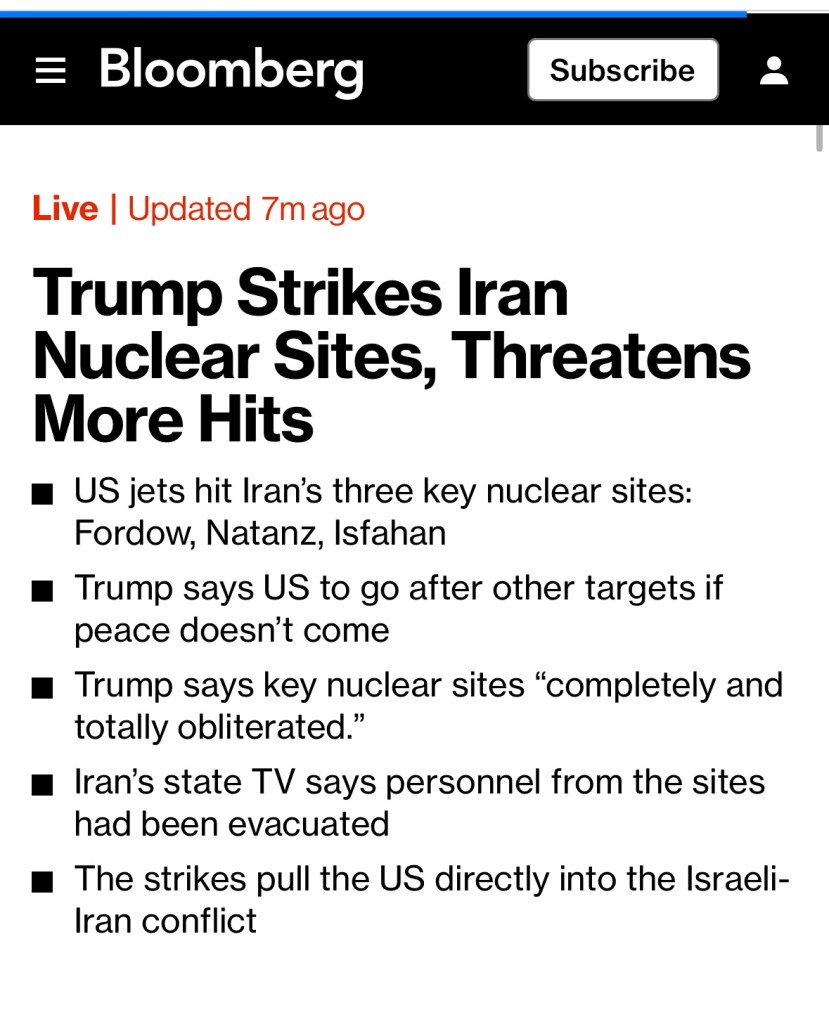
In my crystal-ball view, this is what is likely to happen between the medium to long-term:
Iran will now be turned into the same situation as Syria was …. There will be some more warlike engagement …
Russia will lend some support to Iran for a while along with China but no direct engagement …
The Khamenei regime will be worn down and degraded like the Assad regime was …
Once the Ayatollah is permanently taken out of the picture as Bashar Assad has been today from Syria, Iran too will have a US-Israel backed leadership in power .
Iran’s nuclear ambitions will be shattered to pieces.
With Iran and the GCC (OPEC +) firmly under the strategic grip and control of America and Israel, the world’s entire Energy market will henceforth be held captive by Uncle Sam. China’s energy insecurity will render it vulnerable economically leading ultimately to its military enfeeblement on the world stage.
Russia will look on helplessly pinned down as it is in a war in Ukraine that will never end … at least not anytime in the near future.
Palestine will be taken over by Israel … permanently . The GCC and Egypt will do very little to resist that outcome: a seaside riviera, a Mediterranean Las Vegasowned by America and managed by the new state of Greater Israel.
USA will then at last be able to turn its full geo-strategic attention to China and the South China Sea .
Its allies Japan from the East, Pakistan from the West and South Korea+ Philippines from the South will act in concert with America to first target North Korea and neutralise it just in the same manner as we see today Iran getting eventually neutralised.
Both BRICS and QUAD will be rendered dysfunctional if not irrelevant.
After that significant goal is achieved, China will then have no other choice but to be forced to come to terms with American hegemony in Asia. The world will become unipolar world again as in 1991.
End of story .
And oh, BTW, by the end of his term in office, Donald Trump will be awarded the Nobel Peace Prize and all of us can live happily ever thereafter. It will then seem to us in India that “God’s in his heaven. All’s right with the world.”
In the book Ten Heads of Ravana edited by Rajiv Malhotra, the well-known Hinduism scholar and historian, and his co-author, Divya Reddy, compiled ten excellent essays portraying ten prolific and very influential contemporary Hinduphobic writers in India and abroad. Shashi Tharoor finds a place of pride in the pantheon of those notorious ten who are likened to Ravana, the “dasagriva”, the ten-headed rakshasa villain in Valmiki Ramayana.
Tharoor thus is an Intellectual Ravana.
To make my own point that the Tharoorian view of Hinduism is indeed balderdash, I shall do nothing more than merely quote in extenso from passages from the essay on Tharoor penned by Divya Reddy in Malhotra’s book. Here are those select passages below.
I rest my case .
Sudarshan Madabushi
************ ********** **********
Tharoor has a humungous presence on social media with more than eight million followers on Twitter and he remains an influential personality in the media today.
Some of his best-selling books are Inglorious Empire: What the British did to India, An Era of Darkness: The British Empire in India, The Great Indian Novel, India Shastra: Reflections on the Nation in our Time, Why I am a Hindu, The Hindu Way (excerpted from the bestseller Why I am a Hindu) and the latest The Battle of Belonging: On Nationalism, Patriotism, And What It Means to be Indian.
Tharoor is also celebrated for his mastery over English and is popular for using unique (often unpronounceable) English words in his everyday parlance. His recent book Tharoorosaurus is a testament to his popularity in the world of English vocabulary and lexicon. For an average modern Indian, who views mastery over English as the most important mark of intellectual credibility, Tharoor is viewed as an intellectual giant par excellence.
In academia, popular media and for most aspirational urban Indians, Tharoor is also seen as a modern and perhaps the most eloquent interpreter of Hinduism for the twenty-first century.
Through his books, Tharoor explains what he believes is the essence of Hinduism and counters the ‘narrow-minded’ narratives by the ‘Hindu Right’ popularly referred to as the ‘Hindutvavadis.” He also claims to have written books focusing on Hinduism to counter the growing “intolerance” by the ‘Hindu Right’.
The books are seriously well-written, well-presented and but will mislead uninformed naive readers, especially those eager to know the Hindu story. He has managed to get enough credibility as an insider by masquerading as a patriotic Hindu through his books, especially the ones critiquing and questioning the British rule in India. Much of his critique is nothing new and has always been in the public domain by some serious and well-meaning historians of India.
With his impeccable credentials, one might wonder what makes Tharoor an ‘Intellectual Ravana’. Ravana was an intellectual giant, his strength and valor matchless. Through rigorous tapasya, he had obtained enormous blessings and scholarship which made him unconquerable. However, Ravana used all these powers for adharmic deeds which were harmful for mankind, and he was later vanquished by the forces of dharma.
Tharoor uses his eloquence and impressive public persona to propagate his views on dharma and India. However, his position on dharma is counter-productive to the unity and integrity of India.
********** ********* *************
Tharoor’s work on Hinduism is majorly an assortment of theories drawn from colonial Indologists and historians whose aim was to conjure a history of India which denies the indigenous origin of the country’s mainstream culture, instead giving credit to foreign invaders while devaluing India’s cultural heritage by trivializing her contribution towards the betterment of humanity at large. There are also many instances where Tharoor has taken extensive liberties in his interpretation of Sanskrit words and Hindu ideas, leading to manipulated and loaded narratives.
Tharoor claims to interpret Hinduism through the prism of a pluralistic, liberal Hindu. Given his wide popularity, his work influences the civilizational idea of India and subverts the native cultural identity for the modern Indian. However, a true understanding of something seminal like Hinduism needs to be broad-based and reflect fidelity to the tradition’s own self-perceptions, while not being colored by subjective prejudices. A factual and unbiased analysis of his books, articles, and thoughts is therefore very much … in order to counter some of the biases implicit in his works. (Discerning readers do) not … take his books and narratives at face value, but … delve deeper (to) understand the underlying motives behind such narratives.
********* ************* *********
A careful reading of Tharoor’s work will help one deduce that not only does he aspire to create a class of subservient and submissive Hindus, but also strives to instil a sense of shame by deliberately misinterpreting the sacred scriptures to bring out issues such as misogyny, superstitions, animal cruelty, alcoholism and so forth.
Young Hindu readers, especially those who are reading these books in their attempts to address yearnings for identity, who are subconsciously seeking to understand their place in the world, will be manipulated and their Hindu identities weakened. Reading the books will confuse and, in some cases, even cause damage to the sense of self-worth. This probably is Tharoor’s goal and he is mostly successful.
********* ************ **********
Tharoor claims to be a passionate follower of Swami Vivekananda and credits notable personalities like Dr. Sarvepalli Radhakrishnan, Ananda Coomaraswamy, Ramakrishna Paramahamsa, Paramahansa Yogananda, A.L. Basham, R.C. Zaehner, Raimon Panikkar and Dr. Karan Singh, for his wisdom on Hinduism. He also credits his contemporany fellow ‘intellectual Ravana’,Devdutt Pattanaik, for guiding him on hís book Why I am a Hindu.
Tharoor argues that Hinduism is a religion with no boundaries or barriers of entry, or fundamentals, or defined rituals or prescribed books or a specific place of worship. He emphasizes the fact that it is a faith that accommodates every belief and therefore there is no need to choose some and reject others. He also points out that Hinduism is a faith without dogma and consequently there is no particular framework from which one can deviate.
Hindus can choose from a variety of rituals, deities, customs and practices as per their needs and wishes. An inherent trait of every true Hindu is therefore, to accept and tolerate every worldview. In short Tharoor believes that every way of life is the Hindu way”.
********** ************** *********
Hinduism seemingly embraces myriad forms of beliefs and worship and thus Tharoor wholeheartedly agrees with India’s first Prime Minister, Jawaharlal Nehru, who had famously said that ‘being a Hindu means all things to all men’.
Tharoor concludes by saying: “As a Hindu I subscribe to a creed that is free of the restrictive dogmas of holy writ, one that refuses to be shackled to the limitations of a single volume of holy revelation.”
********* *********** *********
Tharoor asserts that Hinduism stands for ‘universal tolerance and acceptance as emphasized by Swami Vivekananda”. It is therefore, important for every adherent of the faith to tolerate and accept every other religion as their own irrespective of how the other faith treats Hinduism.
“Hindu legends have the gods manifesting themselves in so many shapes and forms that the notion of one agreed image of God would be preposterous. Thus one can imagine God as a pot bellied man with an elephant head, and also as a ten-armed woman with a beatific smile; and since both forms are equally valid to the worshipper, why not also imagine God as a bleeding man on a cross? All are acceptable to the Hindu; the reverence accorded to each representation of the unknowable God by worshippers of other faiths is enough to prompt similar respect from the Hindu. Acceptance is always the name of the game.” (Tharoor 2019:47-48)
********** *********** *********
Thus, as per Tharoor, it is perfectly acceptable for an artist, a filmmaker, an actor or an author to interpret Hinduism in whichever way they deem fit. To counter or defend such interpretations, which many within the Hindu tradition may perceive as distortions, is for Tharoor, no less than an act of intolerance and against the ethos of Hinduism.
Tharoor feels a book needs to be respected, even if it derides a Hindu Goddess, for a book is a sacred item. Therefore, as far as Tharoor is concerned, those who had protested against Wendy Doniger’s (a contemporary ‘Intellectual Ravana’) book on Hinduism and dubbed the book as being anti-Hindu are all intolerant bigots!
Tharoor is also a strong critic of the Rashtriya Swayamsevak Sangh (the RSS) and its ideologues. He alleges that the proponents of Hindutva ignore the concept of tolerance embedded in Hinduism. He criticizes the RSS for its idea of India as a ‘khichdi’ as opposed to his ‘thali‘ theory.
Below is an excerpt from his article where he is critical of the current RSS chief Mohan Bhagwat’s idea of India:
“The first idea assumes that there are various kinds of Indians, with very different views of their own identity, including religious assumptions that differ markedly from each other. Yet, we all belong together and share a common allegiance to India. I have described this for many years now, in various speeches and writings, as my “thali” theory of Indian nationalism. Like a thali, we are a collection of different items in different bowls; since we are in different dishes we don’t necessarily flow into each other, but we belong together on the same platter and combine on your palate to give you a satisfying repast.
Bhagwat’s idea of India is not that of my thali. It is, instead, a khichdi theory of nationalism: We are one dish, with many ingredients all mixed up and cooked together. Thus for him, all true Indians are Hindus; there might be a “Muslim Hindu” here and a “Christian Hindu” there, but they must acknowledge that they are part of the mixed khichdi and have no identity separate from it. Their diversity, in other words, is subordinate to their common role as a part of the larger unity.” (Tharoor: 2018)
********* *********** **********
Tharoor on Religious Conversion
Tharoor quotes Swami Vivekananda and Mahatma Gandhi, to point out that religious conversion is unwarranted. But for a Hindu like himself, he feels that every individual’s spiritual needs are different, and if some wish to find salvation through a different faith, that is entirely their prerogative.
He also feels that a self-confident faith like Hinduism, secure in its own broad-minded liberality, has no need of violence in its defence. He insists that religious conversion is not a threat to society and is a non-violent activity.
Tharoor feels every Indian is entitled to change his faith if he is not happy in his current one, be it for spiritual or materialistic gains and therefore religious proselytizing is not an anti-national activity.
Conversion, according to Tharoor, is just merely trying a different item on the spiritual menu — (his metaphoric thaali). Hinduism, being the most tolerant faith, must also allow its adherents to freely convert to another faith without any apprehensions. Tharoor argues that preventing religious conversion is also against Indian nationalism and the ethos of dharma.
Tharoor also questions why a secure faith like Hinduism should worry about conversions. Religious conversion essentially stands for exclusivity. That is, to convince the adherent of a particular faith that his/her faith is simply not good enough.
To paraphrase it in Tharoor’s own terms —- to convert to a religion that says his/her way is the only way, we are reducing the number of paths to reach the Ultimate. For someone like Tharoor, who is one of the strongest proponents of Pluralism, it is an irony that he supports an act of reducing diversity.
When Tharoor says it is one’s individual freedom to convert, it is also important to point out that, it is every individual’s right to know what he/she is getting into, just like the terms and conditions of an organization that one would agree to, to opt for their product/service. However, going by the data of mass conversions happening in India in contemporary times, it is mostly through deception.
For instance, one must be educated enough to distinguish between Hindu good news and Christian good news. Freedom to proselytize also comes with a moral responsibility. One cannot have unlimited freedom. That would be a level playing field. No other form of conversion can ever be justified, for it is a gruesome violation of human rights, to exploit the vulnerable status of an individual be it due to innocence/poverty/personal problems and so on. It is the pinnacle of religious intolerance that is against achieving world peace. The issue of religious proselytization highlights the fact that Abrahamic faiths are unable to accept the differences of other paths to God and live-in harmony. This goes against the norms of peaceful co-existence. It is ironical that Tharoor lectures a faith with no history of religious conversion on ‘tolerance‘ and acceptance of other religions.
******* ************* **********
The flexibility and the openness of Hinduism does not mean that it is not worthy of expecting the same respect and acceptance from other religions. There is a fine line between accepting and submitting, which Tharoor fails to highlight. Religious conversions are one such example of Hindus being deprived of mutual respect.
As mentioned earlier the pluralistic inherent unity and acceptance of dharmic faiths need to be reciprocated with mutual respect, which is a two-way path. When mutual respect is compromised, whenever it is under siege, dharma needs to be defended or protected, for that is the true essence of dharma. This fact has been constantly emphasized in our puranas, itihasa and the Bhagavad Gita.
However, it is evident through the work of Tharoor that he constantly tries to subdue this Kshatriya spirit of the Hindus. This is one of the major reasons why Tharoor’s work is against the ethos of Hindu philosophy, as not only is his interpretation in contradiction to the fundamental ethos of dharma, but also mentally conditions a Hindu to become submissive and slavish.
********* *********** **********
Tharoor selectively quotes Swami Vivekananda, prompting one to question the integrity and credibility of Tharoor’s interpretation of not only the sage’s work, but of his other sources as well.
One knows of “Cafeteria Christians” (a non-scriptural term used to refer to the practice of choosing for oneself the parts of the Bible to either accept or reject) but one might as well coin ‘Cafeteria Hindu’ to describe Tharoor, due to his selective use of data, inferences, whitewashing historical facts and causes — one can pick and choose one’s use of rationality in his world.
Tharoor’s Chronology of Hinduism
Tharoor’s chronology is based on the Aryan Invasion/Migration Theory. Accordingly, he believes that the Aryans migrated to India sometime before 1500 BCE and thereafter composed the Veda-s.
The four Vedas are believed to have been created between 1500 BCE and 500 BCE. He also believes that the first eight Upanisad-s to have been written between the eighth century BCE to the fourth century BCE, which is congruent to the age of Buddha. The next three Upanisad-s are post-Buddhist and date from 300 BCE to 200 CE and that the remaining ninety-seven Upanisad-s belong to the Puranic period ie., second century CE to the tenth century CE. He believes the Smriti-s were composed between 300 BCE and 200 CE, Ramayana around 200 BCE to 200 CE and the Mahabharata between 400 BCE and 400 CE. He dates the Purana-s to 250 CE and 1000 CE.
This artificial chronology that was created by colonial scholars to serve various purposes, has been challenged and countered time and again over the last century. Yet, it continues to hold sway over academia, and the Western baselining of Indian history still continues in several forums. While, many Indian scholars have begun to challenge the dates and chronological structures framed by colonial Indologists, the silver lining is that, there are increasingly vibrant discussions in public space and awareness amongst the younger generations, as to the logical fallacies in their narrative.
******** ************ **********
Tharoor’s work analyzing Hinduism’s important texts is replete with serious misinterpretations and factual errors. Tharoor believes that Hinduism is not absolved of gender bias and quotes Manusmriti and excerpts from the Anusasana Parva of Mahabharata to substantiate his claims on misogyny.
Firstly, Manusmriti does not define Hinduism. There are few modern Hindus who wake up in the morning and read the Manusmriti to guide their actions, because, fundamentally, smritis are codified law: which are context, time and place driven and not eternal truths or the last word.
Manusmriti cannot be compared to the Bible/Quran which transcend time, place and context. Moreover, Manu’s code is explicit in stating that it is not universal. It calls for updates, amendments and rewrites in order to suit different circumstances.
Tharoor also refers to the Manusmriti as the ‘Hindu Law’ even though it has never been enforced as the divine and all-encompassing “law of all Hindus”. It was the British who referred to the Manusmriti as the ‘Hindu law’ to show that they were ruling in accordance with the laws of the Hindus, albeit with colonial motives.
Indian spiritual texts have traps for the uninitiated, therefore it is of prime importance to rely on a Guru or the one who has the adhikara to interpret the esoteric texts. Tharoor neither has the adhikara nor has he made any attempt whatsoever to learn from the right people and his ignorance shines through his misinterpretations.
******** *********** **********
Some unanswered questions raised by Tharoor have been:
What makes Hinduism flexible and open?
How ‘elastic’ is Hinduism?
Does Hinduism have no boundaries at all? Can any book be thought of as the sacred text? Can anything and everything be part of Hinduism?
Implications of Tharoor’s Work
~anything-goes Hinduism, myth of sameness , relativism, hostile
~forces making way into the system, confused Hindu and a faith that is prone to disintegration
~gateway for digestion eventually leading to extinction
~serves as a narrative for the Breaking India forces
~passivity/complacency toward defending dharma, which leads to adharma
******** ************ **********
While Tharoor is right in understanding Hinduism as a faith that does not have a rigid entity with dogmas enforced by a centralized authority equivalent to a church, nor a single founder, linear history, ‘one truth’ and so forth, it is his muddled understanding of Hinduism’s clear distinction between valid and invalid religious claims which is the cause of concern.
The traditional Hindu teachings make a clear distinction between dharma and adharma, sat (truth) and asat (falsity), daivika and asuric, and so on. Hinduism has certain definitive boundaries that are non-negotiable, for instance the concepts of karma and reincarnation are fundamental to explaining the philosophy of Hinduism.
The Vedas form the basis of dharma, and are fundamental to an “astika”.
As the title of one of Tharoor’s books The Hindu Way suggests, indeed Hindus have a definitive way and not ‘every way’ is a ‘Hindu Way’ as the content of the book seems to suggest. The quote below is from Tharoor’s book The Hindu Way and substantiates our analysis of his thesis:
“Indeed the term “the Hindu way” is in itself a fallacy as there is no one Hindu way.” (Tharoor : 2019)
When Tharoor makes an audacious statement as above notwithstanding the fact that he is paving the way for ‘anything goes’ Hinduism. (Or is that his intent?)
In the realm of pop culture or ‘new age spirituality‘ it is fashionable to interpret Hinduism as infinitely elastic or as vaguely as one pleases.If every way of life counts as the ‘Hindu Way, then the natural question of what defines a Hindu arises.
Although the Hindu dharma provides great flexibility as well as enormous freedom to adapt and evolve, at the same time, the dharma has a boundary and excludes hostile elements that do not reflect this unity.If all religions were the same as Tharoor portrays them to be, then what good is it to remain a Hindu?
When Hinduism is loosely defined, without definitive boundary markers, Tharoor is opening it up for digestion. The term ‘digestion‘ in this context essentially means that the predator religion separates the desirable elements of a particular faith, then ‘scrubs‘ the elements to remove the dharmic context in order to make it more acceptable to appropriate to the predator faith, thereby making the predator religion more robust and stronger. For eg: Christian Yoga.
The threat of such a process is that, it may eventually lead to extinction of a weaker civilization, because the predator religion keeps becoming stronger and what is left of a civilization after the predator is done with it, is waste material to be removed and destroyed. For example, as in the case of pagans of Europe, many of their rituals were appropriated by Christianity eventually leading to the extinction of the faith.
******** ************* *********
Rajiv Malhotra uses the term ‘open architecture’ to explain the flexible, hard to define quality of Hinduism. The term ‘open architecture‘ refers to a framework that can be populated by a range of ideas, practices, symbols, rituals, and so on. He draws an analogy between Hinduism and the functioning of the internet, as explained in the book Indra’s Net:
“The internet is not infinitely open but only relatively so: its boundaries are defined by what it rejects— for example, viruses or abusive elements.
Despite these rejections, the internet has abundant flexibility for the future. Similarly, Hinduism does not comprise all conceivable kinds of spirituality and religious claims, because it must exclude those that would destroy its underlying principles of integral unity, openness and flexibility.”
Swami Vivekananda defined Hinduism with three essential features— belief in God, in the Vedas as revelation, and in the system of karma and transmigration. While Tharoor represents Hinduism as a faith that is infinitely open to embracing everything unconditionally— such extremism is counter-productive because the survival of the entire system is compromised.
As stated above, just as the Internet is hostile to viruses or abusive elements that would hamper its productivity, Hinduism must also be guarded against elements that would threaten its philosophical unity.
Tharoor fails to identify such elements (perhaps deliberately?) and draw a definitive boundary against what is not Hinduism.
********* ************ *********
The question of whether to accept Shashi Tharoor’s perspective on Hinduism—as opposed to a more traditional or orthodox view—is fundamentally a matter of how one interprets Hinduism’s history, diversity, and evolving identity.
Ultimately, whether to accept Tharoor’s or a more traditional one is a matter of personal conviction, scholarly inquiry, and lived experience. In summary, Tharoor’s interpretation is one among many, but it draws on deeply rooted aspects of Hinduism’s history and philosophy. Accepting or rejecting it depends on how one values tradition, reform, and the ongoing dialogue within Hinduism itself.
Tharoor however has and does take enormous liberties to distort and misinterpret the notion of ‘liberalism‘ and ‘pluralism‘ inherent in Hinduism to convince a Hindu into cowardice and inaction.
[Divya Reddy calls Tharoor as “Macaulay-Putra”.]
For an average ‘Macaulayized’ English-speaking Hindu youth, who has no deep moorings in Hindu thinking, it is easy to get swayed by his eloquence, public persona and his well-articulated writings. He positions himself as an insider and leads Hindus on a self-implosive trajectory. If Tharoor had genuinely wanted to discuss Hinduism’s openness and flexibility, there would have been clarity in his explanations of many of Hinduism’s vaunted characteristics.
Other than deliberate misplaced characterizations, the genuine reader, looking for logical and plausible explanations will most likely feel cheated after reading Tharoor.
******* ************** **********
Finally, my submission is this :
Tharoor may be a great elocutionist in English, a great writer and historian, but on his views on Hinduism, he cannot be allowed to go unchallenged. Why ? Because he is such a popular figure that his polluting influence on the minds of educated and young Indian minds can be very very profound.
His writings are considered to be the ‘new-age’ authority on Hinduism, especially in urban India. His works serve as a ‘handbook’ on Hinduism for many modern Hindus, making it important to factually counter his erroneous positions.
For instance, at a marriage ceremony, the Bhagavad Gita was replaced by Tharoor’s book Why I am a Hindu, and the groom’s mother shared this ‘proud revolutionary’ moment on social media. She was also quoted saying that Tharoor’s book was a ‘more meaningful and relevant text’.
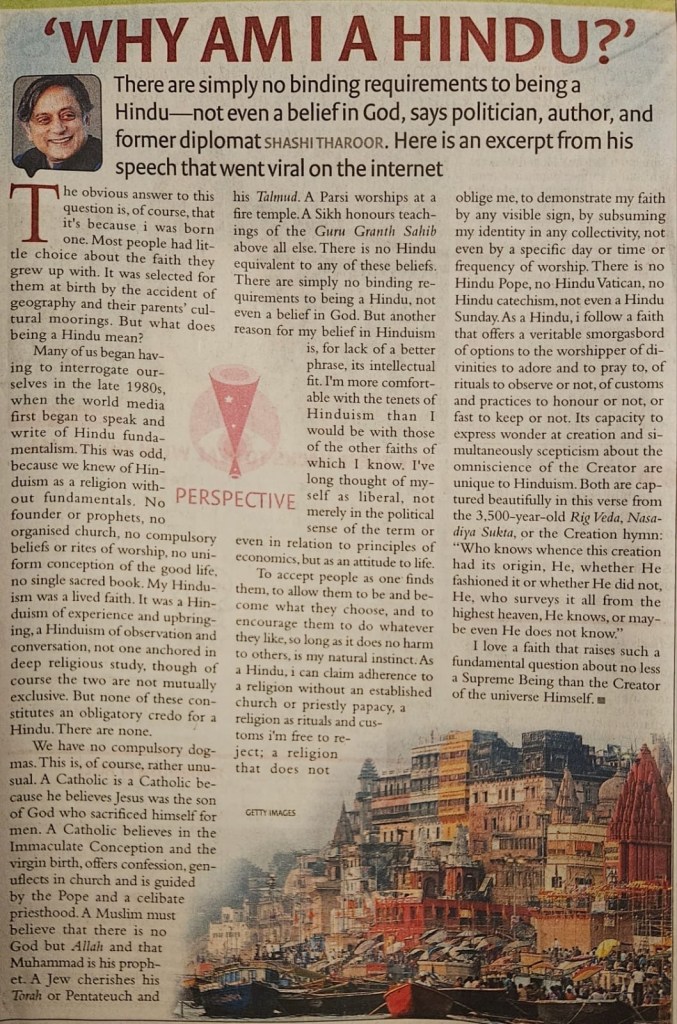
A friend of mine sent me yesterday on WhatsApp a “many times forwarded’ copy of Shashi Tharoor’s excerpted speech reportedly now going viral on the internet. It is titled “WHY AM I A HINDU?” which I read with great interest but great disappointment. For Tharoor as elocutionist, politician, author and astute diplomat, I have great admiration. But when I find him treading into waters in which I think he is all at sea, such as Hindu philosophy, theology and religion, I must say that I often find him a tad disappointing.
I will explain myself why I have such ambivalent feelings towards Shashi Tharoor but not before you have yourself fully read the Tharoor speech as reproduced below.
*************
My first reaction to the Tharoor speech was that it was it was “Tharoorian balderdash”. I chose the term balderdash deliberately since I wanted to express my thought with an uncommon English word that had every bit of the famed Tharoorian dash, panache and flourish.
My comment however did not go down well with many of my friends who are ardent admirers of Shashi. One friend immediately replied snapping back at me on Whatsapp:
“Whatever.! But at least he didn’t curse Hindus like his fellow (the Congress) party members..”
Another friend, a gracious lady who is an author and former business business-journalist was equally angered by and aghast at my comment:
“Why?! What’s wrong in what he says!”
Another learned friend from Udupi who is a retired academician, was almost apoplectic with dismay. He arraigned me with a severe reply after he had probably consulted an English dictionary to make sure “balderdash” meant exactly what I had intended it to convey:
““Balderdash” is a fun word. It refers to nonsensical or absurd talk, writing, or ideas. It’s often used to describe something that’s considered ridiculous, foolish, or utter rubbish. Example: “The plot of that movie was pure balderdash – completely unbelievable!” …. Tharoor’s speech is not balderdash…”, he thundered.
It is …! I insisted to him with a return message of equal vehemence. What does a politician like Tharoor know about Hinduism apart from its generalities? Does he know it better than our seers and Acharyas themselves ? It is balderdash indeed in my opinion to say that “there are no binding requirements to being a Hindu”.
Tharoor is blatantly misrepresenting Hinduism as some sort of inchoate, loose, unstructured and “yahaan sab chalthaa hai” kind of faith. We all are fond of parroting what the Supreme Court of India laid down as a cardinal but vapid definition of Hinduism … that “it’s a way of life” … and not any systematic body of religious thought . That Court observation is taken to be gospel truth by the rest of the country. It may be Constitutional gospel but then it is also equally cardinal religious truth that to be a Hindu you must have faith in the divine nature of the Vedas (“apaurusheyam“). In the speech above, do you notice that not once has Shashi Tharoor even mentioned the Vedas, except right at the very end when he blithely quotes a single rk from a Rg Veda only because he finds it convenient to suit his own fanciful purpose of providing a specious interpretation of it?!
In Hinduism, the very first article of faith is to embrace the Vedas as eternally valid revelations of uninversal Truth. Does Tharoor accept that article of faith or not? He has not said so in his speech. He has cleverly skirted it.
Those who reject the Vedas are not Hindus . Period. But in his speech, Tharoor is being so clever by half while interpreting a single, culminating line from the ‘nasadiya suktam” of the Rg Veda to negate the Veda itself! How then can Tharoor claim to be an enlightened Hindu himself?
The above riposte from me further angered my friend triggering a scholarly volley of messages from him:
““For a farmer (in some corner of India) who knows nothing about Vedas, who believes in worshipping Bhagawan in his simple routine, Hinduism has entirely a different meaning”. For a layman, Hinduism is a way of life where he is free to worship any Bhagawan of his choice. Seers, saints, tapaswis Swami-jis think from a different angle“. And those who don’t believe are also Hindus as it gives them freedom not to have any beliefs. A.N. Moorthy Rao ( https://en.wikipedia.org/wiki/A._N._Murthy_Rao ) or G.T. Narayana Rao (https://www.veethi.com/india-people/g._t.__narayana_rao-profile-6474-25.htm) are legendary examples.
To buttress further his argument in support of Shashi Tharoor’s speech, my academician friend threw at me then a quote from a recent book review he had just read of the work of the noted Hindutva writer, Aravindan Neelakandan:
Aravindan Neelakantan: An in-depth critical review of the book ‘A Dharmic Social History of India’has been done by Jataayu B’luru.
First, it presents a bold challenge to the prevailing narratives and dominant colonial interpretations surrounding Indian society and its historical evolution. It confronts the “standard model” which posits that Indian social history is primarily a story of Brahminical imposition of birth-based stratification, interrupted only by fleeting reform movements.
Second, it presents an alternative framework rooted in Hindu Dharma’s inherent values and its dynamic engagement with social reality over millennia, emphasizing the roles of yajna and bhakti in fostering social inclusion. This is done without any denial or suppression of the factual accounts of social stagnation or bitter instances from the 20th century when traditional religious institutions opposed social inclusion.
For “perplexed Hindu youths”, the book offers “ambrosia” by clarifying the true nature of Hindu Dharma concerning social inequalities and showcasing the historical contributions of saints, sages and leaders in uplifting the downtrodden. By exploring the inherent emancipatory potential within Hindu spirituality, it offers a vision of social justice achieved through harmony rather than conflict. It suggests that the path forward lies in following these examples, enabling Sanatana Dharma to “show the world how to attain maximum welfare for all people.”
************
Now, that my academician friend was taking our discussion to a shriller level of inquiry into the subject-matter by quoting a Hindutva scholar and author (who by the way, had himself written an elegant Foreword for my own published book (2024) on the history of Sri Vaishnavites of Tamil Nadu, “A Tale of Two Cities; The Decline and Fall of the “ubhaya vedantins”), I replied to him as follows and ended our Whatsapp exchange:
“Sir that’s exactly what I mean … you can be a practitioner of Hindu faith without being even aware or self-conscious that you are living the Vedic way of life .
Hinduism is a way of life rooted in a certain faith … please don’t forget that . But if you became aware of the Vedas by acquainting yourself with its tenets, and then choose to reject it or make a travesty of it by giving it your own fanciful interpretations of it … as Shashi Tharoor does so in his speech… you would cease then to be a Hindu … you’d be either a Buddhist, Jain or an Atheist. You would not be Hindu.
It is dead wrong to argue that “there are no binding requirements to being a Hindu”. Tharoor is wrong. To be a Hindu, you must abide by the Veda . It is a “binding requirement”. Of course , since we live in a secular and republican society, you can practice any faith you wish to . . There is no requirement you must be a Hindu to live here. But then that is a political ethic enjoined upon us by the Constitution of India. There is no Hindu ethic to say that Hinduism has no “binding requirement”. Tharoor may quote the “nasadiya suktham” to justify that dubious interpretation of Hinduism of his… But then he is guilty of misinterpreting it… and which is why I say, his speech is balderdash.”
***************
I promised my friend that I would later in a few days, write a blogpost here on my webpage to present my case in a more nuanced and less polemical manner. I hope to do so in a couple of days in Part-2.
My mother, Sangitha Kalananidhi & Padma Shree Awardee, Dr. Smt.Mani Krishnaswami was born on February 3, 1930 in Vellore, North Arcot District of Tamil Nadu.
Sangitha Kalanidhi Dr. Smt. Mani Krishnaswami (1930-2002)
Mani, as she came to be popularly known later in life, was the eldest of 11 other siblings — six daughters and five brothers, age —born to her parents, Candadai Sri Lakshminarasimhachariar and Smt. Margathavalli between 1930 and 1948. It was one large happy and close-knit family headed by my ‘thaatha‘ who was a landowning wealthy and respected elder citizen of Vellore.
Candadai Sri. Lakshminarasimhachariar and Smt. Maragathavalli
All siblings lived under one roof in a sprawling farmhouse in the little village of Kangayenellore about 10 kms. from Vellore. The village would have remained utterly nondescript if not were the fact that the famous Saivite scholar and religious “pravachana” preacher, Sri Krupananda Vaariaar also hailed from there.
While all their twelve children were born in Vellore and grew up in Kangeyanellore Village, my ‘thaata‘ by the late 1940s realized that all his children had to be given modern education in the schools and colleges in the then flourishing city of Madras. He decided to buy a large house in the sylvan neighborhood of Adyar Gandhinagar and into which the entire family moved in circa 1960.
The quiet, lush Adyar neighborhood in those days boasted also of being host to the famous Besant Theosophical Society school and the Kalakshetra. Nearby, there was also the Roman Catholic Irish missionary St. Patrick’s High School and the Rani Meyammai High School too. Not too far from Adyar, there was also the Rosary Matriculation School. All of these institutions easily gave admission to one or more of all my grandfather’s dozen children. My mother and a few of her sisters and brothers went to the Besant School; a few sons and daughters went to the other schools. All children were provided ample opportunities to gain excellent schooling right upto the higher secondary level.
Although Lakshminarasimhachari moved all his children into the new family home in Adyar, Madras, he still had to remain back in Vellore and Kangayenellore to oversee his large farming landholdings that fetched him his only large source of income that was needed to raise such a large family. He and Margathavalli decided that they would have to shuttle between Vellore and Madras but leave all the children in Adyar under the care of their eldest daughter, my mother Mani… who then was hardly out of her teens.
Mani Krishnaswami, after finishing SSLC in the Besant School, was by then just starting pursuit of an education in Arts and Music at the famous school, Kalakshetra, headed by the redoubtable art diva, Smt. Rukmini Arundale. But her father, my ‘thaata‘ however made it clear to her that while she continued her education at Kalakshetra, the care of all his other children at the Adyar family house, would have to be undertaken by her, while he himself could only shuttle between his Vellore farmhouse and Madras. The health of the mother, i.e. my “paatti“, Margathavalli, after so many childbirths, by now had begun to deteriorate and since her condition required expert medical attention at the Vellore Christian Medical College Hospital (CMC), ‘thaatha‘ could neither risk moving her to Madras nor himself get away from his farming livelihood in Kangayenellore.
The long and short of the story is that in the end, Mani Krishnaswami, who was no more than around 20 years old by then was saddled by her father with the burden of doing matronly (inloco parentis) duties for all her siblings — about nine or ten them who were all aged then ranging variously from 15 years of age to 2 years!
So very early in life, my mother Mani thus had to be bear the burden of running a large household of siblings that was made up of a couple of toddlers and several school-going children, all on behalf of her own near-absentee parents.
My helpless ‘thaatha‘ came to depend solely upon my mother to fulfill the role he had been compelled by family circumstances to thrust upon her young shoulders. From his farmhouse in Kangeyanellore, he had no other choice left but to remote-control the running of the Adyar home, a task he had all but completely delegated to my mother. Yet, he knew he had to keep in constant touch with her and keep communications with her on a weekly if not daily basis just to ensure that his family was well attended to and provided for under my mother’s overall supervision though assisted as it was by a couple of loyal and very efficient household domestic servants and maids.
In those days soon after Indian Independence, it seemed like long distance communication was impossible without the use of the Indian Postal Mail service. The use of the good old Postcard was virtually universally prevalent amongst the people of India. It was cheap, efficient and very timely mode of communication… all it needed was a postal stamp of one-half anna, or 3-paisa to be affixed on the card!
My grandfather kept insisting that between my mother in the Adyar home in Madras and himself in Vellore, there must be constant postal mail flow of weekly postcard communication to ensure that he was kept abreast almost on a realtime basis by my mother, Mani K, of how she was doing her household duties as a caretaker, matron and a sort of surrogate mother to her little siblings. The post-card exchange between the father and his eldest daughter in effect thus contained a virtual annal of family history!
My ‘thaatha‘ had a very fine handwriting. He also had a very refined style of writing in English with a lovely turn of phrase and use of apt idioms and proverbs. He was also a very parsimonious man, given his farmer mentality. There was such brevity in his thought and word. There was also frugality in the way he used his resources. So, when he wrote a postcard letter to my mother, he made sure that, in his fine handwriting, he packed into the small, cramped rectangular 7″X4″ mail-writing space of the post-card, every little matter that he could sqeeze into it and which otherwise might have taken all of the writing space available on an A4 paper stationery today!
My mother’s two immediate sibling sisters were named Smt. Vasantha and Smt. Shanti (sadly, both deceased now). They were both, in fact, in their younger years, students of Carnatic music too and in fact used to sing along with my mother in their practice sessions. In the photograph below, my mother Mani Krishnaswami can be seen singing along with her two sisters, Vasantha and Shanti (the former seated on the chair due to physical ailment; the latter seated on the floor between she and my mother… The lady behind them is the youngest of all the seven sisters).
Mani Krishnaswami singing informally with her siblings c. 1998-99
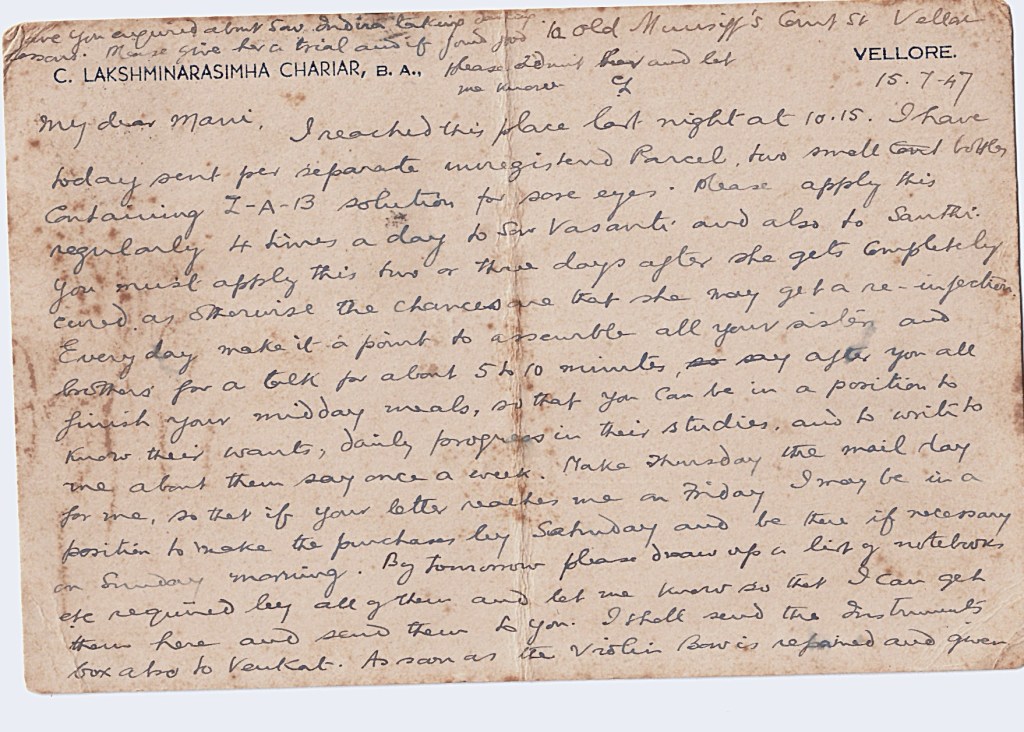
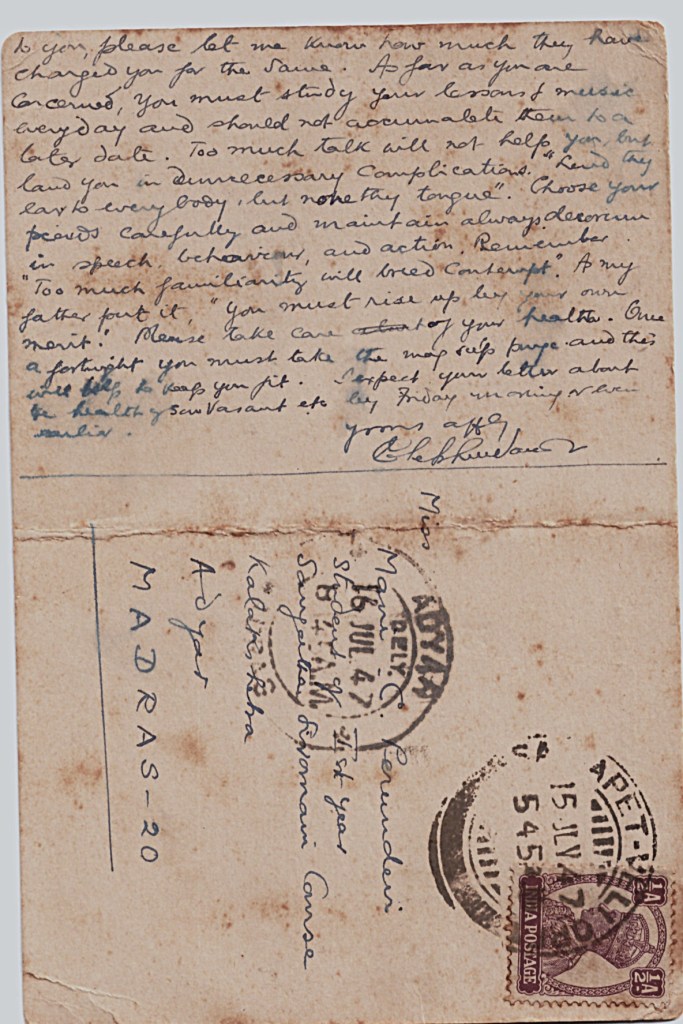
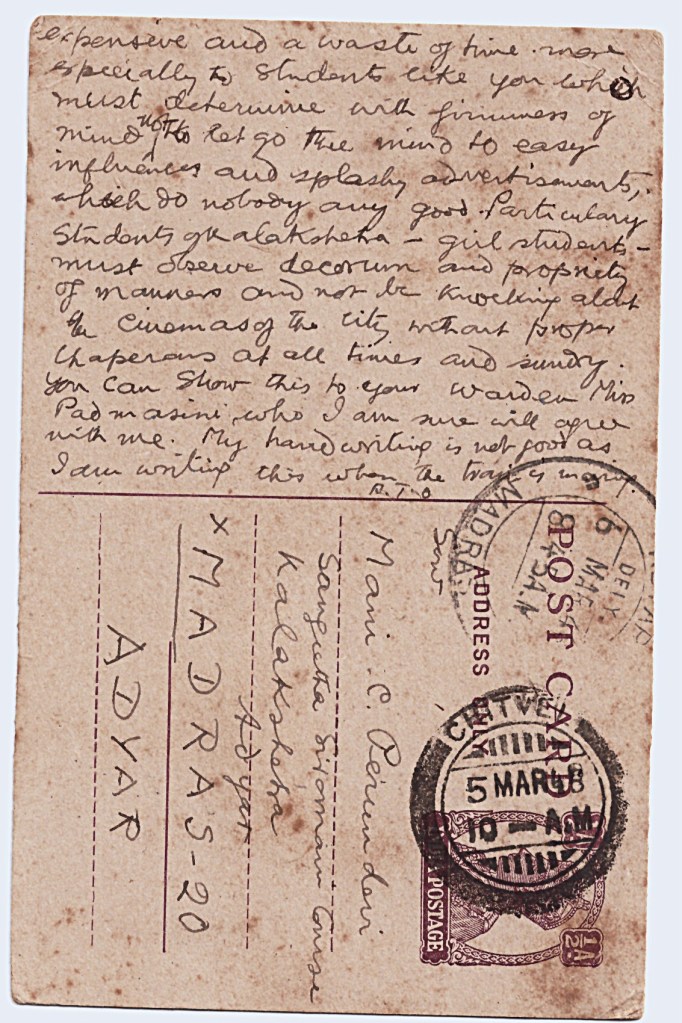
In the postcard letter below dt. July 15, 1947 written by my ‘thaatha‘ to my mother, it is the names of these two sibling sisters, Vasantha and Shanti, that get mentioned. In the postcard, he tells my mother through detailed, meticulous instructions, that she should apply a “Z A B solution” to the two sisters to relieve them of an eye-infection. In 1947, I guess, medical advancements in India had not progressed that much as they are today…. And medications were plain and homemade!
Next, my poor mother is also given a fatherly but stern harangue on a postcard, telling her how she must use management skills to ensure that all her siblings fall in line with her command and obey her without demur! She is their sergeant-major, as it were, and she better act the part!
Then there are further detailed instructions given to Mani about her reporting duties and that he expects her to write file a postcard report that should reach him without fail every Thursday or Friday!
Then follows another strict instruction about how she must go about optimizing the provision of school notebooks to her school-going siblings for the upcoming new academic year! Obviously, in 1947, the schools unlike those of today, did not insist on students buying cartloads of notebook stationery for the inagural new academic year! And there is also a line ‘thaatha‘ inserts in which there is something said about some violin that would have undergone some repair…. I rememember now that for a few years at Kalakshetra, my mother Mani Krishnaswami of versatile musical skills, had also been learning to play the violin!
The most remarkable of instructions, however, that is given on the postcard by my ‘thaatha‘ to my mother is about how she must diligently pursue her own studies without getting unduly distracted by trivial talk!
There is a tone of parental censure in Lakshminarasimhachariar’s lines when he chides my mother about “talking too much”! He even quotes to her a stylish English maxim to drive home his sermon: “Lend thy ear to everybody but none thy tongue”!
Reading the postcard today, I can’t help wondering what did my poor darling mother do that it made her father want to severely counsel her on the virtues of maintaining reticence in her social intercourse?!
As far as I know my mother was always a lady of very restrained and gracious speech…. Nobody ever said they thought she was a bit of a jabberwoky… So, what had made my ‘thaatha‘ want to issue such a rude warning to her about loosening her tongue?!
Looking back upon my very own memories of my dear mother, I feel so very sorry for her indeed…. At such a young age, not only had she been saddled with the burden of upbringing her young siblings at home even while sedulously pursuing her own education but also that the youthful sprightfulness of her insouciant spirit had been reined in or dampened by her father’s strict homilies…
*************
In the next postcard dt. March 3, 1948 seen below, my ‘thaatha‘ shows to my mother the softer, a little more affectionate side of his personality.
In this postcard letter, “thaatha” recalls to his mind the death of Mahatma Gandhi that had happened tragically hardly a couple of months earlier on January 28, 1948. The tone of his words is sombre and wistful… It is quite obvious that like millions of his countryment at that time, he too had been deeply saddened by Gandhi’s death and, evidently, it had been still haunting his mind:
“Mahatma Gandhi as a physical entity is dead and gone… But as an angel and celestial being he is watching over our country’s welfare and is now in a position to watch over everyone of us since his memory is entombed in our hearts”.
But immediately after writing the above poignant lines, ‘thaatha‘ switches from the sublime to the quotidian… He invokes the spirit of Mahatma Gandhi himself in a fresh new homily to my mother and intended to let her know that he does not appreciate her enjoying even the occasional visits she evidently was making to the matinee in cinemas — most likely a harmless, frivolous entertainment my mother might have indulged herself.
The lines below he wrote reflects his frowning displeasure:
“He (Gandhi) has particularly thought that the films as exhibited in cinemas nowadays are never of the best and do not elevate the mind but degenerate it into, at best, very poor and harmful agencies”…
So, that is why, ‘thaatha’s‘ postcard letter continues in the same severe vain, and exhorts my mother Mani Krishnaswami with these grave warnings:
“… students of Kalakshetra — girl students — must observe decorum and propriety of manners and not be knocking about in the cinemas of the city without proper chaperones at all times and sundry…”
Again, after reading ‘thaatha’s‘ gravely intoned sermon in his postcard letter above, I cannot help feeling more than a pang of sympathy that tugs at my heart for my beloved, departed mother.
Mani Perundevi, who my mother then was, she was really no more than a young lass, 18 years of age… A visit to a cinema for a matinee show had, who knows, probably been her only source of relief and a bit of rest and recreation away from her daily matronly chores of looking after her little siblings. Yet there he was, her strict yet well-intentioned, protective father, Kandadai Lakshminarasimhachariar, telling her that she must curb her harmless adolescent proclivity for cinema… and quoting, to boot, the great Mahatma Gandhi himself in support of his view!
Not however having enough writing space on a postcard to express a sudden surge of feelings of warm feelings for his eldest daughter, and fearing that his letter might have sounded a tad too severe and hurtful, the father at the end did have the goodness of heart to slip in and add an affectionate postcript to Mani, his daughter on whom he had been depending so completely to keep his family flock together:
“Yours affly…. this is an advice, and not a censure…”
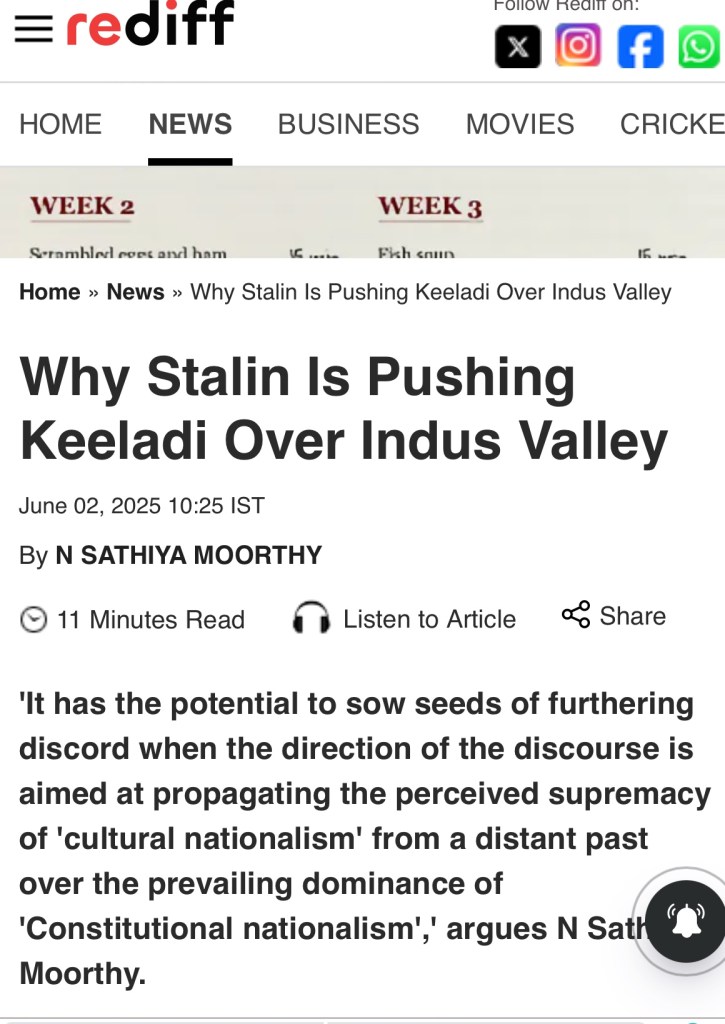
There was this Rediff Op-Ed piece on the subject Dt. June 2nd 2025 which elicited a lot of discussion amongst a small group of email-friends of mine yesterday.
One of the friends … a retired senior bureaucrat, corporate executive, international consultant, government advisor , all rolled into one as a man of many distinguished career accomplishments, commented as follows in an email to me this morning. It read :
QUOTE: “The Dravidians have for long felt that North is trying to impose IVC which gives primacy to Sanskrit and nomads from Across Kyber and the Brahminical influence and the Vedic period and later Hindu religious literature in Sanskrit or Prakrit .
South had its own grand share of religious literature . Like the literature from Sangam period ,Thirukkural and scintillating and awe inspiring poetry from Nayanmars and Azwars in Tamil”.
But I equally blame the Historians like Romilla Thapar etc who thought that India meant North India. M K Stalin in my opinion is in any case better than the likes of Romilla.She distorted and blacked out Indian History selectively with her leftist beliefs”. UNQUOTE
*********
The above comment of my friend struck me as being quite percipient indeed but I also thought of it as being … well, neither here nor there …
Sometimes in trying too earnestly to seem “balanced” in a discourse on any contentious issue, people will go to great pains to hide their real convictions or stand on it through polite facades and nuances expressed in qualifying remarks prefaced by “ifs… buts… on the one hand , but on the other hand … viewing the matter on balance from all angles … etc. ….” Many a time , I must confess, I do that too . But on this occasion, I thought that I must be a little more forthright in stating my own position in the matter of Keezhadi archaeology given that I had blogged on it just a few days ago in a 4-Part series ( accessible here – https://unknownsrivaishnava.in/2025/05/30/keezhadi-below-the-belt-hit-the-dmk-aims-at-the-modi-government-part-1-of-4/)
So, my own reaction to my friend’s email comment was this below :
You wrote : South had its own grand share of religious literature . Like the literature from Sangam period ,Thirukkural and scintillating and awe inspiring poetry from Nayanmars and Azwars in Tamil.
Let me say that many scholars of Tamil religious literature and traditions have pointed out that the works of the Sangam period, Tolkappiyam, Tirukural , Nayanmars and Azhwars … all in fact themselves acknowledged being inspired by pan-Indian Vedic/Vedantic/ Aryan/ Brahminical leitmotifs and influences in several references to them made in their body.
If only Archaeology were to be set free of all these silly games of political one-upmanship which we see are polluting what ought to have been purely academic inquiry and discourse, and if only the findings are truly that Keezhadi in Tamil Nadu did herald the Iron Age in India earlier than IVC which was still about 700 years late in emerging out of the Copper/Bronze Age…. well, tell me who in India is going to begrudge or bemoan the fact? As a Tamil-speaking native born, I for one will be proud of the discovery made that Tamil culture was the cradle of India’s civilisation.
However, this DMK Government’s agenda and motive for pursuing Keezhadi archaeology seems to be aimed more at scoring political brownie points than to allow academic inquiry to come out with incontrovertible proof of discovery bearing the imprimatur of rigorous peer-review tests.
In the American Wild West of the 18-19th century CE … to curb the state of utter lawlessness and rampant violence that prevailed over the vast country where gun-slinging criminals/bandits/carpetbaggers freely roamed around on horseback, the state often announced the reward of hefty “bounty” money for anyone who could bring some of those dreaded criminal hombres to justice … “dead or alive”. Such bounty hunting sponsorship said much indeed about the culture of America which even to this day has a collective mentality steeped in “gun culture”.
In the l’affaire Keezhadi , CM Stalin announced with much fanfare that his political Party would award any archaeologist or anthropologist-epigraphologist a prize money purse of $1 million if he or she could decipher the Harappan (IVC) script which eludes de-encryption even to this day . What was the motive behind putting out such a “bounty hunt” award ? Was it similar to announcing a reward to attract “bounty killers” from anywhere in America to come and do the job that the state was willing to outsource to them viz. the business of laying down law and delivering vigilante justice?
There are 2 ways of looking at it. One is the uncharitable or cynical view. And the other is a purely dispassionate , academician view .
A $1 million reward as “bounty money” for academic research can possibly be more effective than traditional research funding because:
• It acts as an inducement prize, which has been shown to attract a wider pool of participants, including those outside the usual academic circles, and encourages cross-disciplinary collaboration and novel approaches.
• Prizes can leverage significant private investment and effort, often motivating individuals and teams to invest their own resources and creativity to solve the problem, sometimes at a scale much greater than the prize amount itself.
• Such rewards focus attention and urgency on a specific challenge, shaping the direction of research and increasing the number and diversity of contributors, which can accelerate breakthroughs.
• Recognition and prestige associated with winning a high-profile prize can be as motivating as the financial reward, drawing in top talent and increasing visibility for the challenge.
In contrast, traditional research grants are usually distributed among established researchers and may not generate the same level of broad, competitive, and innovative engagement.
That’s the charitable view.
The cynical view is that while the $1 million prize (bounty money) could spur genuine scholarly breakthroughs, its political dimensions are undeniable. By championing Dravidian primacy, Stalin seems only to be aiming to counter BJP-Hindutva aligned historical narratives and to consolidate Tamil cultural pride and set it against any sense of pan-Indian pride. However, his initiative is only risking reducing a complex archaeological mystery to a tool in India’s ongoing ideological battles.
The reward announcement coincides with efforts to revive the Aryan-Dravidian debate, a colonial-era construct that remains politically charged. While genetic and archaeological studies increasingly suggest complex population migrations rather than a clear Aryan-Dravidian divide, Stalin’s framing of the Keezhadi archaeology leans into the theory that Dravidians were India’s indigenous inhabitants, displaced by “invading” Aryans.
Which of the two views really informs the politics of Keezhadi archaeology remains , at least to a common man on the street like me, shrouded in mystery.
However, there is one clear stand that I wish to take on the matter:
No matter whatever Keezhadi archaeology findings are going to be, the undeniable fact is that pan-Indian civilisation was always, and is indeed to this day, a composite confluence of Aryan-Dravidian , Southern-Northern Indian streams of rich cultural life and alluvia of traditions ….
So, I say this : that no matter whatever Keezhadi researchers will conclude, the stark fact of history will not go away and nor will it be ever erased : the fact that within such a composite pan-India civilisation that emerged on tbe scene in such a time long ago in history, there were far larger numbers of people in this part of the Asian continent who thought, spoke and wrote in Sanskrit and Sanskritic languages than there were people who spoke, wrote and thought in Tamil …
That fact, be it as it may be … and whether accepted or outrightly refuted in any quarter … will still make us ask ourselves what and how does it matter really to the unique characteristics of India’s civilisation being a cultural confluence or composite of Aryan-Dravidian influences ?
Oh no! for the DMK it does matter a lot! After all , Keezhadi will make excellent, fertile and copious grist for its political mill long into the foreseeable future.
If only some expert linguist in India today could explain in similar simple yet so clear terms as the professor does in the video-clip above about how Tamil and Sanskrit languages also originated and developed over the millennia …. I believe there perhaps would be much greater and more sensible understanding that both are really etymological cocktails that got brewed at glacial speed across the expanse of Time …
If there was such clarity and sobriety of understanding, then I suppose there would really arise no need for narrative-war over North India/ South India or Dravidian/Aryan divide. The raging ongoing competitive political debate today over which language is more ancient, more pristine, more prodigious in vocabulary or …. and yes, of course … more dear to people in spite of being more “dead” would be irrelevant and unnecessary.
If the Archaeological Survey of India (ASI) were to fully accept the findings of K. Amarnath Ramakrishna’s Keezhadi excavation report—especially its claims regarding the antiquity, urban sophistication, and cultural independence of ancient Tamil civilization—the consequences for Indian prehistory and history would be significant and far-reaching.
1. Rewriting the Chronology of Indian Civilization
• Earlier Urbanization in South India: The Keezhadi findings suggest an urban civilization in Tamil Nadu dating as early as the 6th–8th century BCE, contemporaneous with or even preceding the later phases of the Indus Valley Civilization (IVC) and the Gangetic urban centers. This would challenge the long-held view that urbanization in India was primarily a northern phenomenon, with the south developing later.
• Tamil Brahmi Script and Literacy: The discovery of Tamil Brahmi script dating to at least the 6th century BCE pushes back the history of literacy in South India, suggesting that the region had a literate, urban society independent of northern influences.
2. Challenging Existing Historical Narratives
• Dravidian vs. Aryan Narratives: Acceptance of the report would lend strong archaeological support to the idea that Dravidian (Tamil) civilization was ancient, urban, and possibly connected to or parallel with the IVC, rather than being a later or derivative culture. This could challenge the dominant “Aryan migration” or “Vedic-centric” models of Indian historiography.
• Bridging North-South Divide: Evidence of trade links and cultural connections between Keezhadi and both northern India and Rome would require historians to rethink the extent and nature of ancient pan-Indian and international interactions.
3. Implications for School Textbooks and Public History
• Curriculum Changes: If Keezhadi’s findings are officially recognized, school and college textbooks across India would need to be revised to reflect the new timeline and significance of South Indian civilizations, giving greater prominence to Tamil and Dravidian contributions to Indian history.
• National Identity and Regional Pride: Such a shift would validate long-standing Tamil claims of antiquity and sophistication, fueling regional pride and potentially influencing identity politics across South India.
4. Academic and Political Debates
• Reassessment of Archaeological Methodology: The findings would prompt a re-evaluation of archaeological methods and interpretations across the subcontinent, with increased focus on southern sites that may have been previously neglected or under-explored.
• Political Repercussions: Official acceptance of the report could intensify political debates over the nature of Indian civilization, the role of the Dravidian south, and the framing of national history—issues already highly charged in contemporary Indian politics.
5. International Implications
• Comparative Civilizational Studies: Keezhadi’s acceptance as an ancient urban center would place it alongside other early world civilizations, inviting international scholarly attention and possibly altering global perceptions of early South Asian history.
Would It Force a Rewriting of “Entire” Indian Pre/History?In What Way and What Manner?
• Not a Total Overhaul, but a Major Revision: While it would not erase or invalidate established histories of the Indus Valley or Vedic cultures, it would force a major revision of the narrative, especially regarding the timing, geography, and diversity of ancient Indian civilization.
• Greater Emphasis on Plurality: Indian prehistory would be seen as more regionally diverse, with multiple, contemporaneous centers of urban and literate life, rather than a linear progression from north to south.
• Integration of New Data: Textbooks, academic research, and public discourse would need to integrate Keezhadi’s evidence, rebalancing the historical focus to include the contributions of ancient Tamil society.
So, the bottomline really is this:
If the ASI were to accept the Ramakrishna report in full, it would not erase existing Indian history but would significantly expand, complicate, and maybe even enrich it—forcing a re-examination of long-standing assumptions about the origins, spread, and nature of civilization on the subcontinent.
***********
Some right-wing voices such as BJP and its affiliates have objected to labeling Keezhadi as “Dravidian” and instead they emphasize its place within a broader “Bharat civilization,” arguing that Tamil and Hindu identities are not separate and cautioning against framing the site’s significance as exclusively Dravidian or anti-Vedic.
The BJP’s Tamil Nadu leaders have publicly stated that the Central Government in India supports the excavation and is proud of Tamil civilization, but they reject the notion that Keezhadi’s findings undermine Hindu or pan-Indian narratives.
The issue thus has now starkly exposed ideological differences between Dravidian/Hindutva groups, Southerners/Northerners and Sanskritists/Tamilians with the latter preferring to subsume Keezhadi’s significance within a unified and broad pan-Indian civilizational framework rather than as a distinct parochial Dravidian identity.
************
At the end, what will be the fallout of all this ugly drama in the world of pseudo-academia in the State of Tamil Nadu?
Sadly, it is all going to look only like this:
Prolonged Stalemate and Delays • This deadlock is likely to continue, as neither side appears willing to concede on the fundamental issues of dating and interpretation.
Politicization and Public Debate • The dispute has already become a flashpoint in Tamil Nadu’s politics, with Dravidian parties and scholars accusing the Centre and ASI of attempting to dilute or delay recognition of Tamil antiquity. • The controversy is fueling further public mobilization, media scrutiny, and academic debate, keeping the issue alive in the public sphere.
Institutional Gridlock • Since the ASI’s requested revisions are based on feedback from experts not involved in the excavation, and Ramakrishna refuses to make substantive changes, it is likely the report will remain unpublished or in bureaucratic limbo for some time. • The Tamil Nadu State Archaeology Department may continue its own research and publications, leading to parallel narratives.
Potential for Judicial or Parliamentary Intervention • Given past court interventions and political assurances in Parliament, further legal or legislative action is possible if the stalemate persists.
Long-term Impact • The controversy will likely keep the Keezhadi findings in the spotlight, strengthening Tamil Nadu’s claims of ancient urban civilization regardless of ASI’s official position.
The culture war will likely persist, with Keezhadi’s legacy shaped as much by public and Tamil Nadu State government narratives as by central Government endorsement.
The Ramakrishna Report’s final results seemed to imply that Keezhadi archaeology would compel the prehistory of India to be upturned and rewritten.
The ASI was extra-circumspect in accepting the Report without incontrovertible proof. Hence, the number of critical queries that were raised in their response to Ramakrishna.
This led immediately to a sort of proxy political arm-wrestling between the BJP Union Government of India and the DMK Tamil Nadu State Government. The battle lines between academia and politics were about to be clearly drawn.
The ASI chose to scrutinize the Ramakrishna Report under a fine microscope just to ensure it understood how its integration into mainstream Indian historiography could profoundly reshape Tamil Nadu’s civilizational identity within the larger Indian national identity in several different ways as outlined below:
1. Affirmation of Antiquity and Urban Sophistication
• Earlier Urban Roots: If Keezhadi is officially recognized as evidence of an advanced urban settlement from as early as the 6th–8th century BCE, it would firmly establish Tamil Nadu as one of the cradles of ancient civilization in India, on par with the Indus Valley and Gangetic plains.
• Independent Development: The narrative would shift from seeing Tamil civilization as secondary or derivative to one that developed parallel to, or even before, many northern cultures.
2. Cultural and Linguistic Pride
• Deep Roots for Tamil Language: The discovery of Tamil Brahmi script and evidence of early literacy would reinforce the idea that Tamil is one of the world’s oldest living languages with a continuous literary tradition.
• Strengthening Dravidian Identity: The findings would validate long-held beliefs about the antiquity and uniqueness of Dravidian (especially Tamil) culture, fueling regional pride and a sense of distinct identity.
3. Rebalancing Indian Historical Narratives
• From Margin to Center: Tamil Nadu’s history would move from the margins of Indian history textbooks to a central place, with greater emphasis on Sangam literature, urbanization, and trade networks.
• Plurality in Indian Civilization: The revised narrative would highlight India’s diverse civilizational roots, showing that advanced societies flourished in both the north and south, challenging the “north-centric” view of ancient India.
4. Political and Social Impact
• Empowerment: Recognition of Tamil Nadu’s ancient urban heritage could empower local communities and political movements, reinforcing demands for cultural autonomy and respect within the Indian Union.
• Unity Through Diversity: While strengthening Tamil identity, the broader Indian narrative could evolve to celebrate unity through diversity, acknowledging multiple ancient streams rather than a single civilizational core.
5. Educational and Global Recognition
• Textbook Revisions: School curricula would be updated to include Keezhadi and other Tamil archaeological sites, giving students a more balanced and accurate understanding of Indian history.
• International Prestige: Tamil Nadu could gain global recognition as a key site of early human civilization, attracting scholars, tourists, and cultural investment.
All the above multi-dimensional implications of redefined Tamil identity thus became the cause for much muscle-flexing in the arm-wrestling match the state and the centre began to engage in. So profound would be the political repercussions on Indian history that the DMK Dravidian ideology would have successfully delivered a blow below the belt to the Hindutva ideology.
***********
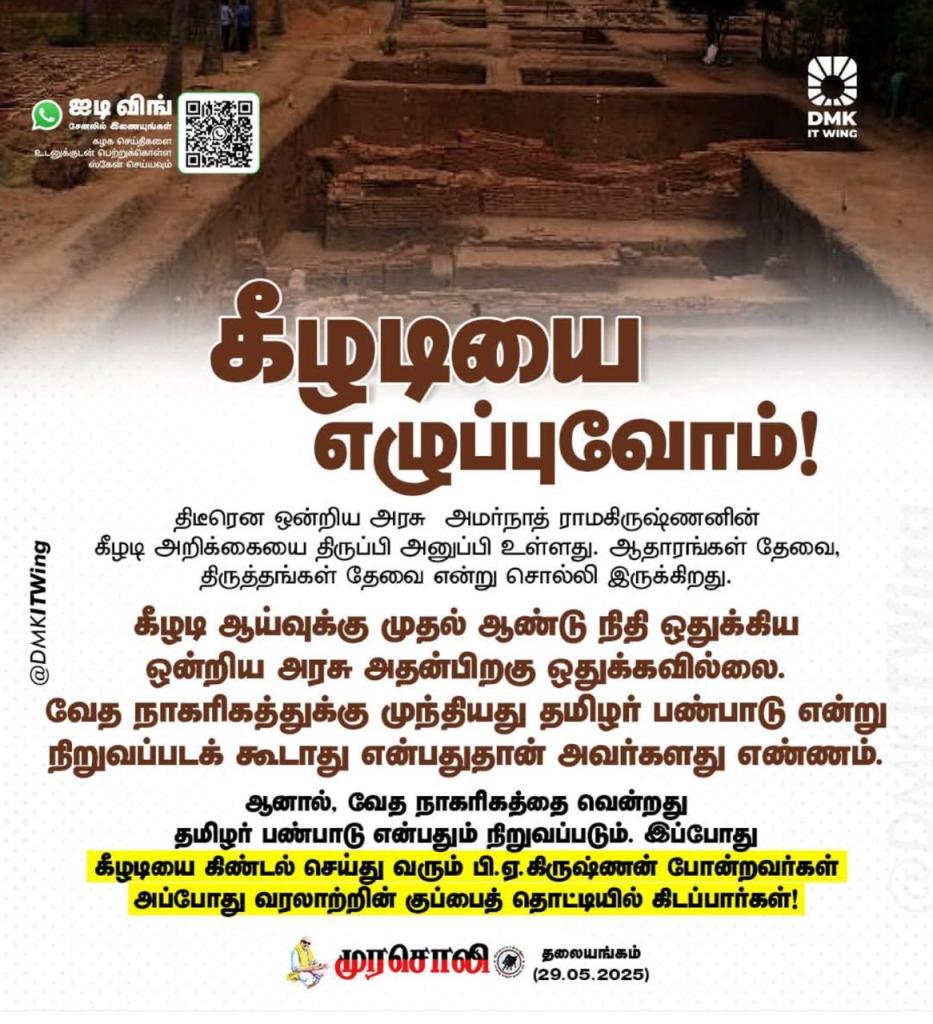
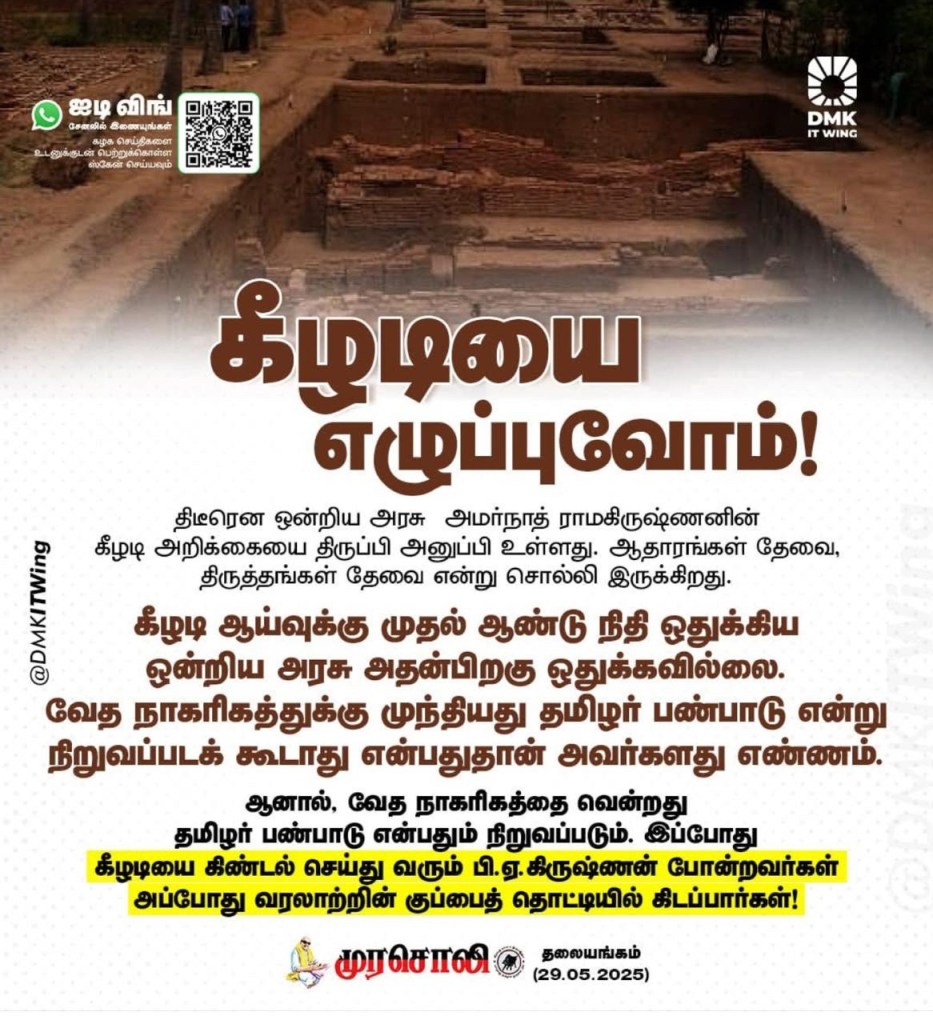
In the digital meme-poster of the DMK shown above, there is the name of one P.A. Krishnan who the Party says will get “thrown into the dustbin of history” once the Ramakrishna Report gets published and official/academic recognition.
Who is this P.A.Krishnan? What is his role in Keezhadi archaeology and in the political arm-wrestling match?
P. A. Krishnan is an Indian writer and essayist who writes in both Tamil and English, with a background as a physics teacher, bureaucrat, and later a senior executive in research and multinational organizations. He is known for his novels (The Tiger Claw Tree, The Muddy River) and essays on social, cultural, and historical topics.
P. A. Krishnan’s role as a critic—despite his lack of direct archaeological involvement—makes him a convenient and symbolically important target in a larger battle over history, identity, and political legitimacy in Tamil Nadu. The DMK’s focus on him is less about his individual influence on research and more about shaping and defending a collective narrative.
Reasons for Targeting P. A. Krishnan
• Influence as a Public Intellectual: While Krishnan is not an archaeologist, he is a well-known writer and commentator whose articles—such as those in The Federal—have questioned the uniqueness, dating, and interpretation of Keezhadi’s findings. His critical stance provides intellectual ammunition to those skeptical of the Dravidian narrative, making him a visible figure in the debate.
• Symbolic Opposition: In highly politicized issues, critics who articulate dissenting views—especially those who are Tamil and have a public platform—are often singled out as representatives of the “other side.” Discrediting such voices serves as a warning to others and helps consolidate the DMK’s narrative.
• Narrative Management: The Keezhadi controversy is not just about archaeology but about cultural pride, regional identity, and political legitimacy. By publicly challenging Krishnan, the DMK seeks to delegitimize alternative interpretations and reinforce its own version of Tamil antiquity and victimhood in the face of perceived central (northern-Aryan) bias.
• Distrust of Dissent: As Krishnan himself has written, there is a “deep distrust” of voices seen as undermining Tamil claims, especially when those voices are Tamil but critical of the dominant narrative. The DMK’s anxiety reflects the high stakes involved in controlling the public perception of Keezhadi.
************
In this ongoing political arm-wrestling match, the most important question playing now on everyone’s mind is this:
What are the possible consequences if the ASI were to accept the findings of the Ramakrishnan Report ? Will it force rewriting of entire Indian pre/history? In what way and what manner ?
The meme-poster above is part of a broader campaign by the DMK and Tamil cultural organizations to pressure the Indian central government into recognizing Keezhadi’s historical importance, granting it protected status, and supporting further research and public dissemination of its findings.
The issue has become both a matter of regional pride and a flashpoint in the ongoing debate over the recognition of Tamil antiquity within Indian history. The Keezhadi site has become a symbol of Tamil identity, with the DMK and other Tamil groups accusing the central government (led by the BJP) of downplaying Tamil history in favor of North Indian narratives. There are ongoing demands for Keezhadi to be declared a protected site and for a museum of international stature to be established there, similar to how sites like Vadnagar and Sanauli in North India have been given prominence.
Why was archaeologist K Amarnath Ramakrishna asked by ASI to revise his report?
Archaeologist K Amarnath Ramakrishna was asked by the Archaeological Survey of India (ASI) to revise his Keezhadi excavation report primarily for the following reasons:
• Dating Justification: The ASI questioned the justification for the early dating of the Keezhadi site, particularly the claim that its earliest phase dates back to the 8th century BCE. The ASI’s letter stated that this time bracket “requires concrete justification” and suggested that, based on their view, the earliest date should be “at the maximum, somewhere in pre-300 BCE”.
• Scientific Rigor and Documentation: The ASI cited a need for “more authentic” data, better classification, clearer documentation, and improved scientific rigor. Specific requests included:
• Proper nomenclature or re-orientation for the three cultural periods identified in the report.
• Clearer presentation of chronological data, including marking layer numbers (not just depth) for comparative consistency.
• Replacement or improvement of certain maps and inclusion of missing documentation such as stratigraphy drawings, trench location plans, and contour maps.
• Feedback from External Experts: The corrections and revisions were based on feedback from two unnamed experts who reviewed the report for the ASI.
Ramakrishna, in response, defended his methodology and findings, stating that the periodization was based on established archaeological procedures, stratigraphic sequences, material culture, and AMS (Accelerator Mass Spectrometry) dating.
He asserted that all documentary evidence and chronological sequences were clearly explained in the report, and he considered the ASI’s demand for further examination as superfluous and contrary to the conclusive findings already presented. He agreed only to minor procedural updates, such as adding layer numbering if missing, and clarified that all required visual data had already been submitted.
Many independent scholars and observers have interpreted the ASI’s request as a possible attempt to delay or dilute the significance of Keezhadi’s findings, especially given the political and cultural importance of the site in Tamil Nadu. The controversy is further fueled by the fact that the ASI took more than two years after the report’s submission to request these revisions, and that the experts who suggested changes were not directly involved in the excavation.
What were the principal findings of the Ramakrishna Report?
The Report findings and evidence presented point to Tamil Nadu’s ancient civilizational identity being elevated from regional pride to global significance. It seeks to not only validate the cultural and historical claims of Tamils but also enrich the broader Indian and world understanding of early urban societies. The result: a more inclusive, pluralistic, and accurate narrative of India’s past—one in which it is Tamil Nadu that stands out as a pillar of ancient civilization.
It was thus that the claims of the Ramakrishna Report and the ASI’s challenging them which all turned and snowballed into not only an academic dispute but also into an arm-wrestling contest between the State and Central Government.
Here below is an official meme-post of the DMK Party presently circulating widely in the social media / WhatsApp cyberspace .
L’Affaire Keezhadi first grabbed headlines in mainstream news media in Tamil Nadu about 5 years ago. Since then it has morphed into a war of words between the Tamil Nadu state government Archaelogical Department and the Union of India Government with the Archaeological Survey of India (ASI) getting caught in the crossfire. The war is being fought simultaneously on three fronts:
(a) aculture war
(b) a heated academic dispute and
(c) a political arm-wrestling match between Dravidian and Pan-Indian perspective on Indian historiography.
Since updates on the above war-fronts do not appear too often in media reports, most people in Tamil Nadu , except for a handful of academicians, historians, political observers and DMK / BJP Party apparatchiks, barely know what it is really all about — what it means, how it arose and why it portends profound changes to the history of all India. In fact, I confess my own knowledge of this Keezhadi controversy has been sketchy and skimpy. All I had been aware of vaguely was this:
Keezhadi is an archaeological site near Madurai, Tamil Nadu, where excavations since 2014 had uncovered evidence of an ancient urban settlement, possibly dating back to the Sangam period (as early as 800 BCE). The findings since then have been significant in establishing the antiquity and urban nature of ancient Tamil civilization, with artefacts showing advanced literacy and urban planning.
The ASI initially led the excavations but later halted operations and transferred the lead archaeologist, K Amarnath Ramakrishna, in 2017, citing a lack of significant findings. This move was widely criticized by Tamil political parties and scholars as an attempt to suppress evidence of Tamil antiquity.
The Tamil Nadu State Archaeology Department later took over the excavations, which have continued to reveal important findings. Recently, the ASI returned Ramakrishna’s comprehensive excavation report (submitted in January 2023), asking for corrections and further justification of the dating and findings, which many see as a delaying tactic. Ramakrishna has strongly defended his report, refusing to make the changes demanded by the ASI, stating that all findings and dating are well-documented and based on scientific evidence.
My conjecture is that with the State Assembly Elections coming up early in 2026, the BJP and the DMK/ Dravidian parties are going to find that this Keezhadi dispute will come in very handy to exploit as potential fertile election issue from which a lot mileage could be extracted. It could be whipped up into a highly emotive issue which can ignite and inflame Tamil electorate’s parochial passions. Keezhadi has already stirred up a broader politico-cultural debate over Tamil Nadu’s ancient civilizational identity. It is now being framed as a debate between Tamil pride versus Vedic-centric historical narratives, and the North-South and Aryan-Dravidian divide.
It was therefore in the context of the above current situation in Tamil Nadu that I wanted to update my own knowledge and understanding of what exactly was happening in l’affaire Keezhadi. So, I decided to spend a little time and effort to educate myself about it through what these days is called taking desk-top, AI-aided “deep-dive” into the subject.
What I have been able to learn from the “deep dive” will be described in summary form in three separate Parts to follow. They will cover all three war fronts mentioned above viz.: