WHAT IS THE (WARREN) “BUFFET INDICATOR” FOR OUR INDIAN STOCK MARKETS?

The Buffett Indicator at All-Time Highs: Is This Cause for Concern?

The current Sensex market cap of India is trending around c. ₹ 198. 86 trillion, equivalent to US$ 2. 71 trillion.


(https://www.bseindia.com/markets/keystatics/Keystat_maktcap.aspx )

The Current estimated GDP (nominal) is c. US $ 2.8 trillion.
(https://en.m.wikipedia.org/wiki/Economy_of_India)

So , the Buffett Indicator for India is around a pretty reasonable and healthy 100%.

Comparing it to the terribly overheated 288% indicator in the USA (please see attached article), wouldn’t one might be safe in saying that the Indian stock markets are still sane , quite steady and pretty rational ?!

🤫🤫
Sudarshan Madabushi

Even if God didn’t exist it would be necessary to invent one

https://wap.business-standard.com/article-amp/international/world-s-281-trillion-debt-pile-is-set-to-rise-again-in-2021-iif-says-121021800277_1.html

The global GDP : US $ 79 trillion
Global Debt : US $ 281 trillion

Therefore , like the typical tunnel-visioned CA that I am, I reckon the NAV (net asset value) today of the whole world is (-) US$ 201 trillion.

The question is :

  1. Does anyone care? No!
  2. Do any of the international multilateral financial institutions (WB , IMF , OECD, BRICs Bank etc.) owned by so-called Developed Nations ( USA, UK, EU, Japan, China) care ? No!
  3. Does the G8 of the world care ? No!

Why not ?

Because, Global Debt is basically an ASSET sitting on the “right-side” of the Balance Sheet of the US Federal Reserve Bank .. while, at the same time, it is LIABILITY sitting on the “left-side” of the Balance Sheets of the Central Banks of borrowing-countries in the rest of the world .

How so ?

Because all Global Debt is denominated in one world-reserve currency only : the US $ . And therefore all debt-settlement can take place in US $ only …

Now who controls the flow of US currency ? The US Fed of course … The Fed can turn on or turn off the tap from which flow all global debt streams — in or out — virtually at will .

The USA cannot default on its own National Debt of c. US $ 28 trillion since it can simply print more currency and payoff itself .

In the rest of the world the countries saddled with the biggest $ debt are Japan, UK , EU , Canada … (you could say the G8 countries) who are all considered “cozy allies” of the USA . If ever they were to default on their debt , the US could (through the multilaterals) always lend them even more billions of $ to stave off default. When the Balance Sheets of the Lender and the Borrower merely mirror each other’s financial indebtedness … each other’s asset and liability … it doesn’t really matter how big the burgeoning debt-based transactions between them is …

As for the rest of the world … whose $ debt on the individual country balance-sheets is a mere fraction of the aggregate global debt … they don’t care since they know in the larger scheme of financial affairs of the world , they don’t matter either .
( https://spendmenot.com/blog/national-debt-by-country/ )

And so … the whole world today is spinning around happily on the merry-go-round of Debt without any care …

Debt much like God Almighty, as someone famously said, is convenient fiction too …. Even if Debt didn’t exist , it would still be necessary to invent it.

😇🤗
Sudarshan Madabushi

THE TAIL THAT WAGS THE DOG: INTEREST RATES AS CENTRAL BANKER TOOL

https://m.economictimes.com/markets/stocks/news/view-interest-rates-are-losing-their-relevance/amp_articleshow/81201347.cms

This article is bang on !

As a monetary tool , Interest Rate control in the hands of Central Banks of countries is fast losing its utility and purpose to tackle inflation and price-levels .

Monetary theory in the last 30 years has been turned upside down. The valve with which Money Flows used to be turned off and on by central bankers is no longer the Interest Rate , the cost of money in an economy.

Money flow today is determined by Debt and Credit policy.

The US Fed announces massive “stimulus” or “quantitative expansion” … which means essentially flooding the economy with cheap debt and credit to arouse “supply side” forces and so-called “animal spirits”. Banking expansion , digitalisation and financial retailing deluges the markets with wave after wave of liquidity. Borrowings and credit off-take are constantly encouraged through policy announcements, prodding and adjustments. The economy is awash with money , money , money … And so much so that even Debt — short and long term — goes around abegging at dirt cheap rates and scanty bond-yield trends.

When the US — the largest economy in the world behaves in a certain way — it sets the standard of behaviour for the rest of the world which trades , transacts and measures all of its own economic activity only in US $ terms. So, it sets off a trend of “competitive monetary easing” throughout the central banks of the world.

Since money — in the form of debt and credit — has no bearing at all to how the economy is functioning , the Economy now is getting increasingly agnostic to it . It matters little to governments and enterprises these days what the height the levels are of its debt and credit on its balance-sheet. The post-tax cost of borrowed capital is either zero or near zero to the governments or enterprises of the world .

So , what then is the net result ?

It is simply this: since money costs virtually nothing in terms of Interest Rate , the purpose it once upon a time served as an inflation-controlling tool is now being served by the supply of money itself ! When supply of capital itself outstrips demand for it , cost of capital becomes simply irrelevant in the equation since inflation and price-stability are no longer determined by cost of capital. The flow of capital itself , as we have seen in these last 30 years, manages and controls inflation quite effectively.

Interest Rate was once the Dog whose tail was Money supply that could be wagged according to policy. But today it’s the tail that wags the dog. It has been dethroned from its preeminent position in monetary economic theory by Debt & Credit.

Interest Rate will soon become an anachronism … a monetary tool whose utility would be more nominal than real.

😇☺️
Sudarshan Madabushi

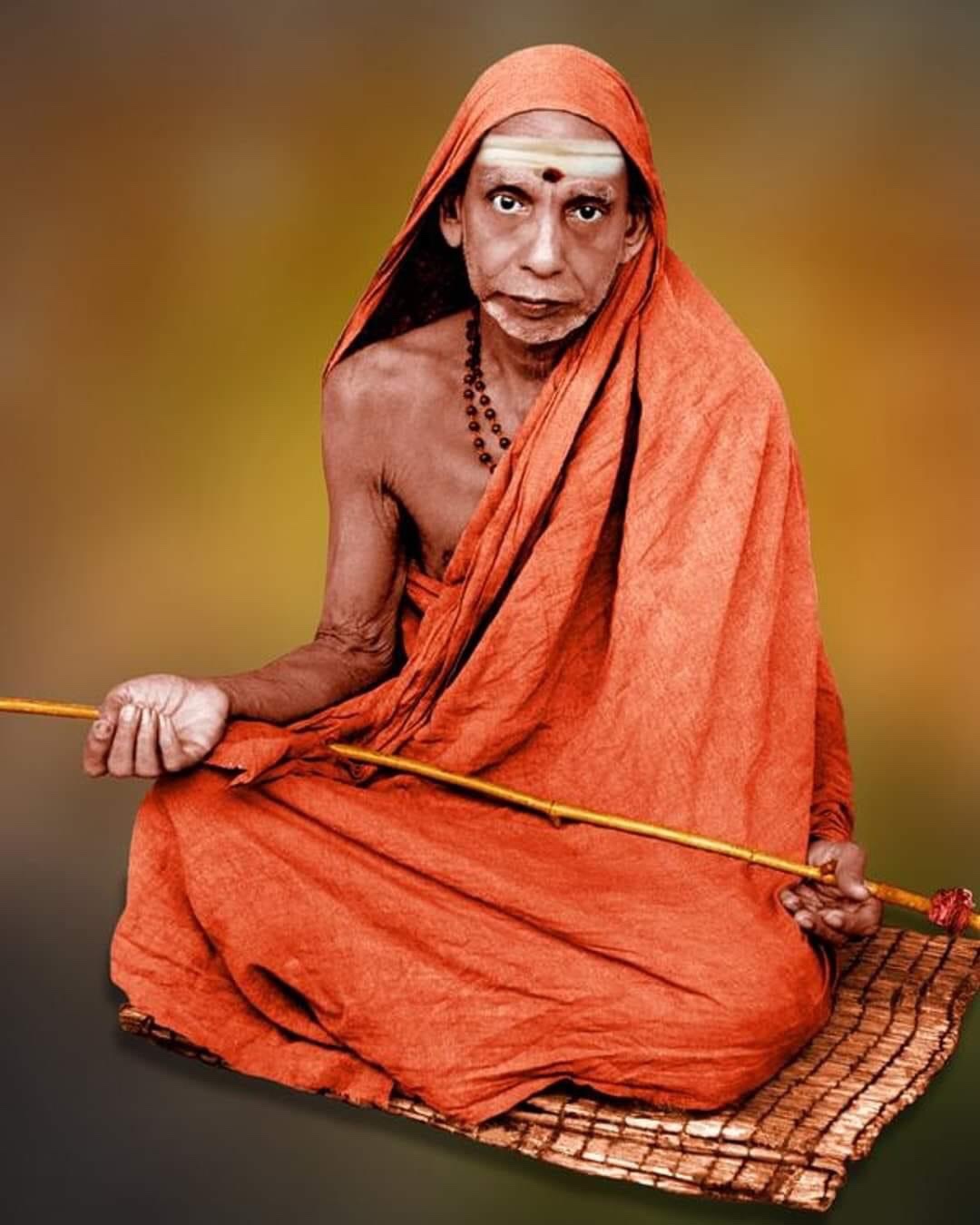
THE EXPERIENCE MY PARENTS TOLD ME THEY HAD WITH THE SAGE OF KANCHI (Kanchi Acharya)

🙏🙏. ..

Dear Sir,

Please permit me here to recollect and relate and share with you an almost similar incident that happened at least 50 years ago which my father Sri M Krishnaswami (MK) and my mother Smt Mani Krishnaswami experienced with Maha Periava .

My parents were once travelling from Madras to Kanchipuram in a car on a personal family errand.

On the way , someone told my father that Kanchi Periava was camping at Kaarvetnagar … a few miles outside outskirts of Kanchi.

Very eager to have Darshan of the Sage , my father immediately decided to take a detour and the car drove straight to the Swamigal’s camp .

My parents alighted from the car and they rushed inside the camp premises hoping they would have the golden opportunity to offer obeisance to Periava . My father also wanted .. if Periava had time and convenience .. permission for my mother Smt Mani Krishnaswami to sing a few Krithis in the presence of the Sage .

Unfortunately , when they entered the acharya’s camp and enquired if they could see him , my father was told by a Mutt official that Periava was observing “mauna vratam” (ritual silence) on the day and would not give audience to anyone .

My parents were extremely disappointed .

My father asked permission from the Mutt official if before going away, Smt Mani Krishnaswami could at least sit at the camp gate outside the small dwelling where Periava was seated, and sing just a couple of songs . Permission was reluctantly given .

My mother then sang 2 Kritis in praise of goddess Amba of Kanchi .

After singing two kritis , my parents lingered for a while hoping that perhaps Periava might change his mind and give them at least a fleeting audience …

After a few moments another mutt official then came from inside Periava’s dwelling and quietly whispered to my father that Periava would not give audience to ladies who were not properly attired in 9-yards saree.

It was then to their shock and shame that my mother realised that she was indeed attired only in 6 yard cotton saree .. !

In her haste and hurry to see the Sage it had slipped the attention of both my parents that Smt Mani Krishnaswami was not in “madissaar”. Since the trip to the Sage’s camp was a sudden and unscheduled one they had not been attired suitably for the occasion.

Adding to the disappointment that they were unable to have Darshan of periava … was now this tacit rebuke that had been delivered to my parents from Periava seated inside . Both my parents were extremely pained .

The Mutt official then gently told my rather distraught father, “Sir, please go away now . Periava gestured to me to tell you that both of you should go now forthwith to Kanchi and have Darshan of Amba Kaamaakshi . And maybe on your return journey to Madras , you may if you so wish come here again .. and if Periava is well disposed then , you could have audience with him .”.

With a heavy heart , my parents departed.

Later that day, after attending to their personal work at Kanchi , my parents offered worship at Sri Varadarajaswamy temple . But due to paucity of time , they were thinking of giving a skip to the visit to the Kamakshi Amman temple but then they remembered Periava’s advice that had been delivered to them earlier in the day . So , in deference to the Sage’s word , they made it to the Kamakshi Amman “Sannidhi”.

There, after they’d had Darshan of the Deity , the Kovil archakas as a token “mariyaadai” to my mother Smt Mani Krishnaswami , an accomplished artiste, blessed her with a beautiful 9-yard saree that they said only that morning had been used to adorn the Deity Ambal!

Immensely pleased to receive the “Vastram” blessings of the Goddess , my mother immediately and proudly changed into it !

When from Kanchi thereafter my parents commenced their journey back to Madras , it was already dusk . When they drove again into the camp where Periava was staying it was already dark … My parents were anxious that they may once again be denied audience with the Sage.

But to their utter surprise and glee , they were told that Periava had just finished his evening “anushtaanam” and his “mouna vratam” too and would have just a few minutes to spare if they hurried inside to see him.

My parents rushed inside and there he was seated … the serene and kindly Maha Periava .

He smiled at my father and mother … knowingly and mischievously … and asked: “Ennaa? AmbaaL prasaadam kidachhidhaa?”

He was obliquely referring to the 9 yard saree of the Deity with which my mother had been blessed earlier in the evening at the Kamakshi Amman Sannidhi and in which she was attired !

My parents were stunned … ! They prostrated at the sage’s feet and beseeched his blessings . The sage then asked my mother to render a krithi in praise of Kamakshi Amman composed by Muthuswamy Dikshitar . He sat listening to the song silently with his eyes closed . Then he gave a fruit each to my parents , blessed them again. Then he arose and gracefully retired into his inner chamber .

My parents were left speechless … with an awe that was far greater than the joy they experienced in their hearts .

To his very last days in 2013 when he passed away , my dear father always used to fondly recollect the incident that he and my beloved mother together had witnessed with the Kanchi Acharya . For them both , it remained all their lives an unforgettable, almost mystical experience.
🙏🙏

Sudarshan Madabushi

26.02.2021

Mahaperiava.

https://www.facebook.com/varadaraj.desikachar.5

Experiences with Maha Periyava: Exemption to rule!

One day a lady came to SriMatham wearing a six yards saree. May be she was coming there for the first time. She was probably not aware of the practice that family ladies visit SriMatham wearing only the nine yards saree.

Another lady, who considered herself a most devoted ‘bhakthai’ (devotee) of the Mutt, saw this lady wearing a six yards saree! She got very furious!

“You can not have ‘darshan’ of Sri Maha Periyava, without wearing ‘madisaar’ (nine yards saree)” thundered she to the poor lady!

Unfortunately for the ‘most-devoted’ lady, Sri Maha Periyava came that side!

When He asked what the shouting was about, He was told what exactly happened.

He called the ‘madisaar’ lady, who was trembling!

“That lady is very poor! She doesn’t have a nine yards saree. She cannot afford to buy one! Go to the shop immediately, buy a nine yards saree and two blouse pieces and give them to her” said Maha Periyava to her!

She immediately obeyed His order, went and purchased the saree and made the poor lady wear it in ‘madisaar’ fashion and led her to Sri Maha Periyava.

“Very good! But what you did is wrong! Ask for her pardon!”, said He to the ‘madisaar’ lady.

Although He stuck to ‘sampradaayams’, Sri Maha Periyava also knew when and where to give exemption!

An exchange of mails between Mr. Ramachandra Guha and I

AN EMAIL EXCHANGE OF MINE WITH THE NOTED HISTORIAN SRI. RAMACHANDRA GUHA ************

On 1 Mar 2021, at 1:33 PM, Ramachandra Guha


Thanks for your most interesting feedback.

I had already indicated what history will think of the buildings Modi will build.

After my piece was published, this further instance of Modi’s megalomania has come to light:

https://thewire.in/government/india-only-nation-to-use-covid-vaccination-certificate-to-push-cult-of-leader-ruling-party

On Mon, Mar 1, 2021 at 8:50 AM sudarshan madabushi mksudarshan2002@yahoo.co.in wrote:

Subject: When a Historian turns a hack

https://amp.scroll.in/article/988101/ramachandra-guha-despite-denouncing-the-mughal-and-british-empires-modi-is-imitating-their-hubris

THE PICTURE OF RAMACHANDRA GUHA

My respect for Ramachandra Guha as a competent historian of contemporary India suffers further erosion as I read this latest broadside of an article of his. I ask myself whether this historian has lost all sense of balance, proportion and objectivity,

The ire, bile and spleen that Guha exhibits in this article does no credit to his credibility as a historian. He takes one incident …. the renaming of a cricket stadium in Ahmedabad after Narendra Modi … and blows it up to exaggerate its historical importance out of all reasonable proportion. He uses this one isolated and almost banal incident to make his grand, sweeping and wholly untenable judgment on the entire career of a PM of just 5 years and much worse … he draws grandiose conclusions of history from it!

According to Ramachandra Guha … Emperor Narendra Modi is styling himself to be seen by the eyes of posterity as an admixture of :

Narendra Shah+ Shah Narendra Shah (of Tehri Garhwal) + Babur+ Shah Jahan+ Adolf Hitler+ King George V + Charles de Gaulle+ Benito Mussolini+ Saddam Hussein+ Kim Il-sung

all rolled into one … an admixture further flavoured by a contemporary seasoning of Jawaharlal Nehru + Indira Gandhi !

In this article of his Guha — while wearing his knowledge on his sleeve as a historiographer who has studied some of the greatest personalities of the past 500 years of Indian and World History— makes no secret of his intention viz.: to belittle and devalue through demonising our present duly (twice) elected Prime Minister of India, Sri Narendra Modi, a ruler Guha tries to convince his readers is a man besotted with himself … a man who is a narcissistic megalomaniac filled with unbounded “imperial hubris”.

Little does Guha realise that in placing Modi amongst such a pantheon of past historical leaders whose impact and imprint on the history of the modern world can neither be denied nor belittled , he achieves the very opposite of what he intends to do . He simply already concedes to Modi already … a Prime Minister who has not even yet completed 7 years in office … a place of such grand significance and eminence in history that took several years and decades in their lifetime for all the great rulers that he names and uses to exemplify his case. Implicit therefore in Guha’s ranting is a sneaking, tacit acknowledgment that in less than 7 years as a democratically elected leader of a republic as vast and populous as India , Narendra Modi has already carved out a niche for himself in future history . That tacit acknowledgment in itself is an unintended albeit rather grudging compliment to the historic impact-fullness of the man who Guha set out in his article to decry and diminish.

This is so evident in a single paragraph that Guha writes in his article :

Quote :

Hindus, thought Modi, had for too long been subservient to or ruled by foreigners. He had now arrived to give them back their self-respect and their dignity. By framing the issue as he had, said my friend, Modi was suggesting that he was the first Hindu ruler to successfully unite the country. For all their bravery, for all the folklore about them, Shivaji and Prithviraj had succeeded only in having a small sliver of the subcontinent under their control. In territorial or political terms, they had not been remotely as successful as (the Buddhist) Ashoka or the (Muslim) Mughals or the (Christian) British. Prime Minister Modi would finally redeem the Hindus by accomplishing what Shivaji and Prithviraj had failed to do.

Unquote

Please read and re-read the above passage Mr Guha ! You will understand then why I now ask you if what you unwittingly hint at above is true … then should I as a proud citizen of India be happy and honour Narendra Modi for what he aspires to do for this nation or should I condemn him for it ?!!

I’ve read more than a few of your books Mr Guha. You’re no longer really a historian .. I am afraid you’re become nothing more than a hack these days .

I am so disappointed in you !

😒😏
Sudarshan Madabushi *****************

Dear Mr Guha ,

Frankly I did not expect to hear from you in response to my email that I sent you yesterday. Thank you for the time you took to reply promptly.

Just a few words of self-introduction . I am a native of Chennai , an alumnus of Loyola College (Class of ‘77), a Fellow Member of the Institute of Chartered Accountants of India with a career record in corporate and project finance of more than 35 years , 25 of which was abroad where I have worked in multinationals and large international conglomerates . I’m now happily semi-retired and live in Chennai engaged in private consulting assignments .. but more importantly pursuing my non-professional interests and passions: reading about and writing (I have published books) on subjects of Indian philosophy, history and religion besides Carnatic music , travelling and engaging with social media .

It was through social media that I came across your recent article on Mr Modi and his “megalomania”. I have read a few of your history books and very much liked “ India After Gandhi”. I’ve held you in regard as an important contemporary historian of India for the scholarly depth of your research and the balance and responsibility with which I found you writing in some of your historical works.

Of late however I find you writing in the popular print and social media far less as a balanced, unbiased historian and more as a prejudiced, political polemicist if not propagandist. The article you wrote in the “Scroll “ a few days ago caught my attention and only confirmed my view about you. I was dismayed and disappointed when again in response to the feedback I sent you, you once again replied by referring me to the link at a news item in the Wire only to reaffirm your own conclusion as a historian that PM Modi is a “megalomaniac”.

Sir, you are entitled to your opinion of course that by having his photo affixed to all Indian citizens’ Covid Vaccine Certificates Mr Modi clearly reveals his “megalomaniacal” leadership traits. But I’m not engaging here with you over whether you are justified or not in your opinion . I’m writing to you with an altogether different purpose viz. to let you know that in expressing your opinion the way you do … in my own humble opinion … does far less credit to your stature indeed as an Indian historian than perhaps you hope it does enhance your image as a liberal-minded freethinker who is fearless in his criticism of and attack on the leadership of Narendra Modi.

Why do I say so ? Only because your opinion does not seem to me to be possess true and broad historian or historiographic perspective. In making such a mean-spirited fuss and hullabaloo as you have done about a mere cricket stadium in Ahmedabad being named after Modi, or in snivelling and snorting in your email to me about the fact that Modi is having his photo getting affixed on Covid Vaccine certificates , and therefore concluding therefrom that Narendra Modi is a pathological “megalomaniac” in the making if not already one … now by constructing such a narrative, Sir, I am afraid you only betray the mindset and worldview of a petty party apparatchik rather than that of an erudite and balanced historian which I still think you are .

For God’s sake , Sir, why have you lost your true historian perspective, historian marbles and historian muse ?!

I was expecting a reply from you that would perhaps have put in grand national perspective India’s historical experience in the last 500+ years of dealing with an unprecedented pan-nation health crisis and challenge of epic dimensions such as the Covid one that we are now still in the grip of and how an Indian Government today in dealing with pandemics and death compares with how, say, in Indian history maharajas, Shahenshahs, Nawabs, Amirs, Dewan Bahadurs, colonial British Viceroys, Governors and provincial district collectors had dealt with it …

Sir, I am sure you know that what I quote below is published history :

In India, during the 1918 influenza pandemic, a staggering 12 to 13 million people died, the vast majority between the months of September and December. According to an eyewitness, “There was none to remove the dead bodies and the jackals made a feast”. But influenza did not strike everyone equally. Most British people in India lived in spacious houses with gardens and yards, compared to the lower classes of city-dwelling Indians, who lived in densely populated areas. Many British also employed household staff to care for them – in times of health and sickness – so they were only lightly touched by the pandemic and were largely unconcerned by the chaos sweeping through the country.

In his official correspondence in early December, the Lieutenant Governor of the United Provinces did not even mention influenza, instead noting “Everything is very dry; but I managed to get two hundred couple of snipe so far this season.”

While the pandemic was of little consequence to many British residents of India, the perception was wildly different among the Indian people, who spoke of universal devastation. A letter published in a periodical lamented, “India perhaps never saw such hard times before. There is wailing on all sides. … There is neither village nor town throughout the length and breadth of the country which has not paid a heavy toll.”

Elsewhere, the Sanitary Commissioner of the Punjab noted, “the streets and lanes of cities were littered with dead and dying people … nearly every household was lamenting a death, and everywhere terror and confusion reigned.”

In the end, areas in the north and west of India saw death rates between 4.5% and 6% of their total populations, while the south and east – where the virus arrived slightly later, as it was waning – generally lost between 1.5% and 3%.

Sir, and then again , I’m sure you as a historian know this too : “Between 1890 and 1900 alone , nearly 1 million Indians died of plague and many more millions died of starvation. The LANCET , a reputed British medical journal , through its Indian special correspondent, concluded in its May 1901 issue that in the previous decade India’s population has declined considerably … “an enhanced mortality must be the chief factor … it is estimated that there were 20, 000,000 more deaths than there should have been under ordinary circumstances … reason either due to disease or starvation or both” .

Now, Sir, given the kind of tragic and devastating historical experience this country has had in dealing with epidemic outbreaks and pandemic deaths , how must I as a citizen look upon how my government today has handled the current pandemic crisis which is perhaps even more global and deadly in its reach than perhaps even the 1919 tragedy ?

Would I be wrong in saying that for the very first time in the history of this country , a pandemic has not only been tamed by a government but also proactively controlled from day 1? Don’t we all know that today, on a per capita basis , India’s Covid infection rate , mortality rate and vaccination rate is one of the best in the world … not even advanced western countries can boast of it?

Under such circumstances as we see tiday around us, who gets the credit ? Our entire medical and para-medical and scientific research fraternity, undoubtedly of course … they’ve indeed done a fantastic job .They do deserve all the credit .

But I ask you Sir , they couldn’t have achieved what they did without inspiring political leadership too , could they? Just imagine for a moment, if despite all their efforts , India had had an unmitigated Covid disaster ? Tell me, who would then have been blamed and pilloried ? Narendra Modi of course, is it not?

So, when on the other hand, thankfully, we find now that they all have very much succeeded in the country’s battle against Covid pandemic , why must Modi not be given the due credit he deserves for having steered this country out of what might otherwise have been a tragedy of epic proportions ? Why must we grudge his photo on the Vaccine certificate even if it does smack a little bit of self-congratulation ? After all, Sir, it is he who has borne the heavy weight and crushing burden of apex leadership during this crisis of the last 12 months , hasn’t he? And again, Sir, I ask you, what after all is the subtext in the Certificate under his photo ? It simply seems to say “let’s fight Covid together”! … To my mind that doesn’t sound like it is “megalomaniac” trumpeting …It sounds to me more like a rousing rallying call to all citizens of India to join the government in battling the deadly virus . Tell me , Mr Guha, who else but the Prime Minister indeed of a nation has the prime duty to give such a clarion call to his countrymen at a time of grave crisis such as the present one?

Sir, as a historian you don’t seem to have got all this at all ! I am surprised! You just don’t see the larger national picture that’s there on the vast canvas of history, do you? Instead you are overly focused on nothing more than but the triviality, the banality and the frippery of local, partisan and petty-minded political anti-Modi polemical aspects of the whole issue?!

Which is why Mr Guha , I must say that you most likely have lost your historian marbles and muse.

With best regards ,

Sudarshan M K

Sent from my iPhone

http://www.ramachandraguha.in

Happiness lies in the eyes of the beholder

And this Turkish artist who apprenticed with the likes of Picasso and Chagall proved it with this his famous painting : it shows a dirt poor family sleeping huddled and crowded together on a creaky bed in a dinghy bedroom roof, probably leaking too … with a worn-out floor-board looking as though it might collapse any moment under the weight of a little cock strutting by past them !

I really love this painting !

“PICTURE OF HAPPINESS: NAZIM HIKMAT The great Turkish poet – once asked his friend Abidin Dino (Turkish artist and well-known painter), to draw a picture of HAPPINESS (sic),” Shahid quipped in the caption. He added, “He drew a picture of a whole family – cramped up on a broken bed under a leaky roof in a shabby room, but still with a smile on each member’s face! (sic).”

Born in 1913 in Istanbul, Abidin Dino was a pioneer in modern Turkish art who is known for his abstract compositions influenced by many art movements. His artistic productions are displayed in museums around the world from Turkey to France, the US, Algeria and beyond.

I do not know what happiness is … but then I find that it makes me happy enough to see it through the eyes of the artist as beholder !

Sudarshan Madabushi

Unusual Essays of an Unknown Sri Vaishnava


Hello viewers! My name is Sudarshan Madabushi and at the outset I want say to you “a big thank you” for visiting this site about my book, “Unusual Essays of an Unknown Sri Vaishnava”. 

Over the following five or six minutes, I am going to briefly introduce myself as author first and then talk a bit about the book I published in 2016-17. Hopefully, the book will arouse your curiosity about its rather unusual title and subject-matter and then, who knows, perhaps make you feel you want to buy a copy too, read and enjoy it!

A few quick words about myself! I hail from the city of Chennai, India. By education and professional pursuit, let me say I graduated from the University of Madras in 1977 and then went on to qualify myself as Chartered Accountant in 1982. Thereafter, for 12 years I pursued an exciting career in the world of corporate finance in India in some of the bluest of blue-chip companies and multinationals in India. Then in 1993 I left the shores of India to abroad and pursue my higher professional ambitions. In the ensuing 25 years, my career took me to all parts of the world to work in transnational, multi-cultural and cross-disciplinary environments in parts of the world stretching from East Asia, the Arabic Gulf countries, the MENA, Europe and USA.

My corporate career has been long, hectic and utterly cosmopolitan. But then it has never come in the come in the way of my pursuing a few of my lifelong personal passions and interests in life. One has been my deep-seated curiosity about the profundities I have found in the vast literature belonging to the ancient Vedantic traditions of Indian philosophy, theology and culture in India. The other interests have been the history of age-old temples of my country as well as life-histories of generations of great saints and savants of India of past severalcenturies. 

***********************

Not many people in the world know that the oldest known languages of the world were spoken in India. Tamil and Sanskrit, both at least 5000-6000 years are much older than Hebrew, Greek, Latin and Arabic.

While Sanskrit was for many centuries the common language of higher learning and cultural intercourse amongst vast populations across ancient sub-continental northern India, deep down inside the southern-most province known as Tamil country, a very ancient people with a unique culture of their own spoke, wrote, thought and communicated  in both Tamil and Sanskrit with equal ease and felicity. They were known as the Sri Vaishnavas of India.

The two oldest languages, Tamil and Sanskrit, have both inherited a vast and rich legacy of literature in philosophy, pure and applied sciences, in theology, drama, poetry, myth, legend, scripture and hagiography. One can say that the collective memories of ancient India are all stored and preserved in the literature of these two great languages.

Several generations of Sri Vaishnavas in the past have lived in South India as communities dedicating entire lives to scholastic pursuits in Tamil and Sanskrit literature. For over 5000 years they have lived and contributed towards preserving the cultural treasures bequeathed by these two oldest languages of the world.Sri Vaishnavas lived and worked mostly as sages, bards, philosophers, poets, mystics, saints, savants, chroniclers and intellectuals.

The Sri Vaishnavas today however are a pale ghost of their former historical selves. They are now a very small population – less than half a million worldwide. Their communities are found mostly within parts of India and a much smaller proportion lives in the global diaspora spread across USA, UK, Australia and the Arabic Gulf. Due to the pressures and pulls of modern living and livelihoods, Sri Vaishnavas have for long — at least in the last 50 years — gradually all but given up their traditional pursuits and professions as preservers of ancient cultural values and thought. Young Sri Vaishnavas today, educated as they are in English and secular institutions and vocations — as engineers, doctors, administrators and corporate managers — find themselves today utterly unable to relate to their own ancient cultural roots simply because they no longer even are familiar with the language of their ancestors — Tamil and Sanskrit.

Sri Vaishnavas of the present generation — in my book I describe them as “unknown Sri Vaishnavas” — cannot even read or write Tamil or Sanskrit with any degree of ease or proficiency. This crippling disability of these young Sir Vaishnavas thus has cut them off totally from connecting in any meaningful way with the vastness and richness of their ancestral and cultural literature, its idioms, mannerisms and contexts. Young Sri Vaishnavas today do not even know how to appreciate their scriptural classics such as the Valmiki Ramayana, the Bhagavath-Gita, the Vishu-Sahasranama or the Tiruppaavai. Cut off from language, young Sri Vaishnavas today are cut off from their very own self-identity. It makes them aliens within their own community and homeland.

My Book : Unusual Essays of an Unknown Sri Vaishnava

Hello viewers! My name is Sudarshan Madabushi and at the outset I want say to you “a big thank you” for visiting this site about my book, “Unusual Essays of an Unknown Sri Vaishnava”. 

Over the following five or six minutes, I am going to briefly introduce myself as author first and then talk a bit about the book I published in 2016-17. Hopefully, the book will arouse your curiosity about its rather unusual title and subject-matter and then, who knows, perhaps make you feel you want to buy a copy too, read and enjoy it!

A few quick words about myself! I hail from the city of Chennai, India. By education and professional pursuit, let me say I graduated from the University of Madras in 1977 and then went on to qualify myself as Chartered Accountant in 1982. Thereafter, for 12 years I pursued an exciting career in the world of corporate finance in India in some of the bluest of blue-chip companies and multinationals in India. Then in 1993 I left the shores of India to abroad and pursue my higher professional ambitions. In the ensuing 25 years, my career took me to all parts of the world to work in transnational, multi-cultural and cross-disciplinary environments in parts of the world stretching from East Asia, the Arabic Gulf countries, the MENA, Europe and USA.

My corporate career has been long, hectic and utterly cosmopolitan. But then it has never come in the come in the way of my pursuing a few of my lifelong personal passions and interests in life. One has been my deep-seated curiosity about the profundities I have found in the vast literature belonging to the ancient Vedantic traditions of Indian philosophy, theology and culture in India. The other interests have been the history of age-old temples of my country as well as life-histories of generations of great saints and savants of India of past severalcenturies. 

***********************

Not many people in the world know that the oldest known languages of the world were spoken in India. Tamil and Sanskrit, both at least 5000-6000 years are much older than Hebrew, Greek, Latin and Arabic.

While Sanskrit was for many centuries the common language of higher learning and cultural intercourse amongst vast populations across ancient sub-continental northern India, deep down inside the southern-most province known as Tamil country, a very ancient people with a unique culture of their own spoke, wrote, thought and communicated  in both Tamil and Sanskrit with equal ease and felicity. They were known as the Sri Vaishnavas of India.

The two oldest languages, Tamil and Sanskrit, have both inherited a vast and rich legacy of literature in philosophy, pure and applied sciences, in theology, drama, poetry, myth, legend, scripture and hagiography. One can say that the collective memories of ancient India are all stored and preserved in the literature of these two great languages.

Several generations of Sri Vaishnavas in the past have lived in South India as communities dedicating entire lives to scholastic pursuits in Tamil and Sanskrit literature. For over 5000 years they have lived and contributed towards preserving the cultural treasures bequeathed by these two oldest languages of the world.Sri Vaishnavas lived and worked mostly as sages, bards, philosophers, poets, mystics, saints, savants, chroniclers and intellectuals.

The Sri Vaishnavas today however are a pale ghost of their former historical selves. They are now a very small population – less than half a million worldwide. Their communities are found mostly within parts of India and a much smaller proportion lives in the global diaspora spread across USA, UK, Australia and the Arabic Gulf. Due to the pressures and pulls of modern living and livelihoods, Sri Vaishnavas have for long — at least in the last 50 years — gradually all but given up their traditional pursuits and professions as preservers of ancient cultural values and thought. Young Sri Vaishnavas today, educated as they are in English and secular institutions and vocations — as engineers, doctors, administrators and corporate managers — find themselves today utterly unable to relate to their own ancient cultural roots simply because they no longer even are familiar with the language of their ancestors — Tamil and Sanskrit.

Sri Vaishnavas of the present generation — in my book I describe them as “unknown Sri Vaishnavas” — cannot even read or write Tamil or Sanskrit with any degree of ease or proficiency. This crippling disability of these young Sir Vaishnavas thus has cut them off totally from connecting in any meaningful way with the vastness and richness of their ancestral and cultural literature, its idioms, mannerisms and contexts. Young Sri Vaishnavas today do not even know how to appreciate their scriptural classics such as the Valmiki Ramayana, the Bhagavath-Gita, the Vishu-Sahasranama or the Tiruppaavai. Cut off from language, young Sri Vaishnavas today are cut off from their very own self-identity. It makes them aliens within their own community and homeland.

When Accounting denies the dead of even the dignity of being counted properly …

The chart below and the news-report I read this morning leaves me appalled, despairing, indignant and … yes… feeling utterly helpless !

When the dead are not counted accurately and the death-count is allowed to go under-reported like this by governments and health-authorities, we the living collectively must bear the moral responsibility for denying the dead the basic dignity they deserve in death — which is to be at least counted .

In a great war , soldiers lay down their lives on the battlefields on faraway foreign soil and often their bodies go unrecovered for several sad reasons … We commemorate them yet by counting them as the “Unknown Dead Soldier” and giving them a quiet resting place of dignity in an unmarked, unnamed tomb in a memorial cemetery.

Well … looking at this chart and reading the news-report gives me a really sick and terrible feeling deep inside my stomach …

I feel that these several thousands who have faced painful death at the hands of this deadly enemy, the Wuhan virus, and were left uncounted…not even as the “unknown dead”… have been denied by me, in a moral, dhaarmic sense, the solemn honour that they too, from the way they all died battling the Covid disease, deserved to receive as much as that unknown soldier who was slain on some unknown far-off battlefield.

The report does not explain how and why these Covid dead went unaccounted. Was it oversight? Was it deliberate fudging? Was it simply sloppy accounting?

Whatever might be the reasons, the fact of the matter is that such underreporting has grave consequences for the whole world :

It understates the grounds of holding culpable and accountable the country that looks most likely to be the cause for the outbreak of the virus in the first place: China

It understates the pathetic lack of capacity and capabilities of our governments in dealing with a pandemic.

It overrates the mettle of our medical and public-hospital infrastructure, our scientific research institutions and medical-care delivery systems.

It makes our public-health authorities look like crooked accountants who are up to no good.

It also lets our pharmaceutical multinationals — who, by all appearances and accounts today, are simply out to make massive profits out of vaccine-manufacturing — “off the hook” circumstantially …

Let’s not please deprive our dead the dignity of the sad death they have met … That would only be conceding defeat to the enemy, the damned virus.

Sudarshan Madabushi

the uncounted dead

There have been twice as many deaths from COVID-19 around the world as have been reported, according to the University of Washington’s Institute for Health Metrics and Evaluation (IHME), which analyzed excess mortality and other factors.

The big picture: The U.S. has undercounted by over 300,000 deaths, while the death tolls in India and Mexico — second and third on the list, respectively — are nearly three times the official numbers, according to the analysis. 

“Many deaths from COVID-19 go unreported because countries only report deaths that occur in hospitals or in patients with a confirmed infection. In many places, weak health reporting systems and low access to health care magnify this challenge,” the report notes.

  • In Russia, which has used unusually strict criteria for attributing deaths to COVID-19, the IHME estimate is five times the official number.
  • In Egypt, there have been nearly 13 deaths for every one that’s recorded, per the report.