In response to my blogpost below I was very happy to receive an elaborate response from Sri Anbil Ramasamy who lives in Atlanta, Ga, USA.
Sri Anbil Ramaswamy is 96 years old. He is an outstanding scholar in Vishishtadvaita Philosophy and Sri Bhagavath Ramanuja theology called “Ramanuja darsana”. He has authored and published 12 outstanding, scholarly books on Sri Vaishnava scriptures, literature and mythology. His contributions to Sri Vaishnava cyber-forums are avidly followed by a vast following of over 5000 online members across USA. He is an ardent devotee of all the Sri Vaishnava orthodox Mathams in India … Sri Ahobila Math , Sri Andavan Ashrams and Sri Parakala Math. His works can be accessed online at his website site : SREERANGASREE website http://www.anbilramaswamy.org launched on 13th April 2021.
Here is what he wrote to me after reading my blogpost on “Bhagavath Tiruvaaradanam”:
QUOTE As you know, I am 96 years old. I am sure that you will grant me some latitude for my age-related lethargy. I was thinking of writing to you. Somehow, this got postponed. Also, I was waiting for your elaborate explanation letter to your son.
In your own unique and inimitable way bearing the stamp of quality of your writings what with style and sentiment, substance, and syntax, – you have explained clearly the importance of the ritual connected with “Bhagavad Tiruvaaraadanam”.
I believe that like a skilled lawyer, you have successfully disabused your son’s mind of any skepticism that he might have had on TA.
You have made a passing reference that TA should be done after one performs the daily Praatah Sandhyaavandanam and Maadhyahnikam rites. I presume that your son knows and performs this Trikaala Sandhyaa Vandanam without fail and does not consider it a meaningless ritual to which category, he seems to have assigned to TA.
May be, you are answering his specific question. Maybe he has understood the significance and importance of SV and for these reasons, you have made this “passing reference” and have not elaborated on the same.
——————————————————————————————–
By constant practice, this TA has become an almost indispensable second nature with devout SrivaishaNavas like you, and for any reason you are forced to skip it at any time, you will feel the void.
I would like to recall the take of Sri Srivatsankachariar Swamin at whose feet I had the bhaaghyam of learning AnushTaana Grantas. He was an authority on matters of AnushTaanams.
==============================================================================================
Sri Srivatsankachariar Swamin used to differentiate between AagjnaaKainkaryam and AnugjnaaKainkaryam.
Aagjnaa Kainkaryam is “Nithya” which means that they can never be skipped because it is ordained by Bhagavaan, involving the risk of incurring Paapam, if not done and SV is this Aagjnaakainkaryam.
There are several Vedic references on SV. like in the 2nd Prasna, 2nd Anuvaaka of Taittreeya AaraNyakaa of Yajur Veda, ChandhOkhya Upanishad (Chapter II Section 6) etc.
Therefore, it is Nithya Aagjnaa Kainkaryam that cannot be skipped.
VishNu DharmOttaram 6.31 cautions:
Sruti Smriti mamaiva Agjnaa,yaha taam ullanghya VartatE,
Aagjnaa ChEthi mama DrOhee madh BhaktOpi, na VaishNava:”
Even if one claims to be my Bhakta, when one does not perform this Nithya Karma, I consider him as a traitor and not a true VaishNava.
Daksha Smriti 2.27 declares
“Sandhyaa Heena: asuchirnithyam anarha: sarva Karmasu,
Yad anyataa kurutE karma na tasya Phalabhaag bhavEth”
Meaning
“One who skips Trikaala Sandhyaa Vandanam is unfit to do any karma, including TA, going to temple, and even venerating parents, Achaaryas and Bhagavaan himself! Even if one does any of these without SV in the first place, such actions will be futile.
I do not know if there is any such scathing stricture on the non-performance of TA as in the case of SV. If any, I would like to be enlightened on this.
—————————————————————————–
On the other hand, Anujnaa Kainkaryam is one in which no sin accrues, even if missed, while doing it is said to bestow spiritual benefits.
This will include performing TA (which in your son’s case, he feels dispensable for the reasons stated by him), visits to temples, doing PradakshiNams, making garlands and decorations for the Archaa vigrahams, drawing KOlams in Sannnidhis etc.
Sri SadagoanIyengar, Editor, Sri Nrisimhapriya (English) observes:
“It would appear that Bhagavaradhanam is a nitya karma, on the same if not a superior footing as Sandhyavandanam. This is prima facie evident from its inclusion in the Ahnika granthams of various Acharyas, stipulating the daily duties (the word Ahnikam itself refers to daily routine) of a Sri Vaishnava”
Thus, TA may have support from Achaaryas’ tradition (“Aagama”) but not the “superior ”Sruti” sanction enjoyed by SV. in terms of VishNu DharmOttaram 6.31 cited above.
——————————————————————————————–
SANDHYAVANDANAM – A JUSTIFIED HARSHNESS
In the matter of doing Nitya karmas likeSandhyaavandanam, asmad Achaaryan is uncompromising. Sometimes, asmad Acharyan H. H. Gopala Desika Maha Desikan may look a bit harsh, but it would always be for our good. It is “Justice tempered with mercy”.
He would ask “Are you doing SandhyaVandanam”
If you say “Yes” he will then ask whether you do it three times a day.
If you say that for some reason you miss doing it all the 3 times, then his tone will turn a bit harsh.
He will ask “Do you go to bed without taking food? If you cannot skip food, why do you skip doing your “Nithya Karma AnushTaanam?”
He will then proceed to explain:
“Do you know when one skips doing it regularly one becomes what Sastras say, “aKarma ChaNDaaLan”. There is redemption for a Janma ChaNDaaLan” (ChaNDaaLan by birth) but there is no redemption for the “Karma ChaNDaaLan” – one who knowingly does not perform Trikaala Sandhya Vandanam. And, turning to your wife who may stand by you, he will say “If he is ChaNDaaLan do you not automatically become a ChaNDaaLi? Do not give him food if he does not do hisSandyavandanam”
Harsh he may be, but out of infinite compassion and recognizing the practical difficulties (like shift duty etc.), he would suggest practical alternatives like pulling up the arrears in the missed performance by doing it along with the next session with a special Praayaschitha Sankalpamsaying “ PoorvEDhyu: un anushTitam … Praata:/ Maadhyaanika / Saaym Sandhyam adhya aham karishyE” He would even suggest that you may doMaadhyahnikam along with Praata Sandhya Vandanam in exceptional circumstances. The bottom line is that this important requirement should not be skipped at any time.
We are, however, experts in making the ‘exception’ the rule to live by!
DVIJA AND TRIJA
Some years ago, some friends wanted me to teach them TA. I insisted that they should be doing first their NithyaKarmas of Trikaala SV and organized 6 sessions to teach SV. About a dozen of them attended these sessions. Some of them were in their 50s, 60s and even 70s, since they had somehow missed doing SV regularly and were grateful for teaching them and promised to be regular in future.
A boy becomes a “Dvija” (Twice born) on his getting Upanayanam. I told them that they have become “Trija” (Thrice born) because having missed doing this karma, they had now joined the mainstream and resumed performing this basic “Nithya anushTaanam” again. I am glad to inform that they are scrupulously adhering to this practice.
Not only this. They report that due to constant practice, they are now able to complete the observance to about 8 minutes (with 28 recitals of Gaayatris) each time – which works out to just 24 minutes out of 24 hours in a day for the Trikaala SV.
—————————————————————————————–
RITUAL AND ATTITUDE
All spiritual and mystical traditions have their own rituals, which put humans in contact with supernatural forces. Rituals define one’s relation to the cosmos and help to mark one’s progress through life and one’s spiritual advancement. According to Heun-Tsu, the rituals make for harmony in the Universe and bring out the best in human beings; they are, indeed, the culmination of culture.
Rituals form an important part of all Religions; so important they are that we can boldly conclude that if there were no rituals, it would not be a religion at all!
Why Religion?
Even in our day-to-day life we go through so many rituals without ever recognizing that we are doing so. Take for example, the “Table manners” which require the placement of Napkins, spoons, forks and knives in specified manner and how and when they should be used. Or, wearing of formal dress with a two piece or three-piece suit, with a tie and a boot ‘to boot’- all even in the sweltering heat of summer – when ‘casuals’ will be more comfortable and none the less elegant.
Are these not rituals?
How about sprinkling of water to wish “Bon voyage”?
Is not a vote of thanks a ritual? Would we plump for a total abolition of the ritual of vote of thanks?
Is it not true that sometimes a vote of thanks is even more regaling and refreshing than the main event itself?
The basic language of religion is symbol ever since religion began and it will always remain so. The craving for enjoyment first experimented with the proximate objects and immediate experience soon fails to satisfy. The craving then extends to something deeper, something more meaningful than these superficial artifacts. Finally, the quest holds up the notion of God as that something that transcends all enjoyment within the ambit of experience. This experience here and now, however, is but symbolic of what the ultimate enjoyment is likely to be.
In Hinduism, rituals if done in the right spirit can serve as visa to the spiritual world. Just as you fill up prescribed forms to get anything done in the material world, rituals are the forms you must fill in order to carry on in the spiritual world.
———————————————————————————————————————
Rituals by themselves cannot be efficacious unless there is a prior change of heart. They indicate that one is willing to retrace one’s steps away from evil ways. They show the fact of one’s repentance and readiness to atone (Praayaschitta).
It should be remembered that there is no saint without a past and no sinner without a future.
In fact, you cannot abrogate sin by mere gifts or even fasts without such a change of heart.
If they could, Saastras would not have prescribed alternative or substitute praayas chittas (expiatory atonement rites). For example, when in the case ofKrichrayana (an expiating ritual) which has to be performed for as many as 36 years, it is seen that in certain cases 12, 3 or even 1 year’s observance would suffice. If this were so, why prescribe 36 years in the first place? The answer is that if the heart can feel what should normally take 36 years sufficiently intensively even within the 12 / 3 / 1 year period, then that would be sufficient.
When a Japa (Chanting of a Mantra) is prescribed to be repeated 1008 times, why a substitute of 108 / 28 or even 10 is provided? If you could muster your mind to concentrate with adequate amount of intensity even for the fleeting moment within which you can recite the Mantra just 108, 28 or even 10 times – then, that would be sufficient.
In this connection, Ahobila Mutt 45th PaTTam Azhagiya Singhar in his Sri VaishNava Sadaachaara NirNayam (Page 449) says that the view of elders is that “Maanaseeka Aaraaadanam” is Superior to time consuming “Baahya Aaraadanam” and goes on to explain that we can mentally offer even rare things like Bhakshyams, BhOjyams etc. without guilt and quite easily too!
Why would Sastras provide for this “Laghu TA”?
Probably to accommodate the circumstances mentioned by people of your son’s age!
He also cautions that it is not very easy to concentrate in mind while offering. Like Andal, we can also offer mentally 100 TaDas of butter and 100 TaDas of ”Akkaara aDisil”
The following 2 SlOkas show how this “Maanaseeka Aaraadanam” can be done.
Aaraadayaami Hridi kEsavam aatma gEhE, MaayaapurE Hridaya Pankaja sannivishTam/
Sraddhaa nadee vimala chitta Jala abhishEkai:, nithyam samaadi kusumai: a-punar bhavaaya//
souvarNE Sthaali varyE MaNigana khachitE gOgrudaath su-pakhvaan,
bhakshyan bhOjyaams cha lEhyaan paramam atha havi: sOshyam annam nidaaya/
naanaa saakair upEtam sadadhi madhu kritam ksheera paaneeya yuktam,
taabhoolaams cha aatmanE asmai prati divasam aham Maanasam kalpayaami//
When the offer is made with the proper attitude of mind, the inference is that the elaborate ritual of “Baahya Aaradanam” need not be resorted to, if circumstances require such skipping.
Thus, attitude is more important than the physical action.
Attitude is only a frame of mind, and a frame of mind cannot be termed a ritual.
A ritual will remain a ritual only when the physical action is done mechanically without putting mind and heart into it and without any faith in what you do. Ritual is a means to an end, not an end in itself. When mind and heart are put in, it becomes loving devotion (which in other words, is known as “Bhakti”
It is the attitude that counts. You have to approach God as a supplicant, not necessarily as a slave or a servant, even as a friend but there should be utmost sincerity about it. That attitude makes a world of difference in performing the rituals prescribed in our scriptures is definitely beyond any doubt.
———————————————————————————————————————
You have mentioned about “Patram, Pushpam, Phalam, ThOyam” as Sri Krishna’s vey own words (BG 9.26) It may be noted that in both lines of this SlOka the word “Bhakti” is repeated. Why? The Lord will accept only if anyone of them – and there is a big “if” there – to denote that the offer is made with utter devotion, nothing less as exemplified by RukimiNi who offered Patram (TuLasi leaf), GajEndra who offered Pushpam (flower) Sabari who offered Phalam (fruits) and Ranti Deva who offered just ThOyam (plain water) backed fully with loving devotion (Bhakti). This loving devotion must accompany invariably while doing SV and TA.
UNQUOTE
Signed Daasoham, Anbil Ramaswamy
A few days ago my son , a young professional working in a multinational IT company in India was discussing with me how difficult he finds it to devote time amidst his hectic work and family pressures to perform Bhagavath Tiruvaaraadanam rite at home. He also said that he finds the performance of the Tiruvaaraadanam a little too ritualistic and mentioned that he is unable to appreciate the significance and purpose of it.
As a father I had to then at great length explain to my young son in a language and idiom he could easily relate to … i.e. without resorting to unfamiliar Sri Vaishnava Sanskrit+Tamizh “paribhaashai” (parlance)… about the deep philosophy and theology that underlies the Tiruvaaraadanam rite.
After listening to my explanation my son expressed some degree of satisfaction and suggested to me then to convert my oral presentation on the subject into a form of a mini-treatise in “easy-to-read- and-relate” plain English language that would be useful to him later as reference material whenever he does try eventually to perform Tiruvaaraadanam ritual in his home.
Accepting his suggestion, I have now written down whatever I explained to my son .
I am wondering if it would also be useful to other young Sri Vaishnava persons like my son both in India and abroad for whom Tiruvaaraadanam explained in plain English might help as an aid in getting them to overcome skepticism and getting started on actually performing the ritual ? If yes, I thought then I would circulate my write-up (which is a 5000+ words long Word document made PDF ) amongst all my friends, relatives, family and acquaintances with whom I’m connected on social media.
I request you all to please do take some time and leisure to read through my monograph on the Sri Vaishnava sacrament of Bhagavath Tiruvaaraadanam, and if you find it convincing enough, to please share it too with other members of your family and friends circles especially amongst the younger generation .
“Sri:”
A Letter from a father to his son:
On the Sri Vaishnava rite of “Bhagavath Nithya Tiruvaaraadanam”
My dear son,
A question you posed to me recently was this:
“Why is it so necessary for a Sri Vaishnava to perform the daily ritual of “Bhagavath Nithya-Tiruvaaradanam”?”
You phrased your question in such way as to leave neither me nor anyone else in any doubt at all that you believe the performance of Tiruvaaraadanam (TA) is unnecessary and it tends to take far too much of your time. Quite understandably, you feel the rite and its sacramental routines are so elaborate or long-drawn that the time it takes to complete it you can ill-afford. Amidst all the quotidian domestic preoccupations that you as a family man have to attend to and the even more hectic pressures and burden I know you must be laboring under in your professional career, to try and make also time for TA is a rather cumbersome daily religious ritual.
None can deny that rite of TA does take a bit of time. It has to be performed only after one performs the daily Pratah-Sandhyavandanam and Maadhyaanikam rites. Thus the 3 rites, all to be done in the forenoon, could easily altogether take about an hour and 30 minutes of valuable time in your normal daily regimen. I do not fault you therefore for thinking that it puts too high a premium on the severely limited time available in the day for you, in which you must both juggle and balance domestic tasks and professional priorities at the same time. I was myself one a family-man… a gruhasthaa… like you and so I have to concede to you that your complaint is not unfair.
I must however confess that I cannot do anything in the matter and must leave the challenge of managing time all to yourself to meet and cope with as best as you think. Time-management is an art by itself. At my age now, I have at last come to realize that every person must figure out how to master the art by himself or herself. There is really no one magic formula for effective Time Management. God Almighty can certainly help, of course, meet the challenge… but then one first has to earnestly ask him!
However, now that you have posed the question to me on the subject of TA, I would like to pen a few thoughts of mine on this daily Sri Vaishnavite rite; much of it I have been able to cull and gather from my own personal experience and turn them into firm conviction of faith. After so many years of somehow managing to perform TA, I can say truthfully, that I do it with reasonable regularity today with great ease and pleasure.
Let me tell you that in the beginning it was not easy for me at all. I too did feel the strain of time then. I fumbled through the motions of the rite. I struggled with its routines and invocations. But gradually over the years, I am glad I persevered. Despite personal and professional pulls and pressures that often conspired to make me want to give up performing the ritual altogether, and settle instead for less onerous, much more easy-going daily sacraments enjoined by saastra and custom, I managed to plod on. Today, I find the performance of TA to be no longer difficult. I find it rather quite a pleasant spiritual experience which I very much look forward to doing as much as any other workaday secular routine of mine.
What has made the difference then after so many years?
I ask myself that question and the answers I am able to provide myself I thought I might now share with you too … if for no other reason but simply to give you a little insight perhaps into the significance of TA, why it commands so much importance in the Sri Vaishnava way of life and what possible spiritual benefits can be hoped will accrue from it if sincerely practiced in daily life.
Below, I am going to share for your sake and benefit some of those stray but carefully worded thoughts on TA in the fond hope that, at some later point in the long journey of life lying ahead of you, you will resolve to undertake to faithfully perform TA, out of your very own free will. When that happens, and these my thoughts and words are recalled by you, I hope, they will surely help you, even if only in a very small measure, in two respects: on one hand, it will make you better than you already are at time-management; and, on the other hand, you will gain a deep appreciation of the true meaning and efficacy of this daily simple rite of God-adoration which our Sri Vaishnava tradition, sampradaaya and Acharyas all have affirmed and re-affirmed so emphatically.
I am mindful ever since you once before told me on an occasion, that you encounter great difficulty in grasping tenets of Sri Vaishnava sampradaayam whenever they get to be explained to you with a surfeit of unfamiliar Sanskrit-Tamizh-ManipravaaLam terminology or archaic “Sri Vaishnava paribaashai“. Therefore, I shall try my best to express myself below, as far as possible, only in common, simple layman English language, grammar and composition so that you do not lose patience with my labored expatiation on the subject matter of TA.
(1)
The practice of a household religious ritual can easily become empty, mechanical or meaningless ritualism when the philosophy underlying it — or the theological intent underpinning it – is unfortunately lost on us. The Sri Vaishnava TA rite is no exception.
So, first off, I must remind you therefore that TA is very much rooted in profound philosophy, more specifically Ethics which as you know is a branch of philosophy. It is as found in the Upanishad, the fount of all Sri Vaishnava thought and faith.
You may already be acquainted with the Sikshavalli section of the Taittireeya Upanishad and you should therefore now understand that the ethic propounded in that enlightening Upanishad is indeed what constitutes the underlying and overriding principle of the entire TA ritual.
“maatru devo bhava, pitru devo bhava, aachaarya devo bhava, athithi devo bhava…”.
Treat your mother as though she were God;
Treat your father as though he were God;
Treat your guru, the teacher, as though he or she were God;
And treat the guest arriving in your home as if he or she were God.
What does the Upanishad mean when it asks us to “treat” mother, father, guru and guest by likening them all to God? What is this particular “treatment” that is implied in that rather cryptic Sanskrit phrase, “devO bhava“? How am I going to actually “treat” my parents, teacher and house-guest?
The answer is very simple and self-evident if only we reflect a bit on the fact of the matter and remind ourselves of all the little things that we do in the normal and ordinary course of our day-to-day lives to please our mothers, fathers, guru and house-guests.
- To please my mother, I offer her a new saree on the occasion of her birthday. Or I buy her a copy of a favorite cooking recipe-book she had always wanted to read. Or buy her a box of chocolates I know she loves.
- To please my father, I know the best way to do that is simply to heed his words of advice and guidance as often and as obediently as possible. That itself pleases him to no end. It makes him feel boastful and go around saying proudly to his friends about me, “My son is a very obedient fellow, bless him“! And occasionally, let’s say, for his “sathaabishekam’, to show him how much he means to me, I please my father too perhaps by buying a Rolex wrist-watch for him?
- Pleasing my guru is lot simpler. It pleases the guru most when he/she comes to know from the grapevine, and through word-of-mouth going around amongst the community or society of followers at large, that wherever I go, and on every opportunity offered to me, I never fail to speak highly of the qualities and of the excellence of work done by my guru. In other words, nothing pleases the guru more than to hear from third-party, disinterested quarters that I, his/her disciple, always extol him/her in every possible way to further my guru’s “keerthi” i.e. fame or reputation.
- Then there is the “athithi“, the house-guest. We please our guests by showering them with utmost hospitality possible, do we not? Be it food, shelter, small favors or merely kind words and gestures… we always feel beholden to our house-guests for having given us an opportunity to show them how much they mean to us through their mere presence in our life.
Truly speaking, that is all there is to understand… and no less, no more… from what the Upanishad enjoins us to do with that famous “vaakya” of “….devO bhava” … i.e. treat your mother, father, guru and guest as though they were God: So, please, do please them!
Now, in Sri Vaishnava theology, there is a special term that has been coined to convey the same sense of the Upanishad exhortation, “… devo bhava!” It is a phrase that sums up pretty much everything we do — the sum of it in fact — as a hundred little acts to express love, adoration, thankfulness, kindness, generosity and/or goodwill to our respective mothers, fathers, teacher and guests.
That special term is “upachaaram“.
(2)
“Upachaaram” means nothing at all really if it is done as a one-off or occasional deed, performed perfunctorily, or far and between, and that too really more for the sake of form and formality than out of genuine feeling and reverence.
- If I were to present my mother with a new saree only once on some blue-moon evening, or else only whenever I just happen to remember her… That would not be real “upachaaram“.
- Similarly, if I paid heed to my father wishes or advice only whenever it happened to suit my own selfish purpose or convenience… that too would not really amount to doing him genuine “upachaaram“.
- Again, if I seldom spoke words of praise of my guru to others and did so only when I thought it would in some way enhance my own personal standing amongst peers and fellow-laity … i.e. make me look more pious or good than I really am … then that would not be doing “upachaaram” at all to my guru or Acharya, would it?
- And finally, if it became known to others that the hospitality of my home extended to guests was an erratic one and it depended upon my varying moods or upon particular circumstances of the moment, then no guest of mine would ever look upon my ministrations as host to be “upachaaram”, warm and genuine, but as pretentious and fickle.
Sri Vaishnava theology therefore clearly sets out what is considered the best test of genuine “upachaaram“: Repetitiveness. The act of any “upachaaram” we offer unto to maatru, pitru, aachaarya and athithi, to be truly meaningful, has be performed, again and again and again, with unbroken, unstinted regularity if it is to be called genuine “upachaara“. If that test is not met, and the “upachaara” is offered only in fits and starts, occasionally or far and between, then such upachaara cannot be said to be consistent with the Upanishad “vaakya” that says “…devO bhavah!” or how exactly we must “treat” our parents, guru and house-guest.
(3)
At this point, a pointed question may arise in your mind and which you should be able to recognize as being deeply theological rather than purely rational in nature.
“What is the purpose of “upachaaram“?” you might ask. “By performing “upachaaram” to mother, father, guru and aachaarya, what follows? And in doing repeated acts of “upachaaram“, what outcome am I to really expect?”
The answer again is stark and simple: Bonding.
Modern psychology has given us a very fashionable and felicitous buzzword these days– “bonding” — to describe the strong and deep degree of intimacy which all of us do seek in human relationship.
If we each look into our hearts, we will have to admit that a latent but overwhelming desire lurks within to find fulfilment in the relationship that we strive to cultivate, maintain and cherish with whomsoever we love most in life. We must also admit that none of us will ever succeed in finding fulfilment in a relationship without establishing deep bonding … It is indeed sine qua non for developing and growing an enduring intimacy of relationship with our maatha, pithaa, with our guru and athithi.
The deeper the bonding, one could thus say, the deeper surely becomes the intimacy.
No “upachaaram“, no bonding; no bonding, no intimacy; no intimacy, no relationship; and if there is no relationship in life, there is really little chance of finding any fulfilment in it. A fulfilled life is indeed one full of fulfilling relationships… with maatru, with pitru, with aachaarya and atithis.
(4)
“Intimacy” in the normal sense in which we know it enriches human relationships is a strange but beautiful complex of the physical, the emotional and psychological states of mind.
The cultivation and nurturing of my intimacy with my mother, father, guru and house-guest has to do with my bonding with them in “flesh and blood”, body and mind. The “intimacy” that is conceived in the rite of “bhagavath upachaaram” or TA is not, however, centered in the psychology of “flesh and blood” because God has no physicality, no form, no tangibility, no tactility … There is, in fact, no “human touch” known to man that can possibly reach out to “touch God”.
To help us overcome this particular difficulty, the ancient Vedic faith in its wisdom has given us the religious practice of “bonding” with God manifested as a “saaligraama moorthy” or “archa moorthy” “aaraadanam”.
The former is a rare “pebble” of assorted size, shape and hue that is obtained from the river-bed or banks of the great River Gandaki flowing high in mountains of present-day Nepal. On the authority of various Vaishnava Agama scriptural texts (i.e. ancient manuals or “smritis” of Vedic ritual-worship such as “paancharaatram” or “aapasthamba sutra” etc.) these “pebbles”, collected and then reverentially consecrated in one’s household as icons of divine presence, are to be regarded as “saakshaat Vishnu-svaroopi”: verily the form in which Vishnu, the Supreme God of all Vaishnavas, deigns to reside on earth.
If a household is unable to obtain such a sacred “saaligrama”, the Agama lays down that a thumb-sized metallic icon (made of silver, copper or bronze) representing the image of Vishnu, or any of his many avatars, can be consecrated too as equal replacement and worshipped in the same manner as the “saaligrama”.
“Archa” in Sanskrit denotes “archana“: “honoring, praising, worshipping” … It is related to the word “archis” which means in Sanskrit “a ray of divine light or luster”. And it is thanks to such luster radiating from the iconic form of Vishnu who deigns to reside in one’s home that is believed causes a bond of deep spiritual intimacy to develop between worshipper and the worshipped.
(Just for your information, in theological terms, such intimacy is called “saarUpyam” and “saameepyam”, both of which are profound Vedantic concepts but into which it is not really necessary to delve here and now).
In the context of TA, therefore, “Intimacy” with Divinity is more a profound theological principle than plain human psychological condition.
(5)
To be able to understand what Intimacy truly means in the special sense I have tried to explain above, we have no choice but to rely upon one seemingly abstruse but truly very valid Sri Vaishnavite theological doctrine called “artha panchakam”.
Without overburdening or overwhelming you with explanations about the heavily doctrinal aspects of “artha panchakam”, I shall briefly explain only that part of it which I believe sheds enough light on the key element of “intimacy” in TA that we should be concerned about.
According to Sri Vaishnava doctrine, a relationship of intimacy is very much possible for an individual to cultivate and realize with Divinity, even here and now in this mortal world, if only he can intuit, absorb and internalize 5 key ontological principles:
- “paramaatma-svaroopa gnyaana praapthi”: understanding the nature and attributes of Godhead or Paramaatma.
- “jivaatma-svaroopa gnyana praapthi”: understanding the nature and attributes of the individual soul or Jivaatma.
- “upaaya gnyaana praapthi”: understanding the proper ways and means shown by the ‘saastras’ with the aid of which the soul (jivaatma) can go seeking God (paramaatma)
- “upaaya virodhi gnyaana praapthi”: being mindful of the many pitfalls and dead-ends that may be encountered by the soul (Jivaatma) while journeying along the path in search of God (paramaatma)
- “parama purushaartha praapti”: the final and eternal state of absolute fulfilment experienced by the individual soul after realizing the supreme Paramaatma.
Much about the entire conceptual framework of “artha panchakam” is indeed Sri Vaishnava soteriology.
A galaxy of Sri Vaishnava preceptors, past and present, have written dozens of elegant commentaries/treatises on it; and several more Achaaryas of the distant past many centuries ago, delivered scintillating, illuminating oral discourses on it in Sanskrit, Tamizh and Mani-Pravaalam which have been recorded and added now to the larger body of Sri Vaishnava scriptural literature for the benefit of posterity. Unfortunately, very few of us in the community today have either the time, energy or motivation to familiarize ourselves with it.
The purpose of my describing the “artha-panchakam” to you however is limited to simply enabling you to grasp, even if only in vague outline, what the doctrine of intimacy with the divine is all about. So, I am going to bravely resort to reducing all those lofty expositions of Sri Vaishnava Acharya’s to a rather crude aphorism of mine own, constructed in modern-day pedestrian idiom solely for the sake of brevity:
Intimacy with the Divine is “knowing the nature of God; knowing oneself; knowing well the nature of the relationship between the two; knowing how the relationship works … and does not work; and lastly, knowing how the relationship consummates itself through Divine Grace.”
(6)
I anticipate that at this point in our discussion on TA, a few perplexing questions might arise in your mind … In fact they are central to the theological underpinning of the TA ritual.
You may at this point in your broad understanding of TA perhaps be able to grasp easily that pleasing one’s mother, father, guru and guest (i.e. the act which the Upanishad describes to us in the terse phrase “… devo bhava“) lies in performing little repetitive acts of “upachaaram” over time, with the genuine purpose of cultivating a relationship of intimacy with each of them, and in the expectation that, ultimately, it will fructify in fulfilment.
But then to likewise imagine, in respect of God himself, how exactly the act of”… devo bhava” becomes operative is not that easy!
In other words, while you are able to understand those forms of ordinary “upachaara” to one’s maatru, pitru, aachaarya and athithi explained above, you would however find yourself most likely at a loss to fathom what possible forms or modes that “bhagavath upachaara” should take so that the “deva” of the Upanishad, likewise too, becomes equally if not more pleased.
Hence the following niggling questions:
How shall I “treat” the God I believe in? How am I to develop the same level of intimacy with Him as I have striven to build with mother, father, guru and athithi? How am I to treat God who is the supreme “deva” … he who is neither of “flesh nor blood”, as parents, guru or house-guest are? The one who, in fact, I made use of in the first place as Upanishadic yardstick for measuring the strength, the depth and intimacy of my relationship with parent, teacher and honored house-guest … how am I to now similarly measure? With what yardstick?!
(7)
The answer to such questions is not easy to obtain through mere intellectual effort alone. They are deeply theological questions and hence we must rely again only upon scriptural authority to shed some light.
In the Bhagavath-Gita is found the clear answer and it came out in Sri Krishna’s very own words:
पत्रं पुष्पं फलं तोयं यो मे भक्त्या प्रयच्छति।
तदहं भक्त्युपहृतमश्नामि प्रयतात्मनः।।9.26।।
“Whoever offers me with devotion a leaf, a flower, a fruit or a little water, that so offered devotedly by the pure-minded, I accept.“
The simplest, blandest, “bare-bones” form of “upachaaram” God readily accepts from a genuine “bhaktha” is described in the above Gita shloka.
The scriptural authority for the whole ritual of daily “tiruvaaraadanam” (TA) is adduced from this one simple, self-explanatory verse of the Bhagavath-Gita!
The offering of “a leaf, a petal, a fruit and a little water” to God with a mental posture conveying overwhelming love and adoration is indeed all that there is to the entire rite of TA.
If this form of “upachaaram” is done repeatedly and with devotion, a certain kind of ineffable bonding and intimacy with God — in terms of the “artha panchakam” – is said to develop in good time and the relationship consummates itself finally in spiritual fulfilment… This fact too in one shloka following the above, is attested by Sri Krishna himself in the Gita:
क्षिप्रं भवति धर्मात्मा शश्वच्छान्तिं निगच्छति।
कौन्तेय प्रतिजानीहि न मे भक्तः प्रणश्यति।।9.31।
“Very soon he becomes righteous and attains to eternal peace; O Arjuna, I proclaim to you for certain that my devotee never perishes“.
In our Sri Vaishnava “sampradaaya“, i.e. in our traditional way of life, the above 2 verses of the Bhagavath-Gita get interpreted by our Achaaryas to mean that “upachaaram” (more accurately termed “bhagavath upachaaram“) is a spiritual process rather than ritualism. It is Process — not the Ritual itself — that helps Man build a special bonding with God, nurtures a relationship of intimacy with him and, finally, attains everlasting fulfillment in it.
(8)
My dear son, I have so far taken pains explaining to you as well as I possibly could that the Sri Vaishnava daily rite of “nithya tiruvaaraadanam” (TA) is not “mere ritualism” as it is often mistaken to be by many young persons of your generation in our community today. I have tried to show you that TA has a clear and profound philosophical basis in the Upanishad. It is rooted firmly too in an ancient theology — “arthapanchakam”, “saarupyam”, “saameepyam”, Bhagavath-Gita. And furthermore, as I have hinted above, the ritual in fact quite remarkably anticipates concepts of contemporary clinical psychology even — “bonding”, “intimacy” in human relationships that modern psychologists say are the prime source of life fulfilment etc…
It is time to turn now from philosophy and theology to the actual practice of the TA rite itself.
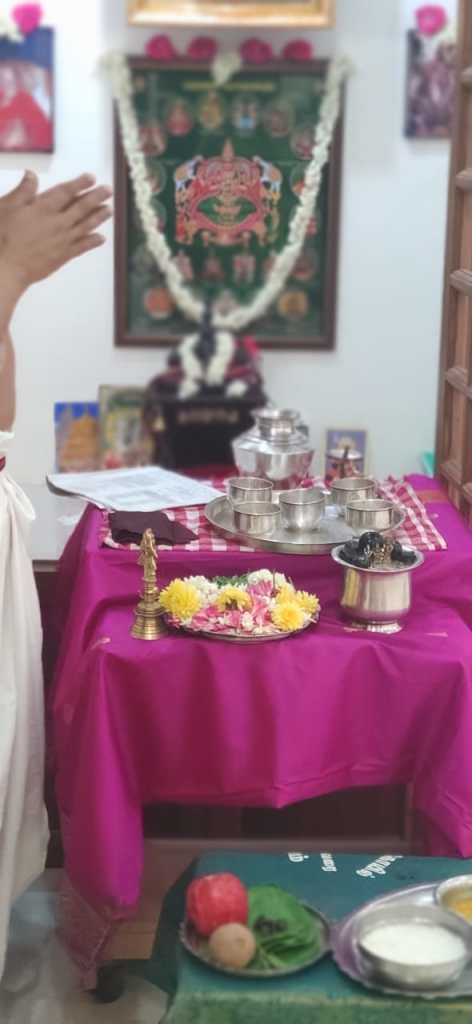
- The observance of the ritual of TA is through a daily regimen in a Sri Vaishnava household where “saaligraama” or “archa-moorthy” of Bhagavan Vishnu is kept consecrated inside a specially made wooden or silver-plated decorative miniature figurine of a stately “mantapam”, or royal-court, called “kovil-Azhwaar” . It is here that Vishnu comes to reside in our homes. It is from here that he readily accepts — as Krishna promised he would in the Gita — what is offered to him by way of worshipful “upachaara”.
- TA is actually nothing more, or nothing less, than Vedantic philosophy plus Sri Vaishnavite theology put in motion through a small-scale but endearingly poignant ritual Ceremony.
The importance of introducing a little bit of ceremony and fanfare while expressing love, adoration and admiration to even one’s maatha, pitha, Acharya and athithi hardly needs to be stressed.
A mother or father expects nothing but only love and respect from a son or daughter, let’s say, on their wedding day; but then, even if I have to show only a token of my love on the occasion with nothing more than a mere box of chocolates, I still do ensure that it is attractively packaged and wrapped in silver foil and gets delivered to my parents with a little bit of ceremony of song and dance … isn’t it so?!
What makes “upachaaram” poignant and solemn yet so delightful to the receiver of “upachaaram” is just that little element of excitement getting added to it. Even a wee bit of exaggerated or lavish ceremonial flourish being infused into “upachaaram” does so greatly enhance the quality of “upachaaram” served.
(9)
The proper way to perform the solemn ceremony of “bhagavath tiruvaaraadanam” (TA) is called “tiruvaaraadana kramam” in Sri Vaishnava parlance and it has been laid down and clearly explained for the laity by past and present Achaaryas of the sect in several scriptural manuals written in both Sanskrit and Tamizh.
[One of the most popular of such manuals available is called “Sri Vaishnava dinasari bhagavath aaradana aachara aahnika grantham” authored by the revered 45th pontiff of Sri Ahobila Math Srimath Azhagiyasingar. It sets out in great detail the procedures and protocol for performing the ceremony of TA. It is available in many bookshops in your city].
Let me hasten to assure you that I am not going to reproduce exhaustive excerpts or dense references from elaborate Sri Vaishnava manuals on how to conduct the TA ceremony. You may, if you so wish, refer to them later after you have made up your mind to make a start performing TA in your own homestead. That will depend entirely upon how quickly and deeply you wish for the bonds of spiritual intimacy with God to grow and develop in your life.
Today, of course, on YOUTUBE channels too, you can come across many video-presentations or practical tutorials that show you how to perform, step-by-step, the TA ritual. They might serve as handy learning tools, enough to get you started.
For the moment, however, by way of concluding this my personal letter to you on TA, I shall share with you the little steps through which I myself have been conducting the ceremony all these years … and what is my own personal experience of it. Most importantly I want to introduce you to the subtle Vedantic concept of “Bhaava”… that is implicit in fact in the Upanishad phrase, “… devO bhava!”
It is through this fine concept of “bhaava” that I can best explain the mental attitude I myself have tried to cultivate personally while performing TA … and to bring it to bear upon my own inner experiences of the ritual. The only purpose for sharing personal experiences with you is that it may perhaps give you some guidance on how to fashion and later adopt your very own personal attitude (i.e. as a Sri Vaishnava who has already undergone “samaasryanam” under the tutelage of your Achaaryan) towards offering TA “upachaara” to the Divinity consecrated as “saaligraama” or “archa moorthy” at home.
(10)
In TA “upachaara” to Vishnu, what is offered unto him is exactly the same offerings spoken about by Sri Krishna in the Bhagavath-Gita viz. पत्रंपुष्पंफलंतोयं… i.e. a leaf, a flower, a fruit and pure water….
- “patram” refers to the tender leaves of the Basil plant (Ocimum basilicum). I take a bowlful of these leaves collected and I use them to offer “archanai” to the “saaligrama”.
- “पुष्पं” …. A variety of sweet-scented flowers (roses, jasmines, lotus, lily etc.) are collected, washed and cleaned (my wife helps in this, in fact) and the “saligraama” or “archa-murthy” is adorned with the soft petals.
- “फलं” … a variety of delicious fruits (apples, grapes, guava, pear or pomegranate) are offered
- “ तोयं” … clear water is collected in metallic pot called in Tamil as “vattil” (made of silver) and using 5 different such vessels known as “pancha paatram”, in prescribed manner, I use them to carry out ritual routines such as “arghyam”, “paadyam”, “aachamaneeyam”, “snaaneeyam”, “paaneeyam” and “shuddhodhakam”. You can look up the manuals to know the exact meaning of these terms but suffice to know for the moment that the ritual water is used principally to ritually “wash the sacred feet” of the “saaligraamam” and “archa moorthy” and then ceremonially “bathe” the deity too with it. Later this water is collected in a separate silver bowl and becomes what is called “perumaal sri paada teertham” … the holy and sanctified water of Vishnu a little of which we reverentially consume every day to mark our own spiritual purification.
(11)
All the above 4 ritual offerings, are used and offered by me to the Deity, in fact, in a well-sequenced series of 10 ritual steps or “upachaaram” in the manner prescribed as proper in the TA “kramam”, or ceremonial routines. The 10 steps are listed below.
The performance of each step in the procedure is done to the accompaniment of several ritual accessories such as — “ghantam” (bell); “dhoopam” (incense); “deepam” (lamp); “gandham” (sandal-paste); “teertha parimalam” (water flavoring); “chaamaram” (ceremonial whisk); “vastram” (ritual vestments); “prasaadam” or “bhakshya vastu” (cooked dishes in the house kitchen especially for the Deity) etc.:
Many Sri Vaishnava Achaaryas in their explications on the TA have referred to the need while performing the rite for one to assume appropriate “bhakthi bhaava” i.e. the correct mental orientation or attitude, a certain emotional stance or posture to be taken which helps one greatly in being able to maintain the focus of the ceremony and the intensity of fervor as well.
Just as “ghantam”, “deepam”, “dhoopam” etc. happen to be physical accessories to aid in the performance of the rite, I say with certainty that the right “bhaava” too is an “emotional accessory” absolutely necessary for the proper conduct of TA.
There are many such attitudes or “bhakti bhaava” to adopt. They are well exemplified by “puraanic” characters”. Some of those commonly known “bhaava” orientations that you may already know about are:
- Maadhurya bhaava – the attitude of the lover and beloved – the TA rite is performed for the pleasure of the Deity with the same attitude with which a lover might take pains to please his or her beloved. E.g. the “gopikas” of Brindavan and Gokulam and Sri Krishna.
- Sakhi bhaava – the attitude that a soul mate shows towards the other. E.g. the attitude that Radha exhibited towards her paramour Sri Krishna; or, the one Sita always showed her husband, Sri Rama.
- Vaatsalya bhaava – assuming a parental attitude towards child. E.g. the tender motherly feelings Yashodha showed for her darling son, Sri Krishna.
- Daasya bhaava – the attitude of the servitor towards his master. E.g. the mental attitude which Hanuman always assumed towards his Lord and master, Sri Rama.
- Sakhya bhaava – the attitude that bosom friends assume towards one another. E.g. this was the attitude Arjuna adopted towards his friend, guide and philosopher, Sri Krishna.
- Santha-bhaava – this attitude is a rather neutral and natural one assumed by a devotee who is spiritually far advanced … It is a very difficult attitude to adopt. Only saintly persons are capable of it and for whom “bhakthi” towards God flows spontaneously in the heart without having to deliberately assume any one or other kind of “bhaava”.
Any one or more of the above 6 “bhakthi bhaava” may be assumed by a Sri Vaishnava who conducts TA. Sometimes, depending on the varying mood of the TA practitioner at different points of time, alternating “bhaavas” by turn might get assumed by him. Sometimes, within the course of the same TA ceremony, multiple “bhaava” might get adopted while performing the 10 different routines listed above.
It is really all a matter of individual choice left entirely to the TA practitioner. It is up to him to decide and determine the nature of the relationship he wishes to fashion with his God, how to gain what in the “artha-panchakam” doctrine is said to be true knowledge of “paramaatma-svarupa” and “jivaatma-svarupa” … and how he wants to go about seeking, cultivating and growing intimacy in such a relationship.
(12)
As for me, if you ask me, over the years now since I began performing TA for the “saaligrama moorthy” in my home, I have chosen to adopt sometimes the “daasya bhaava” – the attitude of the servitor towards the master; it seems to suit best not only my personality but also my philosophical outlook and belief-sets in life.
Sometimes, I also find myself assuming the highly emotional “vaatsalya bhaava”… i.e. the parent-child mental orientation.
It all of course depends upon what the nature of my particular mood happens to be on the day when I commence the TA rite.
But let me confess to you that at almost all times when I perform TA, I tend to draw inspiration directly from the Taittiriya Upanishad “vaakya” in the “seekshaavalli”:
मातृदेवो भव ।पितृदेवो भव ।आचार्यदेवो भव । अतिथिदेवो भव ।
I generally take the pardonable liberty of taking the above “vaakya” and extract inspiration from it by reversing both its words and meaning to suit my purpose conveniently.
“devah: maatarO bhava;
devah:pitharO bhava;
devah: AchaaryO bhava;
and, finally,
devah: atitheeyO bhava”!
In other words, I choose to look beyond the obvious meaning of the Upanishad “vaakya” and to grasp what it seeks to convey to me by implication also, viz.:
Treat God as you know you must your mother;
Treat God as you know you should your father;
Treat God as you would your guru, the teacher;
Or treat God as though he were honored guest arriving home.
Adopting the attitudinal posture, the behavior or “bhaava” of a son, a disciple or else, of a hospitable and solicitous host, and reversing it to be focused more fully towards the “saaligraama moorthy” in my house, works just fine for me. In my experience I often find it adds a certain ineffable quality of intimacy to the ritual performance of the “tiruvaaraadanam” ceremony. It makes me aware — and derive enormous inward satisfaction from such awareness – that the philosophy of the ageless Upanishad, the Sri Vaishnava theological doctrine of “artha panchakam” and the religious ritualism of TA all fuse and merge seamlessly together into one spiritual experience to be savored as a blessing and a grace to both delight in and feel grateful for.
(13)
The “bhaava”, the emotional stance adopted by one who performs the “upachaara” of TA is an essential but yet not quite sufficient prerequisite to conducting the ceremony.
“Bhaava” cannot be expressed in vacuity… you will need words to convey your innermost “bhaava”, your mental stance or attitude towards the God with whom you wish to strike intimacy.
All through the 10 steps listed above as “tiruvaaraadana kramam”, one also needs therefore the perfect and powerful “mantra” to be able to invoke the presence of the Deity in spirit and to consecrate it.
There are appropriate selections of such “mantra” readily provided to us in the Vedas.
Besides the chant of Vedic “mantras” ideally suited for the occasion, there is also the need for reciting beautiful words of praise, prayer, thanksgiving, love, adoration and awe without which it would be impossible to bring forth the true mood or mute, unexpressed feelings that infuse a particular “bhaava” as one experiences it even as one proceeds with the 10 different steps — one after the other in sequence — of the TA “kramam”.
Such beautiful and poignant poetry so very apt for the occasion is readily and copiously available in Sri Vaishnava scriptural literature and “sampradaaya”. A little knowledge of Sanskrit and Tamizh is more than enough to be able to learn such bhakthi-laden poems and mystic hymns and use them at the appropriate moments and stages during the 10 TA procedures described above.
For example, for “suprabaatham”, I usually recite lines from the Ramayana that Rishi Viswaamitra sang to awaken Rama at the hour of dawn:
For “snaanaasanam”, I chant the euphonious and majestic Vedic chant of the “pancha sooktham-s” but then also follow it up with the endearing, heart-rending hymn of Sri Peria Azhwaar who sang the Tamizh “neeraatam” verses while imagining himself to be Yashoda, the foster-mother of Sri Krishna, cajoling her rebellious beloved child to come home to her for his daily bath. This is the hymn in fact that is recited in all Vishnu temples throughout the world especially at the time of Tirumanjanam (ceremonial bath) to the Lord’s idol or “archa”.
Yashoda calls baby Krishna for an oil bath. He refuses and runs away. She entreats him saying- “Having besmeared your body with butter and mud, I will not let you soil your bed tonight. See! For how long I have been waiting with oil, scented soap-nut powder etc. O! Lord! Naarana, who that is beyond anybody’s reach, please won’t you come to mummy and take your bath?!“
Next, during the “mantra-pushpam” step of the TA “kramam”, although it is mandated that 4 brief chants from each of the 4 different Vedas (rg, yajur, saama and atharvana) must be solemnly recited, thereafter, one can choose from a variety of scriptural hymns, “stuthi” and “stotra” works and elaborate “shloka” incantations and recitals fit for the occasion.
It is a joyful experience indeed to recite such exquisite selections of choice traditional Sanskrit and Tamizh verses. When all members of the household family join in these recitations, the experience gets heightened and intensified.
Finally, for the “saatrumarai” step, there is a standard prescribed litany of verses in praise of Vishnu and the Sri Vaishnava “guru-paramparai” lineage.
To learn all the above poetry and “shlokas”, it should not take you more than a little bit of effort and a few weeks of practice to patiently to finally be able to memorize them and then begin using them fluently as “tiruvaaradana krama” chants, mantras and hymns. You can learn all of it from a qualified Sri Vaishnava practitioner who will gladly oblige if only you approached him with genuine purpose. Once memorized and practiced regularly in doing the rite itself, you will find that the meaning, the significance and purport of the entire TA ritual will begin to dawn on you, and fill you up with a strange and ineffable spiritual beatitude.
I now sign off this letter to you, dear son, in the hope that I have in very small measure been able to answer satisfactorily the question you posed to me: “Why is it so necessary for a Sri Vaishnava to perform the daily ritual of “Bhagavath Nithya-Tiruvaaraadanam”?”
It is my fond hope that I have succeeded in disabusing you of any false notion that “tiruvaaraadanam” is “mere empty mechanical ritual”… Please banish all such thoughts.
More important is my other hope that, sooner than later, at some point in your lifetime, by the Grace of God, and after having well understood all the facts about “bhagavath tiruvaaraadanam” ritual I have tried my very best to explain to you, you will begin perhaps feeling the urge to perform it. If you do so, I have no doubt in my mind that you will reap many auspicious blessings in life that Srimann Naaraayana will confer upon you, your children, your family and community at large!
“Sriman Naarayaana charanow sharanam prapadyE I
SrimathE naaraayanaaya namah II”
With all my blessings and love to you,
Appa