The Rt.Hon’ble Srinivasa Sastri’s memory and legacy lives more in Durban than in Delhi? (Part-2)

Throughout the 1920s and 1930s, the mass leaders of the Indian National Congress who were at the forefront of the Freedom Struggle against British Colonial Rule all fell into roughly three broad but clear ideological groupings. They were all patriots devoted to the cause of Independence but they differed sometimes quite widely in their respective approach towards how the struggle must be waged. The end was one but the means were varied.

In that broad spectrum of freedom fighters, at one extreme were arrayed those like Veer Savarkar, Bhagath Singh and Subhas Chandra Bose, to name only a few, who made no secret of their choice to take up arms against the British Governement in India. At the other end of the spectrum were those aligned with Gandhi’s non-violent satyagraha approach — which included ceaseless agitation against the British Government in the form of Civil Disobedience, and Non-Cooperation movements. Straddling the movement in the middle between the two extremities of the spectrum stood those who adopted the old-school Gokhale-Ranade methods of “gradualism” that sought freedom from the British by pressing home their advantage not through overly agitational or revolutionary methods but by exploiting the imperial Britain’s own inherent sense of justice and fair-play, “constitutionalism” and much-touted “liberal-humanist” (Fabian social-democracy) values and “civilisational ethics“.

************

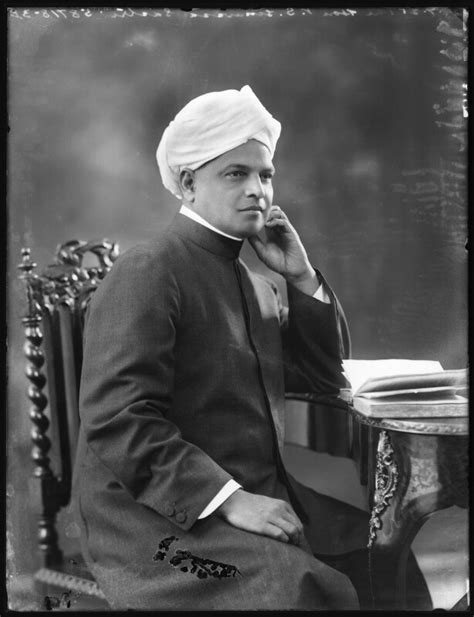
Srinivasa Sastri belonged to this third group. Although he and Gandhi differed in their choice and paths of political activism — in that classic moral binary where the End clashes with Means — the astute judge of men’s innate talents that Mahatma Gandhi was made him recognize and skillfully commission and deploy Sastri’s many versatile skills and capabilities to further his own goals.

Gandhi returned for good to India in the early 1920s after having spent many years working for the rights and freedoms of the indentured Indian-community there. It was in South Africa that his “experiments with truth” and the methods of “satyagraha” had been put into practise and then honed and developed into a powerful weapon of non-violent political agitation. Gandhi was all set then to unleash that weapon in India too against British Imperial rule and for Independence.

The British Government in India was acutely aware of the danger of Gandhi’s Satyagraha mass-movement strategem getting exported from India to South Africa and fomenting there in that country the same Civil Disobedience and Non-Cooperation movements which were gathering steam at home under the auspices of the Gandhi-led Indian National Congress. The virus of Satyagraha, the British were convinced, if it did spread to South Africa too, it would very likely lead to a sort of cross-border consolidation or coalition of freedom-fighters in both India and South African Indians. That would cause a potential cross-continental political crisis for the British Crown that was already tottering from the ravages of the First World War and inevitably lurching towards the Second at that time.

Gandhi was acutely aware of the many deep dangers of such a virus spreading from colonial India to colonial South Africa. Although sympathetic to the almost slavish condition of the Indian community in Durban, Natal and Pretoria provinces that the apartheid regime in South Africa had ruthlessly imposed upon it, Gandhi nonetheless realised that that the general demographic, political and social environment of South Africa was not not same as in India.

With intimate, first-hand knowledge of the South African Indian-community gained during his years when he practised as an activist-lawyer there, Gandhi knew that the community was not yet ready for mass Sathyagraha movement. It would be too early and too potentially self-destrutive for Indians in South Africa to confront and take head-on the might of British Rule employing the sort of methods that Gandhi had launched and set in motion in India. The reason why he felt so was because of the generally poor level and standards of education and awareness amongst them of law, constitution, political and civil-rights.

Also, Gandhi’s own unerring sense of the trajectories and outcomes of mass political movements warned him that if a crisis were to explode amongst Indians in South Africa, it was sure to severely affect the course, the momentum and prospects of success of India’s freedom struggles at home against the British.

************

So, under such overarching circumstances, Gandhi and the Indian National Congress (INC) were compelled to tacitly support the British Crown and Government in India in its efforts to put the lid on and contain any potential political movements of freedom such as mass Sathyagraha or Civil Unrest breaking out in South Africa.

The British thus used very ingenious diplomacy to persuade Gandhi and INC to be sort of “ambassadors-at-large” in South Africa to dissuade the Indian community from pursuing any sort of political activism against British Rule, and instead focus more on the greater goal of amelioration of its overall social, educational and economic plight.

Thus, did the leadership of the INC enter into a sort of unwritten pact under which Gandhi would himself undertake to carry out the very delicate diplomatic and international task of mediation and conciliation between the Crown and its Indian subjects in South Africa.

To put the entire matter in broad historical perspective and to describe in a nutshell exactly what the British Goverment of India did, one may use the Tamil idiom: “முள்ளை கொண்டு முள்ளை எடுத்தல்” (“Mullai kondu mullai eduththal“). In other words, the delicate diplomacy the British used to diffuse the potentially crisis-situation likely to break out in South Africa was to skillfully enlist the Mahatma himself to handle the assignment of persuading the Indian community to forsake — at least for the time being then — any idea or program of freedom struggle against the British that was being contemplated and instead to focus more on its own economic betterment and social development.

Mahatma Gandhi was caught in a bind. On one hand, he knew he had no choice but to accede to the British Goverment’s wishes. On the other hand, he also knew that he himself could not go to South Africa to carry out the diplomatic mission since he and the INC were already committed to the freedom struggle movement in India. If he left India to return to South Africa it would severely cripple and compromise the freedom struggle the INC was waging against the Bristish at home.

Gandhi thus looked around for a workaround and it was then that he immediately recognized that the job of carrying out such a delicate international diplomacy entrusted to him by the Colonial Rulers had to be delegated to someone admirably qualified for it. And Gandhi did not have to look too far and wide in India to recruit such a person.

It had to be the eminent Srinivasa Sastri !

Gandhi thus put aside all his ideological differences with Sastri and persuaded him to take up the assignment to go Durban as the emissary de jure of not only the Government of India but de facto, as his very own personal one!

************

Gandhi’s insistence that Sastri go to South Africa to represent Indian interests abroad highlights how Gandhi valued Sastri’s stature and language skills as critical assets in international advocacy. Gandhi’s political strategy increasingly incorporated appeals to British public opinion and international bodies.

Sastri’s role symbolized this strategy of engaging colonial authorities through persuasion and legal arguments, complementing Gandhi’s mass mobilization at home. The letter that was written on April 6, 1927 shows Gandhi’s recognition of Sastri’s personal integrity, educational background, and ability to act as an interpreter or mediator. Gandhi’s approach often involved aligning himself with respected intellectual figures like Sastri to lend moral and intellectual weight to the independence movement, balancing popular agitation with respectable leadership.

Sastri was known for his deep knowledge of constitutional law, diplomacy, and his eloquence in English. Gandhi’s letter reflects respect for Sastri’s calm, reasoned approach and his ability to represent Indian interests effectively in official and international settings. This likely influenced Gandhi’s strategic use of constitutional dialogue alongside mass civil disobedience, balancing confrontation with negotiation. It was no surprise that Gandhi’s choice of Sastri to be the man for the assignment was influenced Gandhi knowing that Sastri respected constitutionalism, diplomacy, and the importance of international advocacy within the Indian independence movement.

Sastri’s intellectual rigor and polished public persona thus would only complement Gandhi’s mass-based activism, leading to a multi-pronged political strategy that combined moral suasion with direct action.

There can be no doubt thus that it was Srinivasa Sastri who indeed did help Gandhi to broaden the nationalist movement’s reach and impact during the critical phases of the freedom struggle in the 1920-early 1930s.
***********

In South Africa, Srinivasa Sastry handled the truly unenviable task of walking an extremely tight rope of diplomacy, having to represent both the British Imperial Goverment of India as well as Mahatma Gandhi and furthermore, at the same time, also work to advance the interests of the Indian community at large.

Sastri was acutely aware of the perilous assignment he was about to carry out. He was sent to South Africa to act as bridge between a disenfranchised, disempowered, impoverished Indian community and the British Colonial Establishment.

The Indians were disenchanted with the same Colonial Rulers whose representative, ironically, Sastri was! He was also acutely aware that the Indian community would be only to easily prone to compare and pass judgment upon the work he did for them and their causes with the sterling work they had in earlier years witnessed Mahatma Gandhi accomplish.

In a very candid speech that he made to a gathering of Indians in Durban, Sastri was not afraid to be open and honest in laying bare the precarious nature of his assignment:

I will speak about my own mission. As you are aware, I am the first official representative of India in this sub-continent. What led to the creation of the office is within the full experience and knowledge of nearly all of you. But I may be allowed to take you behind the Cape-town Agreement, just to dwell for a moment on the anxieties and fears with which the Government of India and the Imperial Cabinet of Great Britain had always viewed the situation created by the circumstances in which Indians were living in this country, and generally in the Dominions of Britain abroad.

I do not wish to say anything that may be unpleasant or anything that may be in the nature of recrimination. My purpose is not to make matters worse but to make them better, and if I recall the condition and anxieties and fears prevalent among the Government and the people in one common state. If I dwell upon this aspect of the subject, it is merely to show that the Government of India, in handling an extremely difficult and delicate situation, have thought it their duty, first and foremost, to avoid anything that may be in the nature of a diplomatic blunder; for diplomatic blunders have consequences that are far reaching, and fall, in the main, on innocent people and upon generations who are perfectly innocent of the complications through which they are made to suffer.

As representative of the Government of India, it behoves me, also, to walk warily where there are so many pitfalls, and to avoid anything which may be in the nature of added bitterness, for bitterness there is in abundance in all conscience, and if one desires to cure one cannot start by making the disease worse.

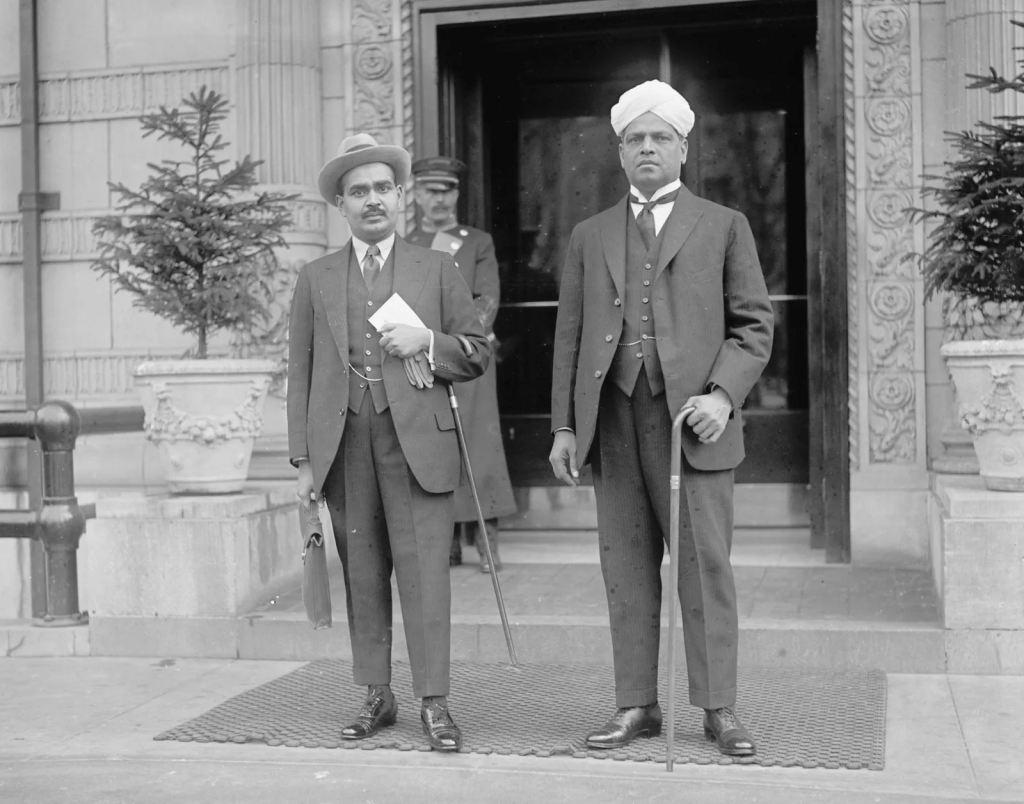
As it turned out, during the two odd, staggered years that Srinvasa Sastri spent in South Africa — first when he arrived there in December 1926 as a member of the Habibullah Delegation which was sent from India to negotiate and study the position and grievances of the Indian community living there. The delegation was officially led by Sir Mohammad Habibullah, a member of the Viceroy’s Executive Council. The delegation was organized after rising tensions and discriminatory laws against Indians in South Africa, notably policies restricting Indian immigration and civil rights. Its purpose was to conduct on-the-ground investigations, negotiate with South African authorities, and seek a diplomatic solution to the discrimination faced by the Indian minority, without explicitly endorsing “repatriation” (return of Indians to India), which South Africa favored.

Although led by Habibullah in title, V. S. Srinivasa Sastri emerged as the main spokesperson and negotiator for Indian interests during the mission, owing to his diplomatic skill and reputation.

Then again when Sastri returned to South Africa in June 1927 to work as the Agent-General to the Government of India until January, 1929), the work he did for the Indian Community and for the British Crown earned him effusive encomiums from both!

How did Sastri pull it off?

(to be continued)

Sudarshan Madabushi
The Rt.Hon’ble Srinivasa Sastri’s memory and legacy lives more in Durban than in Delhi?

The Sastri College in Durban, South Africa is a co-educational, multi-racial, multi-cultural state secondary school with learners from grade 8 to grade 12. The founding of Sastri College was the vision of the (Late) Rt. Hon’ble V.S Srinivasa Sastri (1869-1946 CE). The official opening of the school took place on Monday, 14th October, 1929 when the Earl of Athlone, Governor-General of South Africa inaugurated it https://sastricollege.co.za/about-us/. The College represented the the vision of Sri. Srinivasa Sastri – who was then the Agent General of the Government of India in South Africa — to realise which the Indian Community in South Africa collected and contributed the handsome amount of 18,000 pounds. The school is today located on the periphery of the central business district of the City of Durban. It is a school rich in tradition and respected for its high academic achievement. The website of the Sastri College says this proudly: “These have been handed down to us through the dedication and vision of our predecessors which continues to inspire us today”.

On October 10, 2029, the Sastri College, Durban will celebrate its Centenary Year.

My very dear and long-time friend and fellow Chartered Accountant, Sri. G.Karthikeyan’s is the maternal great-grandson of Rt. Hon’ble Srinivasa Sastri. Yesterday, Karthik (as I have always called him) proudly informed me that the Administration of the Sastri College, Durban, had been so very gracious to send in a full three years in advance (!) a formal invitation to his mother, Sri. Srinivasa Sastri’s grand-daughter, to attend the Centenary Year Celebrations of the college in October 2029! Karthik’s message to me was: “Sudarshan, as an aside, the Ambassador of South Africa to India Mr. Anil Sooklal contacted my mother to inform her that they are planning the centenary celebration of Sastri College in 2029 at Durban. He wanted to invite the Sastri family to Durban for the Centenary celebration...”

How ever so gracious of the Sastri College, Durban!“, I thought! And how grateful they must be to the memory of Srinivasa Sastri that the institution has not forgotten him or his surviving family in India today… even a 100 years after it was founded! I replied to Karthik immediately, expressing my fulsome praise for the South African college, to his mother and to the entire family of Rt. Hon’ble Srinivasa Sastri. I told him I hoped that come October, 2029, he will travel to Durban to attend the Centenary festivities of the Sastri College as a mark of respect to the memory of his great-grandfather.

The above exchange of correspondence with Karthik reminded of my own great admiration for Sri. Srinivasa Sastry. Although I am a student of Indian history during the period of India’s freedom struggle, I had not acquainted myself to well or deeply with Srinivasa Sastri’s own role in it. Everything I knew about Sastri was from what is out there in the public domain that anyone, of course, can easily access:

Srinivasa Sastri was born to a poor temple priest in the village of Valangaiman near Kumbakonam, India. He completed his education at Kumbakonam and worked as a school teacher and later, headmaster in Triplicane, Madras. He entered politics in 1905 when he joined the Servants of India Society. Sastri served as a member of the Indian National Congress from 1908 to 1922, but later resigned in protest against the non-cooperation movement. Sastri was one of the founding members of the Indian Liberal Party. In his later days, he was strongly opposed to the partition of India.

Srinivasa Sastri served as a member of the Madras Legislative Council from 1913 to 1916, Imperial Legislative Council of India from 1916 to 1919 and the Council of State from 1920 to 1925. Sastri also functioned as India’s delegate to the League of Nations, as member of the Privy Council of the United Kingdom and agent to the Union of South Africa.

************

However, my admiration for Srinivasa Sastry did not stem from what little I knew of his work in Indian politics in the Pre-Independence era.

When I was a young man in my early 30s I had grown to admire him greatly when I had first read a book, a compilation of Srinivasa Sastry’s famous “Lectures on the Ramayana”, delivered over several months (April through November 1944) at the Madras Sanskrit College.

Reading that book (https://a.co/d/1wvVj6u) was my very first introduction to not only the “itihaasa’s” magnificence as an ancient epic but also to the exquisiteness of Maharishi Valmiki’s Sanskrit language. More importantly, the lectures of Srinivasa Sastry opened my eyes for the very first time in life to the immense possibilities of ways of understanding and creatively appreciating the Ramayana’s literary and scriptural profundity with the aid of English cadence of which Sastri was an unequalled master. For someone like me who had no more than a mere smattering knowledge of the Sanskrit language, Valmiki Ramayana was brought vividly alive indeed thanks to the sheer brilliance of Sri. Srinivasa Sastri’s Lectures.

Many years later, I myself authored and published a book of essays titled “The Unusual Essays of an Unknown Sri Vaishnava” (2025 edition: https://amzn.in/d/awRFQuB. The couple of essays on the Ramayana that I had penned therein, I must acknowledge, did borrow quite a lot and also did quote profusely from Sastri’s own “Lectures“. So great was the spell of inspiration that Rt. Hon’ble Srinivasa Sastri always had cast upon me, indeed, in my own humble literary forays!

***********

Upon receiving such wonderful, glad news from my friend Karthik about the upcoming 2029 Sastri College Centenary Celebrations in Durban, my mind also turned a little sombre when I began to wistfully recall the history of India’s freedom struggle and Srinivasa Sastri’s own distinguished albeit chequred and, sadly, under-appreciated role in it. It is in that mood that I feel compelled to boldly say too here that I feel, back here in India, especially in Tamil Nadu whose illustrious son of the soil he truly was, the memory of the Rt. Hon’ble Srinivasa Sastry, for some unfathomable reason, has not received half the reverence and celebration that the Sastri College in faraway Durban has deemed it fit to accord him in during the centenary year it will celebrate in 2029.

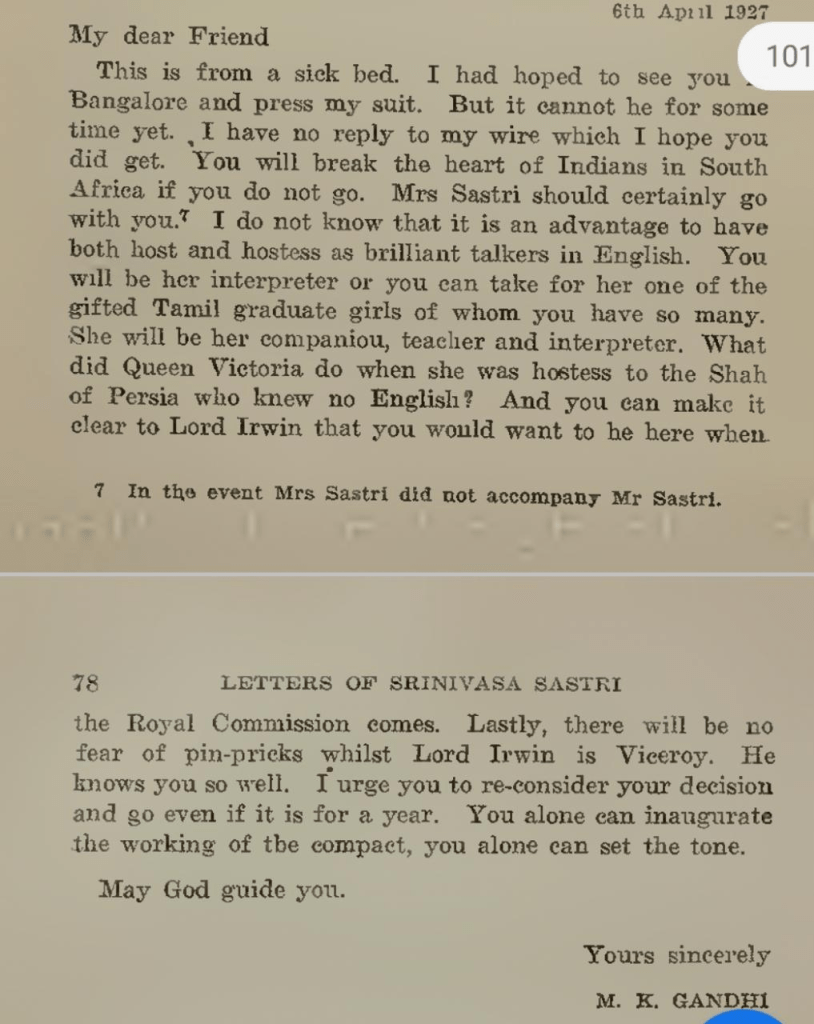
To fathom and to try to understand the reasons might perhaps force me to revisit and dig into — a little bit at least — into India’s pre-Independence history when Sastri has been made a part of it by none other than the Father of the Nation, Mahatma Gandhi. In fact, the best place from which to start digging a bit into history, I would say, is to discover an intimate correspondence that took place between Gandhi and Sastri … a letter in which the Mahatma virtually hustled a reluctant Sastri to undertake a very important and historic political assignment in South Africa.

My friend Karthik yesterday fished out that letter dated in April 1927 which the Mahatma wrote to his great-grandfather and sent it across to me:

This correspondence, written by Mahatma Gandhi to V. S. Srinivasa Sastri on 6th April 1927, centers around Gandhi urging Sastri to reconsider his decision about not going to South Africa to represent Indian interests. Gandhi expresses personal disappointment at not being able to meet Sastri due to illness but strongly emphasizes the importance of Sastri’s visit for the morale and well-being of Indians in South Africa.

Gandhi is persuasive, mentioning that Sastri’s absence would deeply disappoint the Indian community there. He discusses logistical details, such as the presence of Mrs. Sastri or a suitable interpreter, reflecting the complexities of diplomatic responsibilities abroad. Gandhi draws on historical references (such as Queen Victoria hosting the Shah of Persia!) to argue that language barriers could be overcome and should not deter Sastri from making the trip.

Further, Gandhi addresses the broader political context: he refers to the upcoming Royal Commission and the political climate under Lord Irwin, indicating that Sastri’s leadership would help set the right tone and inaugurate the ‘working of the compact’ between India and South Africa. Gandhi earnestly urges Sastri to reconsider his decision, even if only for a year, stating, “You alone can inaugurate the working of the compact, you alone can set the tone.” He concludes with a blessing for divine guidance.

From a careful reading of the above letter of Gandhi, we can easily conclude that Srinivasa Sastri’s influence on Gandhi’s political strategies was very strong in several nuanced ways, especially during the 1920s when Indian nationalist leaders like Gandhi, Gokhale and Nehru were negotiating the complex terrain of colonial politics and international diplomacy.

***********

(to be continued)

Sudarshan Madabushi
Belief and Faith: what’s the difference?

What is the exact Tamil word for faith?”, asked an old ex-colleague and friend of mine who lives now with his children in far away America. It was a casual question but I somehow could not get myself to be anything but serious about it.

I replied:

Sir, you are the expert …Is it நம்பிக்கை? Or விசுவாசம்? The exact Sanskrit word for “faith” is श्रद्धा (śraddhā)…

And he responded :

The second one is more appropriate, I think. The first one in English I think is Belief.”

I couldn’t have agreed more with my good old friend on the definitions.

Belief demands evidence , rationale, “pramaanam”… and with new evidence or emerging facts and conviction, beliefs can change over time.

Faith on the other demands no such thing …

Faith is more about commitment and enduring trust, even in the face of uncertainty or doubt. It is not just intellectual agreement, but also a matter of the heart, and often compels action or loyalty, especially in spiritual or religious context.

In the last 2 weeks, every evening I turned on the TV to savour a YouTube series of video upannyaasam by brahmasri Sri B. Sundarakumar on Srimad Bhagavatham.

Yesterday after listening to the discourse, my mind was in fact dwelling upon a few of the enchanting stories of Krishna’s Leelas in Gokulam and Brindavanam. And I kept thinking about how inexplicably and with what awe and wonder those Gopikas there regarded Sri Krishna? What moved or drove them to feel such intense unconditional , unwavering devotion towards him? Why could they never tear themselves away from him ?

It was such silent yet mind-stirring thoughts that also made me, to some degree, understand then the difference that certainly exists between believing that the Srimad Bhagavatham is true and the abiding in faith that Krishna as a divine avatar did walk the soil on earth.

To believe in anything — a person, a body of thought or just an idea — or to keep faith in it , are both clearly deliberate choices to be made. Not however for a child or infant … it holds no belief that its mother will ever protect and nurture it. But was born however with absolute faith that its mother will protect it … without even knowing what the idea of faith is. We are all thus born only with Faith … we acquire Beliefs only much later in life, in adulthood .

You can endlessly research into, argue over, and go on gathering evidence about whatever you think is true or else in the Srimadh Bhagavatham … or you could reject whatever might strike you as incredible in the purana . But so long as you are unable to accept or embrace Sri Krishna with the same unquestioning, unlearned and innocent faith that the Gopikas reposed in the reality of his person, the Srimad Bhagavatham will remain always a mere Vedantic scriptural text — a collection of tales and miracle-stories — and can never turn into an article of faith for you.

Belief is definable . Faith is indefinable . Belief is a wispy cloud floating high in the sky above you. You can see it but cannot touch or feel it. Faith on the other hand is will-o’ the-wisp wafting about here down upon earth in the morning mist in the lush forests surrounding you… You can’t see it, but you will feel it if you walk slowly through it.

Sudarshan Madabushi

சோம்பரை உகத்தி போலும்….” and “lazy bones”: transformation from the Ravanesque to the Rama-like .

For the last couple of years it’s been my privilege and personal delight to be corresponding via WhatsApp messages with the well-known writer, novelist, playwright and scholar, Sri. Indira Parthasarathy (pen name “Eepa”) almost daily while we casually discuss a whole range of subjects of mutual interest — mostly Tamil and English literature but occasionally also current affairs, politics and celebrities in the art world. Eepas’s responses to my messages (and daily blogposts on this webpage of mine) are often sharp, wise, wry , witty, pungent and very insightful. They make me smile but they also arouse lot of thoughts in me.

At 96 years of age, Eepa’s memory is still prodigious. His mind today works as vigorously as it did during his long and illustrious literary career in the past that saw him produce scores of novels , plays, essays and short stories both in Tamil and English language, winning him both the Sahitya and Sangita Nataka Awards and a Padma Shree to boot.

It is not always that I share with Eepa WhatsApp forwards or messages about only literature, art or politics. On occasions, we also exchange some silly jokes and trivia simply out of sense of enjoying pure fun. At 96, Eepa still enjoys telling and hearing a good joke.

So, yesterday a silly joke I sent Eepa was this one:

A 90-year old toothless geezer of an old man is sitting in a public park on a bench when a lady passing by asks him out of plain curiosity:

“Sir, what do you do for a living?”.

Pat comes the old man’s reply with a bemused twinkle in his eyes:

“Well, in the morning I start off by doing nothing, in the afternoon I finish what I began in the morning and in the evening I retire to take rest from all the hectic activity!”.

While sending the joke to Eepa I also added my own caption to it: “Sir, I just turned 69 a couple of days ago and I’ve decided to take inspiration from this old senior! Bless him !” To further heighten the comical effect of my comment, I added also a very telling and delightful Tamil idiomatic expression that I knew Eepa would be familiar with and be able to savour too. That delightful phrase was “சோம்பரை உகத்தி போலும்….”.

It is difficult to translate this Tamil idiom into English accurately since the sense in which it is used might get easily spoiled. The the nearest equivalent might be something like this: “fie on the lazy bone!” (where the word சோம்பரை denotes indolence).

Eepa quickly responded to my message and to the forwarded joke with a mild note of good-humoured protest by referring to himself:

“It is not சோம்பல்! What else one can do at 96!”

And I retorted:

Sir , please we mustn’t misunderstand the casual, harmless joke … It just so happens that the Tamil idiomatic phrase is what at once popped into my mind on reading the joke and I’m sure you will recall it too: it’s from the paasuram of Tondaradipodi Azhwar:

மேம்பொருள் போகவிட்டு
மெய்ம்மையை மிகஉணர்ந்து
ஆம்பரிசு அறிந்து கொண்டு
ஐம்புலன் அகத்து அடக்கி
காம்பறத் தலை சிரைத்து
உன் கடைத்தலை இருந்து வாழும்
சோம்பரை உகத்தி போலும்
சூழ்புனல் அரங்கத் தானே.

— Verse 38 “Tirumaalai

Here, Tondaradipodi Azhwar is describing a devotee who appears to have renounced worldly pleasures, mastered the senses, and is living at the feet of the Lord. Yet, if such a devotee is idle or spiritually lazy (சோம்பரை), even God (Arangan) would despise such laziness. The phrase “சோம்பரை உகத்தி போலும்” literally means “even You (the Lord) would despise the lazy (devotee).” This underlines the high value placed not just on external renunciation or ritual, but on active, heartfelt devotional effort.

However, the essential meaning of Thondaradippodi Azhwar’s phrase “சோம்பரை உகத்தி போலும்” is a little ambivalengt and it often gets interpreted by Sri Vaishnava theological pundits in two entirely different ways: one represents the Vadakalai standpoint and the other represents the Tenkalai view. Now, which meaning holds greater validity and appeal to a devotee will depend naturally upon which traditional commentary (“vyaakhyaanam”) of the Sri Vaishnava sectarian guru-lineage that the reader, Vadakalai or Tenkalai, might belong to … and there are several traditional gurus in both sects who have written copiously on the Tirumaalai.

Here is how a Vadakalai will tend to translate the above “paasuram”:

“Giving up the pursuit of worldly riches,
Experiencing the highest truth,
Knowing the true state of existence,
Withdrawing the five senses within,
Bowing the head in humility,
Living at your sacred feet—
Even those who do so, if they be lazy, are despised
by You, O Lord of Arangam
(Srirangam, surrounded by pristine waters).”

In direct opposition to the above way of explaining how the Azhwar intended to be understood, here is the Tenkalai rendering:

“This verse praises genuine devotees who fully surrender to the Lord, live solely for Him, and finds spiritual fulfillment beyond worldly pursuits. It emphasizes that for such devotees, close presence and service to God alone is more than enough, and that this humble, self-controlled devotion is all what the Lord values above all.”

********

Without getting lost in a discussion on the dense semantics of Sri Vaishnava “vyaakhyaanam” or splitting hair on theology, Eepa and I changed gears in our WhatsApp palaver.

Staying however still wholly within the very same context of சோம்பரை உகத்தி போலும், Eepa went off suddenly in another entirely different direction of discourse! This was his thoughtful message to me:

Instead of actively being engaged in true meditation for realizing God by controlling the five senses, why should one instead go and do all such things like shaving off ones head and doing all sorts of other things that appear pious but are really only play-acting the pious — i.e. doing nothing really at all but only believing that one is totally devoted to God?”

Eepa followed up that thought of his immediately by recalling a briiliant and apt Kural of Thiruvalluvar:

மழித்தலும் நீட்டலும் வேண்டா உலகம்
பழித்தது ஒழித்து விடின்.   (௨௱௮௰ – 280)

“One need not shave the head or grow long hair, if one simply avoids what the world disapproves of.”

Eepa’s sudden and brilliant quip had me momentarily stumped by the sheer force of its distinct strain of Existentialism philosophy. For an instant, my own mind began filling with a few old quotes of Jean-Paul Sartre (the most prolific thinker on Existentialism) that long ago, as a young man in university, I had once read about on the existentialist condition of Man:

Three o’clock is always too late or too early for anything you want to do”. (Nausea (1938)

“I hate victims who respect their executioners”. (Les Séquestrés d’Altona (1960)

Sartre suggests that certain moments, like three o’clock, fall in a kind of liminal, frustrating zone where it is neither the right time to start nor finish anything meaningful. It reflects the existential feeling of alienation and temporal disjunction—the struggle to find the suitable moment to act in a life that often seems out of sync or lacking in inherent meaning.

By the second statement quoted above, Sartre means that victims who show respect or submission towards their oppressors (whether they are traditions, ideologies, religions, customs or institutions) — i.e. those who metaphorically or literally “execute” them—are failing to assert their freedom and dignity. Sartre, grounded in existentialism, emphasizes that individuals are fundamentally free and responsible for their choices; to “respect” one’s executioners is to surrender that freedom and fall into “bad faith” (self-deception).

Eepa I realised had thus just raised a question of profound spiritual concern: why do some people, instead of sincerely practicing inner meditation and controlling the senses to realize God, merely perform outward rituals like shaving the head or external displays of devotion towards the end of their life? …. And the Kural line “மழித்தலும் நீட்டலும் வேண்டா உலகம் ஒழித்து விடின்” that he quoted could be interpreted here as a reflection on authenticity versus empty prolongation of living.

Tiruvalluvar’s epigram suggests that merely extending life though outward show of piety and devotion without true inner transformation is futile. In many spiritual traditions, genuine realization requires inner discipline—controlling the senses, meditation, and sincere devotion. External rituals without inner change might be due to societal customs, fear of death, or seeking social respect, rather than true spiritual realization.So, the essence of it all is only this: rather than bargaining with external rites or delaying true spiritual awakening, one should focus on genuine inner realization— and just as the Kural implies, there is no point in extending what is destined to end without meaningful essence.

********

With the medley of such thoughts buzzing inside my head, I again messaged Eepa:

“Sir, you make a very valid point .. and yes , it’s a question that many people too ask themselves. In fact, I did too … many a time in the past .

“I once politely posed the same question to “Vaikuntavaasi”, U.Ve. Sri Mukkur Lakshminarasimha Chariar , the famous “upannyaasakar” (who, by the way, I look upon as my unacknowledged spiritual mentor) .

He did not give me a direct response but in a rather roundabout way, provided me one that was very thought provoking : it made me understand that sometimes what you call “play acting” , “role play” or imitation … does serve a spiritual purpose albeit in a limited way:

Why did Ravana, who came to Panchavati “parnashaala” of Rama and Sita to abduct her, don the disguise of an ochre-robed holy mendicant or sannyaasi? That disguise or role got so easily exposed later, didn’t it?

“On the other hand , if Ravana had disguised himself as Sri Rama himself … and had play acted too like him … wouldn’t he have been more successful in befooling Sita and more easily been able to abduct her without drawing undue attention or alarm ?

“The reason why Ravana — the commentators of the Ramayana have said this — chose not to dress up or playact or disguise donning Sri Rama was this : if he indeed had done so , it was possible that merely imitating Rama, even in outward look and deportment, would’ve had the effect of transforming Ravana’s villainous nature and evil intent into something noble. The mere presence of Rama possessed such intense spiritual power that if one were to even merely attempt emulating or “play acting” Rama in any physical , behavioural or moral way , then one would, even without one’s own volition, consciousness or effort , begin to reflect Rama’s saattvic “Guna”, qualities and nature .

“Ravana feared thus that if he donned Rama’s role, then he might falter and not be able to carry out successfully the nefarious mission to abduct Sita .

You must now go and think about this”.

********

I continued next messaging Eepa:

“Sir, therefore, I believe there is much weight to be found that supports the above Ramayana commentary even in modern psychology theory and science .

Imitation of someone else’s behaviour… what you call “play acting” … can often lead to one’s own behaviour undergoing subtle but clear transformation happening within oneself . The central psychological theory explaining why imitation of someone’s behavior—sometimes described as “play acting”—can lead to genuine changes in one’s own behavior is Social Learning Theory.

This theory was introduced by psychologist Albert Bandura and emphasizes that people do not merely mimic others; they also internalize observed behaviors through a process known as observational learning or modeling.

Core Components of Social Learning Theory:

Observation: Individuals watch the behaviors of others (referred to as models). •

Imitation: Observed behaviors are copied, either consciously or unconsciously. •

Modeling: The behaviors adopted become part of the person’s own repertoire, possibly affecting personality, attitudes, or habits. •

Reinforcement and Motivation: People are more likely to internalize behaviors if they see them rewarded in others or if imitation serves a social purpose.

Psychological Mechanisms and Effects

Mimicry and Imitation: Humans automatically and often subconsciously imitate other people, a process that activates the “mirror neuron system” in the brain. This not only facilitates learning but strengthens social bonds.

Identity Transformation: Through frequent and intense imitation or role-playing (as actors do), individuals may experience changes in self-processing. There is evidence that this “suppression of self” leads to genuine shifts in affect, cognition, and even personality traits.

Pretend Play and Acting: Beginning in childhood with pretend play, taking on roles and “acting” is fundamental to developing cognitive, emotional, and social skills. In adulthood, similar play-acting can yield subtle but lasting behavioral shifts, as the boundaries between role and self may blur with repetition and emotional investment.

Mimicry: Spontaneous copying of others’ gestures, expressions, or mannerisms, often at an unconscious level.

Role-playing/Method Acting:Consciously taking on roles or personas, as in theater, which can create emotional and behavioral changes in the one performing.

Vicarious Learning: Gaining new behaviors through observing the experiences and outcomes of others’ actions, even without direct participation.

Modern psychology does not label this as a disorder or “condition,” but views imitation and behavioral transformation through the lens of Social Learning Theory, mimicry, and role-playing. When someone imitates others—especially with conscious engagement or emotional investment—the behavior can become integrated into their own identity, leading to real shifts in how they think, feel, and act over time.

*********

I continued messaging:

“Sir, the key word in the above passage is — “over time”.

“Even if we think that someone is “shaving off his head” and only putting on a show of piety or Bhakthi in one’s sunset years in life … but does not show any signs of having controlled his senses or is in genuine pursuit of the divine … still we must give such a person the benefit of doubt because it is quite possible that he may be a Ravana at heart but he is perhaps role acting the part of a Rama Bhakth and thus “over time” , his inward personality might get transformed from being Ravanesque to Rama-like .

That Sir, I think, is the great power indeed of what even modern psychology theory like Albert Bandura’s too is suggesting: that “observation, imitation, mimicry and modeling” can bring change to bear upon human behaviour. Nonetheless, sir , as I already conceded to you, your original observations drawn from the Kural you quoted are quite right and they offer indeed so much food for thought.

*********

And thus on that very thoughtful and engaging note, the daily exchange of WhatsApp correspondence yesterday between Eepa and I ended .

Sudarshan Madabushi

Hindu Temple funds: The crass casuistry of Dravidianist intellectualism in “The Hindu”

THE HINDU- Monday, July 21, 2025: Opinion: Recently, a political controversy erupted in Tamil Nadu on the issue of diverting temple funds for building colleges.

Scroll down below to read an Op-Ed (Propaganda) that was published by The Hindu yesterday .

This Op-Ed piece is a classic example of the kind of casuistry that the Dravidian intellectual or ideolgue of the ruling dispensation in Tamil Nadu State has truly mastered while engaging with the Hindu Right on the question of how much legitimate licence (pushing the envelope) does the Secular State enjoy under law in intervening and regulating the affairs of Hindu Temples and religious institutions especially the use of “surplus temple funds” for financing public welfare projects.

The casuistry is two-fold:

(A) peddling specious historical narrative through the good old trick of “suppressio veri” and “suggestio falsi”.

(B) obfuscating the substantive issue at hand with pious rhetoric and political motherhood statements and apple pie.

************

With regard to (A), here is an illustrative passage from the Op-Ed to underscore my point on the Dravidianist intellectual peddling specious, distorted and one-sided historical narrative … in other words, “suggestio falsi”:

“Over the last century, the Self-Respect Movement, which emerged from the Madras Presidency, viewed the regulation of temples and oversight of their resources as a critical feature of anti-caste reforms. Without this, there would have been no temple entry legislation in 1936 and 1947.

Now, how tenable or credible is this historical narrative? Does it not suggest that the Hindu Temple Entry Act in Tamil Nadu would never have seen the light of day but for the the Self-Respect Movement of the Dravidianists?

The Self-Respect Movement in Tamil Nadu was no doubt crucial — and the most radical and persistent local engine perhaps for temple reform — but it was most certainly never the sole cause. Temple entry legislation in Tamil Nadu was the product of overlapping social, political, and legal efforts: viz. Congress leaders, the Justice Party, Dalit and Nadar activists, as well as parallel movements in neighboring Kerala, all of which contributed to breaking caste barriers in temple access.

— The Indian National Congress, for instance, passed resolutions as early as 1920 in support of temple entry for Dalits and took an active stand against caste discrimination. In the 1930s, Congress leaders like T.S.S. Rajan and A. Vaidyanatha Iyer spearheaded campaigns for temple entry, most notably the historic 1939 Meenakshi Temple entry, which preceded the passage of the later enabling legislation.

— Key movements like the Vaikom Satyagraha (1924–25) and the Guruvayur Satyagraha in Kerala (1931–32) mobilized thousands and set compelling precedents for temple entry rights. These movements were sometimes led or strongly supported by national leaders such as Mahatma Gandhi and B.R. Ambedkar, both of whom actively advocated for temple reform in the South.

— Leaders from various communities and castes—Dalit, Nadar, and others (even Brahmin in fact —collaborated to demand access and equality. The 1939 Temple Entry Authorization and Indemnity Act, passed by Congress Premier C. Rajagopalachari, responded to a cumulative wave of agitations, demonstrations, and legislative efforts involving multiple stakeholders.

Thus, claiming as this Op-Ed does that the Temple Entry law would never have seen the light of day “without the Self-Respect Movement” overstates its exclusivity and underplays the complex, collective struggle behind these historic changes.

Then there is another variety of “suggestio falsi” and here is an example to quote: “Tamil Nadu and Kerala are among the few States where governments have appointed priests from backward classes after a prolonged legal struggle.”

An arrant non-sequitur like this one appearing right out of nowhere in the narrative seems to suggest indeed that because the appointment of backward classes as temple priests in Hindu temples was a such a big, notable victory won for the Dravidian Self Respect movement, that victory by itself more than justifies the State today appropriating temple funds and resources! It as though it is a matter of not only sovereign right but as best practice in good governance and public policy too!

*************

Next, is the instance of casuistry (B). This is done in two clever-by-half ways.

Firstly, pious rhetoric and political motherhood statements and apple-pie are used to deflect attention away from the central and substantive issue at hand viz. usurping temple funds by the State under a British colonial-era statue whose intentions were clearly imperialistic and malfide in the first place.

The rhetoric is very clever because it invokes both distant and near history, and which are wholly irrelevant and misleading respectively.

Distant History:

Take a moment to please read the nonsense below:

Endowments to temples have a long and rich history. Temples received lavish donations from the sovereign rulers from as far back as in 970 AD, when the Chola empire was at its peak. Historian Anirudh Kanisetti writes that Sembiyan Mahadevi, a Chola queen, made strategic donations of land and kind to temples. The practice continued during the Vijayanagara kingdom.

So what, for God’s sake?! The Op-Ed brings in Chola and Vijayanagar history needlessly into the narrative leaving one to wonder what on earth those two great dynasties had to do with this current issue! Today, we are talking about the Ruler (Govt.) usurping temple wealth. The Chola and Vijayanagar Emperors did the very exact opposite — their grant of wealth to temples over a period of 200 years in history was munificent!

Sembiyan Mahadevi was a 10th-century queen and empress of the Chola Empire, married to Gandaraditya Chola and mother of Uttama Chola. She held power as queen consort (949–957 CE) and later as queen dowager, and is remembered as one of the most influential royal women in medieval South Indian history.
Her most enduring legacy is as a major benefactor of Hindu temples and Saivism in Tamil country:

• Over six decades, she commissioned, constructed, and renovated numerous temples across the Chola heartland and beyond, including the Kailasanathaswami temple at Sembiyan Mahadevi Pattinam.
• She provided generous endowments—donating land, jewels, and wealth—and funded perpetual lamps and regular rituals in major Shiva temples.
• Her patronage extended to both urban and rural regions, often placing gifts strategically to establish royal authority, win popular support, and promote religious unity.

Sembiyan Mahadevi also set artistic standards—the temples and bronzes associated with her era are marked by exquisite Chola craftsmanship and inscriptions.

So, history clearly tells us that what motivated the Chola queen in building and donating to temples was really not politics at all. It was partly aesthetic motive and partly religious motive. More importantly her main objective was to win popular support and promote religious unity in the Chola Kingdom. The contrast with what the Dravidianist ideology seeks today to do with temple funds is so stark and so diametrically opposed indeed to what Sembiyan Mahadevi intended to do with Hindu temples.

As for the Vijayanagar Kingdom, again the Op-Ed cites gibberish, utterly inapposite parallels with the present day situation. This is what it says: “Temples were not just places of worship; they were socio-cultural hubs and were also used for educational purposes. This is confirmed by the inscriptions on temple walls and the spacious mandapams (pillared halls) which were used to hold educational or cultural events. So the original intent argument would also support the theory of utilising temple resources for educational purposes“.

What the above statement badly seems to miss and not fully appreciate is the fact that the official religion of the Vijayanagar Dynasty was Hinduism.

The Kings were wedded to the cause of propagating Hindu Dharma and, yes, they did leverage the power and the influence of temples and priesthood to expand the sway of Sanatana Dharma faith right across their empire. Therefore, if the munificent endowments they made to temples were made for the purpose of “holding educational or cultural events”, as the Op-Ed states, it was most certainly dedicated to the primary if not sole cause of the Hindu religion…. And it most certainly was not for state objectives of “Secularism” and “Rationalism” that we know toda the Tamil Nadu State embraces.

************

Then, there is near History. The Op-Ed invokes British Colonial History, to buttress its argument for and on behalf of the State and make its point but only ends up only botching it up. Read this self-incriminating passage:

“Through colonial rule, the British East India Company and the Crown viewed sovereign involvement in the management of temple affairs as necessary for reasons of revenue and maintenance of local control”.

The proverbial cat is out of the bag! The above statement is profoundly Freudian slip! It reveals completely what is at the heart of the Dravidianist ideolgical case put forward for being able to access the wealth, resources and “surplus funds” of the Hindu temple! It is could not have been more clearly articulated: “sovereign involvement in the management of temple affairs as necessary for reasons of revenue and maintenance of local control”. Underline the phrase “for reasons of revenue and maintenance of local control”! This is exactly what the Dravidian intellectual is championing for and on behalf of his masters in the government.

*************

However, by the far the most insidious of casuistry engaged in by the Dravidianist intellectual or ideologue today is the way he/she deftly sidesteps the most substantive and central issue which is not really about the use of temple resources and funds by the State but its gross and unlawful usurpation and misuse.

The meat of the debate is conveniently forgotten and what is bandied about in the columns of The Hindu is meant only to pull wool over the general public’s eye with nonsensical propaganda, diversionary tactics and intellectual-sounding bunkum laced with toxic political agendum.

What is the real and substantive issue here? It is not about use of temple funds but about its usurpation, misappropriation and misuse ever since the HR&CE Act of 1959 was enacted in Tamil Nadu. While the Op-Ed eloquently explains how state regulation and anti-caste reforms enabled by movements like the Self-Respect Movement contributed to increased access and democratization of Hindu temples in Tamil Nadu, it is resoundingly silent on how those very same reforms have also sparked never-ending rancour and debate about the misuse and misappropriation of temple resources under state management. The people are divided by religion today in Tamil Nadu and not united in the Sembian Mahadevian sense.

Allegations and Evidence of Misuse
Frequent Allegations: There have been numerous reports, legal cases, and civil society complaints alleging widespread misappropriation, underutilization, and diversion of temple funds and assets by both appointed trustees and the state’s Hindu Religious and Charitable Endowments (HR&CE) Department.
Judicial Inquiries: Courts have periodically intervened, seeking explanations for specific instances of swindling, calling for audits, and, in recent cases, halting large-scale government projects funded by temple money due to lack of transparency and accountability.
Audit Backlogs: Tens of thousands of audit objections regarding temple finances and land encroachments remain unresolved, highlighting both administrative laxity and persistent risks of financial impropriety.
Diversion of Funds: Critics point to temple funds being diverted for non-religious and secular state activities, including the construction of colleges and other state institutions, which, while technically allowed under current law, is argued by many to ignore the designated intents of temple revenue and property.

Then there are forever political battles surrounding temples.

Political and Legal Context
Ongoing Controversy: Political parties and Hindu groups argue state control often leads to political interference, with temple resources serving government agendas rather than the religion or the devotees for whom funds are intended.
Mismanagement of Lands: Large tracts of temple lands have reportedly been lost, encroached upon, or leased under dubious terms, causing substantial loss of revenue and impeding the functioning and restoration of temples.
Calls for Reform: Legal petitions and activist campaigns regularly seek to “free the temples” from state control, demanding return of management to devotees and religious bodies, or at least greater transparency and auditing standards.

Amidst all the din and bustle here, does the State act at its own whims and fancies with impunity? Yes!

Lack of Accountability: While legal mechanisms exist, effective administrative accountability has often been lacking, with delays and inaction following audit reports and court directions. Accusations of impunity arise especially when audits reveal major irregularities without follow-up action on the part of responsible officials or trustees.
Recent Interventions: Judicial bodies have increasingly begun to scrutinize and restrain questionable government actions—such as halting major construction projects or demanding restitution of misused funds—but these often come after years of alleged misuse.

So what are we to conclude after reading The Hindu Op-Ed of these Dravidianist intellectuals? Well, there is substantial evidence—documented in court proceedings, audit reports, activist petitions, and media investigations—that the state management of Hindu temples in Tamil Nadu has enabled significant misappropriation and misuse of temple resources. Although judicial and civil society oversight have checked some abuses, issues of transparency, accountability, and impunity remain serious ongoing concerns. Let us hope the High Court of Madras takes notice of the ground reality and render justice accordingly.

Sudarshan Madabushi

***************

The Hindu 21, July 2025

Recently, a political controversy erupted in Tamil Nadu on the issue of diverting temple funds for building colleges.

Beyond the political debates, the issue throws light on a unique social justice model around the regulation of secular practices associated with religion. This model, predominantly developed in the erstwhile Madras Presidency, draws strength from a 200-year-old legislative framework which continues till date. It has gained more acceptance in south India. As elections approach in Kerala and Tamil Nadu, clarity on the issue will help diffuse attempts to polarise voters around it.

Religious endowments law

Through the Religious, Endowment and Escheats Regulation 1817, the East India Company set up the earliest legislative architecture around regulation of religious endowments. When the British Crown assumed direct control over Indian territories in 1858, Queen Victoria issued a proclamation stating that the sovereign would restrict interference in religious affairs. This was necessary as there was concern about losing face from the 1857 Sepoy Mutiny, which was triggered by religious issues.

However, the withdrawal of the British government from religious affairs was not complete. In fact, in the Madras Presidency, various British officials argued for continued oversight of religious endowments. Finally, the British government settled for a balanced approach: the sovereign would not interfere with practices that were essentially religious, such as rituals, but would exercise control over the lands and secular aspects of the religious endowments.

The idea of the government supervising religious institutions came to be crystallised when the Justice Party was elected in 1920. One of the earliest legislative interventions by the Justicites was Bill No. 12 of 1922: Hindu Religious Temples of social justice. Any argument against government control of temple affairs would be striking at the root of social justice Endowments Act. When it was introduced in the Madras Legislative Council, it faced opposition, mainly due to the provision in the law that allowed surplus temple funds to be diverted for other purposes.

The nub of the issue was whether funds provided to a temple could be used for secular purposes. The matter was debated and settled in 1925, when the law was enacted. Since then, every revised version of the plenary law, including the current law – The Tamil Nadu Hindu Religious and Charitable Endowments Act, 1959 – has retained the provision of surplus funds.

Section 36 of the 1959 Act permits the trustees of religious institutions to appropriate any surplus funds for any purposes listed under the law, with the prior sanction of the Commissioner.

‘Surplus’ means any amount remaining after adequate provisions have been made for the maintenance of the temple and training of its officials. The Act also empowers the Joint Commissioner or the Deputy Commissioner to appropriate funds in cases where the original purpose has become impossible to fulfil.

Endowments to temples have a long and rich history. Temples received lavish donations from the sovereign rulers from as far back as in 970 AD, when the Chola empire was at its peak. Historian Anirudh Kanisetti writes that Sembiyan Mahadevi, a Chola queen, made strategic donations of land and kind to temples. The practice continued during the Vijayanagara kingdom. Temples were not just places of worship; they were socio-cultural hubs and were also used for educational purposes. This is confirmed by the inscriptions on temple walls and the spacious mandapams (pillared halls) which were used to hold educational or cultural events. So the original intent argument would also support the theory of utilising temple resources for educational purposes

The 1959 Act has been tested and upheld by constitutional courts. Among the permissible uses of surplus funds under the 1959 Act is the establishment and maintenance of universities or colleges (Section 66). These educational institutions are also required to make available the study of the Hindu religion or Hindu temple architecture. Seen within this framework, building colleges from temple funds is not only legal, but a logical extension of these provisions.

Social justice legacy

The controversy around the use of temple funds cannot be restricted to discussing legal propositions, however; it also carries ideological and sociopolitical significance. In the pre-colonial era, the motivation for the rulers to support large-scale endowments was that the temples acted as channels through which state resources could be allotted for important welfare projects.

Through colonial rule, the British East India Company and the Crown viewed sovereign involvement in the management of temple affairs as necessary for reasons of revenue and maintenance of local control.

Over the last century, the Self-Respect Movement, which emerged from the Madras Presidency, viewed the regulation of temples and oversight of their resources as a critical feature of anti-caste reforms. Without this, there would have been no temple entry legislation in 1936 and 1947.

Today, Tamil Nadu and Kerala are among the few States where governments have appointed priests from backward classes after a prolonged legal struggle.

Ultimately, any argument against government control of temple affairs would be striking at the root of social justice. The role of the government in ensuring that surplus funds are appropriated in a lawful manner is settled. Any reversal of this would only result in a set back of the long legacy of social justice and religious reforms that south India has pioneered.

For God’s sake , please make up your mind, Your Majesty, the GoI !

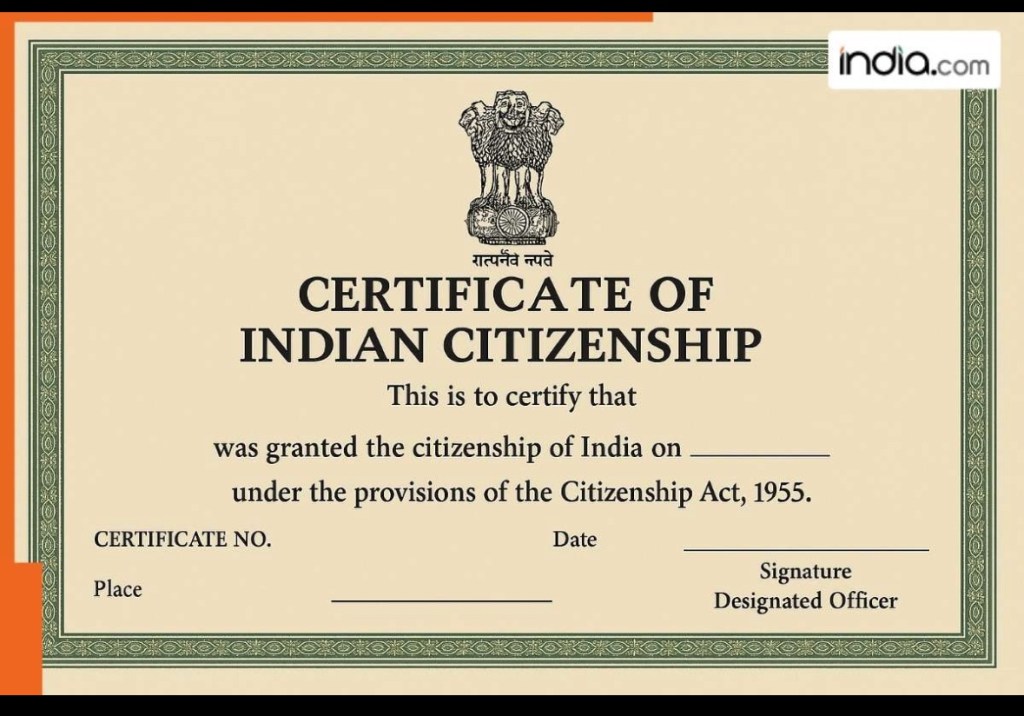
Not Aadhaar card, PAN card or Ration card will prove Indian citizenship;
http://dhunt.in/11aIF6

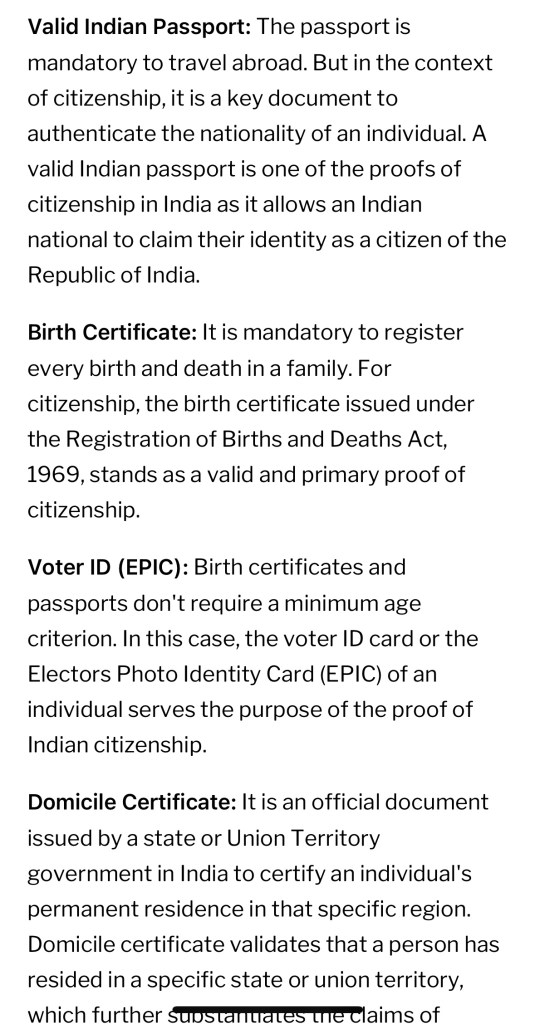
Not Aadhaar card, PAN card or Ration card will prove Indian citizenship; only these documents will, and they are: 

Look at the list above and consider hiw likely that an ordinary citizen living somewhere in the villages of India would possess even one or two of them nor have any reason or incentive to apply for and possess any of them. 

Why would a farmhand, labourer, coolie, journeyman, street vendor, day wage earner in India ever want to apply for a passport ? 

Birth certificate : does the poor man on the street or in some remote village in Bihar — when a child is born in the family — even know where and how to apply for a birth certificate from some non-descript panchayat-located Registrar of Births and Death Office? Why would he journey a whole day just to go and fill forms he doesn’t understand to apply and stand in long queue to get a birth certificate? 

Domicile Certificate : even I don’t know what the hell is the purpose of this silly document , who is the public authority to issue this , how to apply for it and what elaborate paperwork and rigmarole I have to suffer to provide to obtain this certificate ! 

Voter ID EPIC ! This is epic rubbing salt to wound indeed ! To ask me to produce this document while the Census Authorities are today making me run and scramble already from pillar to post to procure this document by furnishing them one or another of the other 3! 

This situation is absurd and so surreal! It is classic Kafkaesque India Babudom, yes, and at its most formidable implacability! 

For God’s sake , please make up your mind, your Majesty, the GoI ! Give me only a single simple-to-get, fool and tamper proof , one-time , permanent and lifetime document proving I’m a citizen of India and loyal son of her soil. And thereafter can you please let me live in peace ☮️, without let or hindrance from you! 🙏

Sudarshan Madabushi

தொல்லை இன்பம் (“thollai inbam”): an oxymoron for Krishna Bhakthi that Peria-Azhwar knew only too well!

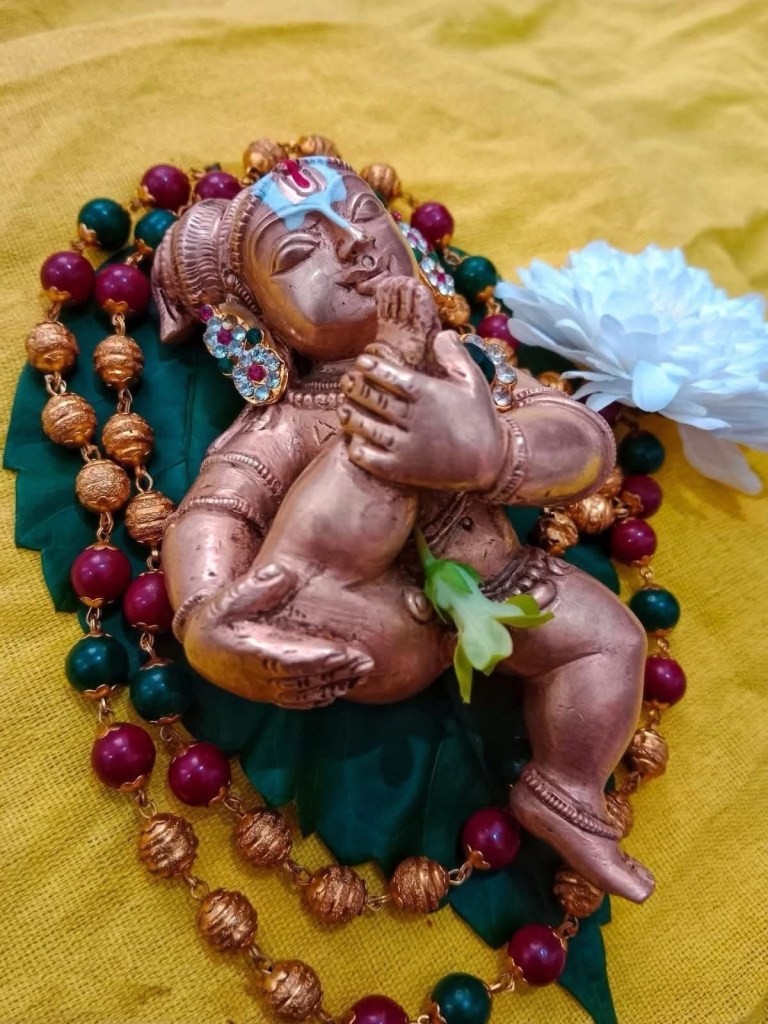
Here is a “paasuram” from Peria-Azhwar’s “tirumozhi” that I consider is an utterly enchanting still-portrait of Krishna Leela theme expounded in the Srimadh Bhaagavatham. You must read it with the portrait of Bala Krishnan above etched in your imagination.

வெண்ணெய்விழுங்கிவெறுங்கலத்தை
வெற்பிடையிட்டு அதனோசைகேட்கும்
கண்ணபிரான்
கற்றகல்விதன்னைக்
காக்ககில்லோம் உன்மகனைக்காவாய் *
புண்ணில்புளிப்பெய்தாலொக்கும்தீமை
புரைபுரையால்இவை
செய்யவல்ல
அண்ணற்கண்ணானர்
மகனைப்பெற்ற
அசோதைநங்காய்! உன்மகனைக்கூவாய்

—- யெரியாழ்வார் 2.9

Your little boy ate up all the butter from our empty pots,
He climbs mountains and makes loud noises just to show off!
We can’t even protect the knowledge we worked hard to learn –
So please, Yasodha, you take care of your son.
Just like how sour things make wounds worse,
His naughty acts are painful and hard to tolerate.
You, the mother of the boy with beautiful eyes,
please call him back and stop him!”**

In this verse Periyazhwar assumes the “bhaava” of a Gopasthree — one among the small bucolic community of simple-minded cow-maidens in the hamlet of Gokulam. She is fed up with the brattish pranks of little Krishna. It is a gentle complaint to Mother Yasodha about young Krishna’s mischievous behavior, conveyed however with a sort of wry indulgence, affection and humor.

***********

Many a stalwart Sri Vaishnava Tamil theologian in the past has commentated (‘vyaakhyaana-karta’) on the Azhwar’s “paasurams” in the Naalaayira Divya Prabhandham hymns such as this one. And it is thanks to their delightful expositions that today we are able to appreciate the depth, intensity, complexity and esotericism of Krishna Leela and Krishna Bhakthi, the two principal leitmotifs of Maharishi Vyaasa’s Srimadh Bhagavagtham.

There are two phrases in the above verse that seem very tantalising, why, even puzzling to a reader like me, unschooled in the scholarly “vyaakhyaana” of the Divya Prabhandham Acharyas:


கற்றகல்விதன்னைக்
காக்ககில்லோம் உன்மகனைக்காவாய் *

புண்ணில்புளிப்பெய்தாலொக்கும்தீமை
புரைபுரையால்இவை
செய்யவல்ல

The first expression is loosely translated as “we have lost the knowledge we worked hard to gain”. An ordinary reader may ask: What knowledge of the gopasthree is the Azhwar talking about ? The second phrase also raises the question at once in our minds: What is the “sour thing” that aggravates wounds of the gopasthrees?

The traditional commentators shed fascinating light on these two questions. Below is attempted a rough paraphrase of mine about what they explain.

************

There are two dimensions to the way we humans lead our lives and go about our countless activities on earth. One is called “vyavahaarika” or “loukeeka“. The other dimension is called “adhyaatmika“.

In the vyavahaarika or loukeeka world, we are fully engaged with mundane and secular affairs — i.e. earning a livelihood, working endlessly to provide security and comfort for our families, getting ahead in our careers and vocations, and seeking all manner of material ambitions and fulfilment. In such lifelong endeavour, we are all deeply committed to fulfilling our karmic obligations.

Then there is the other dimension called “adhyaatmika“. In this world, we sometimes find ourselves — albeit only rarely, fleetingly, suddenly and momentarily — freed totally from “loukeeka vyavahaarikam” i.e. all our secular obsessions, committments and concerns. In such rare moments we experience ineffable sense of divinity… a strange, inexplicable and overwhelming sense of bliss … “a joy that passeth understanding”. No ostensible reason for such momentary bliss and lightness of pure being can be fathomed. It is neither attributed to this or that object, sensation, thought or impression.

In that “adhyaatmika” moment, everything seems to stands still. All our other normal life and “loukeeka” activities get totally disrupted and come to a halt. We are unable to focus on day-to-day chores and duties… Our quotidian routines simply freeze. It is in those moments of near-mystic stillness in which everything about the world and ourselves is simply erased from consciousness… We stand transfixed in the moment of bliss not knowing what we are experiencing.

***********

The Peria-Azhwar verse above refers precisely to such a disruption of the gopasthree’s vyavahaarika activities and her loukeeka world being turned upside down! She goes thus to Krishna’s mother Yasodha, complaining that everything in her humdrum regular cow-maiden life, her values, her daily regimen and all her sense of right and wrong are being constantly distracted and disrupted by the little Krishna — by his enchanting mischief and divine gambols in the village of Gokulam.

In the context of the poem, the gopī (or gopasthree) is humorously complaining to Yashodha (Krishna’s mother) about his trouble-making ways. The “knowledge” she is talking about isn’t any academic or scholarly knowledge, but her humble, workaday, vocational concerns — i.e. the “vyavahaarika” dimension of dailly life which is being disrupted every now and then by Krishna. What she means by “knowledge” refers to how she manages daily tasks, runs the household, handles the business of vending butter, curd and milk for a living, and distinguishes between right and wrong behavior in her ordinary cow-maiden’s existence. Her complaint is that Krishna’s mischief — like stealing butter, breaking pots, and charming the village belles and damsels — renders all her efforts to carry on her humble trade in an orderly, disciplined manner.

The implication here is that Krishna’s divine presence overwhelms all worldly knowledge and routines (vyavahaarikam), making the gopasthree lose herself in loving devotion to him alone, forgetting every other concern… which is exactly the state of “adhyaatmikam” that the phrase கற்றகல்விதன்னைக் காக்ககில்லோம் denotes.

So, the “knowledge” spoken about here is worldly workaday knoweldge which the gopī has cultivated but which has now been rendered useless because Krishna’s magical exploits upends everything in the course of even day-to-day living. The phrase is thus expressed, half in jest and half in awe. It is meant to convey the meaning that no matter what she knows or however hard she tries, the gopasthree simply can’t cope with Krishna’s overwhelming, mischievous charm.

************

The other phrase that at first glance is also puzzling is புண்ணில் புளிப்பெய்தாலொக்கும் தீமை புரைபுரையால் இவை செய்ய : the “sour things that aggravate wounds”. It is indeed a rather strange metaphor is used in this verse.

In everyday life, applying something sour (like lemon juice or tamarind) on a bruise or wound causes stinging pain and makes the wound worse…. We can recall that common idiom in English language, “rubbing salt into the wound“. It is similar idea that the above Tamil expression too conveys. The poet, Periyazhwar, uses this imagery to express how Krishna’s ceaseless mischief-mongering goes on piling up on the gopasthree’s troubles and embarrassments. It’s like rubbing salt to wound.

For her, the “wounds” are pain, trouble and emotional distress caused by Krishna’s constant playful pranks (stealing butter or breaking pots, letting the calves devour all their mother-cow’s udders, frolicking with fellow-cowherd boys.. and so on). The “sour things” are Krishna’s non-stop mischievous actions that add to the daily stress. Just as a sore gets more painful with something sour, the gopī’s frustration grows each time Krishna does something new that is outrageously naughty— thus, she feels her dignity and peace are being repeatedly “wounded” by him.

So, this Tamil phrase is not about any physical wound nor about actual sourness; it’s a vivid way to describe how Krishna’s relentless mischief — “cheshtitham” — makes her day-to-day life more difficult and emotionally challenging. The metaphor highlights her feeling of both helplessnes and love mixed together, making things very complicated for her.

************

There is in the Tamil language another exquisite phrase which in fact graphically and most accurately helps us in understanding the mixed feelings of love and exasperation expressed by the gopasthree (impersonated by Sri Peria Azhwar).

The word is ““தொல்லை இன்பம்” (thollai inbam).

This expression is superb shorthand used to describe what the original verse of the Azhwar expresses through its vivid imagery and delighful emotional nuance. An oxymoron like thollai inbam is perhaps the only nearest approximate way to adequately describe that bitter-sweet complex nature of Krishna Bhakthi tinged as it always is with an element of exasperation.

The oxymoron is not directly from Periyazhwar’s own vocabulary, but over centuries it has evolved into fine interpretive coinage by Divya Prabhandham commentators and is even today commonly used to distill the complex bittersweet joy that is found in the Azhwar’s poetry.

“Thollai inbam” is indeed an apt and deeply evocative oxymoron. It reflects the dual experience so often found in Tamil devotional poetry: the devotee’s life is filled with Krishna’s playful troubles (“thollai”), which can be exasperating, confusing, and even overwhelming—but these very troubles are what bring the deepest joy (“inbam”), intimacy, and meaning to the relationship with the divine. It is in fact the sum of complex feelings though which is experienced “vyavahaarika” being eclipsed by “adhyaatmikam”.

Indeed,  “தொல்லை இன்பம்” (thollai inbam), is a uniquely Tamil poetic idea that means “the trouble that brings joy or the nuisance that brings bliss“. Periyazhwar in his paasuram thus describes the mischief and pranks of young Krishna as a “thollai“—an irritation, nuisance, or constant trouble—but one that is filled with love and sweetness, and therefore becomes “inbam“—joy or delight.  For the gopasthree, Krishna’s actions certainly disturb her daily routines and cause her to rail and complain about it to Yasodha, but at the same time, those very disturbances fill their lives with meaning, laughter, and tender affection. The “wound” Krishna causes is instantly sweetened by the delight of experiencing his divine play, making even the struggle itself a cherished part of their lives.

So, thollai inbam, an oxymoron, perfectly describes the paradoxical pleasure that comes from the loving mischief of the divine, especially when played by someone as dear as the avatar of Krishna.

************

The oxymoron “thollai inbam” is explicitly used in a paasuram by another Azhwar — Sri. Kulasekhara Azhwar and which, therefore, clearly tells us that Tamil Azhwar poetry and the wider bhakti tradition in the schemata of Divya Prabhandham hymnology, often present this fascinating dynamic tension of Krishna Bhakthi in the exactly the same way: i.e. as love for Krishna that is never pure sweetness nor faultless bliss, but is always tinged with a sense of helplessness, playful plaint and railing, deep longing, and loving frustration.

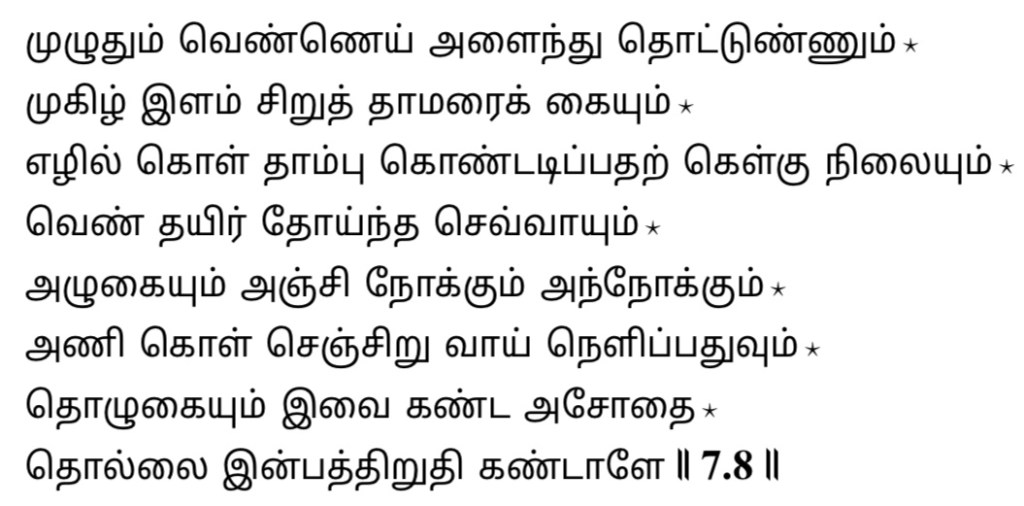
muzhudhum veNNey aLaindhu thottuNNum

mugizh iLam siRuththAmaraik kaiyum

ezhil koL thAmbu koNdadippadhaRk(u) eLgu nilaiyum

veN thayir thOyndha sevvAyum


azhugaiyum anji nOkkum annOkkum

aNikoL senjiRu vAy nELippadhuvum
thozhugaiyum ivai kaNda asOdhai

thollai inbaththiRudhi kaNdALE

The last line in the verse above is — “thollai inbaththu iRudhi kaNdALE!

The mother Yasodha’s own experience of “adhyaatmikam” as she feasted her eyes upon her child Krishna is expressed here by Kulasekhara Azhwar.

She experienced the boundary of experiencing “paramapadham” — the acme of spiritual bliss. Such bliss has no boundary, no limits, it knows no time and knows no waning. Paramapadham is cited to be without any boundary in authentic Vedic texts such as the Anandavalli and Brghuvalli passages in the Taittiriya Upanishad.

It is spiritual ecstasy experienced by nithyasuris [permanent dwellers of paramapadham] and mukthaatma-s [those who attained paramapadham after being liberated from samsara] .

But the Azhwar in this verse says that even such bliss as experienced in paramapadham does have boundaries since there the liberated souls cannot experience the rare bliss of witnessing Krishna as a frolicking boy, merrymaking and playing pranks, stealing butter and gambolling amongst the village maidens of Gokulam.

Can they see him as a baby crying? No! Can they see him performing anjali, beseeching his mother Yashodha not to punish him for stealing butter or milk? No! Therefore, the Azhwar convinces us here that even the bliss in paramapadham has limits and boundary…. it is not unsurpassed.

Here on earth, in Gokulam too, yes, there is bliss of Bala Krishnanubhavam — true. But then this bliss is too tinged by a sense of exasperation, fretting and stress caused by the mischief of irrepressible Krishna Leela! So, there is, of course, a nameless boundary, indefinable limit to bliss in this experience too…

The upshot of both the above paasurams of Peria Azhwar and Kulasekhara Azhwar is thus only this:

The gopis, Yasodha, and the poets themselves constantly oscillate between delight and distress, their exasperation transformed by love and devotion into profound sweetness.

“Thollai inbam is not just a poetic flourish but a powerful expression of the real, lived experience of Krishna Bhakti—one that is bittersweet, filled with longing and laughter, complaint and contentment, all at the same time. This deepens our grasp of bhakti by showing that true devotion is found not in escaping the emotional messiness of love, but in saturating oneself in its complexity until even trouble tastes sweet.

Words alone rarely capture such nuances, but “thollai inbam”—troublesome joy—gets very close indeed. The oxymoron reveals to us that that Krishna’s devotees accept, and even cherish, the bittersweet and paradoxical nature of his presence: a love that wounds and heals, frustrates and fulfills, all at once. Such is the unique, enduring flavor of Krishna Bhakti in Tamil as well as pan-Indian devotional literature.

***********

Oothukadu Venkata Subbaiyer’ was a brilliant Tamil kavi and composer in the Carnatic music world. He was a man of creative brilliance and encyclopedic erudition and lived approximately between 1700-1765.

One of his masterpieces is a composition that even today music lovers simply find delectable beyond words — “தாயே யசோதா” (“Thaaye Yashoda”). It is lilting kriti which humorously and lovingly captures Krishna’s “thollai inbam” (troublesome joy) as experienced by the gopasthrees of Gokulam. The song was rendered masterfully by that outstanding Carnatic musician of yesteryears , Sri.Musiri Subramani Iyer. Please do listen to the YouTube recording at the link given right below). தாயே யசோதா

தாயே யசோதா
உந்தன் ஆயர் குலத்துதித்த மாயன்
கோபால கிருஷ்ணன் செய்யும் ஜாலத்தை கேளடி (தாயே)

தையலே கேளடி
உந்தன் பையனை போலவே இந்த வையகத்தில்
ஒரு பிள்ளை அம்மம்மா நான் கண்டதில்லையடி (தாயே)

(சரணம்):

காலினில் சிலம்பு கொஞ்ச கை வளையல் குலுங்க
முத்து மாலைகள் அசையத் தெருவாசலில் வந்தான்
காலசைவும் கைசைவும் தாளமோடி சேர்ந்துவர
நீலவண்ணக் கண்ணனிவன் நடனம் ஆடினான்
பாலனென்று தாவி அணைத்தேன், அணி மாலை இட்டவன் போல்
வாயில் முத்தம் இட்டானடி
பாலனல்லடி, உன் மகன்,
ஜாலம் மிக செய்யும் கிருஷ்ணன்
நாலு பேர் கேட்ட சொல்ல நாணம் மிகவாகுதடி (தாயே)


Thaaye Yasodha
O Mother Yasodha,

உந்தன் ஆயர் குலத்தில் பிறந்தவன், கோபால கிருஷ்ணன், செய்யும் ஜாலங்களை கேளடி தாயே
your son Gopala Krishna, born in your noble cowherd clan—
please listen to all the magical mischiefs he does!

தையலே கேளடி
Dear lady, listen—

உந்தன் பையனை போலவே இந்த வையகத்தில் ஒருபிள்ளை காணோம் தாயே
There’s no child anywhere in this wide world who matches your boy, Mother!
(He is truly one of a kind!)

காலினில் சிலம்பு கொஞ்சும், கை வளையல் குலுங்கும், முத்துமாலை அசையும்…
His anklets jingle sweetly on his feet, his bangles clink on his tiny hands,
and his pearl garlands sway as he walks…

பேரழகு கண்ணனவன் வருவான்
This beautifully charming Krishna walks down our street…

சாலியுடன் வந்து நின்று, சாப்பாடு சாப்பிடாமல், வாயிலே முத்தம் இடுவான்
He comes into our homes, stands right next to the meal,
and instead of eating, he leans in and kisses us
full on our lips!

பால பசும்பாலை எடுத்து, பாத்திரத்தில் வைக்காமலே,
தாளாட்டும் நிமிடத்தில் வாங்கிப் பசிக்கிறான்

Without waiting, he snatches fresh milk straight out of the pots
—even as we’re rocking the cradle or looking away—and drinks it, saying he’s hungry!

கண்ணில் கண்டால் தெரியாது, குருந்த மலர் போலே அழகு,
மண்ணில் போனாலும் தெரியாது, மாடம் ஊஞ்சல் ஊர்வான்

He sparkles brightly like a blossomed kurunthu flower—he’s exquisitely handsome,
light-footed to the point you can’t trace him—
One moment he’s on the ground, next moment swinging on a high terrace swing!

பாவம் பாவம் என்று சொல்லி, பச்சை நிலை பொற்கட்டிலும்
வீடிலிருந்து விளையாடி மீண்டும் திரும்பி வருவான்

After creating bedlam at someone else’s house,
he walks away with an innocent “What a sin, what a pity!” look—
Then he comes back home and plays joyfully, as though nothing happened.

தன் தவம் செய்த புண்ணியம் எல்லாம் உடைத்து விடுவான்
நீயும் யாருக்கோ சொல்லி நாணத்தில் தகைத்திடுவாய்

Whatever spiritual merit his actions may earn—he breaks it halfway through!
And when others find out, you just smile nervously, too shy to explain anything!

அம்மா, உன் மகனை யார் வளர்க்க முடியும் சொல்லடி
Mother, who can possibly raise such a child?!
Tell me, who else can handle this bundle of divine mischief?!

காட்டில் வந்து விளையாடி, கறவைகளுக்கு இசையாழும் வாசிப்பான்
He plays in the forest and serenades the cows by playing sweet melodies on his flute.

நீல நிறம் பூண்டவன், நிறைந்த அன்பில் ஆனந்தம் கொண்டவன்
பல விளையாட்டுகள் செய்வான் பலவிதமான

Adorned in his dazzling blue hue, full of love and overflowing with bliss,
He plays countless pranks—each more unique than the last!


தாயே யசோதா…
So, O Mother Yasodha—please hear the charming “troubles” your Krishna causes!
We’re troubled, but we’re enchanted. We complain, but we laugh.
There’s thollai (trouble), but also inbam (joy)—because it’s Krishna after all.

This song is a marvellous melodic celebration of “thollai inbam”—that oxymoronic emotion where the mischief of divinity that exasperates also gives at the same time, ineffable temporal joy. It captures the gopasthree’s irritation, , but also her love and devotion for Krishna which overrides her frustration and heartburn. Every complaint against Krishna tirggers a knowing smile in Yasodha for she knows that every prank is a divine blessing in disguise.

************

Only a very few poets and novelists in the Western world we know have been able to echo this emotional duality of Love. But since their conception of Love does not sublimate itself beyond the carnal plane, they often lack the playful, devotional, and child-God mischief dimension so central to the Indian “thollai inbam.” Instead, they frame it as the “sweet sorrow” or “bitter joy” of erotic love:

Parting is such sweet sorrow, that I shall say good night till it be morrow.” Shakespeare (Romeo & Juliet)

The course of true love never did run smooth.” Shakespeare (A Midsummer Night’s Dream)

Roses have thorns, and silver fountains mud; / Clouds and eclipses stain both moon and sun, / And loathsome canker lives in sweetest bud.” Shakespeare (Sonnet 35)

She dwells with Beauty—Beauty that must die; / And Joy, whose hand is ever at his lips / Bidding adieu.” John Keats (Ode on Melancholy)

The above sampling of verses suggest that the troubles, delays, and misunderstandings of love are not to be avoided—they are what make human love memorable, deep, and even addictive. This is a close equivalent to the Tamil devotional “thollai inbam”— the joy found not despite, but within, the mischief and trouble love for the divine brings in its wake. While the exact cultural form of “thollai inbam”—the playful, loving exasperation towards a mischievous child-God—is uniquely South Indian, the oxymoron of joy-in-trouble is a universal theme.

Sarvam Shri Krishnaarpanam!

Sudarshan Madabushi

The song of the Madras “IIT-ians”: a song of hope or lamentation?

தமிழ்நாட்டில் உள்ள 125 ஆறுகளின் பெயர்களையும் வைத்து ஒரு பாடலை உருவாக்கி வெளியிட்டிருக்கிறது மெட்ராஸ் ஐஐடி கல்வி நிறுவனம். ஆறுகளின் பெயர்களை கேக்கும் போது நமது உடலும் உணர்வும் சிலிர்க்கிறது பெயரோ – ஆறு அவையே – நூறு

Listening to this song filled my mind with mixed feelings .

As a schoolboy in the 1960s I remember walking or bycycling 🚴 to school along the River Adyar .

On a clear day I could see the river flow by in all its silent glory … the waters were clean , the river banks were clear , not a single building or concrete structure anywhere … There were only two playing grounds on the banks . The rest of the riverbank on both sides of the river was covered with wild grass and trees .

The river estuary along the Bay of Bengal could be seen from the river banks as the Adyar travelled gently under the bridge and disappeared into the sea hedged in on the northern side by the wide , clean unlittered beach sands known as foreshore estate and on the southern side by the dark, sylvan woods of the Theosophical Society … As school kids I remember that on an odd adventurous day, we would saunter gaily along the river banks trying to catch sight of fish 🐠 and migrant birds 🦅….

Today , the Adyar riverbank has vanished . From the road leading to my school I can no longer see the river … It’s all covered chockablock by ugly concrete jungle — structures of all shapes and size. The old ecology has vanished. What I see now is its monstrous ghost.

So, this IIT Madras song leaves me with roiling mixed and wan feelings .

I am unable to say if this is a song of celebration or a song of lamentation? Do I feel joy listening to this song or is it sad reminiscence that floods my mind with despair?

This song is no doubt well-intentioned . I know it is a clarion call for action and responsibility. It is meant to give us all hope and resolve and rouse us to do our best to bring 125 rivers, rivulets, streams and brooks of Tamil Nadu back to life … It is a song to bring awareness amongst us that the situation of our rivers in our state is pathetic; nonetheless, not all is lost; it’s still possible to restore these scores of rivers to their past pristinity and good health.

So, I for one will be the first to join in the collective prayers of Tamilians that, at least in the time of our sons and daughters and grandchildren, the great hope for our rivers is realised some day.

———— ————— ————-

In Tamil Nadu we all see there is so much pride being expressed with such great bombast about Tamizh Thaai mozhi. It often makes me wonder silently who really is the mother of Tamil lands ? The language — மொழி — or the lands’ life-giving, life-sustaining rivers : நதி? Why don’t we Tamil people take at least half as much pride in our rivers as we do in our language ?

If மொழி is பெற்ற தாய் , we must realise that நதி is வளர்த்த தாய்…We Tamils are being overly partial to our biological mother but are culpably guilty of utterly neglecting our foster mother.

If we cared for வளர்த்த தாய் even half as much as we do about our பெற்ற தாய், wouldn’t we all be showing far more zeal and concern towards protecting and preserving the good health of our rivers as much as we go around boasting about our so-called, vaunted love for our great Tamil language?

Sudarshan Madabushi

The “Tolkappiyam” and Melkote Tirunarayanapuram: sombre thoughts

In 2017 , I had darshan of Lord Narasimha the deity on the sacred hill of Melkote . From the ramparts of the temple I took the opportunity to shoot a video clip of the lush green and vast landscape around Tirunarayana Puram. What a marvellous panoramic breathtaking scenery! In Sri Vaishnava sampradayam we call Nature’s beauty as “Bhagavath svarupam”. That’s not only apt but also true ! 🙏💐👏🌟

Naaraayana! Naaraayana!

Although Melkote today is a town that is in State of Karnataka and not in Tamil Nadu , still the magnificent scenery in the video-clip evokes in our mind that famous line from the Tamil classic “Tolkappiyam”: ‘மாயோன் மேய காடுறை உலகம் ‘ .

My revered friend the famous Tamil writer and nonagenarian scholar Sri Indira Parthasarathy (Eepa) reminded me in fact of the Tolkappiyam epigram that in fact encapsulates an ancient Tamil cultural tradition related to Vishnu temples and their natural environs. It’s a brilliant and such an apposite allusion to come up with immediately on watching the video-clip of Melkote … and as only Eepa can do !

மாயோன் மேய காடுறை உலகம்’ — தொல்காப்பியம்

மாயோன் மேய காடுறை உலகம்’ என்பது தொல்காப்பியத்தில் அகத்திணை இயல் பகுதியில் (அகத். 5) குறிப்பிடப்பட்ட ஒரு ஆகப்பட்ட உரை ஆகும். இதில் தமிழர் பண்பாட்டு நிலங்களில் ஒவ்வொன்றும் தனித்த தெய்வம், இயற்கையுடன் இணைந்து குறிப்பிடப்படுகின்றன.

மாயோன் மேய காடுறை உலகமும்
சேயோன் மேய மைவரை உலகமும்
வேந்தன் மேய தீம்புனல் உலகமும்
வருணன் மேய பெருமணல் உலகமும்
முல்லை குறிஞ்சி மருதம் நெய்தல் எனச்
சொல்லிய முறையான் சொல்லவும் படுமே.

முல்லை நிலம்: ரம்யமான காடு மற்றும் மலர்ப்புறவுகளில் காணப்படும் நிலம். இங்கு மாயோன் எனப்படும் திருமால் (விஷ்ணு) பிரதான தெய்வமாகக் கூறப்படுகிறார். “மாயோன் மேய காடுறை உலகம்” என்பது, திருமால் வாழும் முல்லை நிலம் ஆவதாகும்.


• குறிஞ்சி நிலம்: மலை, முருகன் தெய்வமாக (சேயோன்).
• மருத நிலம்: வயல் நிலம், இந்திரன் (வேந்தன்) தெய்வமாக.
• நெய்தல் நிலம்: கடலோரம், வருணன் தெய்வமாக.
இவை தமிழரின் ஐந்திணை நிலங்கள் மற்றும் அவற்றுக்குரிய தெய்வங்களை அடையாளப் படுத்தும் போது குறிப்பிடப்பட்ட வாக்கியங்கள்.

முக்கியக் கருத்துகள்
• மாயோன் (திருமால்) தமிழில் பழங்காலத்திலேயே பிரதான தெய்வமாகக் காணப்படுகிறார்.
• முல்லை நிலம் என்பது “காடுறை உலகம்” என்று அழைக்கப்படுகிறது.
• தொல்காப்பியம் தெய்வத்தையும் நிலத்தையும் இணைக்கும் முறையில் தமிழக பண்பாட்டின் சாரத்தை எடுத்துரைக்கிறது.

மேற்கோள்கள்
• “முல்லை நிலத்தை ‘மாயோன் மேய காடுறை உலகம்’ என்பர்… முல்லை நிலமும் திருமாலாகிய மாயோன் விரும்பி வாழும் இடம்”.
• “முல்லைத்தெய்வம் மாயோன்” என்று தொல்காப்பிய உரையில் தெரிவிக்கப்படுகிறது.

சுருக்கமாக
‘மாயோன் மேய காடுறை உலகம்’ என்பது குறித்த பகுதியில் முல்லை திணை நிலம், அதன் தெய்வமாக திருமாலை, அதனைச் சூழ்ந்த காடுகளை, தமிழ்ச் சங்க பண்பாட்டின் அடையாளங்களாக தொல்காப்பியம் வகைப்படுத்தும் விதமான

Now , the above in English below ⬇️

‘The forest land where Māyon dwells’ — Tolkāppiyam
Verse and Meaning

‘The forest land where Māyon dwells’ is a well-known phrase found in the Akaththinai section of the Tolkāppiyam (Akatthinai. 5), which describes how each ancient Tamil landscape is associated with a specific deity and closely connected to nature.

The forest land where Māyon dwells,  
The mountainous land where Seyyon dwells,
The fertile land where the king dwells,
The sandy shore where Varunan dwells:
Mullai, Kurinji, Marutham, Neithal in this order,
Are the divisions as told in tradition.
Explanation
  • Mullai Land: Refers to forests and groves. Here, Māyon, known as Thirumal (Vishnu), is considered the principal deity. “The forest land where Māyon dwells” means Mullai land is presided over by Thirumal.
  • Kurinji Land: Mountainous region, where Murugan (Seyyon) is the deity.
  • Marutham Land: Fertile agricultural fields, associated with Indra (the king).
  • Neithal Land: Coastal areas, with Varunan as the presiding deity.

These lines identify the five Tamil landscapes and their corresponding deities as described in ancient Tamil culture.

Key Points
  • Māyon (Thirumal/Vishnu) was considered a primary deity in ancient Tamil culture.
  • Mullai land is referred to as “the forest land” in these texts.
  • Tolkāppiyam connects land types with their respective deities, reflecting the core of Tamil tradition.
References
  • Mullai land is called ‘the forest land where Māyon dwells’ … Mullai land is the place beloved by Māyon (Thirumal).”
  • “The deity of Mullai land is Māyon,” as stated in Tolkāppiyam commentaries.
In summary

‘The forest land where Māyon dwells’ is an expression describing Mullai thinai (one of the five Tamil landscapes) and its deity Thirumal (Vishnu), showing how Tolkāppiyam systematically connects landscapes and gods as cultural markers of ancient Tamil society.

A sharp observer who has read the above might ask : Only 4 landscapes are described here but why is it being listed as 5 ?

The answer given by Tamil scholars is a bit circumlocutory but nonetheless very nuanced:

The reason four landscapes are described in the earlier verse but the system is known as five landscapes (five tinais) is because the classical Tamil concept of Thinai traditionally classifies the land into five ecological and poetic regions, each associated with distinct geography, human activity, mood, and deity. These five are:

  • Kurinji (mountainous region)
  • Mullai (forest/pastoral region)
  • Marutham (agricultural/fertile plains)
  • Neithal (Neydal) (coastal/sea region)
  • Palai (desert/wilderness region)

The verse cited earlier mentions only four (Mullai, Kurinji, Marudham, Neythal) because Palai is often treated separately or symbolically and sometimes omitted in poetic examples, as Palai is a dry, arid, and desert-like terrain formed by the transformation of other landscapes during drought—hence not always described as a naturally distinct land type like the other four.

In Tolkāppiyam and Sangam literature tradition, the five-fold division of land (Aindhinai) forms a fundamental descriptive framework, corresponding to different emotional themes and deities in classical Tamil poetry and culture. Palai, the fifth thinai, is associated with hardship and separation, and therefore often linked with the theme of separation (portrayed as a transformed landscape rather than a baseline one).

Thus, the “five” reflects the full traditional set of land types, although sometimes individual verses or discussions focus on fewer for poetic or thematic reasons.

  • The five-fold land division, its association with human emotion and geography in Tolkāppiyam and Sangam poetry is well documented in research on the ancient Tamil poetic landscape.
  • Palai thinai’s relative omission from some poetic examples is common as it is considered a transformation from other lands and linked to specific emotional states rather than a distinct geographical entity.

————— —————— ————

What conclusion do I personally draw from all the above explications of the Tolkappiyam?

The moral of the Tolkappiyam that I would like to draw from the above is this :

The deeply cherished ancient Tamil tradition was not only to build, protect and upkeep the sanctity and condition of temples but also to preserve the natural beauty of the temple’s environs — it’s streams, lakes, trees, fish and fauna.

Today , in Tamil Nadu we, alas, only witness the all-round degradation and desecration of both temples and their natural surroundings.

Have we Tamils lost our souls —- and our தமிழர் பண்பாட்டு ?

Sudarshan Madabushi

Democracy is not in the voting but in the counting … and well before counting , it’s in the voter listing

Very pertinent points raised in this The Hindu Op-Ed today. 

It all boils down simply to the fundamental problem related  to certifying citizenship of this country. 

Aadhaar card was touted as the technological marvel that had solved the problem permanently. We all remember how 10-12 years ago, all citizens were made by the government to run helter-skelter scrambling and rushing into thousands of Aadhar online registration booths and centres. 

A year later , after the countrywide mammoth process was done with, the Government triumph shyly announced that almost 98% of India’s population now had Aadhar ID. It was the Aadhar card ID that then became the lynchpin for the grand DBT strategy (direct bank account transfer) of taking social welfare payout-benefits, banking and financial services (both of the Govt and the private sector) to the vast masses of the country who were hitherto known to be excluded. 

If only that had been true , there would be no need at all for Voter ID, Ration Card, School leaving certificate, passport. 

The question I ask myself today while reading this The Hindu Op-Ed is this : 

If the Govt. finds itself able to place trust in the Aadhar ID as sufficient proof of identity for citizens claiming various social and public welfare benefits, doles and subsidies, why does it view the same Aadhar card as suspect when it comes to granting them the right to vote ? 

Why aren’t the wise men of the Supreme Court asking the same question ? 

Sudarshan Madabushi