An engineer friend of mine this morning forwarded it to me and exclaimed in confounded astonishment!
“This is very difficult to comprehend! A food delivery company which went public only a year ago is valued more than ONGC!!”
It astonished me too but I was not confounded at all since I am a Chartered Accountant with 37 years of working experience in Corporate and Project Finance in both India and abroad and am very familiar with the rather arcane, shifty specialism called Company Valuation. Over the years I have discovered a few truths and half-truths — and quite a few fanciful myths too — about this special branch of High Finance in the world …. enough to have formulated a few theories of Valuation of own.
With one such original theory of my own, I was able to explain in simple terms to my dear friend the Zomato-ONGC paradox-inside-a-conundrum- inside-an-enigma.
Here below ⬇️ is the theory in outline:
Value is relative … And has a lot to do with human psychology and perception.
Zomato delivery service is part and parcel (sorry for the punning) of the consumer’s immediate, tangible, palpable and pleasant retail experience.
The Zomato delivery man promptly delivers right at the doorstep whatever the consumer has eagerly ordered for and is awaiting it as a yummy , yummy goody … that is perceived to be true value.
ONGC on the other hand is not felt similarly as consumer retailed experience… It’s a perceived as a far off corporate monolith somewhere out there digging for ONG in the ocean depths or plying giant oil tankers … Why, even at the petrol pump station, People in fact when they shell out a ₹100/- or more per litre of gas to fill their vehicle fuel tanks, they feel it not as any pleasant consumer experience but as consumer burden. The product is received and experienced only with a grumble .
The difference between Zomato and ONGC is precisely that : one is yummy , the other is grumpy . And that gets reflected as difference in valuation too.
My friend thought my theory to be very hilarious! But he also understood exactly what I was saying to him.
Finance and Financial Services Industry is a pseudoscience when it is not an outright scam. This great truth was discovered in the 2008 financial meltdown in America and its continuing aftermath lasting to this very day is felt worldwide with governments tottering and lurching in near financial crises that are hovering just around the corner.
Corporate Finance is a very convenient truth which is why people simply cannot do without it .
Even if God didn’t exist, people will want to invent Him is a very old quip. Modern monetary truths —- of which Company Valuation is one important one — doesn’t really exist as a genuine body of knowledge but then we all still have to invent it and reinvent it as one just to be able to carry on the business of life.
My engineer friend seemed convinced and appreciated my piece of “gyaan” for the day.
I thanked him 😁🤗…. And told him “Please make this viral by calling it a new theory of Company Valuation by guru M K Sudarshan ! 😂”
Let it not be misunderstood that today in the Democratic Republic of India, any body — not even an obscure, even maybe obscurantist writer like me — would be foolhardy enough to argue for the Manu Smriti to replace the Constitution of India. That would be sheer political sacrilege today in India… No, none of the views expressed here by me should be misinterpreted as any sort of call for cultural revanchism in bringing the spirit of Maharishi Manu back into political vogue or social practice. Leave Manu’s spirit aside…. yes … but do respect a few of his profound ideas.
In today’s political discourse in India, the Manu Smriti is regarded altogether as “untouchable“… i.e. it is as untenable and repugnant as pre-Galileo astronomy might have been when the Church posited the universe to be geocentric. Indian social norm and life has travelled far in the last 75 years after Independence. Today it revolves firmly and heliocentrically — and can never swerve from that very narrow orbital path — around the glorious sun of the Indian Constitution. So, it should be made clear by me here that the Manu Smriti is being referred to only in the specific context of the “Elite Overproduction” problem of modern societies that Peter Turchin, the American sociologist has analysed so deeply in his thesis “End Times: elites, counter-elites, and the path of political disintegration” (2023).
Manu Smriti did divide society into four varnas with distinct duties and rights assigned to each, according to their natural aptitudes (guna) and actions (karma). But the motive behind Manu’s “social engineering” was never to create “social dicrimination”. By explicitly prescribing different expectations, duties, and privileges for each class, Maharishi Manu created a framework in which aspirations for status, power, and vocation were “restructured” to suit broader social stability, thus aiming to avert widespread elite rivalry (“elite overproduction”). He cautioned that deviation from one’s prescribed role would lead to societal disorder. The Smriti thus was only reflecting a deliberate effort to minimize disruptive competition and align individual ambition with collective dharma.
The principle echoed in the Manusmriti, in fact, is clear: it stresses maintaining harmony and order, both by rewarding conformity to duty and punishing deviation, ensuring that no segment of society overreaches its prescribed sphere.
*********
In the Western world today, as Peter Turchin explained in his book, there are many forces in society operating powerfully to exacerbating the problem of “elite overproduction” which Maharishi Manu had clearly anticipated many millennia ago when he wrote his seminal Smriti.
What are those great forces?
I have been able to recognize at least four of them myself. There are perhaps many others too only far more percipient social observers than I — such as Turchin — can shed enough light upon. They are:
(a) AI, artificial intelligence
(b) Protectionism and Nationalism
(c) Immigration and
(d) Social Media
************
(a) AI, artificial intelligence: According to Peter Turchin and related analyses as AI takes over routine cognitive tasks previously reserved for credentialed elites, many who expected elite careers may face underemployment or marginalization, increasing social tensions around status and opportunity. AI and automation threaten to displace many traditional elite-aspirant jobs (e.g., lawyers, accountants, management consultants), reducing the number of high-status roles available relative to the growing number of highly educated aspirants. In fact, Turchin warns that generative AI and other advanced technologies will create a “huge destabilizing shock” in social systems, intensifying intra-elite competition and elite frustration, which are core drivers of instability in his model of elite overproduction. The “musical chairs” metaphor applies: with a roughly fixed number of elite positions, adding AI-driven displacement could mean even more players chasing fewer chairs, escalating conflict and alienation among elite aspirants.
(b) Protectionism and Nationalism: Worldwide today, and more especially, in America, Europe and United Kingdom, there is marked trend in Governments favouring a return to Protectionism and Nationalism. Donald Trump’s “tariff war” on the rest of the world is classic illustration of this trend. The question thus is: Does the problem of “elite overproduction” in society go away with governments of the world returning to Protectionism and Nationalism ?
Elite overproduction arises, as already explained earlier, when a society produces more educated and highly ambitious individuals than there are high-status positions available, typically due to sustained economic growth, rising educational attainment, and cultural narratives valuing elite success. Protectionism—tariffs, trade barriers, or import restrictions—can limit economic competition from abroad but rarely creates enough domestic elite positions to absorb excess aspirants. In fact, it may reduce economic dynamism and opportunities for upward mobility, increasing frustration among the local elites. Nationalism sometimes channels elite energy into domestic projects or government service, but unless structural reforms increase the number of meaningful elite positions or absorb surplus talent, nationalism risks intensifying intra-elite competition within the nation.
Turchin explains with historical and contemporary examples that when market size contracts due to protectionism, overproduction leads to more elite rivalry, “musical chair” competition, and political disruption—sometimes worse, because the competitive arena shrinks but aspirant numbers remain high.
(c) Immigration: Historically, outward migration allowed societies to “export” surplus elites—for example, Victorian Britain overcame elite overproduction partly via emigration to colonies, which absorbed elite ambition and relieved domestic competition. When talented or highly-credentialed individuals face saturation of elite positions domestically, immigration enables them to seek status, opportunity, and influence abroad, redistributing elite competition internationally. Host countries may benefit from incoming elites who bring skills, capital, and entrepreneurial energy, sustaining innovation and economic growth (see policies like skilled immigration and investor visas).
But there is a dangerous flipside or precipitous downside here. A surge of highly qualified immigrants can intensify competition for elite jobs, especially when combined with domestic elite aspirants, raising the risk of underemployment and credential inflation in the host society. If integration policies are poor or economic opportunities don’t expand, elite immigrants and aspirants may become frustrated, leading to intra-elite and cross-cultural conflict in the new country. This is precisely what is happening today in America, Europe and UK.
In the Manu Smriti, all immigrants into the country of Bharathavarsha were held to be “mlecchas” — outcastes. And the Smriti laid down very clear policies on how native societies or communities must deal with them to avoid the downsides of the immigration surge.
(d) Social Media : Social media exposes users—especially young people—to aspirational lifestyles, success stories, and elite role models, kindling ambitions and expectations that often exceed their immediate societal status or opportunities. The platforms magnify the voices and visibility of elites and successful individuals, which can create a perception that elite status is widely attainable and desirable, fueling competition for limited elite roles. Education and social media combined have empowered many youth to engage in social and political discourse, yet this often leads to disillusionment and frustration when structural barriers prevent actual elite status attainment given limited opportunities. Social media also facilitates the rapid spread of discontent and critique of elites by surplus aspirants, making visible the social contradictions that arise from elite overproduction, and sometimes fuelling political polarization or instability. The Indian example shows that social media has disrupted traditional political narratives, enabling more direct but also more fragmented elite and counter-elite interactions, elevating tensions from elite overproduction dynamics.
In times of Maharishi Manu, there was of course no such invention available called “social media”.
**********
Finally, let us turn attention to India today.
India’s challenge with elite overproductionis acute and worsening, with an educational system producing millions of aspirants for relatively fixed or slowly expanding elite jobs. This mismatch has already led to high unemployment, underemployment, and social tension—making India one of the world’s salient examples of the elite overproduction phenomenon.
Prime Minister Narendra Modi’s vision for an “Atmanirbhar Bharat” (Self-Reliant India) and “Viksit Bharat” (Developed India), articulated especially in recent years culminating around 2025-2047 goals, primarily emphasizes economic self-sufficiency, technological innovation, energy independence, and global competitiveness. Modi’s policy framing largely focuses on building a robust, resilient economy and empowering citizens through entrepreneurship, innovation, and skill development, to create greater opportunities across sectors.
While the discourse stresses inclusive growth and expanded employment opportunities, there is no explicit public acknowledgment or direct policy reference to the sociological concept of elite overproduction—that is, managing the surplus of educated elite aspirants and their competition for scarce high-status roles. The social and political complexities around elite rivalries, credential inflation, or elite surplus as studied by scholars like Peter Turchin do not appear as distinct considerations in official speeches or policy lines identified so far.
The policy path on which India today is focused on is serving an “aspirational India” indeed risks giving rise to elite overproduction sooner or later if it does not also include mechanisms for structuring expectations. As more citizens attain higher education and professional qualifications under the banner of aspiration, the number of highly qualified individuals competing for limited elite roles inevitably rises.
Without social frameworks or institutions to channel these aspirations realistically—whether through accepted vocational diversity, regulated elite numbers, or differentiated social roles—the competition intensifies, causing underemployment and social frustration. Turchin wrote that “Elite overproduction historically leads to increased intra-elite rivalry, political dissatisfaction, and potential instability, as surplus aspirants struggle to find suitable status or influence positions“.
Manu Smriti’sVarnashrama system addressed the problem squarely. It deliberately structured expectations: assigning fixed societal roles and duties suited to natural aptitudes, and limited chaotic competition for elite positions. Removing or aggressively “hollowing out” such social structuring from all of Indian society without replacements is certainly going to risk repeating these dynamics of “elite overproduction”.
*********
What are the broad implications for India’s Development Path as it heads towards 2047 ?
India’s expansive goals of economic growth and democratized opportunity need complementary policies addressing managing elite expectations and diversifying opportunity structures beyond just education and urban jobs.
Elevating vocational training, promoting blue-collar work dignity, and creating credible alternate elite roles (e.g., entrepreneurship, rural leadership) can help balance elite aspirations against actual elite opportunities. Without such balancing mechanisms, the democratization of higher education and aspirational uplift may paradoxically deepen elite surplus, risking social fragmentation and instability.
India must embrace all that is best found in the wisdom of the Manu Smriti… and adapt it to the need of our times…. and not disrespect it as some obscurantist Brahminical text while throwing the baby out with the bathwater. Realising aspirations in India will have to go hand-in-hand with the need to structure those aspirations and expectations carefully, echoing ancient wisdom found in systems like Varnashrama or its modern variants and adaptations, if elite overproduction and its social risks are to be avoided. Yes, pursuing a policy path that serves an “aspirational India” without simultaneously structuring expectations is likely to lead to elite overproduction.
The Varnashrama system, as described in Manusmriti and other ancient texts, was structured fundamentally to organize society based on vocational aptitudes and duties, aiming to maintain social order and harmony in accordance with cosmic and moral laws (dharma). (Chapter 1.88-91).
This system classified society into four main varnas: Brahmins (priests and teachers), Kshatriyas (warriors and rulers), Vaishyas (traders and agriculturists), and Shudras (servants and laborers), prescribing for each a defined set of duties and rights that ideally aligned with their natural qualities and societal role.
Each varna had specific responsibilities (dharma), contributing to the overall stability and functioning of society. Social roles and duties were ideally assigned based on one’s inherent qualities (guna) and actions (karma), not strictly birth alone, although in practice the system during some periods in long history got ossified into rigid caste structures. Flexibility, in fact, was recognized in the Manusmriti (9.336), which anticipated and allowed adaptation of varna duties in times of social distress, indicating the Maharishi’s deep awareness of social dynamics and necessary resilience.
The Varnashrama system aimed to prevent rampant rivalry among elites — within all three castes by clearly delineating their respective societal roles, thus aiming to avoid the destructive competition and instability seen in societies with unregulated elite aspirant surpluses.
In contemporary discourse, the Varnashrama or caste system has often been demonized or misunderstood, especially by socio-political ideologues who reduce it to rigid, hereditary discrimination without recognizing its originally intended social-structural function and its nuanced philosophical basis. This oversimplification fails to appreciate the ancient Indian effort to integrate social order, vocational aptitudes, and moral duties in a complex, interdependent framework designed for societal harmony.
Thus, from a sociological and historical perspective, the Varnashrama system can be seen as an early institutional mechanism to manage elite competition and maintain social stability, a function that modern societies — both in Western countries and in India — struggle with amidst egalitarian ambitions but face disruptions such as elite overproduction.
*********
The Varnashrama system in Manusmriti mapped directly onto the dynamics of elite overproduction by preemptively managing social aspirations, stratifying duties and privileges, and preventing competitive instability among elites.
How was that accomplished by the Maharishi? By assigning specific roles, duties, and privileges to each varna (Brahmins, Kshatriyas, Vaishyas, Shudras), directing individuals toward pre-designated spheres of influence and occupation, thereby restricting mass competition for elite status.
By “restructuring expectations,” the Manu Smriti ensured that Brahmins remained wedded to serving as priests/teachers; and Kshatriyas remained rulers/warriors; and they were prepared respectively for spiritual/intellectual or governance/military leadership. Others (Vaishyas, Shudras) were to remain focused on trade or service respectively. This greatly minimized rivalry among the aspirants for top positions and kept the elite numbers in check. Manu thus provided a direct answer and pragmatic solution to the “musical chair” syndrome central to elite overproduction.
The “restructuring of expectations” was related not only to the assignment of mundane vocations but it was also hitched to transcendent ideals to be realised in life called “purushaartha-s”. These were four in number and they each became the highest goals in life in which the 4 different castes would each aspire to find fulfilment …. even in times of āpada (आपद्), or “distress” “calamity,” “misfortune,” “danger,” “hardship,” or “social crisis“.
They were “dharma” (rule by virtue) for the Kshatriya; “artha” (acquisition of material wealth) for the Vaishya; “kama” (contentment in enjoying creature comforts or the “good things in life”) for the Sudra and…. for the Brahmin, the highest “purushaartha” was “moksha” (ceaseless striving for spiritual elevation and final liberation).
In Manu’s system of varnashrama, thus, secular vocations of each caste — i.e. varna dharma — all got tied to ultimate spiritual ends — the 4 purushaarthas.
“These are the misdeeds (apad-dharma) of the four castes which have been declared; despite which, if only their duties they properly perform, each shall attain the supreme goal.”
*********
Rishi Manu furthermore also imposed hierarchical constraints and restricted privileged access on each social class.
In other words, his Smriti laid down lengthy rules for Brahmins and Kshatriyas (over 1000 verses each!), but then he restricted access to elite knowledge, rituals, and governance to these classes, and largely excluded the broad population. Shudras and Vaishyas were to face barriers to upward mobility to elite positions, which, while limiting individual aspirations, however, did stabilize social order and prevented an excess of elite competition for a limited pool of prestigious roles.
Manu’s system next went on to prescribe certain penalties for role deviation and promoted virtue through dharma, ensuring that aspirants to upward mobility within society conformed first to their assigned duty before engaging in higher elite occupations. Such a penal system prevented the proliferation and frustration so characteristic of “elite overproduction”. And it was the king’s role (rajdharma) to enforce the norms, using law and punishment to stop rebellious ambition and maintain the social equilibrium.
*********
In his monumental work on Indian Philosophy, “A HISTORY OF INDIAN PHILOSOPHY” (1922) – 5 Volumes , Surendranath Dasgupta explained Manu’s system of “hierarchical constraints, restricted privileged access and penalties for non-conformity’ very lucidly:
QUOTE:
The duties of Hindu ethical life consisted primarily of the prescribed caste-duties and the specific duties of the different stages of life, and this is known as varnasrama-dharma.
Over and above this there were also certain duties which were common to all, called the sadharanadharmas.
Thus, Manu mentions steadiness (dhairya), forgiveness (ksama), self-control (dama), non-stealing (cauryabhava), purity (sauca), sense-control (indriya–nigraha), wisdom (dhi), learning (vidya), truthfulness (satya) and control of anger (akrodha) as examples of sadharana–dharma. Prasastapada mentions faith in religious duties (dharma-sraddha), non-injury (ahimsa), doing good to living beings (bhuta-hitatua), truthfulness (satya-vacana), non-stealing (asteya), sex-continence (brahma-carya), sincerity of mind (anupadha), control of anger (krodha-varjana), cleanliness and ablutions (abhisecana), taking of pure food (suci-dravya-sevana), devotion to Vedic gods (visista-devata-bhakti), and watchfulness in avoiding transgressions (apramada).
The specific caste-duties however, according to Manu, must be distinguished from the common duties described above.
The specific duties of a Brahmin are acceptance of gifts as alms, teaching, performing sacrifices and so forth; the specific duties of a Kshatriya are protection of the people, punishing the wicked, not to retreat from battles and other specific tasks; the duties of a Vaisya are buying, selling, agriculture, breeding and rearing of cattle, and the duties of a Sudra are to serve the three higher castes.
Thus, the individual of a specific community who observes the duties of his class does not serve his own community merely, but also and in the same process, all other communities according to their deserts and needs, and in this way the whole of humanity itself.
… The sadharana duties are obligatory equally for all individuals, irrespective of their social position or individual capacity. The statement that the common good (sadharana-dharma) could be regarded as the precondition of the specific caste-duties implies that, if the latter came into conflict with the former, then the former should prevail. This is, however, inexact; for there is hardly any instance where, in case of a conflict, the sadharana dharma, or the common duties, had a greater force.
…In the Rămayana … Sambüka was a Sudra saint (muni) who was performing ascetic penances in a forest. This was a transgression of caste-duties; for a Sudra could not perform tapas, which only the higher caste people were allowed to undertake, and hence the performance of tapas by the Sudra saint, Sambuka was regarded as adharma (vice) in the kingdom of Rama; and, as a result of this adharma, there was a calamity in the kingdom in the form of the death of an infant son of a Brahmin. King Rama went out in his chariot and beheaded Sambüka for transgressing his caste-duties.
Instances could be multiplied to show that, when there was a conflict between the caste-duties and the common duties, it was the former that had the greater force. The common duties had their force only when they were not in conflict with the caste-duties.
The (Bhagavath) Gita is itself an example of how the caste-duties had preference over common duties. In spite of the fact that Arjuna was extremely unwilling to take the lives of his near and dear kinsmen in the battle of Kuruksetra, Krishna tried his best to dissuade him from his disinclination to fight and pointed out to him that it was his clear duty, as a Kshatriya, to fight.
It seems therefore very proper to hold that the common duties had only a general application, and that the specific caste-duties superseded them, whenever the two were in conflict.
UNQUOTE
**********
In essence, Manusmriti’sVarnashrama system functioned as a very efficient societal solution to elite overproduction: by tightly regulating ambition, defining roles, and punishing transgression, it deterred surplus elite rivalry and kept society stable and hierarchical.
**********
In India today, on everyone’s lips and heart there is one remarkable catchphrase: “aspirational young generation” hailed as the “great demographic dividend” that in this century, the country will surely reap — in terms of unprecedented economic growth and societal advancement by leaps and bounds. It is this sense of national surging optimism that, in fact, is seen reflected too in Modi’s great vision statements such as “atma-nirbhar” and “vikshith bhaarath“.
This great mood of optimism is not really misplaced. But then, to me, it does appear more often than not greatly overstated for the simple reason that the vision does not seem to take into consideration Peter Turchin’s problem-definition of “elite overproduction”.
In June 2023 — around the time that the terrifying storm of havoc caused by the Corona Virus abated, Peter Turchin, an American social-scientist published a book with a title as terrifying as the great Pandemic itself. The book “End Times: Elites, Counter-Elites, and the Path of Political Disintegration”https://a.co/d/6tKhBYZ very soon attracted the attention of mainstream academia not only in America but worldwide — economists, sociologists and political scientists began analysing and debating on it. “Peter Turchin brings science to history. Some like it and some prefer their history plain. But everyone needs to pay attention to the well-informed, convincing and terrifying analysis in this book” wrote Angus Deaton, winner of the 2015 Nobel Prize in Economics.
The main reason why Turchin’s book became a terrific hit in the academic world was because the principal theory it contained had a very intriguing name. It came to be famously known as “Elite Overproduction“.
*********
What is “Elite Overproduction” theory?
In very brief terms, Turchin’s theory caught the attention and imagination of the academic world only because it was the very first of what qualifies to be called as a quantitative or statistical approach to studying a socio-economic problem that hitherto academia had gone about explaining only through dense, non-empirical, historicist and overly discursive treatises. Earlier, sociologists and historians—such as C. Wright Mills and Arnold J. Toynbee— had in their own works discussed this deep-seated social problem only in very broad terms of historical meta-events and dynamics. Turchin, in a refreshing change of approach, examined the same social phenomena as they giving it a new name: “elite overproduction”! The phrase was was coined to give the problem a specific name and a clear analytical framework in Turchin’s work to shed new light, as it were, on an old problem. “Elite overproduction” came to be projected by Turchin as some overwhelming, baleful and impersonal force that inevitably caused social instability in historical cycles. This was new perspective on a very old social phemomenon.
Some of the key quantitative (or statistical) measures Turchin used to substantiate his theory of “elite overproduction” included the following:
(a) Indicators of unrest, such as growth in protest movements and self-funded political campaigns amongelites.
(b) Real wages and median income (relative to GDP and to elite incomes).
(c) Trends in educational attainment versus elite job growth.
(d) Rates of elite mobilization (function of elite numbers and declining incomes).
(e) Political Stress Indicator (an aggregate combining elite numbers, elite incomes, and intra-elite competition).
*********
According to Turchin, periods of political instability have throughout human history been due to the purely self-interested behavior of the elite.
— When the economy faced an expansion in the workforce, exerting a downward pressure on wages, the elite generally kept much of the wealth generated to themselves, resisting taxation and income redistribution.
— In the face of intensifying competition, they also sought to restrict upward mobility to preserve their power and status for their descendants.
— The above actions exacerbated inequality, which inevitably then becomes a key driver of sociopolitical turbulence due to the proneness of the relatively well-off and well-educated to turn to radicalism. In the modern Western world, the popularity of progressive political beliefs among university graduates, for instance, may be due to widespread underemployment rather than from exposure to progressive ideas or experiences during their studies.
Turchin has said that it is elite overproduction that can explain many of the social disturbances and upheavals during later years of various Chinese dynasties, the late Roman empire, the French Wars of Religion, and France before the Revolution. Turchin correctly predicted in 2010 that this situation would cause great social unrest in the United States during the 2020s. In 2025 too, today, we see much of the same deep social unrest unfolding not only in America but in France, Germany, the UK and other parts of Europe too.
Turchin came up with this theory by comparing the number of elite aspirants (e.g., college graduates, law degrees, PhDs) with the number of available elite positions over time in societies like the United States. He showed that, for example, in 1950s America, fewer than 15% of people had bachelor’s degrees, meaning competition for elite jobs was relatively limited; by the 1990s, the number of graduates far outstripped elite job openings, intensifying competition—a measurable trend in educational attainment versus elite job growth.
Turchin also tracked the growing number of self-funded political candidates, using it as an indicator of swelling elite aspirant ranks vying for a fixed number of power positions (e.g., Congress seats), and highlighted the increase in intra-elite competition.
Thus, “elite overproduction”, Turchin explains, happens during periods when elite numbers and appetites exceeded society’s ability to absorb them. He used the analogy of “musical chairs” to visualise how “elite overproduction” leads to “too many educated people chasing too few elite positions and elite status in society.
The resulting “elite inflation” thus ends up, his theory concluded, in declining elite incomes and escalating intra-elite conflict—a pattern visible in proxy measures like falling median wages, rising credential requirements, frequency of elite aspirant protests, and increased “counter-elite” activity. What made Turchin’s approach notable was its attempt to find “objective, statistically grounded” correlations between elite overproduction and political instability, using both historical and contemporary data on elite aspirants, credentials, and economic trends.
********
Peter Turchin’s theory seems not at all far-fetched when one looks around India.
India too currently faces a severe problem of elite overproduction—defined as a surplus of highly educated, ambitious individuals competing for a relatively small number of elite, high-status jobs. This phenomenon manifests in several distinct ways, with recent data and reporting showing its significant and growing impact.
Youth Unemployment Crisis:India’s educated youth represent the majority of the country’s unemployed—about two-thirds of unemployed Indian youth have a college degree or higher, a fraction that has doubled since 2000. The unemployment rate among recent graduates is over 29%, and among college grads under 25, more than 40% are unemployed.
Job Market “Musical Chairs”:Even graduates of India’s elite colleges (IITs, NITs, IIMs) now face falling placement rates, stagnating salaries, and declining job opportunities relative to the number of highly qualified applicants. Competition for top jobs is intense, resembling the “elite overproduction” pattern seen globally, and is worsening with each passing year.
Underemployment and Skills Gap:Many young graduates find themselves overqualified for low-paying or unrelated jobs.
Societal and Political Implications:Frustration among educated, underemployed youth drives protests, political engagement, and can contribute to social instability—a classic sign of elite overproduction as theorized by Peter Turchin. (Dalit community in the State of Tamil Nadu and Women are clamouring today for Hindu Temple high-priest jobs!) India’s ultra-competitive civil services exams (success rate often below 1%) and centralized power structures further reinforce fierce rivalries for elite status.
Women Most Affected:Educated young women in India experience especially high unemployment and underemployment, accounting for 95% of youths not in employment, education, or training. Elected Governments have a hard time meeting pre-election promises to set up Self-Help and Women Empowerment Programs for women from the underprivileged sections of society.
India’s challenge with elite overproduction, thus, is indeed very acute and worsening, with an educational system producing millions of aspirants for relatively fixed or slowly expanding number of elite jobs. This mismatch has already led to high unemployment, underemployment, and social tensions—making India one of the world’s egregious examples of the elite overproduction phenomenon.
**********
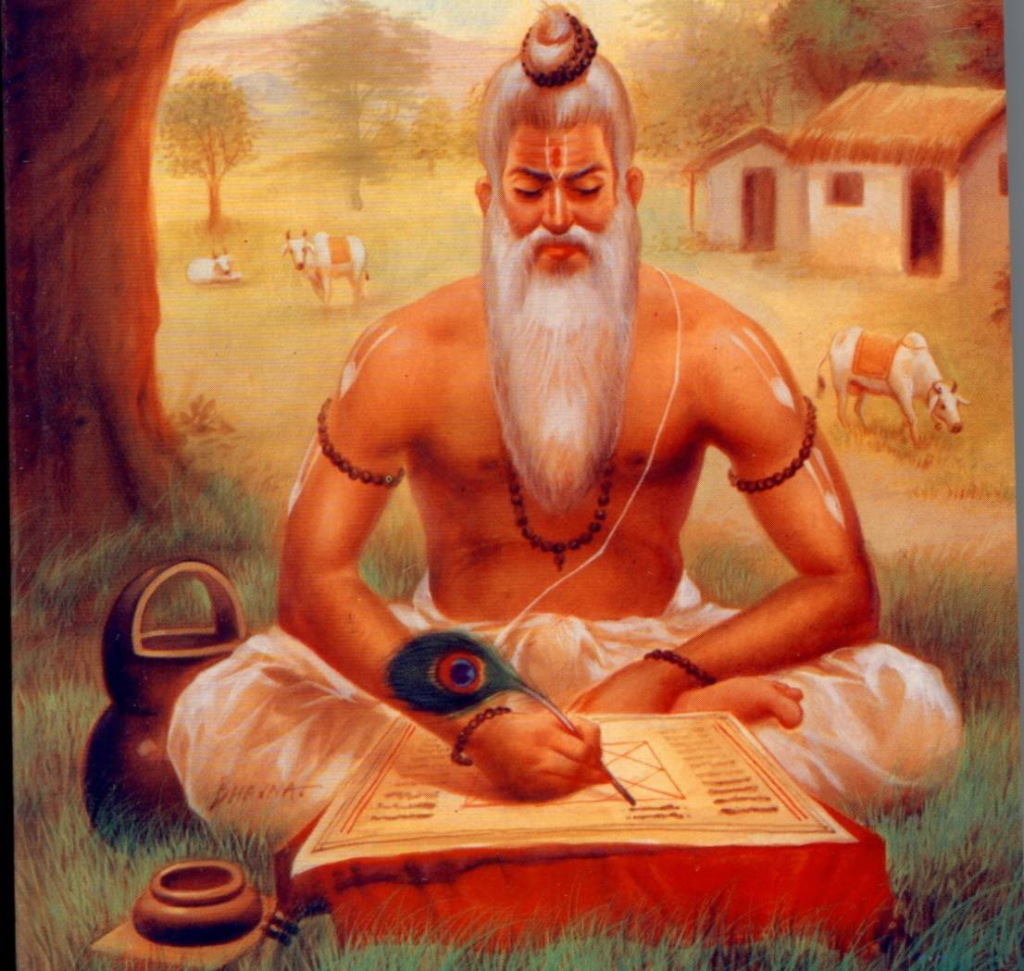
Long before the likes of academicians and intellectuals like Peter Turchin … and even centuries before great historians like Arnold Toynbee, Max Weber or C.Wright Mills … studied the social phenomenon of Elite Overproduction, in ancient India it was already anticipated, explored fully and understood deeply by a Vedic seer who is known today as Maharishi Manu. In the Hindu cosmology and religion, Manu holds a significant place as the first man, the progenitor of humanity, and a central figure in various Creation narratives in Purana and Itihasa literature.
The Manusmriti, also known to the West as the “Laws of Manu”, is a foundational text in Hindu jurisprudence and ethics. Attributed to Rishi Manu, it outlines the principles of dharma (moral law), social order, and the responsibilities of individuals within society. The Key teachings from the Manusmriti include: Guidelinesfor social conduct and the duties of different Varnas (social classes); Rules for family life, including marriage, inheritance, and education; Principles of justice and governance, emphasizing the importance of righteous leadership. These teachings remain influential in contemporary discussions about ethics and social justice within Hindu communities.
The Manu Smriti did not coin any equivalent fancy phrase for “elite overproduction”. However, it did speak very elaborately and accurately about the very same conditions of social unrest, instability, upheaval and intra-elitist competition that Peter Turchin, Arnold Toynbee or any other modern sociologist have described in the modern times.
Manu called the social phenomenon of “elite overproduction” not specifically but generally by referring to it with the Sanskrit term, āpada (आपद्), which literally means “distress” “calamity,” “misfortune,” “danger,” “hardship,” or “crisis.”
In the context of his Dharmaśāstra or Smriti context, āpada specifically referred to periods of extreme difficulty or crisis that suspend or modify the usual codes of conduct amongst social classes due to real and present threats to survival or well-being. The literal sense of āpada is “a fall into trouble“—with “āpatti” as a related noun form—referring to being overtaken by unavoidable adversities or emergencies requiring exceptional measures.
Manu’s term “distress” refers thus primarily to severe circumstances of material or existential hardship, especially those that threaten a person’s ability to subsist or maintain the minimum standards of ritual purity and lawful livelihood prescribed by their social order (varna). Manu’s usage of the term “distress” includes situations such as: Extreme want of livelihood (i.e. declining wage levels, inequality of wealth etc); Failure of issue (childlessness) (i.e. grave demographic decline); Threat to survival or well-being (i.e. widespread unemployment, lack of upward social mobility etc.); Disruption of routine, law, and ritual (i.e. sociopolitical turbulence, radicalism etc.)
Distress or āpada (आपद्) in Manu’s times, in his famous Smriti treatise, he characterized it as “want of livelihood” and “falling in ruin,” causing a suspension or disruption of regular dharmic restrictions in the social-order to preserve life and future ritual (i.e. communal) continuity.
********
It seems to me that the ancient seers in India — like Maharishi Manu — clearly presaged even millennia ago what great harm elite overproduction could potentially bring upon any society. Which is why, very wisely, Manu structured the concept of Varnashrama upon which the whole of the Vedic Social Contract was drawn up.
Manu’s social contract envisaged a societal structure founded upon a system of vocational aptitudes of citizens and upon prescribed duties and rights for specific castes or classes of people. The Varnashrama system was designed thus very wisely to avoid precisely what Peter Turchin today calls the “musical chair” and “elite overproduction” crisis into which modern democratic societies — with their unbridled fetish for notions of absolute, utopian egalitarianism — find themselves plunging headlong into.
Peter Turchin, being an American intellectual, maybe also suffers from the same failing of most Western academicians and social scientists. They focus overly on the realities of only American History which is hardly 250 years old while forgetting that ancient civilisations like India (more than 5000 years old) had indeed already thought about, analysed and even successfully dealt with social phenomena such as “elite overproduction“.
One reason why Peter Turchin may have wanted in the writing of his famous book to altogether ignore studying the Vedic Varnashrama system of social-order could be that in the last 100 years in our country it has been denounced, demonised and cast aside into the dustbin of history … by India’s very own best academicians and socio-political commentators today.
The most lethal and effective weapon Donald Trump can deploy to instantly end Ukraine war is not Tariffs or Sanctions … It’s weaponising American tech-giant companies . Or, even threatening to deploy it .
How is that possible ? Here is a plausible explanation :
Trump can commandeer all the undersea fibre-optic cable networks around the globe and clamp up data-traffic to Russia and China . In other words, he could weaponise or threaten to weaponise the deep sea data-cable network of the entire world to impose a total “data embargo” on Russia and China.
The vast majority of the world’s intercontinental data traffic—over 99%—flows through undersea (submarine) cables, while satellite links and signal towers on land account for only a tiny fraction of such traffic. Signal towers and terrestrial infrastructure are critical for local and last-mile connectivity, but for transoceanic and global data movement, undersea cables are the backbone.
Ownership and control of undersea cables have clear geopolitical significance and can be “weaponized” during conflict. While cables often serve many countries, there have been historical and recent instances of deliberate cable cuts or acts of sabotage to disrupt rival communications:
During World War I, Britain cut Germany’s undersea cables to limit its communications.
In current times, concerns of hostile nations (e.g., China or Russia) using submarine drones or anchor-dragging ships to sever or tamper with cables have increased, especially in regions with chokepoints like the Malacca Strait or the Baltic Sea.
The ability to tap, surveil, or disrupt cables offers states both intelligence and military leverage in times of tension or war.
The ownership of deep sea cable networks operated by private multinational tech-giant companies is heavily dominated by American-based firms, with significant—though much more limited—participation from European and Asian companies.
American tech giants Google (Alphabet), Meta (Facebook), Microsoft, and Amazon own or co-own the overwhelming majority of privately operated deep sea cable segments across the Atlantic, Pacific, and global routes.
These companies not only lead or co-lead new construction but also often secure significant portions of existing consortia or buy exclusive “fiber pairs” on joint cables.
European involvement as sole private operators is limited . Major Asian telecommunications operators (e.g., NTT and KDDI in Japan, Tata Communications in India) have some private stakes, but Asian tech-giant companies like Alibaba and ByteDance have very little reported independent cable ownership outside China’s direct state or telco projects.
Nearly all subsea cables directly owned or majority-controlled by tech giants are led by U.S.-based firms: Google, Meta, Microsoft, and Amazon.
The trend toward direct private ownership by tech companies is “nothing short of revolutionary” and, as of 2025, shows no sign of reversing U.S. dominance.
This means the landscape of deep sea cable ownership among tech giants is overwhelmingly American, with some European telecom participation at the consortium level, and comparatively little representation from other regions.
Trump doesn’t need Tariffs or Sanctions or secondary sanctions and much less F35s, B2s or ICBMs to bring Russia, China and the world to its knees. He can do it with simply with the data-traffic undersea cable network of 1.4 million kilometres around the world now owned by his industry friends in the US tech industry —- the Zuckerbergs, Pichais, Nadellas, Bezos et al .
******* ********* **********
There is of course the possibility that if Trump went ahead and weaponised the global data-cable undersea infrastructure, then that could trigger immediately a large war … even World War 3.
However, I ask myself this question :
Almost all the world thinks this POTUS is a “madman” . And there’s now a full blown bloody senseless war going on for the last 3 and half years in Ukraine. If the Americans and Brits — CIA and MI6– thought nothing of carrying out sabotage operation to blow up the undersea Nordstream-2 gas-pipeline in the Russian Arctic Sea running from Siberian coastline to Germany, why would they not boldly repeat the operation, if push comes to shove, with data-cables undersea? Did any bigger World War break out when that dastardly act was executed?
As a result of that notorious act of sabotage, German and the entire European economy has been badly hobbled today, with all its energy security going awry and disrupted and now increasingly dependent on US energy supply-chains. They are now importing energy on giant oceangoing tankers!!
Europe has been mauled and browbeaten today by the USA with dire threats of withdrawal of military security guarantees via NATO — so long taken for granted since 1945 — if EU does not halt energy imports from Russia and start importing from the USA .
Did war break out between EU and America under all the events described above?
So, what did not happen as feared when that critical energy undersea supply-line and Nordstream infrastructure were destroyed by America in a brazen act of guerrilla warfare in the Arctic Sea, why should we think that if it did happen too again in the case of the undersea Data-cable-network infrastructure … and these were to be similarly destroyed or threatened to be destroyed in the Indian Ocean … a greater War will surely break out?
After all, all is said to be fair in love and war, isn’t it? Even our Mahabharata affirms that .
Eepa’s unique perspective still did not stop me from persisting in the other more pedestrian question for which too I pressed him for an answer:
What could have been the language in which Hanuman spoke so impressively that it absolutely captivated Sri Rama ?
“யார் கொலோ இச்சொல்வின் செல்வன்?”
(“Who is this prince of words?”)
In Valmiki’s Ramayana, Hanuman is described as speaking in a language that is both sweet and perfect, with mastery over Vedic knowledge, grammar, and syllabic precision. The Ramayana describes Hanuman as speaking in a “sweet human language” (मधुरं मानवाक्यम्, madhuram manusham vakyam), meaning language of the people, not of elite pundits or archaic Sanskrit. Tamil scholars for many decades now have proposed that “madhuram” here refers not merely to “sweetness” but possibly to a specific spoken language commonly understood across the Kishkinda region (now borderlands of Telengana and Karnataka State) .
There is a strong tradition—especially in Tamil scholarly circles—that Valmiki’s use of “madhuram” alludes to early Tamil or a proto-Tamilic language, reflecting its wide use in Southern and possibly Eastern Deccan region of India at that time.
The theory of these Tamil scholars is that Hanuman did not use Sanskrit, so as not to arouse Rama and Lakshmana’s suspicion, but chose a refined common tongue—characterized variously as “madhura bhasha”, “manusham vakyam”, or “human speech. The pedagogic reasoning is that the phrase “manusham vakyam” contrasts with “deva bhaasha” which means “the language of the gods” — an epithet by which Sanskrit has always been known in all ancient annals of historic and pre-historic India.
The theory therefore is that since Valmiki wrote specifically that Hanuman spoke to Rama in “manusham bhaasham” which was “madhuram” and not in “deva bhaasha“, he must have spoken in Tamil not in Sanskrit. Implicit in such a conclusion is the averment that Sanskrit is not as sweet or “madhuram” as Tamil.
**********
The Tamilian Ramayana punditry has also been fond of further expanding the theory of Hanuman having spoken to not only Rama in the Kishkinda Kandam in some kind of “proto-Tamil” local, indigenous dialect, but that he resorted again to the same language in the Sundara Kandam when he landed secretly in the dark groves of Ashokavana in Lanka to discover where Sita was kept imprisoned by Ravana. This interpretation is once again derived from the “madhura bhaasha” theory of Tamil scholasticism although it relies not on direct scriptural statements, but on literary analysis of how Valmiki describes the speech, the usage of specific proverbs, and interpretations of the language described as “madhuram” (sweet, pleasing).
In the Sundara Kanda, Ashokavana episode, Hanuman repeatedly debates with himself as to which language to use with Sita, fearing that if he speaks in Sanskrit, she will mistrust him and suspect he was some kind of demon trying to trick her, since Sanskrit was the language of the learned and Ravana’s court. (vide Smt. Jayashree Saranathan’s expositions). Narayana Iyengar was a Tamil scholar who, in an article in 1938, claimed that Hanuman spoke to Sita in Tamil by citing as authority Valmiki’s poetic choices and by the identification of a Tamil proverb (“A serpent only recognises the feet of another serpent”) that he stated was embedded in Sita’s speech as a folk saying found only in Tamil tradition, not Sanskrit or Prakrit…. “பாம்பின் கால்களைப் பாம்பே தெரியும்“.
So, it is averred that Hanuman spoke to Sita in Ashokavana only in the Tamil language, or at least in a language closely related to ancient Tamil, when he first conversed with her in Lanka. Many other proponents of the Tamil theory suggest that “madhuram” is not just about “sweetness of speech,” but is an euphemism for an ancient Tamil or Tamilic lingua franca widely spoken in southern and central India, thus possibly the language Hanuman used.
One of the proponents of the theory was, in fact, none other than the venerable 44th Pontiff of the Sri Ahobila Mutt, Srimad Vedanta Desika Yathindra Mahadesikan (“Mukkur Azhagiyasingar”) who too, it is learnt, believed that Hanuman spoke to Sita in a proto-Tamil dialect. Sri Vaishnava orthodoxy thus puts its full weight behind the “madhura bhaasha” theory of proto-Tamil being the preferred language in which Hanuman spoke both to Rama and Sita in the Valmiki Ramayana.
***********
Even in the face of such overwhelmingly formidable scholastic arguments of stalwarts in favour of the “proto-Tamil” argument, I remained skeptical of the theory because, as I messaged back to Eepa, I felt that there was more to explore by way of theorization than making sweeping conclusions in the way Tamil Ramayana scholars have done for so long jumping to them. I shared my candid view with Eepa as follows:
Dear Sir, The term “madhuram” is key … in my humble opinion …
Sweetness , sonority, pleasantness, cadence … all these are characteristics not of Sanskrit or Tamizh which although beauteous in their own way still possess hard harsh guttural sounds … more consonants than vowels …
Telugu is the most soft and languid language of all Sanskritised and / or Tamilised languages and dialects. Every word almost is made to end and sound in a vowel … like “u”, “i” or “a”. The hardest consonant is softened by use of a vowel syllabled suffix … And unlike Tamil there is no difficult retroflex approximant like “zh” in Telugu …
I’d like to believe that Hanuman spoke to Rama in some prehistoric Sanskritised proto-Dravidian local tribal dialect which was perhaps the primordial ancestor of “sundara telungu” — the language that centuries later, was extolled by the great Tamil poet Bharathiyar himself in these soul-stirring words:
சுந்தர தெலுங்கில் பாடும் இசைஞர் துன்பம் இல்லை அந்த சொல் தென்றல் வாடும் மலரின் வாசம் போல சொற்கள் யாவும் மலரும், இனிய கீதம் போல.
I had the temerity thus to argue thus with Eepa: Sir, don’t the above lines highlight how Bharathiyar extolled the sweetness and melody of Telugu, comparing its words to fragrant breezes and blooming flowers, and its songs to beautiful, blissful music? So, why not theorise on the basis that the Hanuman spoke in some kind of “proto-Telugu” language to Rama instead of conclusively inferring that it must have been “proto-Tamil” only?
**********
My own analysis as I tried to explain to Eepa was of course largely speculative. But I persisted in putting it forward only to underscore a key linguistic possibility about Hanuman’s speech—one that is still widely debated today but rarely resolved.
Ancient sources describe Hanuman’s speech as “madhuram,” and much hinges upon whether this term indicates specific phonetic qualities, a particular language, or an overarching style valued for sonority and pleasantness. Nothing in the Ramayana text specifies an exact language—only “the human tongue” and “sweet words.” So, everything is only interpretative and nothing can be said to be conclusive.
Telugu’s open-syllable structure and vowel-ending words give it a melodic, vowel-rich, soft sonority unusual among the major classical languages. Early Telugu (pre-literate or proto-stage) was likely shaped by both Dravidian and local Prakrit influences, potentially resembling a widely spoken, accessible lingua franca in the Deccan or southern peninsula. Unlike Tamil, Telugu’s phonology avoids retroflex approximants like “zh,” and the tendency to “soften” consonants with trailing vowels is ancient and distinctive only to Telugu.
Wikipedia, in fact, gives this remarkable clue: “While written Telugu literature emerges on record around 575 CE and florid poetry after 10th c., the spoken dialectmust have existed far earlier as a “softened” regional speech amidst harsher Sanskritic/Prakritic or archaic Dravidian forms”.
Linguistic evidence suggests therefore a proto-Dravidian vernacular spoken perhaps widely in South and parts of Central India long before historic Tamil or Telugu literature. Structural features such as retroflexion, vowel harmony, and word-final open syllables are ancient Dravidian innovations—gravitating toward what became the “sweet” quality of later Telugu.
I did however concede to Eepa that my hypothesis—that Hanuman spoke a proto-Telugu/Dravidian-tribal tongue (ancestral to Sundara Telugu), marked by vowel-ending words and mild consonants— might fit mainstream linguistic theory but there is no way I could prove it by any direct textual evidence. That task must be done by Dravidian linguists and well renowned Ramayana scholars.
All that I could say however was only this by way of hypothesising:
While tradition offers Tamil or “common Prakrit” as Hanuman’s language, a strong phonological case can be made for a soft, vowel-rich proto-Dravidian—possibly a precursor to Sundara Telugu—as being “madhuram” in both sound and feeling, aligning with the sonorous linguistic ideals Hanuman displayed.
**********
Eepa in his Whatsapp messages to me emphatically made it clear that he did not support my hypothesis. His support for the “proto-Tamil theory”, he explained to me, was based on a much broader and deeper knowledge of Tamil grammar rather than on any subjective hermeneutics i.e. on notions of “sweetness” or “madhuram” attributed to Hanuman’s speech in Valmiki Ramayana.
He said in his message to me:
Unlike the other Dravidian languages, viz. Kannada Telugu and Malayalam, Tamil grammatical works starting from Tolkappiyam to Nannool, laid down strict rules and regulations how to adopt Sansrit words in Tamil to safeguard its unique identity and structure. This is the reason why the other Dravidian languages were highly Sanskritised but not Tamil. Kamban calls Rishyasingar as “கலைக்கோட்டு மாமுனிவன் “.
Eepa further went on to expand the context of our interesting Whatsapp conversation to the next higher level. He posed further two more questions which also momentarily flummoxed me:
“My query is what could have been the historical reasons for this?What is the reason for Tamil as a language to have been hell bent upon keeping its historical distinctiveness ? Even Alwar poems, as I know them, follow the Tolkappiyam grammatical rules”.
To answer the question adequately, I knew I had to read up more than a bit about Tamil classical literary history since the Sangam times. It was a fascinating subject indeed about which, I confessed, I had never hitherto never given any thought. Eepa was certainly trying to test my own depth in Tamil scholasticism. I told him frankly that I held no pretensions to such in-depth knowledge of the Tolkappiyam to draw from as an answer to his question.
I read up quickly my Encyclopaedia Britannica and a few other sources online too which I generally used as my standard reference sources on any topics related to Tamil literature of the classical kind … such as the Naalayira Divya Prabhandham with which I had at least more than a modicum of close acquaintance.
After my self-taught crash-course in researching the Tolkappiam I was able to answer Eepa’s question by dredging up something as follows. I am not sure however whether it will pass muster with the scholar Eepa.
************
The historical reasons why Tamil grammatical works like Tolkappiyam and Nannool laid down strict rules to regulate Sanskrit word adoption, safeguarding Tamil’s unique identity—unlike Kannada, Telugu, and Malayalam which became more heavily Sanskritized—are rooted in a combination of cultural, political, and linguistic factors:
Tamil Linguistic Identity and Purism
Tamil grammar treatises from ancient times explicitly framed Tamil as a distinct classical language with its own grammar, phonology, and literary tradition, separate from Sanskrit and Indo-Aryan languages. This helped institutionalize Tamil linguistic identity and cultural pride.
These grammatical works prescribed how Sanskrit loanwords should be adapted into Tamil phonetics and morphology to maintain Tamil’s distinctiveness, preserving its native sound system and structure rather than allowing Sanskrit to overwhelm it.
This linguistic purism was motivated by a strong sense of Tamil cultural nationalism already present by the Sangam period, reflected in epics like Cilappatikaram, emphasizing Tamil literature and heritage as unique and superior in its own right.
Historical and Political Context
Tamil cultural nationalism grew as Tamil kingdoms (Cholas, Pandyas, Cheras) consolidated power, fostering a sense of regional pride and identity distinct from northern Sanskritic influence.
Tamil’s relative isolation in the south also protected it from some direct cultural imposition, allowing sustained development of a robust literary ecosystem in Tamil without wholesale adoption of Sanskrit grammar and vocabulary.
Sanskritization did influence royal courts and religious practices, but Tamil literary scholars and grammarians often moderated Sanskrit influence on poetic and grammatical norms to retain Tamil’s autonomy and purity.
Contrast with Other Dravidian Languages
Kannada, Telugu, and Malayalam experienced more extensive Sanskritization due to stronger and earlier interactions with Sanskritic and Brahmanical culture, including religious and royal patronage, facilitating greater lexical and phonological borrowing.
Their literary traditions began developing later and with more direct Sanskrit influence; thus, these languages integrated Sanskrit more freely, lacking the early linguistic purism framework that Tamil had established.
Kamban’s Epithet for Rishyashringa
The phrase ‘கலைக்கோட்டு மாமுனிவன்’ used by Kamban reflects Tamil’s reverence for learned sages who master arts and knowledge but also implicitly reinforces the Tamil ideal of scholarly purity and guardianship over Tamil tradition, contrasting with excessive Sanskritization.
It symbolizes Tamil’s balance between open yet cautious acceptance of Sanskritic elements, ensuring that Tamil’s core identity remained unsullied and sovereign in the literary and cultural realm.
Tamil’s resistance to heavy Sanskritization lie in its robust early grammar tradition, strong regional cultural identity, and conscious linguistic purism that framed Sanskrit borrowings as something to be adapted delicately. This contrasts with other Dravidian languages whose later literary emergence and sociopolitical contexts favored deeper Sanskrit integration
**********
My quick and rough research dive into this subject of Tamil Resistance to Sanskritization over the ages helped me to grasp one other important finding which I had never in the past bothered ever to inquire:
Which historical periods saw active de-Sanskritisation efforts in Tamil?
While, historically, it was linguistic purism which motivated a strong sense of Tamil cultural nationalism already present since even the pre-Sangam period, and which emphasized Tamil literature and heritage as unique and superior in its own right, that pride was never chauvinistic or parochial; nor was it rabidly xenophobic as we know it to be today in the State of Tamil Nadu. De-Sanskritization in the period before the later part of the 20th century CE was about Pride whereas in the post-1950s period it was all not about Tamil Pride but about anti-Sanskrit or anti-Hindi.
Post-Independence 1950s onwards: The most prominent phase of active de-Sanskritisation in Tamil occurred during this time by followers of Dravidianism. Leaders and intellectuals consciously promoted the use of “pure Tamil” (taṇittamiḻ) by removing Sanskrit loanwords and focusing on native Tamil vocabulary especially in formal documents, literature, education, and public speeches.
Late 19th to early 20th century: While Sanskrit influence was still prevalent, the seeds of language purism and resistance to Sanskritization emerged among Tamil scholars and reformers, setting the stage for later systematic efforts.
Medieval Period (11th to 13th centuries): Although Sanskrit vocabulary entered Tamil during this period, literary and religious Tamil texts retained a considerable degree of linguistic self-regulation. Tamil poets like Kamban celebrated Tamil literary traditions while acknowledging Sanskrit epics indirectly, helping preserve Tamil’s distinct identity
All the above movements were a response to the heavy Sanskritization seen in other Dravidian languages (Telugu, Kannada, Malayalam) and aimed to protect Tamil’s unique classical heritage. The result was a perceptible decline in the Sanskrit loanwords in Tamil literature and formal use—from estimates of 40-50% down to about 20% in the 20th century and beyond.
**********
My exchange with Eepa ended there with the the unasked, unanswered and unthinkable question: By de-Sanskritizing Tamil language, did Sanskrit lose or did Tamil lose linguistic “praana” — life-force ( प्राण) — or the vitality which in Tamil is called “uyir”, (உயிர்)?
Reading the below summary (please scroll down below to read ) makes me feel very sympathetic to Sri. Amit Shah or for that matter anyone who occupies the Home Minister of India seat.
I now understand with much greater clarity than ever before how British Colonialism must bear full responsibility for India’s stupendous and enervating illegalimmigration problem .
Our vast porous land borders that are massive and wide open doorways for millions of illegal migrants from abroad are actually the accursed legacy of British imperial rule— Indo-Pakistan, Indo-Nepal, Indo-Myanmar, Indo-Lanka, Indo-Bangladesh, Indo-Tibet…
The creation of so many independent nation-states all around India was actually the bloodless way (except the Partition riots in Punjab in 1947) by which the British succeeded in Balkanising greater India and in leaving behind a perennial, suppurating source of mutual tensions and forever conflicts amongst the peoples of South Asia at large.
The British left India in 1947 but the terrifying ghost of their Divide and Rule Pax Brittanica dictum still haunts India today but as “Divide and Prevail legacy” from halfway across the globe.
I am able to clearly imagine today how if India had not been vivisected into so many different nation-states , our country would never have had to grapple daily with the currently insoluble problem of illegal immigration. They would all have been our very own people, our own countrymen … not illegal immigrants.
Yes, but then, I am sure many of you will jump up to say to me that we would probably be encountering then another altogether different but equally big problem such as the one we know China faces today viz. internal migration of vast waves of people moving about from one part to another part of the country in search of better and urban living standards, jobs and education.
Howver, I would argue that such a problem, daunting though as it would certainly be, would still however not be a pestering, festering law and order or grave national security problem such as what India suffers today —- to name only a few, they are Voter Fake ID, citizenship proof issue, undocumented domicile status , cross-border smuggling, currency counterfeiting, and border patrolling, etc.
As in China today, India would then only have had to deal mostly with the central governance problem of providing education, food and energy security to a much larger population, and having to allocate and spend more on larger defense-outlay budget to protect more distant but then also far fewer borders with neighbouring countries such as China and Iran.
The 500 years in world-History during which the “sun never set on the British Empire” (because even“God wouldn’t trust an Englishman in the dark”), the idea of Balkanisation of many parts in the world through redrawing and inventing borders was realised by Western Imperialists not only by dividing and ruling peoples. They did not stop there. They ensured through insidiously Balkanised legacies they left behind everywhere — as they certainly did in India — its baleful impact and wretched consequences would just continue to wreak havoc in many different ways upon those peoples amongst whom the seeds of enmity, confusion, mayhem and instability were sown ever so deeply.
Conquest is achieved not by military conquest alone. Conquest by redrawing borders — Balkanisation— is, in fact, ever more lasting …
Sudarshan Madabushi
******** *********** ********
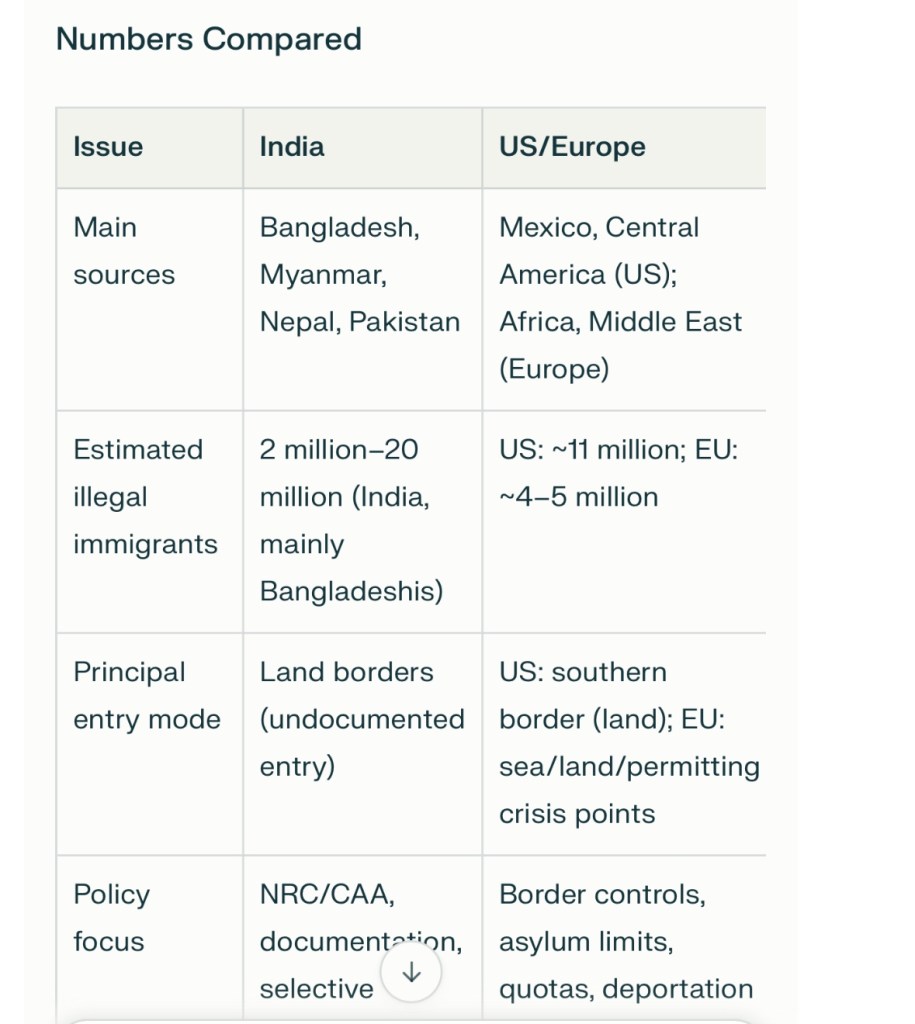
India’s illegal immigration issue is fundamentally different from that of the US and Europe: it is shaped by porous land borders and large numbers of undocumented migrants mainly from neighboring countries, especially Bangladesh and Myanmar, rather than by transcontinental refugee flows or border crises seen in the West.
India’s Illegal Immigration Scenario
Scale and Origins: Estimates of illegal immigrants in India range from 2 million to over 20 million, with the largest group being Bangladeshi nationals. There are also significant populations of Rohingya from Myanmar (about 40,000–75,000), along with smaller numbers from Nepal and Pakistan.
Key Hotspots: Border states like Assam, West Bengal, and Tripura are especially impacted, but large cities (Delhi, Mumbai, Hyderabad, Bengaluru) also have significant undocumented enclaves.
Socio-political Impact: Illegal immigrants have triggered periodic political controversy, with debates over voter rolls, access to public benefits, and cultural change; issues like the Assam NRC exercise and the Citizenship Amendment Act have directly targeted these populations.
Contrasts With US and Europe
US/Europe Issues: Their crisis is driven by arrivals from Latin America, the Middle East, North Africa, and Asia (including some from India), resulting in border surges, asylum backlogs, and debates over refugee quotas and integration.
India’s Problem: India’s challenge is less about refugees or asylum, and more about steady, large-scale, undocumented entry and settlement for economic reasons, mostly from immediately neighboring countries, enabled by hundreds of kilometers of permeable land borders.
Policy Response: Unlike the militarized border and sanctuary policy debates in the US/Europe, India’s approach includes local documentation drives (NRC), regular deportations, and periodic demolition of illegal settlements, but persistent political and administrative bottlenecks limit effectiveness.
Numbers Compared
India thus faces a chronic, long-standing, large-scale illegal immigration challenge dominated by its neighbors, rather than acute crises or sudden border waves like those witnessed in the US and Europe.
The Tamil literary doyen Sri Indira Parthasarathy — popularly known as Eepa the novelist and playwright who is the only one who won both the Sahitya and Sangitha Nataka Akademi Awards — suddenly asked me this question via a WhatsApp message the following intriguing question. It momentarily baffled me .
When Hanuman meets Ram in the forest for the first time introduces himself in such a way that Ram feeling amazed by Hanuman’s vocabulary exclaims ‘யார்கொலோஇச்சொல்லின் செல்வன்?’ What language Hanuman could have spoken?
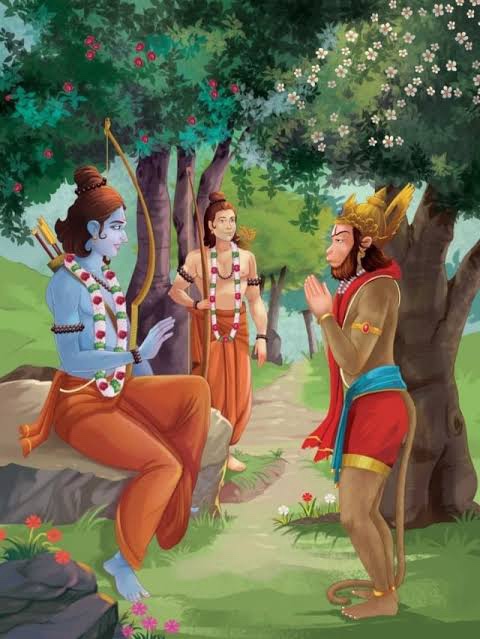
Eepa is a formidable Tamil scholar and my knowledge of the language is so limited that I could never hold a candle to his . Yet , the question was so intellectually fascinating to me that i tried to delve a bit into Valmiki Ramayana and revisit the episode in Kishkinda Kandam wherein Sri Rama first encounters Hanuman and is enchanted by the latter’s speech.
Eepa’s reference was obviously to Hanuman, when he first met Rama in the forest, spoke in such an eloquent and refined language that Rama was amazed by his vocabulary and the sweetness of his speech, leading to the famous Tamil phrase “யார் கொலோ இச்சொல்லின் செல்வன்?” (“Who is this prince of words?”). In Valmiki’s Ramayana, Hanuman is described as speaking in a language that is both sweet and perfect, with mastery over Vedic knowledge, grammar, and syllabic precision.
The Ramayana describes Hanuman as speaking in a “sweet human language” (मधुरं मानवाक्यम्, madhuram manusham vakyam), meaning language of the people, not of elite pundits or archaic Sanskrit. While Valmiki’s text itself does not name the language, the context and repeated use of the word “madhuram” suggest Hanuman’s flawless command of a literary “desiya” (indigenous) language.
Based on my above understanding of the Kishkinda episode, my off-the-cuff and “shoot-from-the-hip” response to Eepa was as follows :
Sir, I know there are many linguistic theories about this question . My personal view is that Hanuman spoke in some old dialect of “Sundara Telugu” language . In the Ramayana , Valmiki says Rama found the language used by Hanuman to be “Maadhuryam” … sweet and sonorous .
Rama and Hanuman first met each other in Kishkinda … which today is somewhere in the triangulated border areas of Andhra Pradesh and Karnataka . So , the local dialect there may have been pre-historic mix of Telugu and Kannada .. both of which languages are derived from Sanskrit .
Secondly , even Mahakavi Bharatiyar , a great Tamil poet , characterised Telugu as “sundara Telugu” .
So, we may be allowed to reason that Hanuman spoke in some predated version of Telugu .
Of course, I know Tamil scholars of Kamba Ramayanam will not agree with my view.
*****
Eepa did not quite agree with me. He replied :
“Telugu and Kannada are basically Dravidian languages highly sanskritized”.
Eepa however went on to make another intriguing observation offering a very different perspective :
Hanuman approaches Ram not only to inform him about who he is but more importantly he was keen to also convey in a subtle manner that he (as Sugriva’s chief-of-staff) may be also needing Ram’s favour (a military alliance, as it were) in regard to some domestic political issue of Kishkinda state … And Hanuman did so in the choicest most carefully chosen words reflecting an intellect and wisdom of the highest order. That is precisely the reason why Ram who was quick to understand what Hanuman was broaching him for is thoroughly impressed and exclaims ‘யார்கொலோஇச்சொல்லின்செல்வன் ‘?
Eepa’s insight into the Kamban lines were penetratingly brilliant indeed and it left me thinking suddenly about what a waste of scholarly energy and research had been expended on this question by other run-of-the-mill Tamil and Kamba Ramayana scholars, past and present, on the hotly disputed question about in which language Hanuman could possibly have spoken to Sri Rama if it was not Sanskrit?
Eepa was saying that the real question is not one of linguistics at all because it was not the literary form or quality of Hanuman’s speech that impressed him so much as the deft, delicate and diplomatic subterranean content in his speech. Which meant that the unending scholarly debate of many years over what language was spoken by Hanuman is rather inconsequential if not wholly irrelevant.
Eepa further emphasised his point:
“I believe Kamban or Valmiki did not really bother much at all about the medium of conversation or the quality of the language used between all the characters in question for that matter…. Because Ram travelled all the way from Ayodhya to Lanka not to appreciate language but in search of someone who could help him find his lost Sita. It is thus not the language but the hard content of what they spoke which really matters. So I feel Ram was amazed at the way in which Hanuman spoke so subtly with choicest idioms to test the waters for forging some kind of an alliance between Sri Rama and Sugreeva.
Thus, Eepa’s whole argument was that the Kamban phrase — “யார் கொலோ இச்சொல்லின் செல்வன்?” (“Who is this prince of words?”) — really refers to Rama’s admiration for Hanuman sense of adroit realpolitik as reflected in his speech rather than for its purely literary or semantic elegance.
Eepa’s perspective was truly an absolutely blinder of an eye-opener for me!
******
Eepa’s perspective still did not stop me from persisting in the other more pedestrian question for which too I pressed him for an answer: What could have been the language in which Hanuman spoke so impressively that it absolutely captivated Sri Rama ?
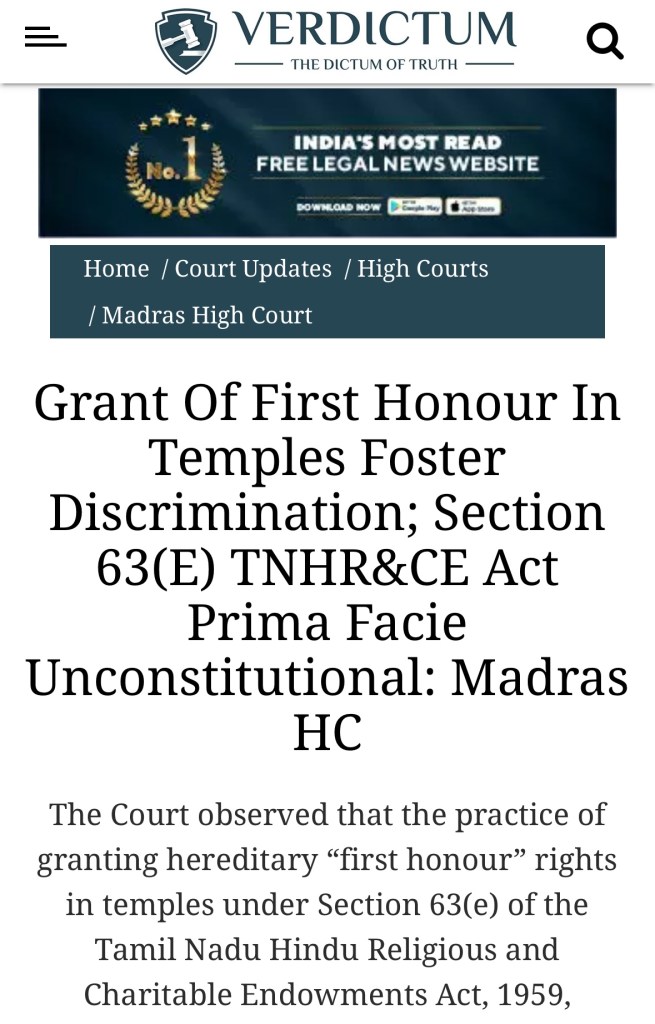
Please scroll right down below to read a summary of the above verdict delivered by the Madras High Court in the matter of dispute over claims to rights of “Mudhal mariyadhai” in the Arulmigu Sri Kallazhagar Kovil , in Madurai, Tamil Nadu.
It could be argued that this verdict is blatant overturning of the well established legal dictum which says that hoary religious customs — mos majorum — have as much sanctity as what is known in legal parlance otherwise as “essential feature of a faith”.
The practice in Hindu temples of a certain protocol established by centuries of religious custom cannot be interfered with by operation of secular law in this rather cavalier fashion. This interference will, in fact, cause more social unrest than the custom itself has been alleged by the Court to be egregious cause. One Kallazhagar Kovil incident does not and cannot be the pretext to do away wholesale with the custom. That would be frivolity of the Law, not its Majesty.
The custom of “mudhal mariyadhai” in temples is as old as the common customary protocol of “primus inter pares” … first amongst equals . There is nothing at all to suggest social or caste discrimination or hierarchy here in such a custom that prevails almost universally. It is a form of religious sentiment , plain and simple … and a sentiment that accords “primus inter pares” status on persons based on some well reasoned or objective criteria. The religious community within itself decides from time to time what such criteria should be. And I for one am not able to see what earthly justification the Government has to interfere into religious affairs by overriding even what has been duly instituted as custom even in the Statutes of the Tamil Nadu HR&CE Act.
This status of “mudhal mariyadhai” or “primus inter-pares” is seen to be widely granted and observed even in many secular spheres , is it not ?
For e.g. at public or government events such as the Republic Day parade, for example, there is a clear protocol for even seating on the occasion according to some order of rank, length of service or by recognition of eminence … so on … Now, would that protocol also be regarded as “discriminatory”? That would be so nonsensical.
Surely, the Courts of our land possess enough wisdom to realise that not every pecking order in the world must have to be seen necessarily through the jaundiced lens of so-called “social justice”?
The Judiciary in Tamil Nadu seems to be playing excellent second fiddle to the political powers-that-be at the moment. The Judiciary is expected however by the common man to show utmost respect for the People and their mos majorum: i.e. time-honored traditions, principles, and behaviors passed down through generations.
The Church and State must maintain respectful distance at all times if Peace must prevail in this country.
Sudarshan Madabushi
**************************************
Background
The petitions arose from a dispute over ceremonial “first honour” rights during the annual Aadi festival at Arulmigu Kallazhagar Thirukovil in Madurai.
Two groups from Vellaripatti Village contested entitlement to the honours associated with temple rituals, including the right to wear the Parivattam and other ceremonial privileges conferred during the festival. One group contended that only four Karais (clans) from the village are entitled to these honours based on earlier agreements and rotational arrangements made in 2014 and revised in 2016 before the local Tahsildar. They argued that the honours should be conferred according to this mutually accepted rotational structure, asserting that the rival claimant’s turn had not yet arrived.
The opposing group, however, relied on a 1978 civil court decree recognising the existence of seven Karais in Vellaripatti, six belonging to the Kallar community and one to the Konar community. They contended that rights cannot be restricted to only four clans and insisted that honours must be allocated as per the recognised seven-Karai structure.
Following rival claims over entitlement to the first honour during the temple festival, the matter was brought before the Deputy Commissioner of the Hindu Religious and Charitable Endowments Department.
The Deputy Commissioner, after considering the materials placed on record, directed the parties to approach the civil court to establish their respective rights conclusively.
Aggrieved by the Deputy Commissioner’s direction, the parties approached the Madras High Court seeking relief.
Court’s Observations
The Court observed that the practice of conferring hereditary or customary ceremonial honours dates back to the feudal era, where certain families or groups were historically accorded special rights during temple festivals.
Referring to Section 63(e) of the HR&CE Act, which recognises such claims, the Court expressed that the provision appears increasingly inconsistent with modern constitutional principles.
The Court noted that “such practices, including the grant of first honour in temples, foster discrimination and unrest, and have the propensity to cause communal disharmony among citizens, thereby demonstrating a form of passive untouchability prohibited under Article 17 of the Constitution of India.”
In Pleas Seeking Installation Of Ganesh Idols Justice Saravanan also recalled his earlier observations in orders in Marimuthu v. Commissioner, HR&CE Department and Kasinathan v. Joint Commissioner, HR&CE Department, reiterating that “it is time for Section 63(e) of the Tamil Nadu Hindu Religious and Charitable Endowments Act, 1959 to be struck down or deleted from the statute by the Legislature, taking note of the fact that it is not in consonance with the cherished dream under the Preamble to the Constitution, Part III (particularly Article 14), Part IV, and Part V of the Constitution of India.”
However, he clarified that the broader constitutional question regarding the validity of Section 63(e) would need to be addressed independently in appropriate proceedings seeking a declaration that the provision is ultra vires, should the legislature fail to amend or repeal it.
Conclusion
While raising concerns over the constitutional implications of Section 63(e), the Court, considering the existing rotational arrangement and the circumstances of this case, directed the Deputy Commissioner of the Hindu Religious and Charitable Endowments Department to confer the first honour for the current year’s Aadi festival on the petitioner who had approached the Court seeking such relief. The petitions were accordingly disposed of with liberty granted to the parties to approach the civil court for adjudication of their competing claims to the temple honours.
Cause Title: M. Muthu Karuppan Ambalam v. Joint Commissioner (Administration), HR&CE Department & Ors. (Neutral Citation: 2025:MHC:1900) Appearances: Petitioners: Advocate H. Lakshmi Shankar, Advocate K.P.S. Palanivel Rajan, Senior Counsel, for Advocate SMA. Jinnah Respondents: Advocate S.S. Madhavan, Additional Government Pleader; Advocate S. Manohar, Standing Counsel
On February 19, 1945, the anniversary of the death of Gopala Krishna Gokhale, Sastri spoke for about forty-five minutes at a public-meeting and suddenly lost consciousness. When he regained it after a while, he was advised by his doctors to give up all arduous work including public speaking.
Nevertheless, on March 6. 1945, he gave a press interview on the subject of reform of The Hindu Code, which was under public discussion then across the country. The question was did the legislature have the right to deliberate and decide upon issues that religious in nature and ought to be left only to the Hindu religious orthodoxy leaders.
Sastri argued saying in his view the legislature, as then constituted, was competent for the purpose and that some of the suggested reforms were unobjectionable and even necessary. He made his position clear: while the objections raised by the Hindu orthodoxy should he heard with respect and their pleas also must be met as far as possible, the reforms, in their essentials, should not be sacrificed. He was also confident, Sastri said, that Hindu religious orthodoxy had a remarkable capacity to adjust itself to the reforms after enactment, though their capacity to see the need for them during the lead up to the enactment would suggest inflexibility. Sastri, ever the Brahmin Liberal-Humanist he was, by that statement showed that he possessed not only a very acute but also accurate understanding of the Hindu psyche and its religious leaders; they would baulk at the reformative moves in the beginning but in the end, he felt, they in their wisdom, would come around to accepting and accommodting reforms if found to be reasonable and in the larger good of the country.
in his biography, Kodanda Rao writes, that “even the mild exertions involved in giving that interview by Sastri however, took toll on his health. He had a severe heart attack which lasted some three hours. He could not sleep and had to be administered sedatives”.
***********
In the biographical notes of D.V.Gundappa is to be found an endearing anecdote on the end that was nearing Srinivasa Sastri.
One day as he lay weak in his sick bed at “Swaagatham“, his home on V.M.Street, Mylapore, Sastri expressed a desire to listen to Tyagaraja’s kriti “Paahi Raamachandra Raghava…” in the Carnatic raagam of Yadukula Kaambhodhi rendered by one of Sastri’s favourite musicians, Sri Musiri Subramania Iyer. The song was played for him, at his frail bidding, on a 78-rpm gramaphone disc. Sastri closed his eyes and was utterly engrossed in listening to the poignant lyrics of the song wherein Saint Thyagaraja beseeches Sri Rama to save him:
“O Lord rAma candra! O Lord rAghava! O Consort of sItA! O Lotus Eyed! O Lord rAma – worthy of praise by those highly reputed! O Lord worshipped by Emperors! O Ruler of this tyAgarAja!
There is none to protect for me and nowhere is a God better than You, so please protect me.As You are my refuge, please come, protect me quickly.
Is it possible that, no matter how much I entreat You, You would not have even a little mercy towards me? I entreated You to relieve my troubles because I considered You to be the Lord, my most beloved.Please save me quickly because what is the use of life bereft of Your grace?
Does my appeal seem to You to be a plaything? Otherwise, what could be the nature of my fate?You test me but am I worthy of Your tests?There is no time to delay any further, because I will not go begging for Your Grace at any sundry place(when I have come to you directly)!“
After song ended on the gramaphone, Sastri opened his eyes, moist with tears, and whispered softly… “Can it be played again for me please?… I want to listen to the song once more....”.
This story has been recorded and is widely cited as a testament to Sastri’s devotion to classical music and the personal spiritual resonance of Bhakti he found in Tyagaraja’s inspiring compositions.
***********
Early in January, 1946, with his cardiac condition worsening, Sastri was advised to get admitted into the Madras General Hospital. Mahatma Gandhi, who was on a visit to Madras, called on him in the Hospital on January 22 and was permitted to be with him for a few minutes.
The meeting was most moving, according to the biographical accounts.
Sastri, who was reclining in bed, sat bolt upright and moved towards the edge of the bed and extended his hands towards the Mahatma and said in a voice choked with emotion:
“I want to come near enough to hug you, little brother.’
In soothing tones, the Mahatma begged Sastri not to excite himself and helped him to recline in bed as Sastri held the Mahatma’s hands in both his own. With great effort, Sastri expressed his disappointment then with Gandhi’s no-show at the Simla Peace Conference that the British Government had organized in the aftermath of World War-2. The Conference was convened by the Viceroy, Lord Wavell, at the Viceregal Lodge in June-July 1945. Its primary aim was to facilitate Indian self-government after World War II, as Britain was preparing to leave India. Lord Wavell proposed a new Executive Council for India with a majority of Indian members (except the Viceroy and the Commander-in-Chief) and representation for major communities, including Hindus, Muslims, and other minorities. All portfolios except Defence would be controlled by Indians.
Gandhi hoever had refused to participate in the Simla Peace Conference because its Agenda failed to meet the main Congress demands for genuine transfer of power and full independence. The other major sticking point was over the appointment of Muslim representatives—Congress insisted it had the right to nominate Muslims delegates, but the Muslim League was adamant about having the sole right to appoint Muslim representatives. When this deadlock wasn’t resolved, Congress viewed the whole process as British-Muslim design to divide Indian unity and was unwilling to participate unless these issues were addressed on their terms. More broadly, Gandhi had grown wary of British offers after failed previous protracted negotiations (like the “Cripps Mission“, for example), seeing them all as inadequate gestures that wouldn’t lead directly to real independence or unity.
So, Sastri lying in a hospital bed virtually awaiting the hour of death, told Gandhi:
“I have wanted to say one thing to you. Another opportunity for peace has been lost. They are sitting there at the Peace Conference Table. But who is there to speak for humanity except you? I am afraid India has failed to do her duty”. Even if they do not ask you, you must go as the apostle of truth and non-violence and be on the spot. Your mere presence will have a tremendous effect. You must not stand on ceremony.”
Mahatma gently reminded him that he did not come to discuss politics with him in the hospital. Sastri then jokingly retorted: “I see, you think I am not good for it.”
After exchanging further pleasantries, the Mahatma left, knowing that Sastri’s end, sadly, was very imminent.
**************
The above meeting between Sastri and Mahatma Gandhi is testimony to their lifelong friendship and obvious love for each other as kindred souls. But then in many other less obvious ways the meeting not only forebode Sastri’s death but also the death of Brahmin Liberalism in the Independent India of the future.
In the grindingly long history of the Indian freedom struggle, Sastri had come to be known as an exemplar of the “vita contemplativa” as well as the “vita activa“… As (explained already in Part-16), it meant for Sastri a life lived adhering steadfastly to the fundamental tenets of Sanatana Dharma… He had famously averred that “the Hindu civilization rooted in Sanātana Dharma, has constantly been enriched by brahma and safeguarded by kṣāttra. For Sastri, that essentially meant for him, again, the “contemplative way of life” focused on intellectual and spiritual reflection i.e. the way of true “braahmanic living”, combining itself closely with the “active way of life” i.e. engagement with the world through moral virtues, social and economic duties, military work, and practical actions … For Sastri, the two “vita-s” were more or less entirely reflected in 19th-20th century ideas of “classical liberalism”. And such blending of “brahma” and “kṣāttra” in his own life became definitive Brahmin Liberalism.
It was truly the Brahmin-Liberal in Srinivasa Sastri that made his dying heart melt with Brahminical Bhakti feelings while listening to a Thyagaraja kriti and at the very same time, also vigorously engage Gandhi in a debate over the political strategy and tactics adopted by him in the final stages of the great battle for India’s freedom that was nearing its end in the year 1946.
In the democratic-secular political discourse and social fabric of India as we all know it today, the Brahmin-Liberal is an outright oxymoron…. i.e. you can either be a Brahmin or a Liberal, but you cannot be both because the “vita brahmin” and “vita liberal” are believed to be as mutually exclusive as “vita contemplativa” and “vita activa” are as described in Greek philosophy. In the ideological construct of the Dravidian South, especially in Tamil Nadu of which Sastri was a native, the Brahmin is today regarded as an extremist-protagonist of Sanatana Dharma while the Dravidian-Liberal is his extremist-antagonist.
Srinivasa Sastri’s life though was anything but that of an extremist in any sense of the word anyone could ever imagine… He simply defied the myth which latter-day vicious political propaganda has perpetuated — that a true Brahmin can never be a true Liberal …. and that Dravidian Secular culture and Sanatana Dharma — well, “never the twain shall meet“. Sastri’s imminent death thus would signify, and sadly too, a fin de siècle moment for Brahmin Liberalism too. From his death-bed never would he have given in to maudlin lamentations. We cannot imagine Sastri saying to his friend and compatriot, Mahatma Gandhi, and saying “Après nous, le déluge, mon ami” (“after you and I pass on, dear friend, the deluge shall come…) … In all likelihood, silently while preparing for his own end, Sastri might, however, have brooded: “Après moi la décadence morale”…. With the death of “Classical Liberalism”, a general moral decadence in the new era of a free India?
***********
The biographies continue to narrate the last days of Sastri right to the end.
The Mahatma, with several friends, called on Sastri again on January 30.
Sastri hailed his friend as the greatest man living and a blessing to him in a hundred ways. The Mahatma protested. Whereupon Sastri quoted a sloka from the “Ramayana” which said that he who did not see Rama or whom Rama did not see was despised by every one in the world. He (Sastri) spoke of his trance the previous day when he had written a beautiful essay on the episode when Sita persuaded Hanuman to spare from his wrath the minions of Ravana who merely carried the orders of their master in humiliating her (during her days in captivity in Lanka); they were not guilty themselves. It was forgiveness, said Sita, that made life worth living. Forgiveness was divine and was the noblest of virtues. None was so free from error that he did not need to be forgiven. She regretted that there were not two or three people who dared to tell the truth to Ravana, the King of Ceylon, and save him from wrongdoing.
Turning to the Mahatma, Sastri said: “That is the duty we owe to friends and we fail to discharge. I have done that for you one or twice, and as for you, you do it and sometimes publicly, much to the consternation of everybody. But it is the noblest office of friendship.“
***********
The Mahatma paid a third visit to Sastri though he had only three hours in Madras and had several engagements to fulfil. It was a Monday, when the Mahatma observed silence. Therefore, while Sastri talked, the Mahatma replied on paper. Deeply inoved, Sastri said:
“Brother, you have done me an exceptional honour, especially by paying this visit when you were in a great hurry. You are nearer and dearer to me than my own brothers, sons and other members of the family. We have come together by some inner affinity. No external reason can explain our friendship. Gokhale was but the occasion of it.”
He became breathless with emotion. The Mahatma waved Sastri a fond farewell and went away.
Sastri’s health steadily and gradually grew worse. He passed away at 10.35 p.m. on April 17. 1946. He was conscious till about fifteen minutes before the end and was speaking to the members of his family. He then lost consciousness and did not regain it.
The news appeared in the morning papers on the 18th, and a stream of relatives, friends and admirers called at his house “Svaagatam” to pay their last respects. His mortal remains were cremated according to orthodox Brahminical rites.
**************
The ““Après moi la décadence morale” prediction seemed to come almost true on the very day Srinivasa Sastri passed away.
It was rather strange, inexplicable why no official mourning or condolence messages were issued by British Commonwealth leaders at the time of Srinivasa Sastri’s death in 1946 was forthcoming. Although he was internationally respected through his work as India’s Agent-General in South Africa, his participation in the League of Nations, and diplomatic engagements in Britain and the Dominions, the published obituaries and tributes that were reported in the newspapers following Sastri’s death did not focus on Sastri’s death as much as they did on Mahatma Gandhi’s much later in the year 1948. There is no record of formal messages from Commonwealth or any other foreign government heads.
The mourning and tributes after Sastri’s death that became public were primarily from leading Indian statesmen, reformers, and public intellectuals, most notably Gandhi and contemporaries in the liberal nationalist tradition. The news-report below is a revealing list of who were true Sastri admirers.
The reason why neither the British Government nor the British Commonwealth leaders of the world sent in condolence messages on Sastri’s death is most likely because they knew that Sastri had always been and still was the “eternal outsider” of Indian politics and especially the Indian National Congress with whom momentous negotiations for India’s Independence were still underway then and poised at a very critical stage. The British officials knew well that many of the top leaders of the INC — save Gandhi — nurtured barely cordial collegial relations with Sastri and thus did not wish to irritate or in any way embarass leaders like Nehru, Rjajaji or Patel by sending in condolences expressing encomiums for Sastri who, in many different ways, had often chosen to oppose their own programs and ideas in mainstream politics.
While none of these three leaders is known to have spoken of Sastri with personal spite, politically he had been often a source of embarrassment for them: an eminent Indian statesman that Sastri certainly was and whose rhetorical gifts and international stature were quite legendary, could not however still erase the fact that he had taken positions which the post‑Quit India Congress wanted to leave behind. So their public silence in death very likely mirrored their silence in political life toward him over the previous decade — a calculated distancing, not an accident. Gandhi’s openness in honouring Sastri stands out precisely because it showed he could acknowledge deep political disagreements without withholding public respect.
Available public records and major biographical sources today do not show evidence that Jawaharlal Nehru, C. Rajagopalachari (Rajaji), or Vallabhbhai Patel made notable public condolence statements specifically reported or widely cited at the time of Sastri’s passing. Their individual official condolence messages—if they were published—are not prominent in standard accounts or referenced in major archives. Similarly, there are no readily accessible records or major press coverage of an official message of condolence issued by the Indian National Congress upon Sastri’s death. The egregious absence of well‑documented, widely reported condolence messages from Jthese leaders of the INC does create a striking and disappointing impression on our minds today. All three leaders had known Sastri personally for decades, Rajaji in particular enjoyed an ongoing personal acquaintance with him in Madras. Yet none of them went on public record to condole the death of Sastri. And that lapse on their part can today certainly be read as a lapse in statesmanlike generosity — at least in the symbolic and historical sense.
Publicly acknowledging the passing of a figure like Sastri would have been both an act of personal respect and a recognition of his contribution to India’s public life. It’s possible these leaders may have expressed condolences privately, in closed meetings, or via less‑publicised statements that were never picked up by national newspapers and thus never entered the durable historical record. The political climate of early 1946 was certainy extremely intense — negotiations with the British, the Cabinet Mission’s arrival, and the approach of independence and partition all dominated the leaders’ time and public messaging. Sastri by then was far from the political mainstream, which may have made his passing less of a media priority and also for the INC and other national leaders. That said, from a moral perspective, however, the lack of visible tribute does inevitably appear ungenerous and hence appears to have been the inauguration of the era of “la décadence morale” in India.
Many of the obituaries for deceased leaders of the great stature of Srinivasa Sastri, especially if received from leaders like Nehru and Rajaji, tended to be reprinted decades later in collected works, biographies, or in the Collected Works of Gandhi/Nehru/Rajaji. The fact that no well-documented evidence of such condolences exists in these sources — while Gandhi’s note alone is well preserved — strongly suggests one of two possibilities: The lapse had either slipped through somehow historical records. Or, these Congress leaders simply did not issue public messages at all — perhaps out of political calculation, given Sastri’s known opposition to Quit India and his wartime cooperation with the British. If anything was however said by them at all, it was done in a very minor, perfunctory way, maybe in a local setting, without press release or AICC-INC resolution, so it never entered the durable public record. It simply “slipped through”. Given the norms of the time and the way obituaries for major figures were covered, the second scenario — i.e. deliberate public silence or near-silence — seems more plausible than the “slipped through history” argument.
What makes the absence of condolences from Nehru, Patel and Rajaji rather morally reprehensible is probably that it reflects a conscious choice rather than an archival accident. It fits with the broader reality that by 1946 Sastri was very much outside the Congress mainstream, and the top leadership was focused on partition negotiations and the Cabinet Mission, not on paying tribute to a man whose politics they regarded as outdated or even unhelpful. By 1946, for Jawaharlal Nehru, Rajaji, and Vallabhbhai Patel, the Rt. Honb’le V. S. Srinivasa Sastri represented a political tradition they had not only outgrown but, in some respects, wished to keep at arm’s length.
************
On the death of Srinivasa Sastri in April 1946, Mahatma Gandhi publicly conveyed his condolences with a heartfelt tribute in the pages of Harijan, stating on historical record:
“Death has removed not only from us but from the world one of India’s best sons.”